
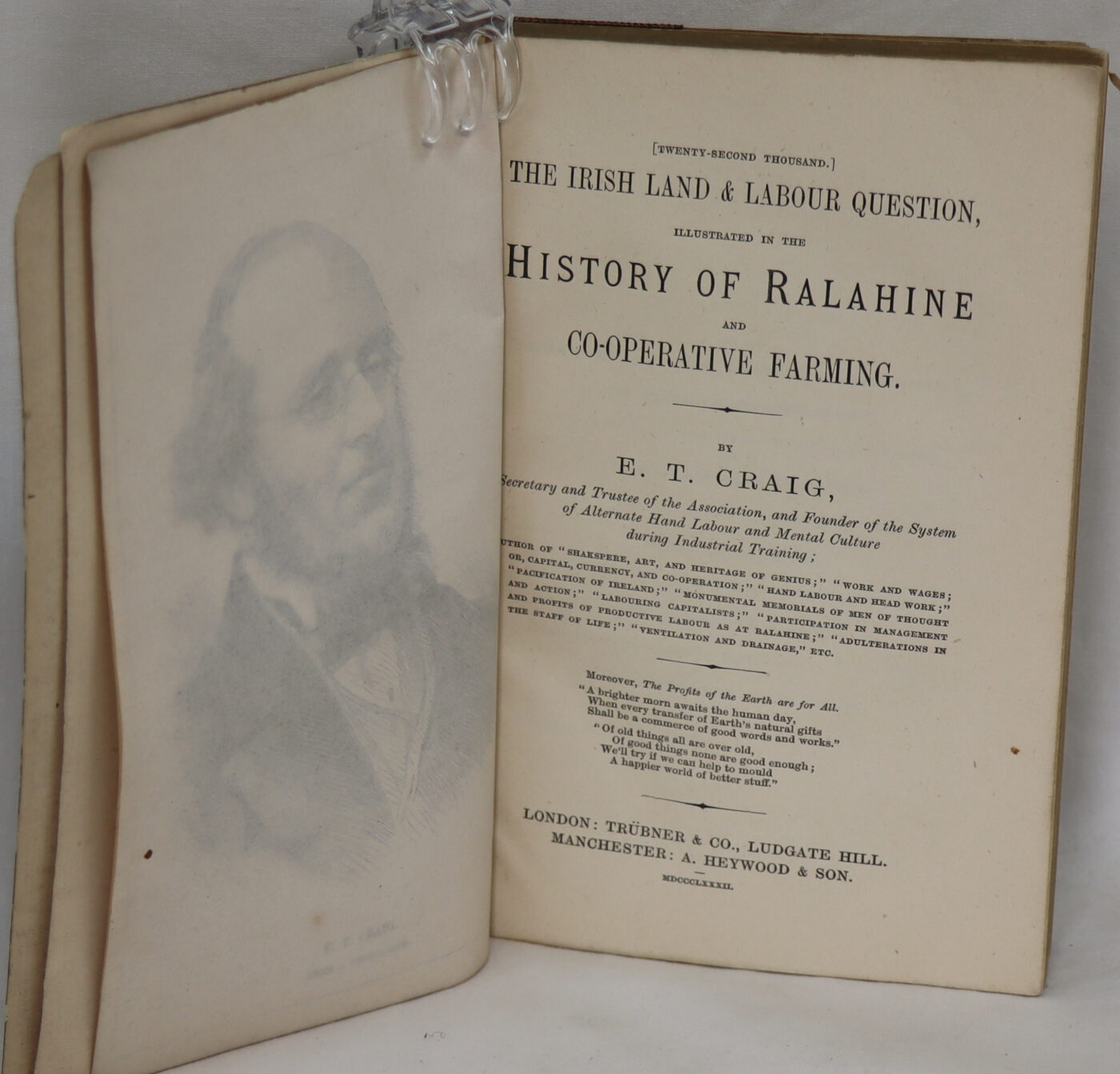
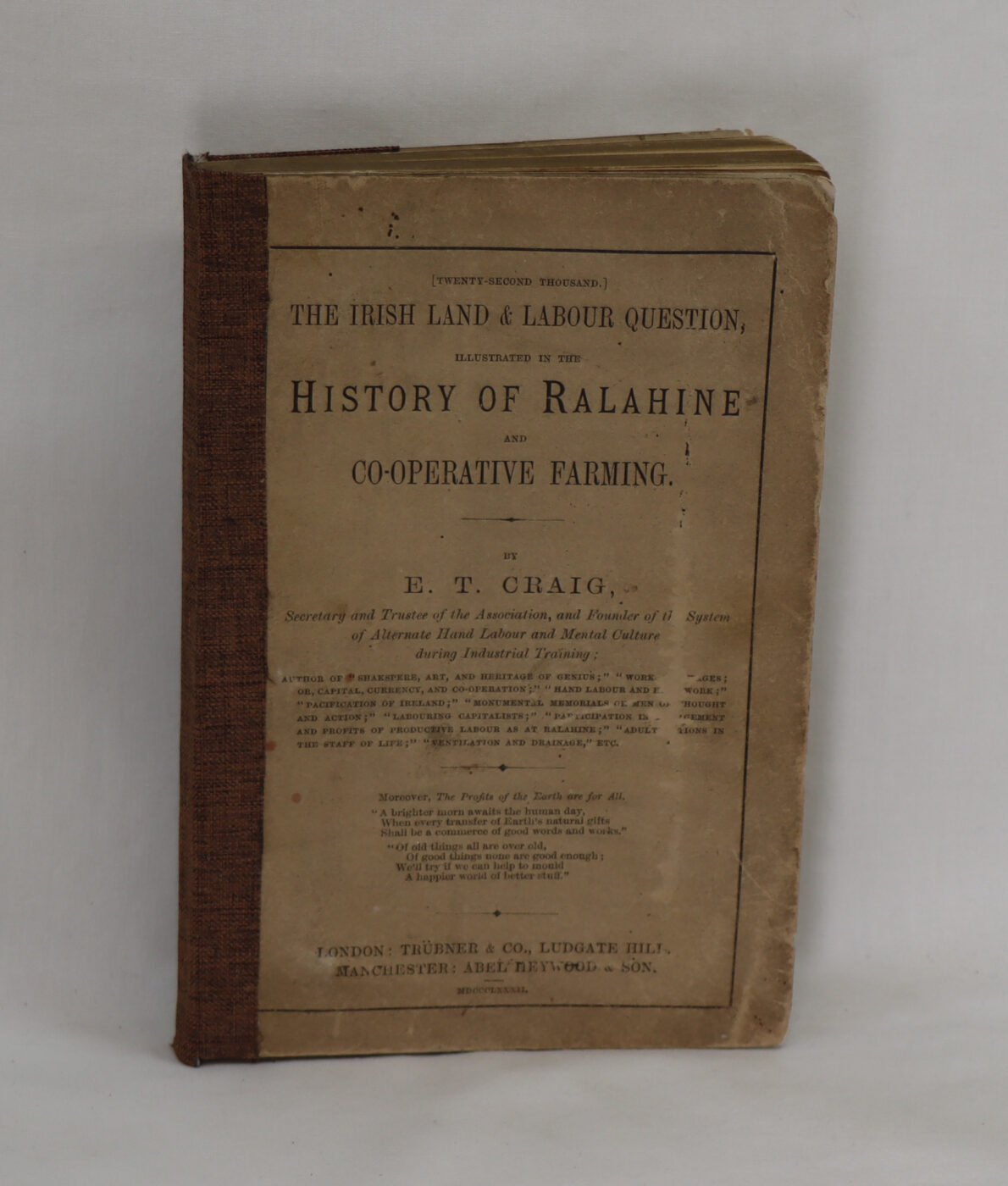
The History of Ralahine and Co-Operative Farming. (UNIQUE)
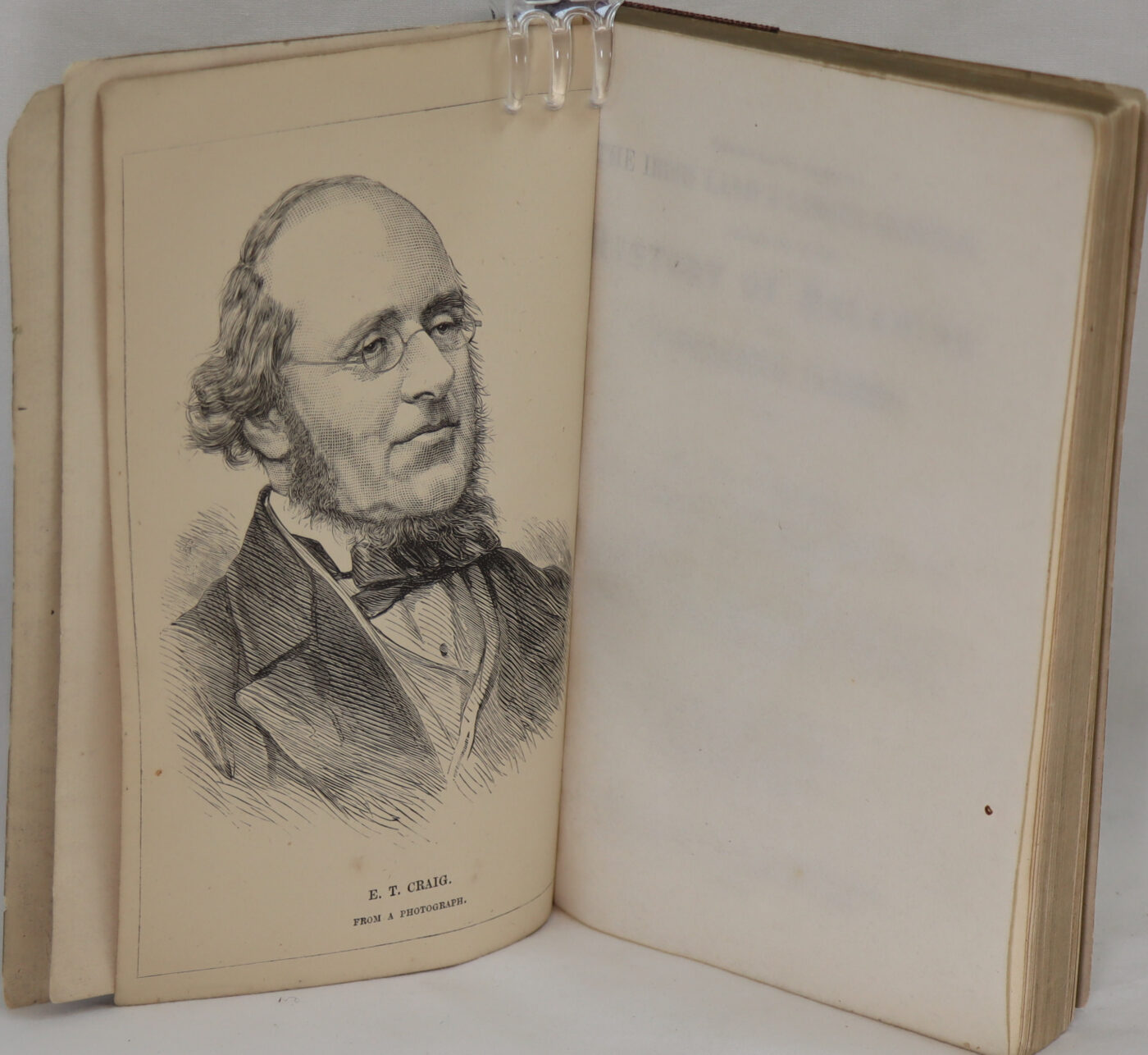
By E T Craig
Printed: 1882
Publisher: Thubner & Co. London
| Dimensions | 12 × 18 × 1.5 cm |
|---|---|
| Language |
Language: English
Size (cminches): 12 x 18 x 1.5
Condition: Good (See explanation of ratings)
£499.00
FREE shipping
Buy Now

Item information
Description
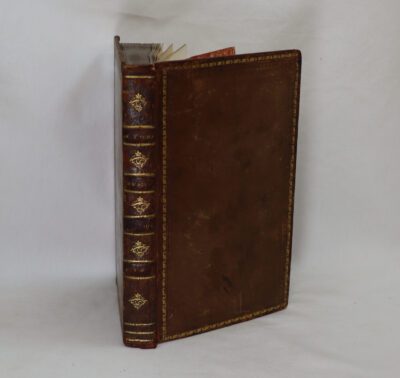
Tan board backed binding with black title on the front board. Repaired cloth spine.
We provide an in-depth photographic presentation of this item to stimulate your feeling and touch. More traditional book descriptions are immediately available.
-
Note: This book carries a £5.00 discount to those that subscribe to the F.B.A. mailing list
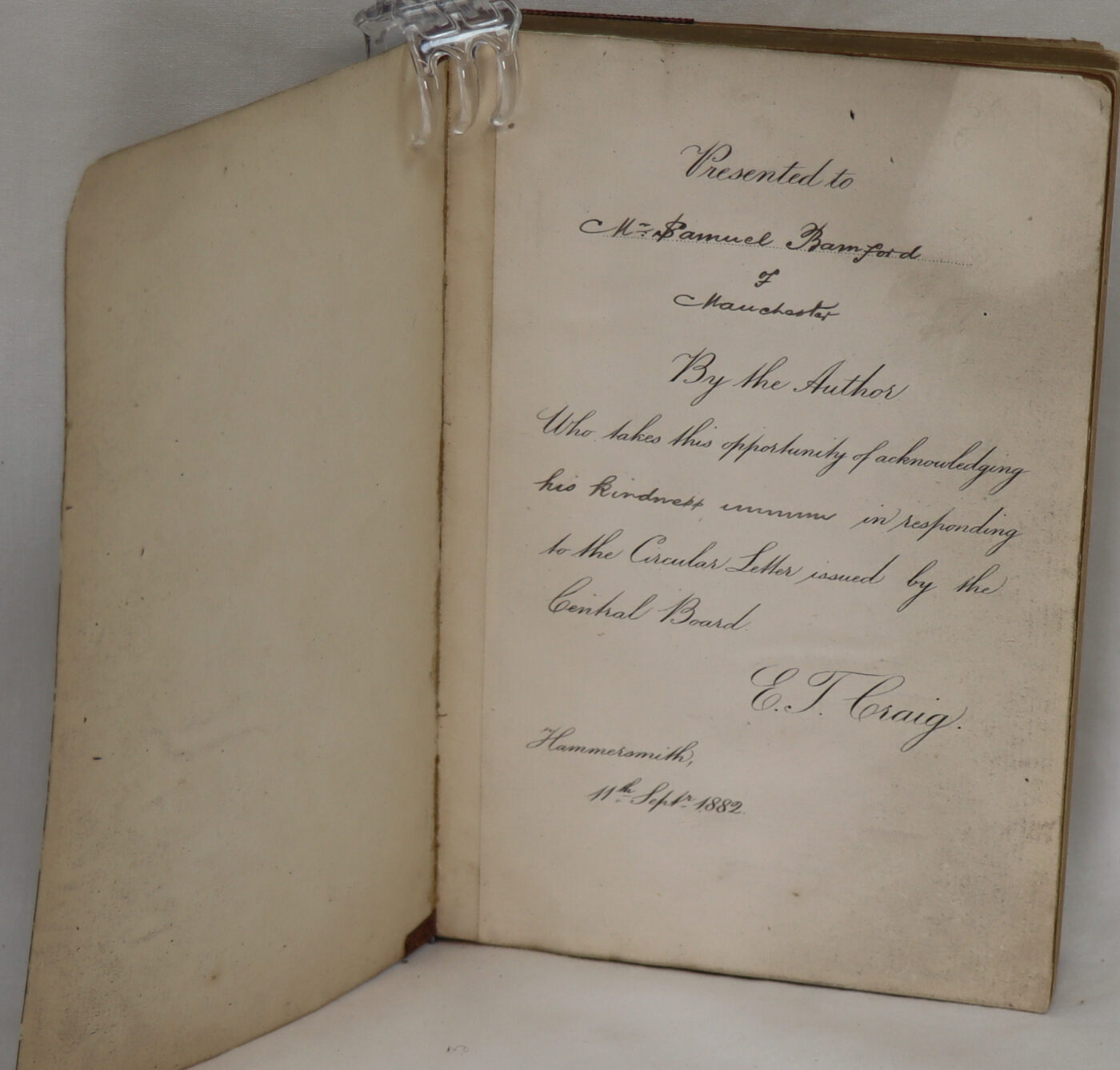
A fantastic book, presented by the author and by repute, its original papers were once held by Benjamin Disraeli. It is a museum piece portraying the inside story of what the world may have become. This is not only an extremely rare book but one that has great historical significance. The book is carefully restored and is highly readable. The History of Ralahine is a high water mark for early 19th century World Socialism with Karl Marx, Friedrich Engels, Benjamin Disraeli and the Russian Czar, all of whom took a profound interest in this noble project. Ralahine was an Irish socialist experiment devised from the ideas of Robert Owen that actually worked. Yet, in the end, it failed because the property landlord, John Scott Vandeleur led a dissolute life in Dublin which ultimately led Vandeleur’s creditors to ruinously take over Ralahine. For a variety of reasons most original copies of this book were destroyed by the British. This copy remained because Jack Lang’s grandfather cherished it. Below you will find notes on the personages that created this great work:
-
The Ralahine Commune was a cooperative society founded in 1831
-
Craig, Edward Thomas (1804–94)
-
Vandeleur, John Scott (1791–p. 1833)
- Robert Owen (14 May 1771 – 17 November 1858
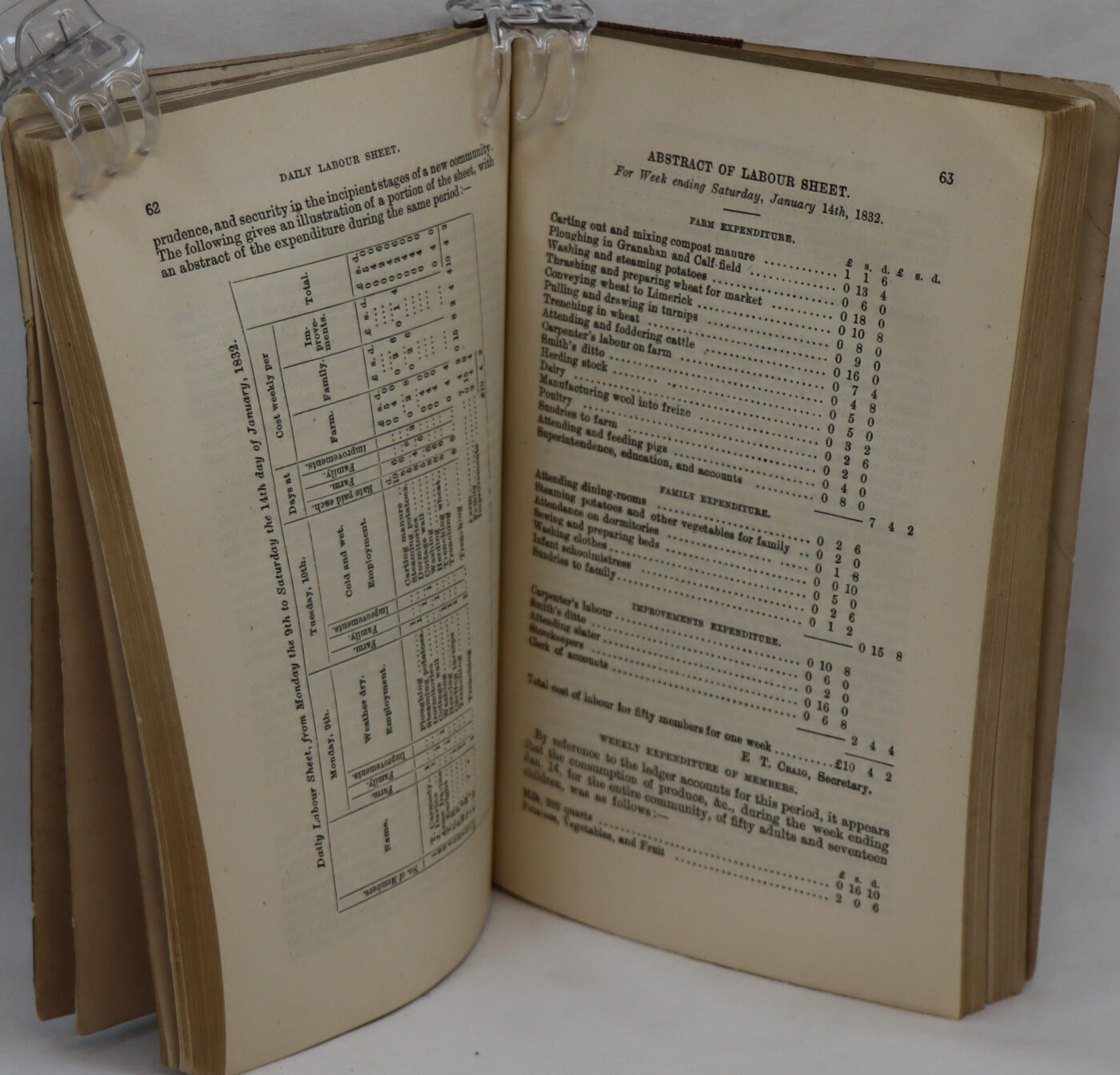
Craig, Edward Thomas (1804–94), Owenite social reformer, was born 4 August 1804 at 49 Hanover St., Manchester, son of Joseph Craig (d. 1808) and his wife Elizabeth. Losing his father at the age of 4, he was fostered with his paternal grandparents in Lancaster till the death of his grandmother (1815); he then returned to his mother’s home in Manchester, where he was plunged into an atmosphere of rigid Calvinist piety. He witnessed the killings at ‘Peterloo’ (1819). Trained as a fustian cutter, he joined the Manchester Mechanics’ Institute on its inception (1825). Reading an account by Robert Owen (1771–1858) of the social experiment at New Lanark, Scotland, he became an enthusiast for cooperation on the utopian Owenite model. He helped to set up (1828) a profit-sharing fustian manufacturing society in Manchester, which broke up due to problems in marketing. By 1830 he had become president of the small Owenian Co-operative Society. In May 1831 Craig acted as one of the organisers of the first British co-operative congress in Manchester, and between June and September 1831 he edited several northern co-operative journals. He was not by any means well versed in the practicalities of co-operative organisation when approached in the summer of 1831 by John Scott Vandeleur (qv) seeking a suitable manager for a proposed co-operative commune at Ralahine on his Co. Clare estate. Vandeleur, however, did not tell Craig the whole story of his preparations at Ralahine. Having been curious since 1823 about the theories of Robert Owen he had systematically enlarged his demesne near Bunratty, Co. Clare, by ejecting smallholders out of lease, with the vague intention of ultimately setting up a co-operative farm ‘to secure better rents . . . more interest for capital, and ten times more . . . enjoyment to labourers’ (Craig, 18). While intensifying agriculture on the demesne he approved the harsh labour regime of his steward, Daniel Hastings, who was shot (April 1831) by ‘Terry Alt’ agrarian protesters. By this date the buildings that were to comprise a co-operative village were already under construction on the demesne. Fleeing to England with his family after the murder, Vandeleur consulted John Finch of Liverpool, an iron-merchant and noted Owenite, who recommended Craig. It is clear that Craig leapt at the opportunity of running his own community and he took ship for Dublin in late August 1831. Though he was surprised to find buildings already constructed and worried to hear of the murder carried out months earlier on the estate, his naive goodwill in a few weeks won over ‘moody, dubious and discontented’ Irish-speaking estate labourers (Craig, 21). It did not lessen their suspicions of Vandeleur. While Craig drew up regulations for the commune and attempted to inculcate the advantages of organising work by a division of labour, Vandeleur prepared a tight-fisted contract, unveiled on 7 November 1831 to the assembled fifty-odd individuals more or less under obligation to work in the commune. On condition of being provided with the use of buildings, land, and stock, the commune ‘agreed’ annually to deliver to different agents of the estate a ‘commodity-bundle’ made up of wheat, barley, oats, butter, pork, beef, and hay to the value of approx. £900 at 1831 Limerick market prices. Any surplus might be shared once the goods on loan were purchased. Vandeleur himself nonchalantly agreed that the rent was severe; a committee (which he formally dominated) served to organise the labour routine. Craig was more interested in the edifying effect of rules designed to bring about social harmony within the commune than in the economic and other constraints on the experiment, and neglected, for instance, to ensure that the contract had legal validity. He was in fact an ideal instrument for Vandeleur’s purposes, and was quickly caught up in the minutiae of preparing daily labour sheets, developing an internal communal currency in labour notes, working out rules for the marriage of members inside and outside the commune, and ensuring justice and equality in all internal transactions. In essence Vandeleur did not care how the labourers managed themselves, so long as returns were regular and inconvenience was minimal. Though Craig liked to think that Vandeleur pursued a heroic course in championing the interests of utopian cooperation against the wishes of his wife and family (they were indeed critical), Vandeleur rarely concerned himself with the commune and showed no companionable interest in his manager. Somewhat moralistic in outlook, Craig was, however, gentle and innocent by nature and, though the routine was fairly demanding, the community was happy with the security and spartan pleasures of well ordered communal life. There is no doubt that the stress on equity had immense appeal to the former labourers. William Thompson (qv) and Robert Owen came to see the small miracle of contented industry. The enterprise collapsed suddenly in November 1833 when Vandeleur went missing after a disastrous bout of gambling in Dublin clubs. The contract was found not to protect the commune and the family clawed back its nominal possessions in order to pay creditors. Craig managed to pay all outstanding debts to the unfortunate labourers and returned to England. His memoirs never conceded the extent to which he may have been manipulated. The myth of Ralahine as one of the grand misadventures of Irish (and British) socialism does not bear examination. Between 1834 and 1841 he organised an industrial school at Ealing Grove, London, edited the journal The Star in the East, commenced an innovative school for infants in London, and finally, assisted in the establishment of the Monea Fen community in Norfolk. From 1841 he made a penurious living as a lecturer and journalist. In the 1880s he supported the renewal of socialist organisation in England. He continued to oppose what he saw as the coercive aggression of capitalist society. He also believed in phrenology. He died 15 December 1894 at Ralahine Cottage, Hammersmith, London, and is buried in Hammersmith cemetery. He married (11 July 1833) Mary Bottomley (b. July 1810), who survived him. They seem to have had no children.
Sources: John Finch, ‘Ralahine; or human improvement and human happiness’, New Moral World, 31 Mar.–29 Sept. 1838; William Pare, Co-operative agriculture: a solution of the land question as exemplified in the history of the Ralahine co-operative association, County Clare, Ireland (1870); Biographical sketch of E. T. Craig (1889); Times, 17 Dec. 1894; J. F. Hogan, ‘Early modern socialists, II’, IER, xxvi (1909), 19–38: 26–30; Edward Thomas Craig, An Irish commune: the experiment at Ralahine, County Clare, 1831–1833 (c.1920); James Connolly, Labour in Ireland (1922); Richard Pankhurst, William Thompson (1775–1833): pioneer socialist (1954); Ronald G. Garnett, Co-operation and the Owenite socialist communities in Britain, 1825–45 (1972); Cormac Ó Gráda, ‘The Owenite community at Ralahine, County Clare, 1831–33: a reassessment’, IESH, i (1974), 36–48; Patrick Bolger, The Irish co-operative movement: its history and development (1977); David Lee, Ralahine: land war and the co-operative (1981); Vincent Geoghegan, ‘Ralahine: an Irish Owenite community (1831–1833)’, International Review of Social History, xxxvi, no. 3 (1991), 377–411; Fintan Lane, The origins of modern Irish socialism, 1881–1896 (1997)
Vandeleur, John Scott (1791–p. 1833), landlord, was born in Co. Clare, first son of Col. Boyle Vandeleur of Ralahine, Co. Clare, and his wife Diana, daughter of John Scott of Cahircon, Co. Clare. He was educated at the school of the Rev. Louis Kerr, entered TCD in May 1805 aged fourteen, and graduated BA (1808). He inherited the family estate on his father’s death, and in 1828 was one of a group of Clare landlords who signed a petition protesting against the election of Daniel O’Connell (qv). Renowned as a harsh landlord, he lived in fear of reprisals from local agrarian secret societies, and in April 1831 his steward, Daniel Hastings, was shot dead. Fearing a similar fate, and hoping to wean his tenants away from agrarian violence, Vandeleur announced that he was going to initiate a programme of reform on his estate. He was aware of the social writings of Robert Owen and invited one of Owen’s disciples, Edward Thomas Craig (qv), to found a commune on his estate. The sincerity of Vandeleur’s convictions are open to question as the financial arrangements of the scheme were calculated to minimise the risks to him: the estate and property remained his, at a rent of £700 a year, until the commune had acquired sufficient capital to purchase it. The Ralahine Owenite commune, consisting of fifty-two of Vandeleur’s tenants on 618 acres of his estate, came into existence on 7 November 1831 and initially was a considerable success. The members of the commune were also provided with livestock and equipment, for which they paid £200 a year, and paid off their debt to their landlord by providing free labour. They were allowed to keep a share of the profits from each year and their ultimate goal was to purchase the commune’s land. Vandeleur, however, was a habitual gambler and, after a bad losing streak in 1833, he fled the country to avoid his creditors. In November 1833 he was gazetted as a bankrupt, and when he failed to appear before the commissioners for bankrupts a writ of outlawry was issued in January 1834. The details of his later life remain unclear; it has been suggested that he fled to America. His family took control of the estate and the commune was closed down. Over the ensuing years, various economic historians have debated its chances of success, but ultimately, all economic considerations were over-ridden by Vandeleur’s lack of success at the card-table. John Scott Vandeleur married Emily, daughter of Arthur Molony of Woodstock; they had two sons and three daughters.
Ralahine (Irish: Ráth Fhlaithín) is a townland of County Clare best known for its experiment in communism in 1831.
The Ralahine Commune was a cooperative society founded in 1831 on the estate of John Scott Vandeleur at Ralahine, Newmarket-on-Fergus, County Clare, Ireland. In an attempt to keep his tenants away from secret societies like the “Ribbonmen”, he brought a socialist named Edward Thomas Craig from Manchester, England to advise him on the establishment of the commune, which came into existence on 7 November 1831.
Location
Ralahine is a townland of Munster located about 3 miles south-east of Newmarket-on-Fergus Village in the South of County Clare.
History
John Scott Vandeleur attended a lecture in Dublin in 1823, which was presented by Robert Owen. Ralahine Commune was a 618-acre estate owned by John Vandeleur. Half the estate, some 300 acres, consisted of cultivated land, a bog of sixty-three acres used as a fuel source, a lake for power, and a small stream. Due to bad treatment by John Vandeleur, many of the peasants fought back against those in power and went underground forming various gangs. These gangs roamed the country controlled by no one, not even the priesthood. Some of these gangs included the Whitefeet, Lady Clare’s Boys and the Terry Alts, named after Terry Alt from Corofin, a Protestant army pensioner and an ardent loyalist. Clare was a particularly violent place at the time, being compared to as the most crime-ridden county in Ireland.
Life in the Ralahine Commune
Vandeleur spent many years planning the layout of the commune. He wanted to build a weaving factory, a flax scutching mill and housing for those who would work and live in the Ralahine commune.The commune was made up of 52 members, 7 married couples, 21 single men, 5 single women, 5 children under the age of 5, and 7 orphans below the age of 17. Rent in the commune cost 700 pounds per year, until those paying rent could afford to buy the property off of Vandeleur himself, under an agreement signed between the commune members and Vandeleur.
A list of many rules was written up and each member of the commune had to live by them. Alcohol, tobacco and snuff were banned, as was gambling of any kind. The members had to work twelve hours a day in summer and from dawn to dusk in winter, with a one-hour break for dinner. The commune had many purposes, such as acquiring common capital, to protect the members from sickness and old age, to improve the morale and mentality of the adult members, and lastly, to educate the children of the commune.
Instead of money, the workers were paid “labour notes” which they could spend in the co-operative store. In this way, the commune would be more self-sufficient as the members would be buying goods they themselves had worked to produce. If they wished to spend money outside the commune, the treasurer would change the labour notes into coins for them. The commune prospered for a time and 29 new members joined. New machinery was bought and the first mowing machine in Ireland was introduced by the Ralahine Commune. Wages varied depending on the gender of the workers, seeing male farm labourers earn 8p a day, and female workers earn 5p a day.
Religion
Due to the area that the Ralahine commune was established as being of Irish nationality, the religion that the members of the commune followed was Catholic. The only Protestant members of the commune was Vandeleur, his family, Craig, and his wife Mary.
Commune downfall
The commune was viewed as a success under the guidance of Edward T. Craig, who ran the schools, and taught the society how to make bread. Ralahine commune seemed to prosper and give hope of a new agrarian order in turbulent times, but went crash when the benefactor, owner of the 600-odd acre property on which it was situated, gambled away all his property and was ruined. As Craig relieved Vandeleur of the responsibility of running his estate, he spent more and more time at his club. His debts mounted and he absconded. On 23 November 1833 the experiment came to an end. The commune members signed an agreement with Vandeleur, which saw them being evicted from the commune when Vandeleur went bankrupt due to his gambling losses. Members of the Ralahine commune who were paid by Vandeleur by “labour notes” were reimbursed by Edward Craig himself, out of his own fortune. The collapse of the Ralahine Commune led to Edward Craig’s reputation and legacy being damaged.
Robert Owen (14 May 1771 – 17 November 1858) was a Welsh textile manufacturer, philanthropist, political philosopher and social reformer, and a founder of utopian socialism and the co-operative movement. He strove to improve factory working conditions, promoted experimental socialistic communities, sought a more collective approach to child-rearing, and ‘believed in lifelong education, establishing an Institute for the Formation of Character and School for Children that focused less on job skills than on becoming a better person’.
Having trained as a draper in Stamford in Lincolnshire, England, Owen worked in London before relocating at age 18 to Manchester and textile manufacturing. He gained wealth in the early 1800s from a textile mill at New Lanark in Lanarkshire, Scotland. In 1824, he moved to the USA and put most of his fortune in an experimental socialistic community at New Harmony, Indiana, as a preliminary for his utopian society. It lasted about two years. Other Owenite communities also failed, and in 1828 Owen returned to London, where he continued to champion the working class, lead in developing co-operatives and the trade union movement, and support child labour legislation and free co-educational schools.
Biography: Robert Owen was born in Newtown, a small market town in Montgomeryshire, Wales, on 14 May 1771, to Anne (Williams) and Robert Owen. His father was a saddler, ironmonger and local postmaster; his mother was the daughter of a Newtown farming family. Young Robert was the sixth of the family’s seven children, two of whom died at a young age. His surviving siblings were William, Anne, John and Richard.
Owen received little formal education, but he was an avid reader. He left school at the age of ten to be an apprentice draper in Stamford for four years. He also worked in London drapery shops in his teenage years. At about the age of 18, Owen moved to Manchester, where he spent the next twelve years of his life, employed initially at Satterfield’s Drapery in Saint Ann’s Square.
On a visit to Scotland, Owen met and fell in love with Ann (or Anne) Caroline Dale, daughter of David Dale, a Glasgow philanthropist and the proprietor of the large New Lanark Mills. After their marriage on 30 September 1799, the Owens set up a home in New Lanark, but later moved to Braxfield House in Lanark.
Robert and Caroline Owen had eight children, the first of whom died in infancy. Their seven survivors were four sons and three daughters: Robert Dale (1801–1877), William (1802–1842), Ann (or Anne) Caroline (1805–1831), Jane Dale (1805–1861), David Dale (1807–1860), Richard Dale (1809–1890) and Mary (1810–1832). Owen’s four sons, Robert Dale, William, David Dale and Richard, and his daughter Jane Dale, followed their father to the United States, becoming US citizens and permanent residents in New Harmony, Indiana. Owen’s wife Caroline and two of their daughters, Anne Caroline and Mary, remained in Britain, where they died in the 1830s.
Textile mills: While in Manchester, Owen borrowed £100 from his brother William, to enter into a partnership to make spinning mules, a new invention for spinning cotton threads, but exchanged his business shares within a few months for six spinning mules that he worked in rented factory space. In 1792, when Owen was about 21 years old, mill-owner Peter Drinkwater made him manager of the Piccadilly Mill at Manchester. However, after two years with Drinkwater, Owen voluntarily gave up his contract of partnership and left the company, and went into partnership with other entrepreneurs to establish and later manage the Chorlton Twist Mills in Chorlton-on-Medlock.
By the early 1790s, Owen’s entrepreneurial spirit and management skills and progressive moral views were emerging. In 1793, he was elected as a member of the Manchester Literary and Philosophical Society,where the ideas of the Enlightenment were discussed. He also became a committee member of the Manchester Board of Health, instigated principally by Thomas Percival to press for improvements in the health and working conditions of factory workers.
In July 1799 Owen and his partners bought the New Lanark mill from David Dale, and Owen became its manager in January 1800. Encouraged by his management success in Manchester, Owen hoped to conduct the New Lanark mill on higher principles than purely commercial ones. It had been established in 1785 by David Dale and Richard Arkwright. Water power provided by the falls of the River Clyde turned its cotton-spinning operation into one of Britain’s largest. About 2,000 individuals were involved, 500 of them children, brought to the mill at the age of five or six from the poorhouses and charities of Edinburgh and Glasgow. Dale, known for his benevolence, treated the children well, but the general condition of New Lanark residents was unsatisfactory, despite efforts by Dale and his son-in-law Owen to improve their workers’ lives.
Many of the workers were from the lowest social levels: theft, drunkenness and other vices were common and education and sanitation neglected. Most families lived in one room. More respectable people rejected the long hours and demoralising drudgery of the mills.
Until a series of Truck Acts (1831–1887) required employers to pay their employees in common currency, many operated a truck system, paying workers wholly or in part with tokens that had no monetary value outside the mill owner’s “truck shop”, which charged high prices for shoddy goods. Unlike others, Owen’s truck store offered goods at prices only slightly above their wholesale cost, passing on the savings from bulk purchases to his customers and placing alcohol sales under strict supervision. These principles became the basis for Britain’s co-operative shops, some of which continue trading in altered forms to this day.
American communal living experiments
To test the viability of his ideas for self-sufficient working communities, Owen began experimenting with communal living in the United States in 1825. Among the most famous efforts was the one set up at New Harmony, Indiana. Of the 130 identifiable communitarian experiments in the United States before the American Civil War, at least 16 were Owenite or Owenite-influenced. New Harmony was Owen’s earliest and most ambitious of these.
Owen and his son William sailed to the United States in October 1824 to establish an experimental community in Indiana. In January 1825 Owen used a portion of his funds to purchase an existing town of 180 buildings and several thousand acres of land along the Wabash River in Indiana. George Rapp’s Harmony Society, the religious group that owned the property and that had founded the communal village of Harmony (or Harmonie) on the site in 1814, decided in 1824 to relocate to Pennsylvania. Owen renamed it New Harmony and made the village his preliminary model for a Utopian community. During Owen’s 1824 American tour, New York activist and columnists Cornelius Blatchley shared with him Thomas Jefferson’s 1822 reply to Blatchley’s communitarian pamphlet, illustrating early transatlantic exchange between American and Owenite cooperative ideas.
Owen sought support for his socialist vision among American thinkers, reformers, intellectuals and public statesmen. On 25 February and 7 March 1825, Owen gave addresses to the House of Representatives in Congress and to others in the US government, outlining his vision for the Utopian community at New Harmony, and his socialist beliefs. The audience for his ideas included three former U.S. presidents – John Adams, Thomas Jefferson, and James Madison – the outgoing US President James Monroe, and the President-elect, John Quincy Adams. His meetings were perhaps the first discussions of socialism in the Americas; they were certainly a big step towards discussion of it in the United States. Owenism, among the first socialist ideologies active in the United States, can be seen as an instigator of the later socialist movement.
Owen convinced William Maclure, a wealthy Scottish scientist and philanthropist living in Philadelphia to join him at New Harmony and become his financial partner. Maclure’s involvement went on to attract scientists, educators and artists such as Thomas Say, Charles-Alexandre Lesueur, and Madame Marie Duclos Fretageot. These helped to turn the New Harmony community into a centre for educational reform, scientific research and artistic expression.
Although Owen sought to build a “Village of Unity and Mutual Cooperation” south of the town, his grand plan was never fully realised and he returned to Britain to continue his work. During his long absences from New Harmony, Owen left the experiment under the day-to-day management of his sons, Robert Dale Owen and William Owen, and his business partner, Maclure. However, New Harmony proved to be an economic failure, lasting about two years, although it had attracted over a thousand residents by the end of its first year. The socialistic society was dissolved in 1827, but many of its scientists, educators, artists and other inhabitants, including Owen’s four sons, Robert Dale, William, David Dale, and Richard Dale Owen, and his daughter Jane Dale Owen Fauntleroy, remained at New Harmony after the experiment ended.
Other experiments in the United States included communal settlements at Blue Spring, near Bloomington, Indiana, at Yellow Springs, Ohio, and at Forestville Commonwealth at Earlton, New York, as well as other projects in New York, Pennsylvania, and Tennessee. Nearly all of these had ended before New Harmony was dissolved in April 1827.
Owen’s Utopian communities attracted a mix of people, many with the highest aims. They included vagrants, adventurers and other reform-minded enthusiasts. In the words of Owen’s son David Dale Owen, they attracted “a heterogeneous collection of Radicals”, “enthusiastic devotees to principle”, and “honest latitudinarians, and lazy theorists”, with “a sprinkling of unprincipled sharpers thrown in”.
Josiah Warren, a participant at New Harmony, asserted that it was doomed to failure for lack of individual sovereignty and personal property. In describing the community, Warren explained: “We had a world in miniature – we had enacted the French revolution over again with despairing hearts instead of corpses as a result … It appeared that it was nature’s inherent law of diversity that had conquered us … our ‘united interests’ were directly at war with the individualities of persons and circumstances and the instinct of self-preservation”. Warren’s observations on the reasons for the community’s failure led to the development of American individualist anarchism, of which he was its original theorist. Some historians have traced the demise of New Harmony to serial disagreements among its members.
Social experiments also began in Scotland in 1825, when Abram Combe, an Owenite, attempted a utopian experiment at Orbiston, near Glasgow, but this failed after about two years. In the 1830s, additional experiments in socialistic co-operatives were made in Ireland and Britain, the most important being at Ralahine, established in 1831 in County Clare, Ireland, and at Tytherley, begun in 1839 in Hampshire, England. The former proved a remarkable success for three-and-a-half years until the proprietor, having ruined himself by gambling, had to sell his interest. Tytherley, known as Harmony Hall or Queenwood College, was designed by the architect Joseph Hansom. This also failed. Another social experiment, Manea Colony in the Isle of Ely, Cambridgeshire, launched in the late 1830s by William Hodson, likewise an Owenite, but it failed in a couple of years and Hodson emigrated to the United States. The Manea Colony site has been excavated by the Cambridge Archaeology Unit (CAU) based at the University of Cambridge.
Return to Great Britain
Although Owen made further brief visits to the United States, London became his permanent home and the centre of his work in 1828. After extended friction with William Allen and some other business partners, Owen relinquished all connections with New Lanark. He is often quoted in a comment by Allen at the time, “All the world is queer save thee and me, and even thou art a little queer”. Having invested most of his fortune in the failed New Harmony communal experiment, Owen was no longer a wealthy capitalist. However, he remained the head of a vigorous propaganda effort to promote industrial equality, free education for children and adequate living conditions in factory towns, while delivering lectures in Europe and publishing a weekly newspaper to gain support for his ideas.
In 1832 Owen opened the National Equitable Labour Exchange system,] a time-based currency in which the exchange of goods was effected using labour notes; this system superseded the usual means of exchange and middlemen. The London exchange continued until 1833, with a Birmingham branch operating for just a few months until July 1833. Owen also became involved in trade unionism, briefly leading the Grand National Consolidated Trade Union (GNCTU) before its collapse in 1834.
Socialism first became current in British terminology in discussions of the Association of all Classes of all Nations, which Owen formed in 1835 and served as its initial leader. Owen’s secular views also gained enough influence among the working classes to cause the Westminster Review to comment in 1839 that his principles were the creed of many of them. However, by 1846, the only lasting result of Owen’s agitation for social change, carried on through public meetings, pamphlets, periodicals, and occasional treatises, remained the Co-operative movement, and for a time even that seemed to have collapsed.
As Owen grew older and more radical in his views, his influence began to decline. Owen published his memoirs, The Life of Robert Owen, in 1857, a year before his death.
Although he had spent most of his life in England and Scotland, Owen returned to his native town of Newtown at the end of his life. He died there on 17 November 1858 and was buried there on 21 November. He died poor apart from an annual income drawn from a trust established by his sons in 1844.
Philosophy and influence
Owen tested his social and economic ideas at New Lanark, where he won his workers’ confidence and continued to have success through improved efficiency at the mill. The community also earned an international reputation. Social reformers, statesmen and royalty, including the future Tsar Nicholas I of Russia, visited New Lanark to study its methods. The opinions of many such visitors were favourable.
Some of Owen’s schemes displeased his partners, forcing him to arrange for other investors to buy his share of the business in 1813, for the equivalent of US$800,000. The new investors, who included Jeremy Bentham and the well-known Quaker William Allen, were content to accept a £5,000 return on their capital. The ownership change also provided Owen with a chance to broaden his philanthropy, advocating improvements in workers’ rights and child labour laws, and free education for children.
Owen felt that human character is formed by conditions over which individuals have no control. Thus individuals could not be praised or blamed for their behaviour or situation in life. This principle led Owen to conclude that the correct formation of people’s characters called for placing them under proper environmental influences – physical, moral and social – from their earliest years. These notions of inherent irresponsibility in humans and the effect of early influences on an individual’s character formed the basis of Owen’s system of education and social reform.
Relying on his observations, experiences and thoughts, Owen saw his view of human nature as original and “the most basic and necessary constituent in an evolving science of society”. His philosophy was influenced by Sir Isaac Newton’s views on natural law, and his views resembled those of Plato, Denis Diderot, Claude Adrien Helvétius, William Godwin, John Locke, James Mill, and Jeremy Bentham, among others.Owen did not have the direct influence of Enlightenment philosophers.
Owen hoped for a better and more harmonious environment that promoted mutual respect, love and moral values. He believed everyone would have a good education and better living conditions to live righteously. He valued social and educational reforms for the middle class and rejected the capitalist power which elevated the powerful figures at the expense of others. Owen funded kids’ schools and advocated for free education, equal rights and freedom. He participated in legislation to improve labourers’ wages and working conditions.
Owen believed compassion, kindness and solidarity corrected bad habits, encouraged self-discipline and enhanced a person’s attitude. Force oppressed people and affected their mental health. In his view, unless people were educated in a proper environment, obtained equal opportunities for jobs and maintained social norms, differences between labour classes, conflicts, and inequalities would persist just as in the British colonies. Without making any changes in the national institutions, he believed that even reorganizing the working classes would bring great benefits. So he opposed the views of radicals seeking to change in the public mentality by expanding voting rights.
Education
Owen’s work at New Lanark continued to have significance in Britain and continental Europe. He was a “pioneer in factory reform, the father of distributive co-operation, and the founder of nursery schools”. His schemes for educating his workers included opening an Institute for the Formation of Character at New Lanark in 1818. This and other programmes at New Lanark provided free education from infancy to adulthood. In addition, he zealously supported factory legislation that culminated in the Cotton Mills and Factories Act 1819. Owen also had interviews and communications with leading members of the British government, including its premier, Robert Banks Jenkinson, Lord Liverpool. He also met many of the rulers and leading statesmen of Europe.
Owen’s biggest success was in support of youth education and early child care. As a pioneer in Britain, notably Scotland, Owen provided an alternative to the “normal authoritarian approach to child education”. Supporters of the methods argued that the manners of children brought up under his system were more graceful, genial and unconstrained; health, plenty and contentment prevailed; drunkenness was almost unknown and illegitimacy extremely rare. Owen’s relations with his workers remained excellent and operations at the mill proceeded in a smooth, regular and commercially successful way.
Perhaps one of Robert Owen’s most memorable ideas was his silent monitor method. Owen was opposed to common corporal punishment; therefore, to have some form of discipline he developed the “silent monitor”. In his mills, he would hang a four-sided block each displaying a different colour representing the behaviour of the employee.
Labour
Owen adopted new principles to raise the standard of goods his workers produced. A cube with faces painted in different colours was installed above each machinist’s workplace. The colour of the face showed to all who saw it the quality and quantity of goods the worker completed. The intention was to encourage workers to do their best. Although it was no great incentive in itself, conditions at New Lanark for workers and their families were idyllic for the time.
Owen raised the demand for an eight-hour day in 1810 and set about instituting the policy at New Lanark. By 1817 he had formulated the goal of an eight-hour working day with the slogan “eight hours labour, eight hours recreation, eight hours rest”.
Socialism
In 1813 Owen authored and published A New View of Society, or Essays on the Principle of the Formation of the Human Character, the first of four essays he wrote to explain the principles behind his philosophy of socialistic reform. In this book he spoke against Malthusian theories, saying each new person could grow food to feed ten people if given the proper opportunity, so capitalist management, not any deep-seated fundamental, was the reason for hunger and misery.
Owen also spoke out for government involvement in the economy, saying
… the present arrangement of society is the most anti-social, impolitic, and irrational that can be devised; that under its influence all the superior and valuable qualities of the human race are repressed from infancy, and that the most unnatural means are used to bring out the most injurious propensities …
Owen had been a follower of classical liberalism as espoused by utilitarian Jeremy Bentham, who said that free markets and laissez-faire, in particular the right of workers to move and choose their employers, would release workers from the excessive power of capitalists. However, Owen developed his own, pro-socialist outlook.
Owen embraced socialism in 1817, a turning point in his life. Some of these views had been presented earlier in “A New View of Society”. He outlined his position in a report to the committee of the House of Commons on the country’s Poor Laws. As widespread misery and trade stagnation drew national attention after the Napoleonic Wars, the government called on Owen for advice on how to alleviate the industrial concerns. Although he ascribed the immediate misery to the wars, he saw it as the underlying cause of competition of human labour with machinery and recommended setting up self-sufficient communities.
Owen appealed to the self-interest of capitalists, pointing out that just as machines need proper care and treatment to guarantee they work smoothly and efficiently, so do humans.
Owen proposed that communities of some 1,200 people should settle on land from 1,000 to 1,500 acres (405 to 607 ha), all living in one building with a public kitchen and dining halls. (The proposed size may have been influenced by the size of the village of New Lanark.) Owen also proposed that each family have its private apartment and the responsibility for the care of its children up to the age of three. Thereafter children would be raised by the community, but their parents would have access to them at mealtimes and on other occasions. Owen further suggested that such communities be established by individuals, parishes, counties, or other governmental units. In each case, there would be effective supervision by qualified persons. Work and enjoyment of its results should be experienced communally. Owen believed his idea would be the best way to reorganise society in general, and called his vision the “New Moral World”. His son Robert Dale Owen, then only 23 years of age, reflected on his father’s pioneering work in education and co-operative living in the book On the Outline of the System of Education at New Lanark (1824).
Owen’s utopian model changed little in his lifetime. His developed model envisaged an association of 500–3,000 people as the optimum for a working community. While mainly agricultural, it would possess the best machinery, offer varied employment, and as far as possible be self-contained. Owen went on to explain that as such communities proliferated, “unions of them federatively united shall be formed in the circle of tens, hundreds and thousands”, linked by a common interest.
Spiritualism
In 1817, Owen publicly claimed that all religions were false. In 1854, aged 83, Owen converted to spiritualism after a series of sittings with Maria B. Hayden, an American medium credited with introducing spiritualism to England. He made a public profession of his new faith in his publication The Rational Quarterly Review and in a pamphlet titled The Future of the Human Race; or great glorious and future revolution to be effected through the agency of departed spirits of good and superior men and women.
Owen claimed to have had medium contact with the spirits of Benjamin Franklin, Thomas Jefferson and others. He explained that the purpose of these was to change “the present, false, disunited and miserable state of human existence, for a true, united and happy state… to prepare the world for universal peace, and to infuse into all the spirit of charity, forbearance and love.”
Spiritualists claimed after Owen’s death that his spirit had dictated to the medium Emma Hardinge Britten in 1871 the “Seven Principles of Spiritualism”, used by their National Union as “the basis of its religious philosophy”.
Legacy
Owen was a reformer, philanthropist, community builder, and spiritualist who spent his life seeking to improve the lives of others. An advocate of the working class, he improved working conditions for factory workers, which he demonstrated at New Lanark, Scotland, became a leader in trade unionism, promoted social equality through his experimental Utopian communities, and supported the passage of child labour laws and free education for children. In these reforms he was ahead of his time. He envisioned a communal society that others could consider and apply as they wished. In Revolution in the Mind and Practice of the Human Race (1849), he went on to say that character is formed by a combination of Nature or God and the circumstances of the individual’s experience. Citing beneficial results at New Lanark, Scotland, during 30 years of work there, Owen concluded that a person’s “character is not made by, but for the individual,” and that nature and society are responsible for each person’s character and conduct.
Owen’s agitation for social change, along with the work of the Owenites and his children, helped to bring lasting social reforms in women’s and workers’ rights, establish free public libraries and museums, child care and public, co-educational schools, and pre-Marxian communism, and develop the Co-operative and trade union movements. New Harmony, Indiana, and New Lanark, Scotland, two towns with which he is closely associated, remain as reminders of his efforts.
Owen’s legacy of public service continued with his four sons, Robert Dale, William, David Dale, and Richard Dale, and his daughter, Jane, who followed him to America to live in New Harmony, Indiana:
-
Robert Dale Owen (1801–1877), an able exponent of his father’s doctrines, managed the New Harmony community after his father returned to Britain in 1825. He wrote articles and co-edited with Frances Wright the New-Harmony Gazette in the late 1820s in Indiana and the Free Enquirer in the 1830s in New York City. Owen returned to New Harmony in 1833 and became active in Indiana politics. He was elected to the Indiana House of Representatives (1836–1839 and 1851–1853) and U.S. House of Representatives (1843–1847) and was appointed chargé d’affaires in Naples in 1853–1858. While serving as a member of Congress, he drafted and helped to secure passage of a bill founding the Smithsonian Institution in 1846. He was elected a delegate to the Indiana Constitutional Convention in 1850, and argued in support of widows and married women’s property and divorce rights. He also favoured legislation for Indiana’s tax-supported public school system. Like his father, he believed in spiritualism, authoring two books on the subject: Footfalls on the Boundary of Another World (1859) and The Debatable Land Between this World and the Next (1872).
-
William Owen (1802–1842) moved to the United States with his father in 1824. His business skill, notably his knowledge of cotton goods manufacturing, allowed him to remain at New Harmony after his father returned to Scotland, and serve as an adviser to the community. He organised New Harmony’s Thespian Society in 1827 but died of unknown causes at the age of 40.
-
Jane Dale Owen Fauntleroy (1805–1861) arrived in the United States in 1833 and settled in New Harmony. She was a musician and educator who set up a school in her home. In 1835 she married Robert Henry Fauntleroy, a civil engineer from Virginia living in New Harmony.
-
David Dale Owen (1807–1860) moved to the United States in 1827 and resided at New Harmony for several years. He trained as a geologist and natural scientist and earned a medical degree. He was appointed a United States geologist in 1839. His work included geological surveys in the Midwest, more specifically the states of Indiana, Iowa, Missouri, and Arkansas, as well as Minnesota Territory. His brother Richard succeeded him as state geologist of Indiana.
-
Richard Owen (1810–1890) emigrated to the United States in 1827 and joined his siblings at New Harmony. He fought in the Mexican–American War in 1847, taught natural science at Western Military Institute in Tennessee from 1849 to 1859, and earned a medical degree in 1858. During the American Civil War he was a colonel in the Union army and served as a commandant of Camp Morton, a prisoner-of-war camp for Confederate soldiers at Indianapolis, Indiana. After the war, Owen served as Indiana’s second state geologist. In addition, he was a professor at Indiana University and chaired its natural science department from 1864 to 1879. He helped plan Purdue University and was appointed its first president in 1872–1874, but resigned before its classes began and resumed teaching at Indiana University. He spent his retirement years on research and writing.
Criticism
Owen’s project was considered unachievable because he did not establish a guideline that stipulated the administration of properties and the conditions of memberships. As a result, some critics found his plans unsatisfactory and ineffective because the overpopulation and shortage of supply created antagonism within the community. Owen’s opponents view him as a dictator, and a blasphemer of Christianity because he rejected sacred beliefs and defied anyone who differed from his views. Owen perceived religion as a source of fear and ignorance. Therefore, people were unable to think rationally if they stayed attached to “fallacious testimonies” of religion.
Other notable critics of Owen include Karl Marx and Friedrich Engels, even though they viewed his work as a precursor to their own. They recognized in Owen the important understanding, developed by Marx in Capital, that it is the working class that is responsible for creating the unparalleled wealth in capitalist societies. Similarly, Owen also recognized that under the existing economic system, the working class did not automatically receive the benefits of that newly created wealth. Marx and Engels, differentiated, however, their scientific conception of socialism from Owen’s societies. They argued that Owen’s plan, to create a model socialist utopia to coexist with contemporary society and prove its superiority over time, was insufficient to create a new society. In their view, Owen’s “socialism” was utopian, since to Owen and the other utopian socialists “socialism is the expression of absolute truth, reason and justice, and has only to be discovered to conquer all the world by its power.” Marx and Engels believed that the overthrow of the capitalist system could only occur once the working class was organized into a revolutionary socialist political party of the working class that was completely independent of all capitalist class influence, whereas the utopians sought the assistance and the co-operation of the capitalists to achieve the transition to socialism.
NOTE: This is an original book from the library gathered by the famous Cambridge Don, computer scientist, food and wine connoisseur, Jack Arnold LANG. Note: Jack founded the Michelin Guide ‘Midsummer House’- Cambridge’s paramount restaurant. This dining experience is hidden amongst the grassy pastures and grazing cattle of Midsummer Common and perched on the banks of the River Cam. The Midsummer House experience is imaginatively curated to delight and amaze, so the surprise set menu changes regularly and is ‘Midsummer’s’ playground to showcase.
In 2008, Jack was one of the co-founders of the Raspberry Pi Foundation, alongside other members of the Department, and acted as the Foundation’s Chair. The project’s original goals were modest: to build and distribute low-cost computers for prospective applicants to our Computer Science degree. Initially the project was a “success disaster”, as Jack would say, as demand far outstripped the low-scale manufacturing plans. Ultimately the Raspberry Pi became the UK’s most successful computer with more than 60 million sold to date. Jack was drawn to the educational possibilities of the Raspberry Pi, its potential uses in emerging economies and the way it could support self-directed learning.
Want to know more about this item?
We are happy to answer any questions you may have about this item. In addition, it is also possible to request more photographs if there is something specific you want illustrated.
Ask a question
Related products

Share this Page with a friend
