
Tried and Approved Recipes.
By 'A Lady'
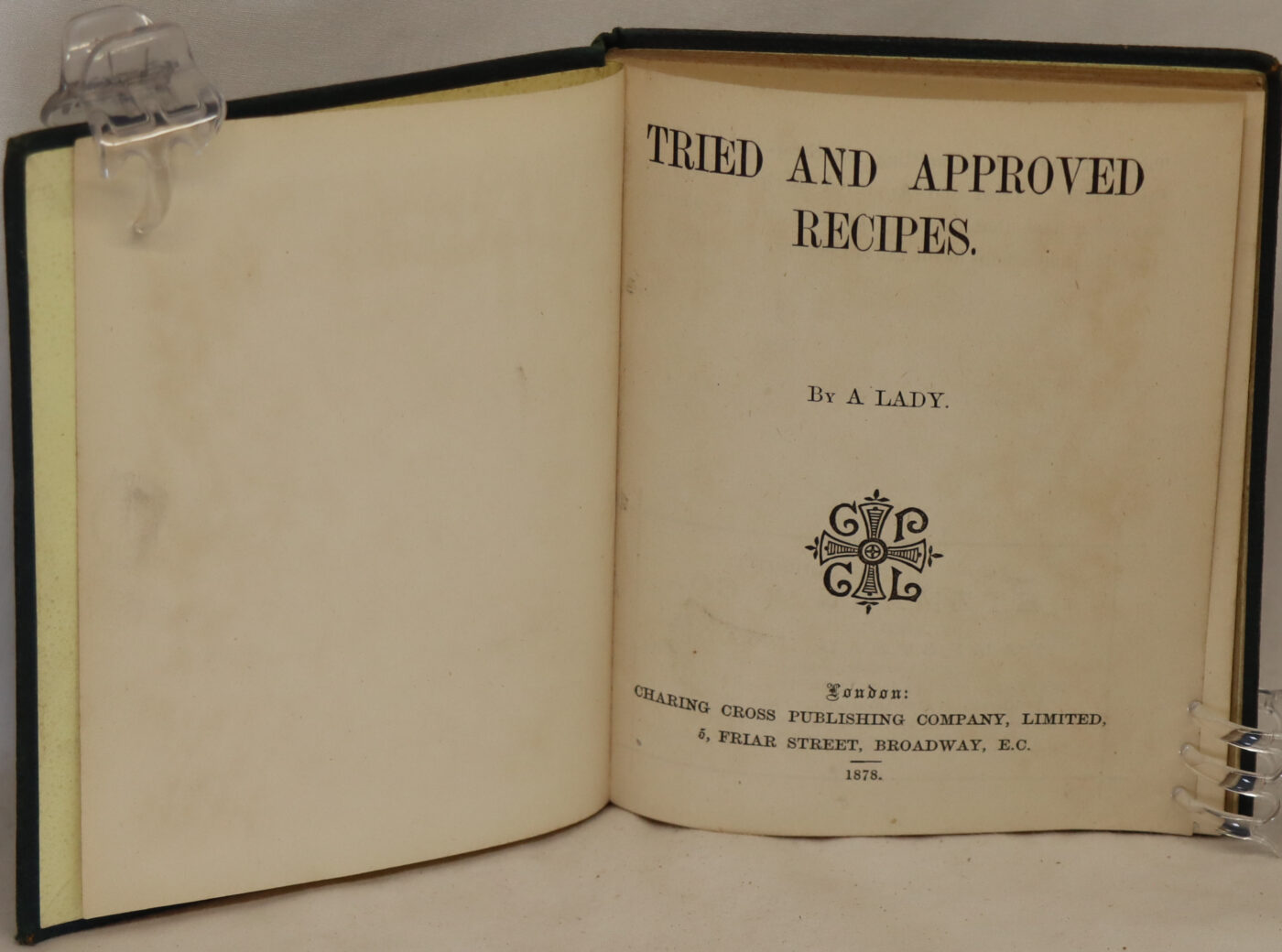
Printed: 1878
Publisher: Charing Cross Publishing co. London
| Dimensions | 11 × 14 × 1 cm |
|---|---|
| Language |
Language: English
Size (cminches): 11 x 14 x 1
Condition: Good (See explanation of ratings)
£94.00
Buy Now

Item information
Description
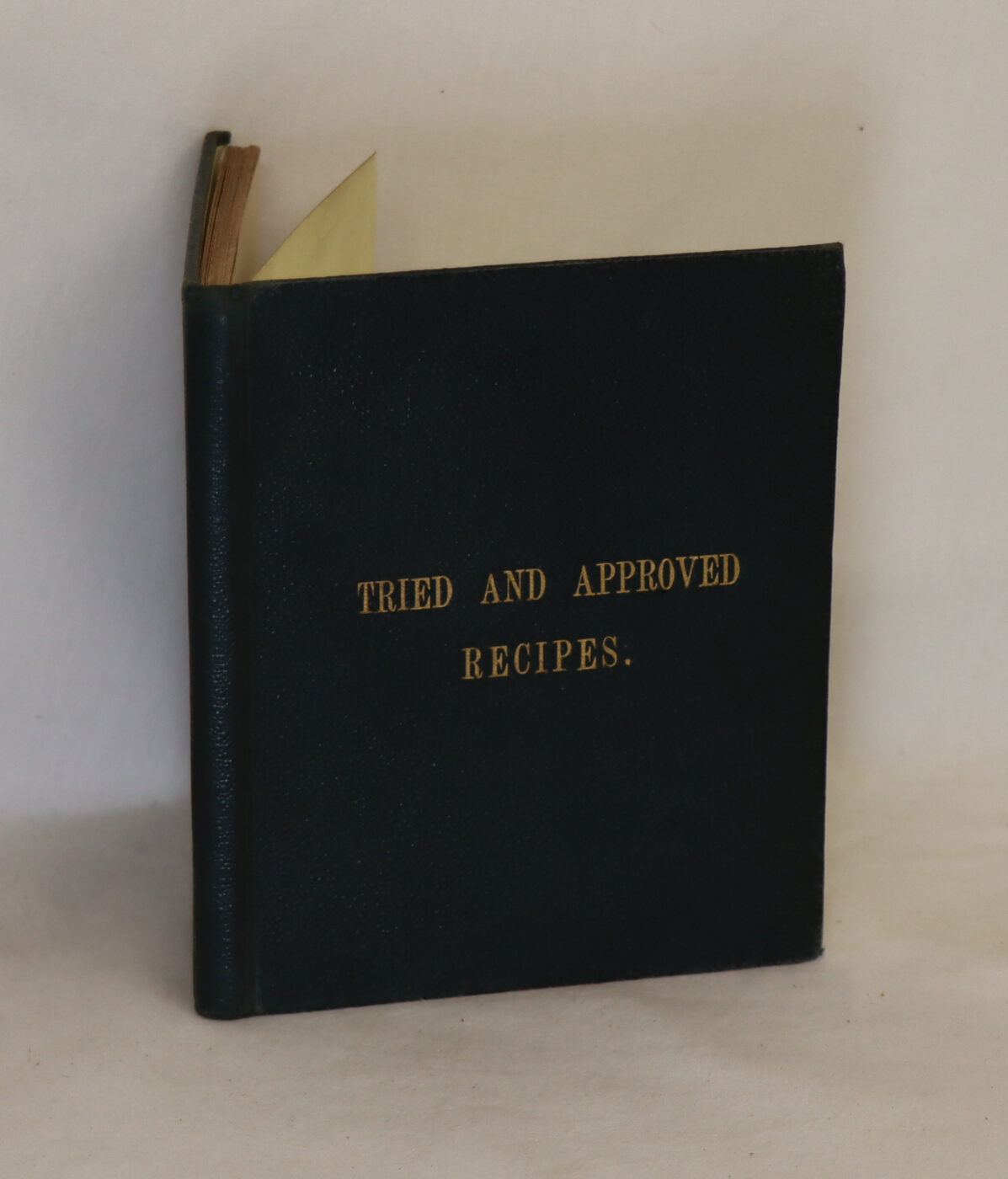
Green cloth binding with gilt title on the front board.
We provide an in-depth photographic presentation of this item to stimulate your feeling and touch. More traditional book descriptions are immediately available.
- Note: This book carries a £5.00 discount to those that subscribe to the F.B.A. mailing list
Tried and Approved Recipes. By ‘A Lady’ Printed: 1878 Publisher: Charing Cross Publishing co. London Language: English Size (inches): 4.4 x 5.6 x 0.4 Condition: Good
This is an antique Victorian cookery book: Tried and Approved Recipes by “A Lady” (1878), published by the Charing Cross Publishing Co. in London.
Bibliographic & Historical Context
- The Publisher. According to Victoria Research Web, the Charing Cross Publishing Co. was a short-lived London firm active between 1873 and 1881. Formed by the Amateur Authors’ Association, it operated largely as a vanity or self-publishing press and produced a very small output—only nine titles in 1878.
- The Author. Publishing anonymously under the pseudonym “By a Lady” was standard practice for upper- and middle-class women in the 18th and 19th centuries. It preserved female modesty while lending a sense of domestic authority and gentility to household manuals.
- Rarity & Format. Because it was printed by a small vanity press in pocket-sized dimensions (4.4 × 5.6 inches), surviving original 1878 copies are relatively scarce compared to major commercial Victorian cookbooks (such as Mrs Beeton’s). Modern print-on-demand reprints of this title are occasionally listed on platforms like AbeBooks, making genuine 1878 first-edition copies interesting to collectors of Victorian ephemera and culinary history.
Biography of the author ‘by a lady’
There is no known biography for the author of Tried and Approved Recipes (1878) because she remains unattributed in historical and library records. While bibliographic archives preserve the book’s existence, the true identity of this specific “Lady” has never been uncovered.
Why Her Identity Remains Unknown
- Anonymous Publishing Convention. “By a Lady” was not a single person, nor was it a pen name belonging to one famous writer. Instead, it was a widespread 18th- and 19th-century convention used by hundreds of different women—ranging from Jane Austen (Sense and Sensibility, 1811) to everyday Victorian housewives—to avoid the social stigma of a respectable woman seeking public fame or commercial profit.
- Vanity Press Secrecy. The book was printed by the Charing Cross Publishing Co., a small London firm run by the Amateur Authors’ Association that specialised in self-financed works. Because authors paid to have their manuscripts printed in very small runs, publisher ledgers were rarely preserved, leaving no paper trail linking the pseudonym to a real name.
- Lack of Attribution in Archives. Major bibliographic catalogues, including the British Library and WorldCat, record the 1878 edition strictly under its title and anonymous credit without a confirmed real-world author.
What the Book Reveals About Her
Even without a name, the book itself offers a clear portrait of who she likely was in Victorian society:
- Middle- or Upper-Class Status. Paying a vanity publisher to print a private collection of household “receipts” required disposable income, leisure time, and literacy.
- Domestic Management Role. Compiling “tried and approved” recipes shows she was an experienced mistress of a household—someone who oversaw a kitchen, tested dishes with her family or cook, and wanted to pass down reliable domestic knowledge to peers or younger women.
Chapter headings and price
Because Tried and Approved Recipes (1878) was printed in a very small vanity run by the Charing Cross Publishing Co., neither a full table of contents nor an exact auction price history is publicly indexed online. However, based on comparable 1870s British pocket cookery books, we can estimate its structure and current market value.
Estimated Market Value (Original 1878 Edition)
- Typical Retail Value (£45 – £95). In “Good” condition, scarce anonymous 1870s–1880s British cookery books from minor London publishers generally sell through antiquarian booksellers for between £45 and £95 (roughly $60 to $120).
- Comparable Benchmarks. Similar 1878 Victorian cookery volumes listed by UK rare book dealers—such as The Official Handbook for the National Training School for Cookery (1878) and Dainty Dishes (1878)—typically retail between £55 and £90 depending on binding wear and provenance.
- Factors That Increase Value. Because the Charing Cross Publishing Co. operated as a small vanity press, the rarity of the imprint appeals to specialist culinary historians. Value rises toward the top end of the range if the book retains its original decorative Victorian cloth binding, has clean pages without heavy kitchen staining, or contains handwritten family recipes tucked inside.
- Reprint Note. Modern print-on-demand paperbacks of this title sell for around £10–£18 on major marketplaces, so buyers look for original 19th-century laid paper, letterpress printing, and period bindings to verify authenticity.
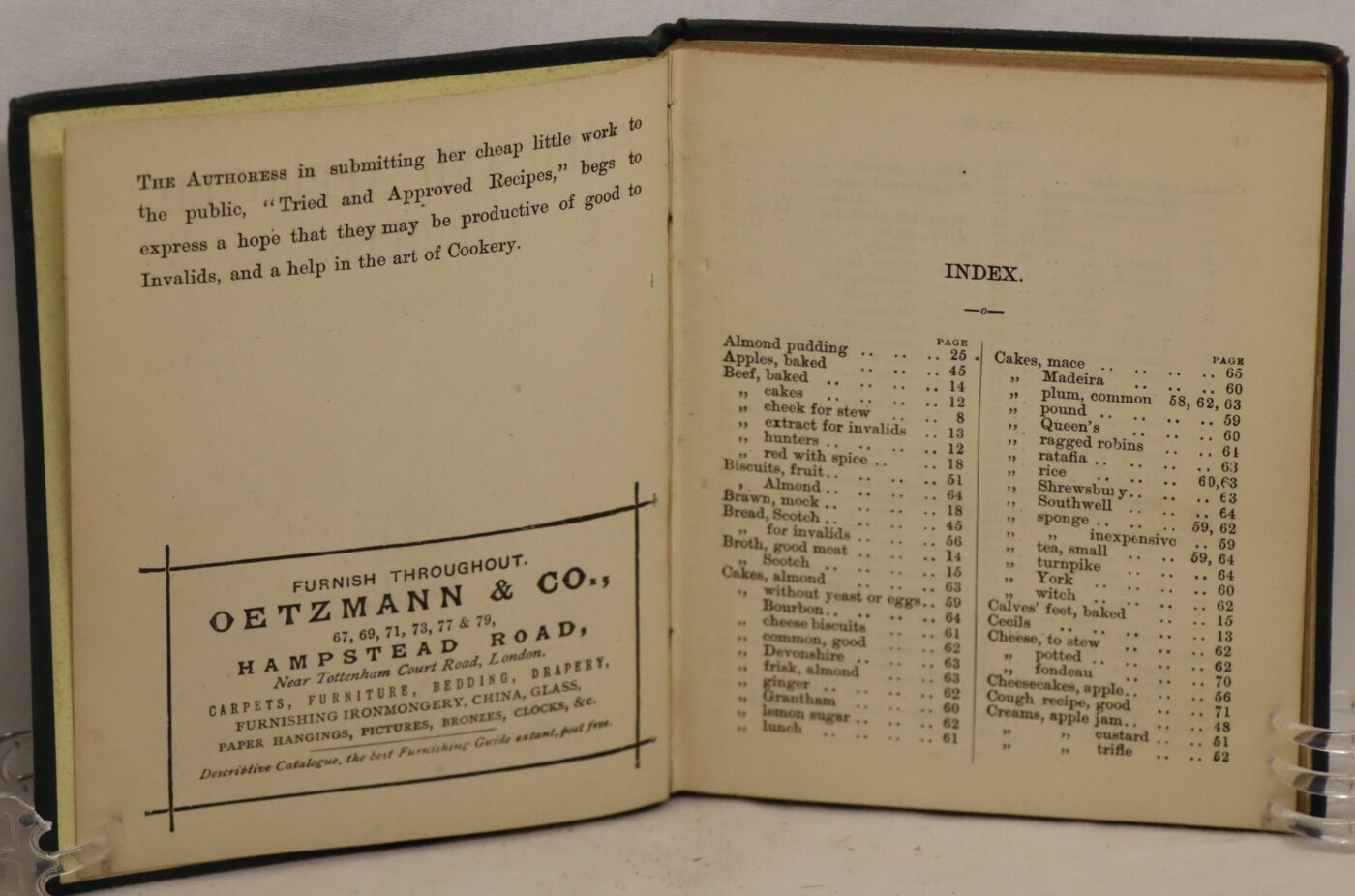
Expected Chapter Headings & Structure
Pocket-sized Victorian domestic manuals (4.4 × 5.6 inches) were designed as practical kitchen companions rather than encyclopaedias. While the exact wording of the headings in this copy may vary, a book of this size and era typically groups recipes into classic Victorian meal-course sections:
- Soups & Broths. Clear soups, mutton broth, vegetable stocks, and invalid broths.
- Fish. Boiling, baking, and frying freshwater and sea fish, along with fish sauces.
- Meat, Poultry & Game. Roasting, boiling, stewing, and hashing beef, mutton, veal, pork, and fowl.
- Made Dishes & Entrées. Croquettes, rissoles, curries, ragouts, and ways of using cold leftover meats.
- Vegetables & Salads. Plain boiling, stewing, and dressing seasonal garden produce.
- Puddings, Pies & Pastry. Suet puddings, baked custards, fruit tarts, and shortcrust or puff pastry.
- Cakes, Biscuits & Confectionery. Tea cakes, gingerbread, seed cakes, creams, and jellies.
- Pickles, Preserves & Home-Made Wines. Jams, marmalades, chutneys, vinegars, and cordials.
- Cookery for the Sick / Household Hints. Beef tea, gruel, barley water, and basic domestic remedies.
NOTE: This is an original book from the library gathered by the famous Cambridge Don, computer scientist, food and wine connoisseur, Jack Arnold LANG. Note: Jack founded the Michelin Guide ‘Midsummer House’- Cambridge’s paramount restaurant. This dining experience is hidden amongst the grassy pastures and grazing cattle of Midsummer Common and perched on the banks of the River Cam.
In 2008, Jack was one of the co-founders of the Raspberry Pi Foundation, alongside other members of the Department, and acted as the Foundation’s Chair. The project’s original goals were modest: to build and distribute low-cost computers for prospective applicants to our Computer Science degree. Initially the project was a “success disaster”, as Jack would say, as demand far outstripped the low-scale manufacturing plans. Ultimately the Raspberry Pi became the UK’s most successful computer with more than 60 million sold to date. Jack was drawn to the educational possibilities of the Raspberry Pi, its potential uses in emerging economies and the way it could support self-directed learning.
Want to know more about this item?
We are happy to answer any questions you may have about this item. In addition, it is also possible to request more photographs if there is something specific you want illustrated.
Ask a question
Related products
Share this Page with a friend
