
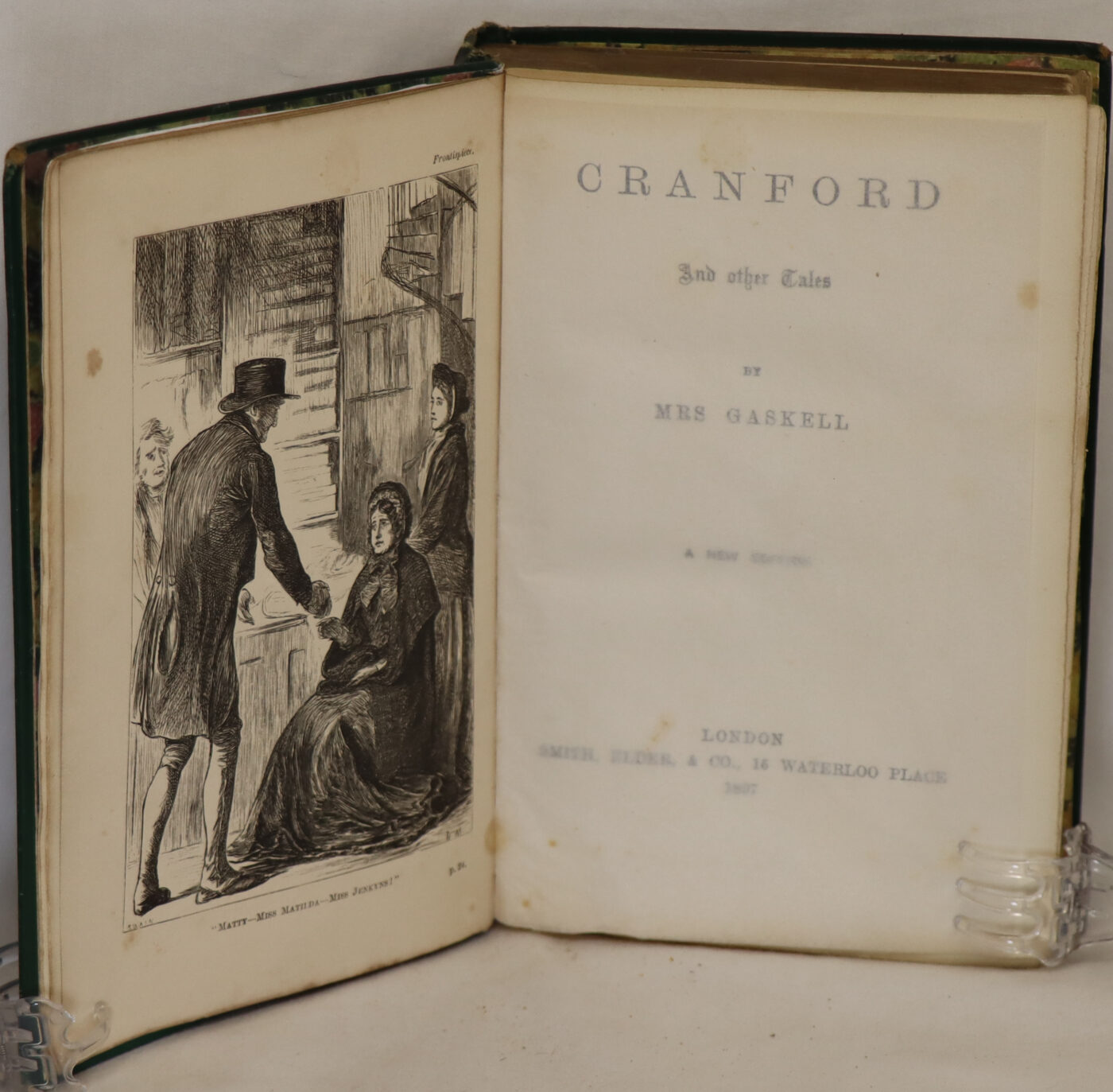
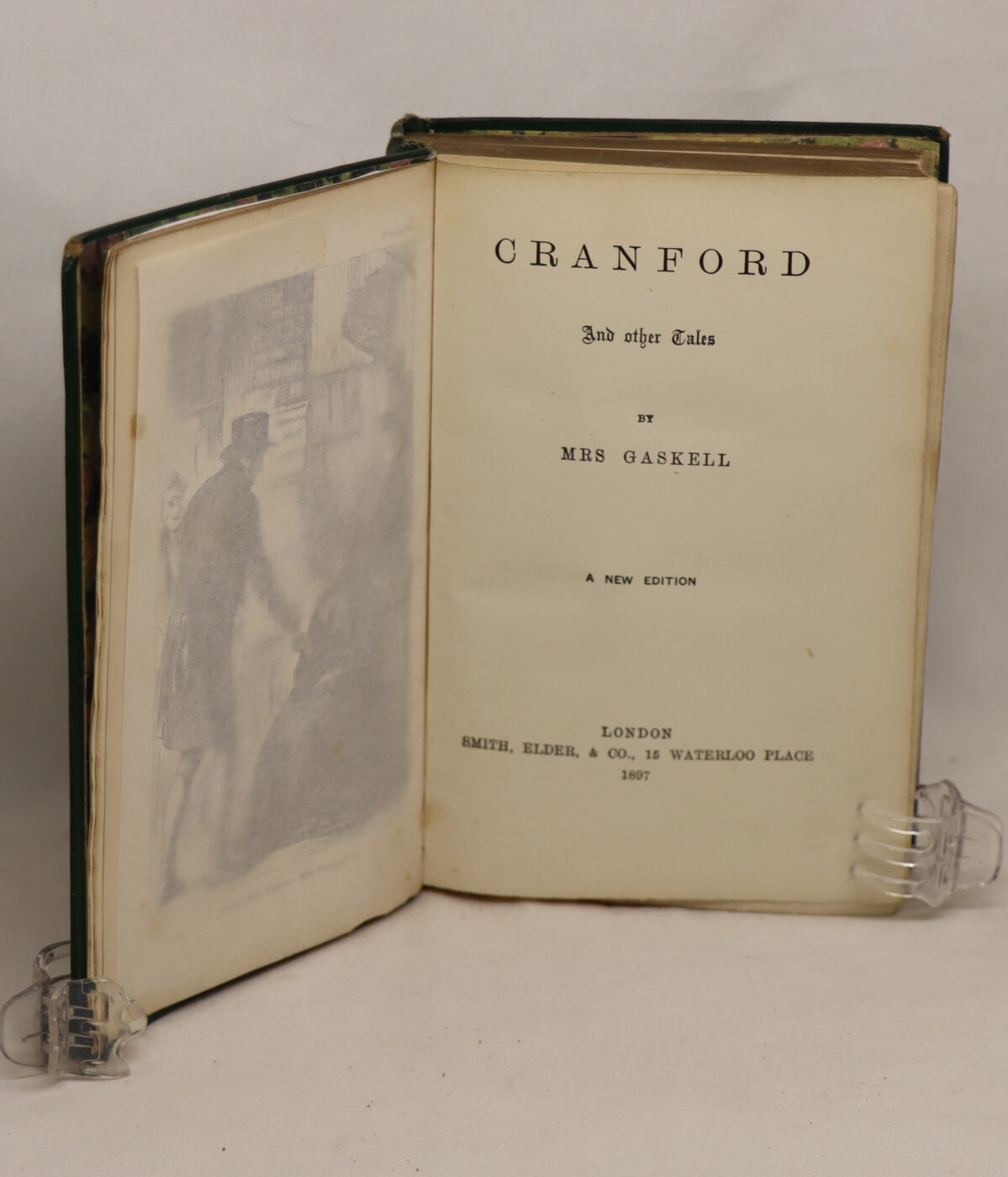
Cranford and Other Tales.
By Mrs Gaskell
Printed: 1897
Publisher: Smith Elder & Co. London
| Dimensions | 13 × 18 × 3 cm |
|---|---|
| Language |
Language: English
Size (cminches): 13 x 18 x 3
Condition: Good (See explanation of ratings)
£24.00
Buy Now

Item information
Description
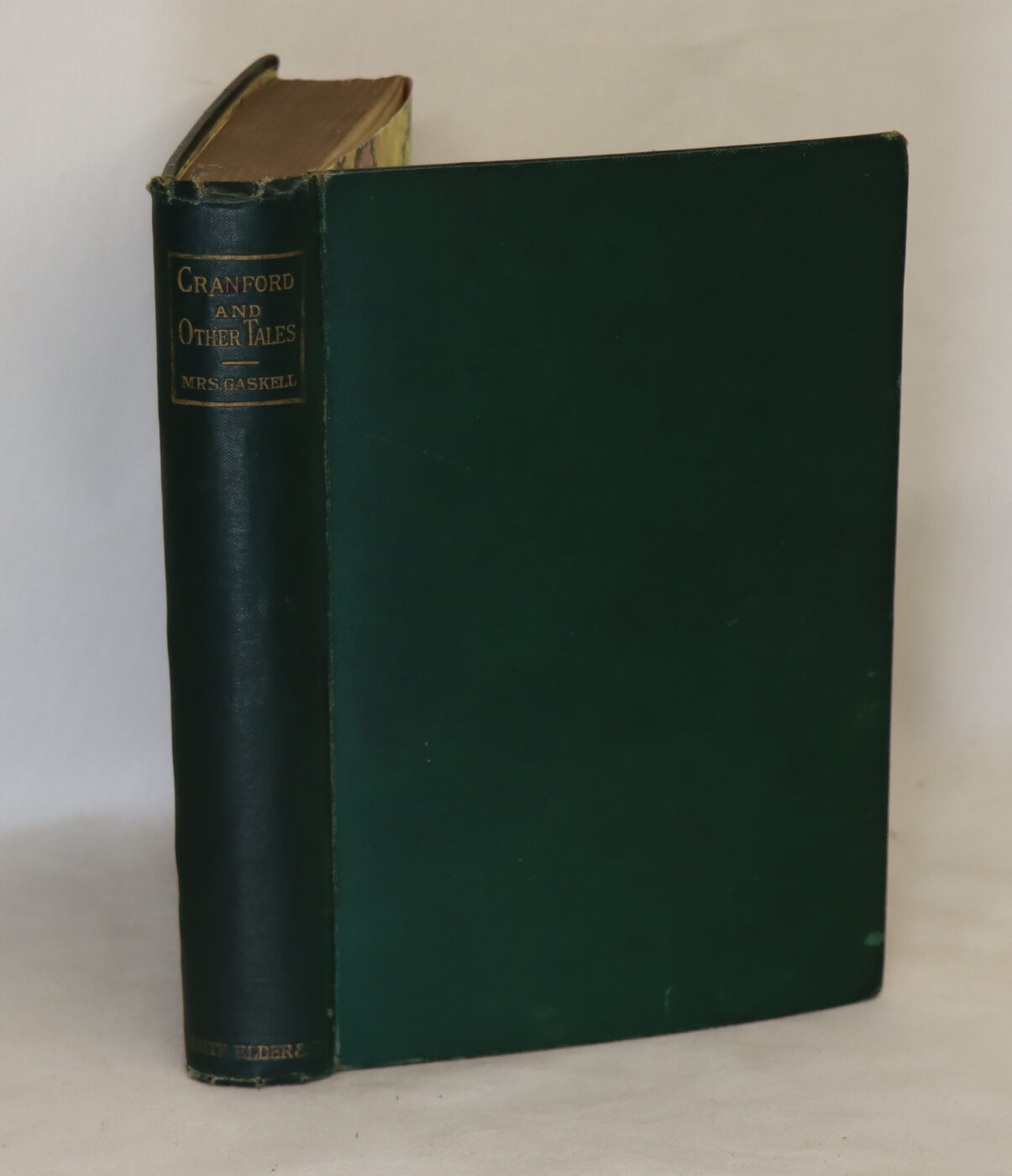
Green cloth binding with gilt title on the spine.
We provide an in-depth photographic presentation of this item to stimulate your feeling and touch. More traditional book descriptions are immediately available.
- Note: This book carries a £5.00 discount to those that subscribe to the F.B.A. mailing list
This 1897 Smith, Elder & Co. edition of Cranford and Other Tales by Mrs. Gaskell is a late-Victorian reprint of her classic collected works, typically valued between £12 and £28 in “Good” secondhand condition. Because Cranford was first published in book form in 1853 and Smith, Elder & Co. issued many subsequent impressions throughout the 1890s, this copy holds value primarily as an attractive, readable antique rather than a rare first edition.
Edition Details & Context
- Publisher History. Smith, Elder & Co. was Elizabeth Gaskell’s primary London publisher during the Victorian era, producing uniform collected editions of her novels and short stories through the late 19th century.
- Dimensions & Format. Your book’s measurements (5.2 x 7.2 x 1.2 inches) match the standard Crown Octavo (8vo) cloth-bound format Smith, Elder & Co. used for their popular 1890s reprints.
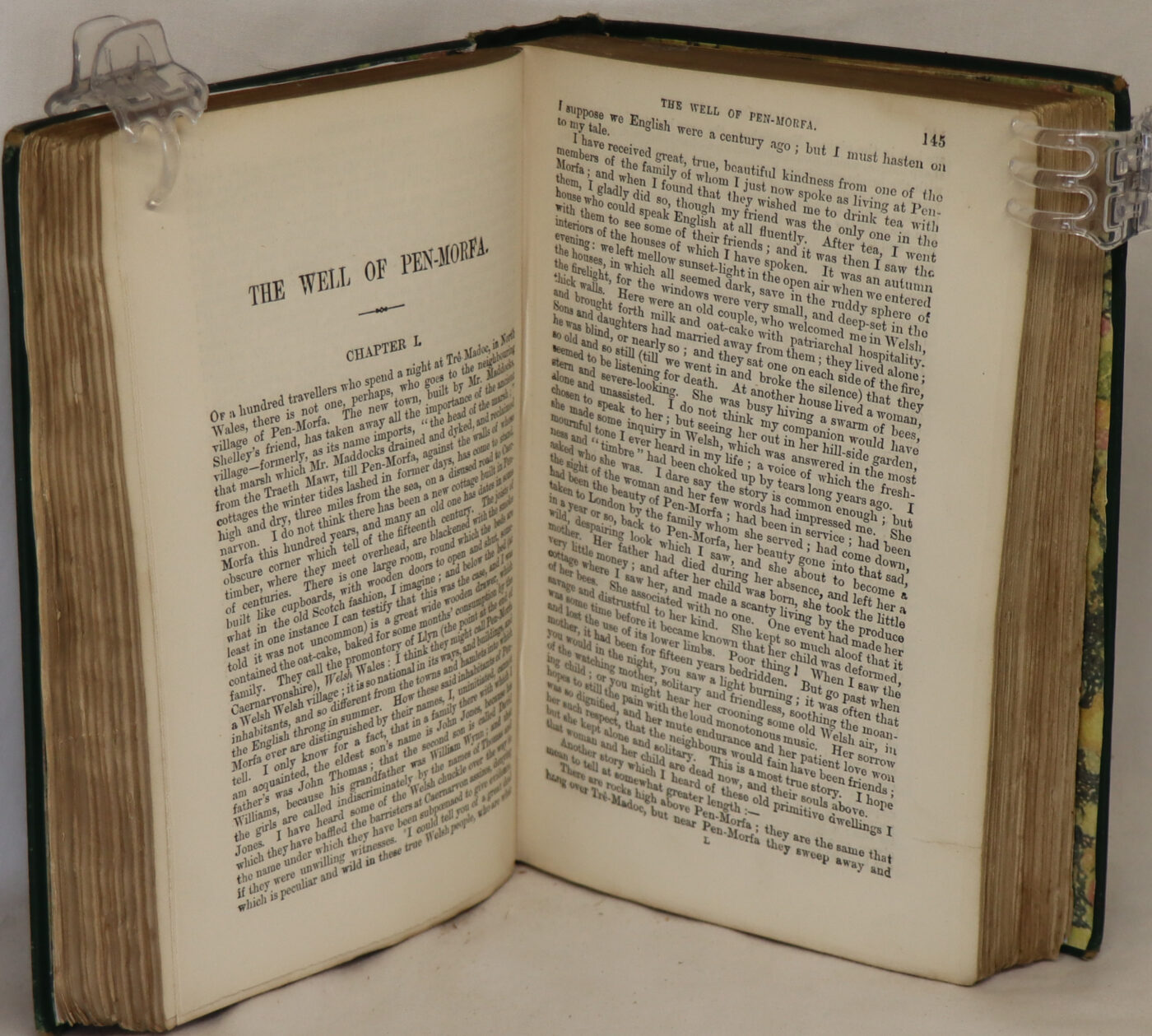
- Included Works. Alongside the titular novel Cranford, these volumes typically compile several of Gaskell’s shorter stories, such as The Squire’s Story, Curious if True, The Moorland Cottage, Disappearances, Right at Last, The Manchester Marriage, and Lois the Witch.
Comparable Market Listings
To help gauge current asking prices in the UK market, similar 1890s Smith, Elder & Co. hardcover reprints of Cranford and Other Tales are listed as follows:
- Richard Dalby’s Library: A 1890 green cloth hardcover with gold lettering in “Good” condition (showing spine wear and page yellowing) is listed at £15.00.
- AbeBooks UK: A Smith, Elder hardcover copy in “Good” used condition from a UK seller is priced at £9.99.
- Etsy UK: A vintage blue cloth Smith, Elder & Co. copy is listed at £19.99.
- Old Stuff Books: An 1892 Smith, Elder & Co. hardcover with noticeable board wear and foxing is offered at £8.00.
Factors Affecting Value
- Binding Style. Copies in original decorative Victorian cloth (such as green or blue boards with gilt lettering and black floral blocking) generally sit toward the top of the £15–£20 range, whereas plain or heavily faded cloth sits closer to £8–£10.
- Illustrations. While the most sought-after 1890s Cranford editions are those illustrated by Hugh Thomson (Macmillan, 1891) or C. E. Brock (1898), Smith, Elder editions sometimes include engraved plates by George Du Maurier, which add modest appeal for collectors.
- Structural Integrity. In an 1897 volume graded “Good,” buyers look closely at whether the hinges are cracked, if all pages are intact without loose signatures, and whether there is heavy foxing or ink inscriptions.
Biography of Mrs. Gaskell
Elizabeth Cleghorn Gaskell (née Stevenson; 1810–1865), widely known during her lifetime as Mrs. Gaskell, was one of the most prominent English novelists and short story writers of the Victorian era. Renowned for her vivid portraits of industrial life in northern England as well as charming chronicles of rural society, she bridged the worlds of social reform and domestic realism.
Early Life and Upbringing
- Birth and Family. She was born in Chelsea, London, on 29 September 1810, to William Stevenson, a Unitarian minister and writer, and Elizabeth Holland.
- Childhood in Knutsford. After her mother died just thirteen months after her birth, young Elizabeth was sent to live with her maternal aunt, Hannah Lumb, in the quiet Cheshire market town of Knutsford. Her idyllic upbringing in Knutsford directly inspired the fictional village of Cranford.
- Education. She attended Avonbank boarding school in Stratford-upon-Avon from 1821 to 1826, receiving a broad education in languages, literature, and the arts.
Marriage and Life in Manchester
- Marriage to William Gaskell. In 1832, she married William Gaskell, a Unitarian minister at Cross Street Chapel in Manchester. The couple settled in Manchester, where they had four surviving daughters and a son, William, who tragically died of scarlet fever in infancy in 1845.
- Encountering Industrial Poverty. Living in Manchester—the heart of the Industrial Revolution—exposed Elizabeth to the harsh living conditions, poverty, and labour unrest faced by factory workers. Her active charity work and visits to working-class homes gave her firsthand insight into the sharp class divides of Victorian Britain.
- Turn to Writing. To cope with her grief following the death of her infant son, her husband encouraged her to write. Her debut novel, Mary Barton: A Tale of Manchester Life (1848), was an immediate success, earning praise from literary giants like Charles Dickens and Thomas Carlyle.
Literary Career and Major Works
- Collaboration with Charles Dickens. Following the success of Mary Barton, Charles Dickens invited Gaskell to contribute to his newly founded weekly magazine, Household Words. She became one of his most valued contributors, publishing ghost stories, essays, and serialized novels in its pages.
- Social Problem Novels. Gaskell used fiction to advocate for empathy and social reform. Alongside Mary Barton, she published Ruth (1853)—a controversial yet sympathetic novel about an unmarried mother—and North and South (1854–55), which contrasted the industrial north with the genteel south of England.
- Provincial and Domestic Classics. Alongside her industrial novels, she excelled at affectionate, humorous studies of small-town English life. Cranford (1853) became her most enduringly popular work, followed late in her career by her masterpiece, Wives and Daughters (1864–66).
- Biography of Charlotte Brontë. Gaskell formed a close friendship with fellow novelist Charlotte Brontë. After Brontë’s death in 1855, Charlotte’s father asked Gaskell to write her official biography. Published in 1857, The Life of Charlotte Brontë remains a landmark in English biography, though its candid details forced Gaskell to revise later editions to avoid libel suits.
Final Years and Legacy
- Sudden Death. In 1865, using the proceeds from her writing, Gaskell secretly bought a country house called The Lawn in Holybourne, Hampshire, intending it as a surprise retirement home for her husband. On 12 November 1865, while visiting the house with her daughters, she died suddenly of a heart attack at the age of 55, leaving Wives and Daughters just a few chapters short of completion.
- Enduring Influence. Initially celebrated mostly for her gentle rural sketches like Cranford, modern literary criticism recognizes Elizabeth Gaskell as a bold, versatile writer whose social realism, psychological depth, and nuanced female characters place her alongside Charles Dickens, Charlotte Brontë, and George Eliot at the forefront of Victorian literature.
Please view our photographs. NOTE: This is an original book from the library gathered by the famous Cambridge Don, computer scientist, food and wine connoisseur, Jack Arnold LANG. Note: Jack founded the Michelin Guide ‘Midsummer House’- Cambridge’s paramount restaurant. This dining experience is hidden amongst the grassy pastures and grazing cattle of Midsummer Common and perched on the banks of the River Cam.
In 2008, Jack was one of the co-founders of the Raspberry Pi Foundation, alongside other members of the Department, and acted as the Foundation’s Chair. The project’s original goals were modest: to build and distribute low-cost computers for prospective applicants to our Computer Science degree. Initially the project was a “success disaster”, as Jack would say, as demand far outstripped the low-scale manufacturing plans. Ultimately the Raspberry Pi became the UK’s most successful computer with more than 60 million sold to date. Jack was drawn to the educational possibilities of the Raspberry Pi, its potential uses in emerging economies and the way it could support self-directed learning.
Want to know more about this item?
We are happy to answer any questions you may have about this item. In addition, it is also possible to request more photographs if there is something specific you want illustrated.
Ask a question
Related products
Share this Page with a friend
