
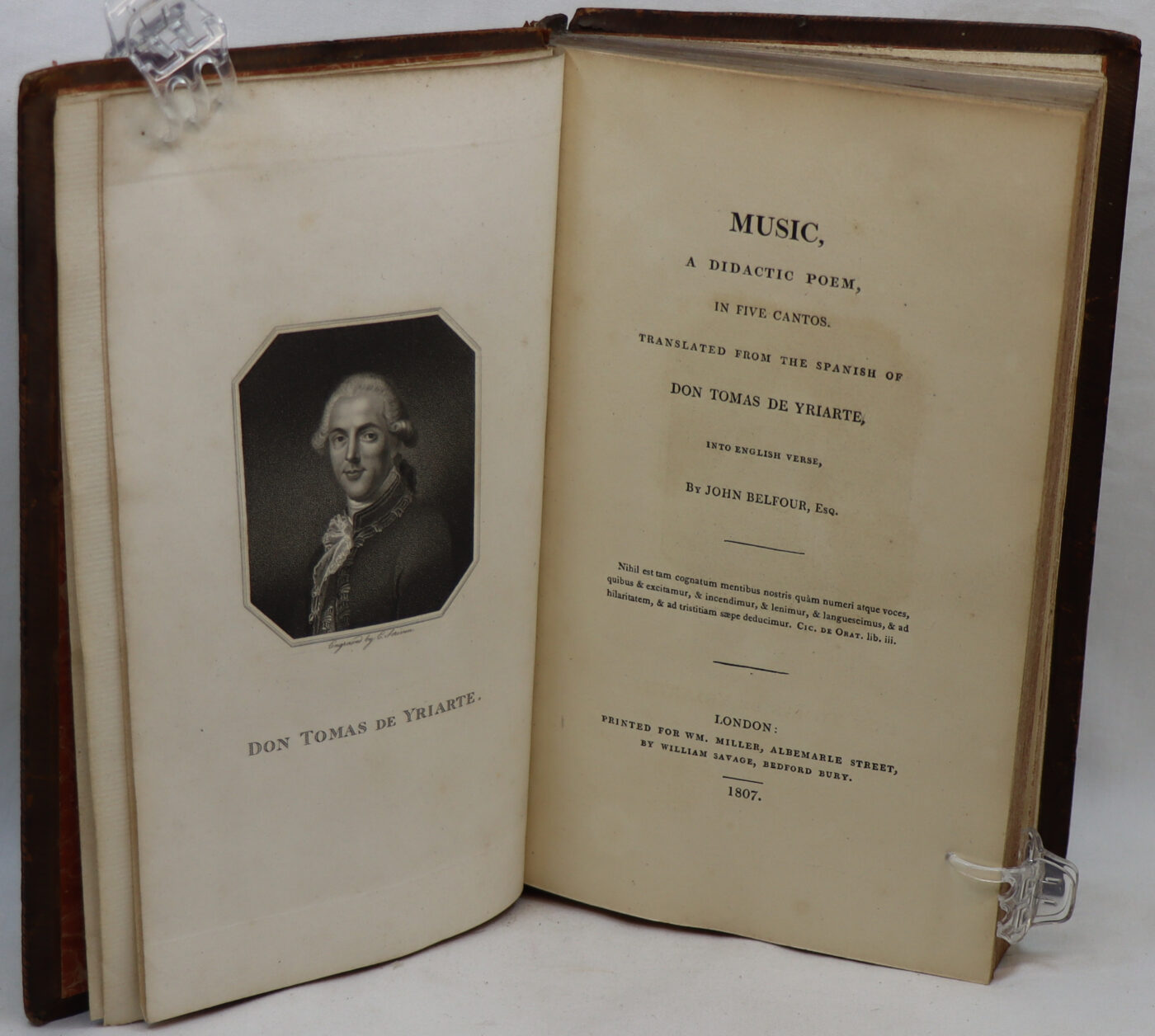
Music, A Didactic Poem.
By Tomas de Iriate
Printed: 1807
Publisher: Wm Miller. London
| Dimensions | 15 × 24 × 3 cm |
|---|---|
| Language |
Language: . London
Size (cminches): 15 x 24 x 3
Condition: Good (See explanation of ratings)
£1284.00
FREE shipping
Buy Now

Item information
Description
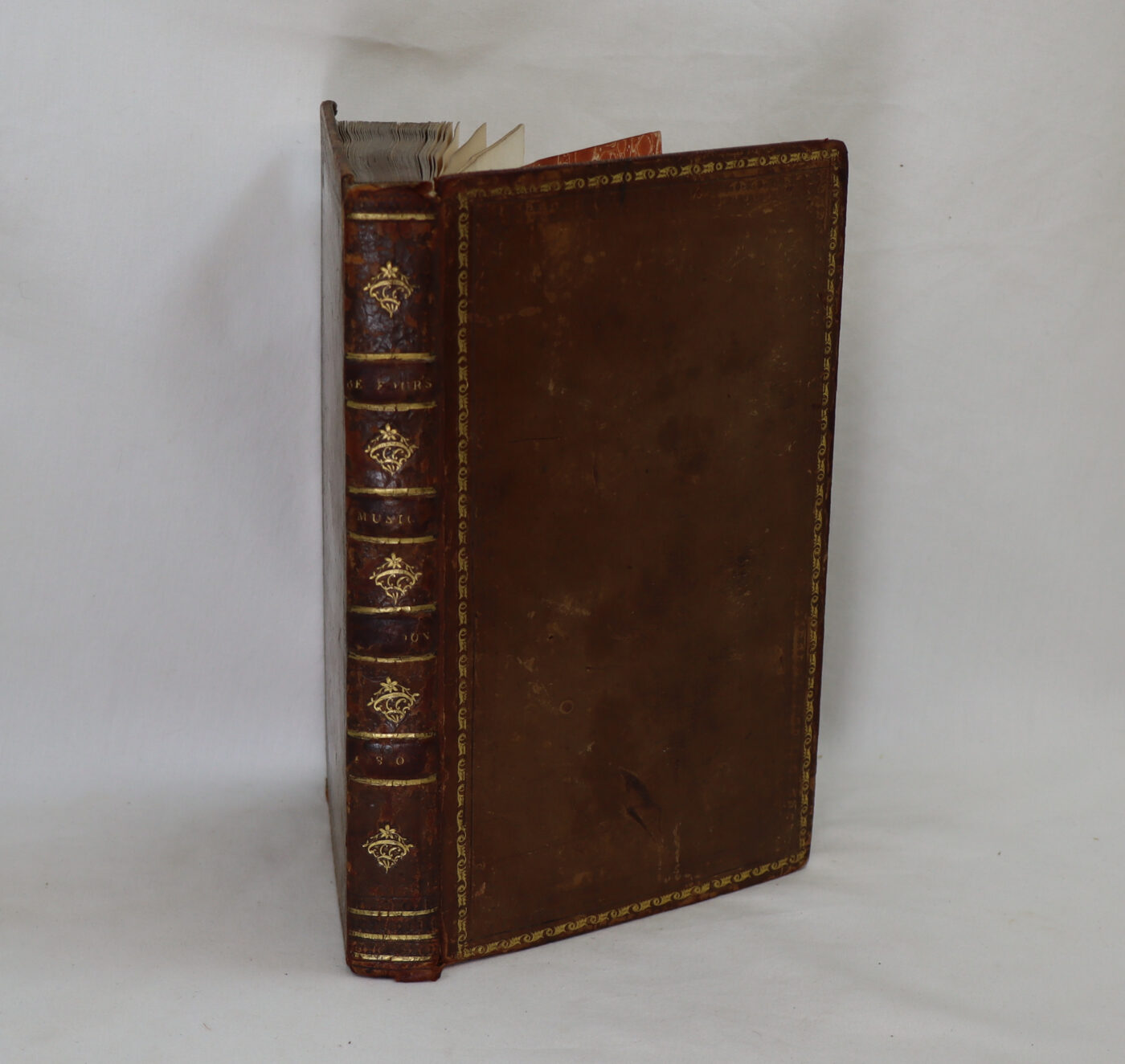
Brown calf binding with gilt banding, decoration and title on the spine.
We provide an in-depth photographic presentation of this item to stimulate your feeling and touch. More traditional book descriptions are immediately available.
-
Note: This book carries a £5.00 discount to those that subscribe to the F.B.A. mailing list
Translated by John Balfour.
Please view our photographs. This is a very, very rare book in good condition printed in English. An original second Spanish copy would fetch up to £2,000. The first Spanish edition is dated 1774, not as well printed as the second Spanish edition. A French translation was completed in 1799 par Grainville, addressed to the Conservatoire de Musique and approved by Cherubini, Gossec, etc. Contemporary binding in full red morocco signed Derôme le jeune, spine in five compartments richly decorated with grotesque gilt circles and diamond shapes, double gilt fillets and roulettes framing the boards, double gilt fillet highlighting the leading edges, fine gilt lace work tooling framing the paste paper endpapers, all edges gilt. Rubbing on the spine ends, compartments, joints and corners can fetch £3,000 or more. This more modest printed version in English has fetched upwards of £1,600.
Tomás de Iriarte (1750-1791) was a renowned poet, fable writer and playwright. La Musica is a didactic poem in which its author explains the rarity of his undertaking in the prologue, including two other attempts, of lower caliber, in the field. The first song defines music by summarising it with two essential principles: sound and time. The second deals with expression. The third song deals with the excellence of music based on its uses. The fourth is about theatre music and the fifth exposes music intended for entertainment and music devoted to solitude.
La Música (The Poem)
-
Published in Madrid in 1779.
-
Written in five cantos covering scales, rhythm, harmony, and theater music.
-
Translated into French, Italian, German, and English.
-
Inspired by Madrid’s salon musical gatherings (academias de armonía).
Musical Works & Involvement
-
Composed small-scale vocal and instrumental pieces.
-
Wrote light theatrical musical numbers like tonadillas.
-
Fables like The Musical Ass (El burro y la flauta) explicitly use music to satirize foolishness and accidental success.
Tomás de Iriarte (or Yriarte) (18 September 1750 in Puerto de la Cruz, Tenerife – 17 September 1791 in Madrid) was a Spanish neoclassical poet. Tomás was born to the Iriarte family, many of whose members were writers in the humanist tradition. His father was Don Bernardo de Iriarte, while his mother was Doña Bárbara de las Nieves Hernández de Oropesa; therefore his full name is variously given as Tomás de Iriarte y Nieves Ravelo or Tomás de Iriarte y Oropesa. His brother was Bernardo de Iriarte.He received his literary education at Madrid where he went aged 14, in 1764, under the care of his uncle, Juan de Iriarte (Puerto de la Cruz, 1701 – Madrid 1771), librarian to the king of Spain. At 18 Tomás began his literary career by translating French plays for the royal theatre, and in 1770, under the anagram of Tirso Imarete, he published an original comedy entitled Hacer que hacemos. In the following year he became official translator at the foreign office, and in 1776 keeper of the records in the war department. In 1780 he authored a didactic poem in silvas entitled La Música, which attracted attention in Italy as well as at home.
The Fábulas literarias (1782), with which his name is most intimately associated, are composed in a variety of metres, and was known for humorous attacks on literary men and methods, as was the case repeatedly, with Juan Bautista Pablo Forner (1756–97).During his later years, partly as a consequence of the Fábulas, Iriarte was entangled in personal controversies, and in 1786 was reported to the Spanish Inquisition for his sympathies with French philosophers. He died of gout at Madrid, 17 September 1791, aged only 41. He is the subject of an 1897 monograph by Emilio Cotarelo [es] (1857–1936), a member of the Royal Spanish Academy.
Didacticism is a philosophy that emphasises instructional and informative qualities in literature, art, and design. In art, design, architecture, and landscape, didacticism is a conceptual approach that is driven by the urgent need to explain. The term has its origin in the Ancient Greek word διδακτικός (didaktikos), “pertaining to instruction”, and signified learning in a fascinating and intriguing manner.
Didactic art was meant both to entertain and to instruct. Didactic plays, for instance, were intended to convey a moral theme or other rich truth to the audience. During the Middle Age, the Roman Catholic chants like the Veni Creator Spiritus, as well as the Eucharistic hymns like the Adoro te devote and Pange lingua are used for fixing within prayers the truths of the Roman Catholic faith to preserve them and pass down from a generation to another. In the Renaissance, the church began a syncretism between pagan and the Christian didactic art, a syncretism that reflected its dominating temporal power and recalled the controversy among the pagan and Christian aristocracy in the fourth century. An example of didactic writing is Alexander Pope’s An Essay on Criticism (1711), which offers a range of advice about critics and criticism. An example of didacticism in music is the chant Ut queant laxis, which was used by Guido of Arezzo to teach solfege syllables.
Around the 19th century the term didactic came to also be used as a criticism for work that appears to be overburdened with instructive, factual, or otherwise educational information, to the detriment of the enjoyment of the reader (a meaning that was quite foreign to Greek thought). Edgar Allan Poe called didacticism the worst of “heresies” in his essay The Poetic Principle.
Examples
Some instances of didactic literature include:
-
Instructions of Kagemni, by Kagemni I(?) (2613–2589 BC?)
-
Instruction of Hardjedef, by Hardjedef (between 25th century BC and 24th century BC)
-
The Maxims of Ptahhotep, by Ptahhotep (around 2375–2350 BC)
-
Works and Days, by Hesiod (c. 700 BC)
-
On Horsemanship, by Xenophon (c. 350 BC)
-
The Panchatantra, by Vishnu Sarma (c. 300 BC)
-
De rerum natura, by Lucretius (c. 50 BC)
-
Georgics, by Virgil (c. 30 BC)
-
Ars Poetica by Horace (c. 18 BC)
-
Ars Amatoria, by Ovid (1 BC)
-
Thirukkural, by Thiruvalluvar (between 2nd century BC and 5th century AD)
-
Remedia Amoris, by Ovid (AD 1)
-
Medicamina Faciei Femineae, by Ovid (between 1 BC and AD 8)
-
Astronomica by Marcus Manilius (c. AD 14)
-
Epistulae morales ad Lucilium, by Seneca the Younger, (c. 65 AD)
-
Cynegetica, by Nemesianus (3rd century AD)
-
The Jataka Tales (Buddhist literature, 5th century AD)
-
Philosophus Autodidactus by Ibn Tufail (12th century)
-
Theologus Autodidactus by Ibn al-Nafis (1270s)
-
The Morall Fabillis of Esope the Phrygian (1480s)
-
The Puruṣaparīkṣā by Vidyapati
-
The Pilgrim’s Progress, by John Bunyan (1678)
-
Rasselas, by Samuel Johnson (1759)
-
The History of Little Goody Two-Shoes (anonymous, 1765)
-
The Adventures of Nicholas Experience, by Ignacy Krasicki (1776)
-
Critical and Miscellaneous Essays, by Thomas Carlyle (1838–1839)
-
Critical and Historical Essays, by Thomas Babington Macaulay (1843)
-
The Water-Babies, by Charles Kingsley (1863)
-
Fors Clavigera, by John Ruskin (1871–1884)
-
If-, by Rudyard Kipling (1910)
-
Siddhartha, by Hermann Hesse (1952)
-
Sophie’s World, by Jostein Gaarder (1991)
-
The Wizard of Gramarye series by Christopher Stasheff (1968–2004)
-
Children’s Books in England: Five Centuries of Social Life. by F. J. Harvey Darton
In Spanish poetry, a silva is a poetic form consisting of in eleven- and seven- syllable lines: hendecasyllables (endecasílabos) and heptasyllables (heptasílabos), the majority of which are rhymed. Although, there is no fixed order or rhyme, nor is there a fixed number of lines. Silvas are used by persons of high rank, usually in soliloquies, and for highly emotional narration and description.
The use of the silva can be found in Luis de Góngora’s Soledades and in Sor Juana Inés de la Cruz’s First Dream.
Want to know more about this item?
We are happy to answer any questions you may have about this item. In addition, it is also possible to request more photographs if there is something specific you want illustrated.
Ask a question
Related products

Share this Page with a friend
