
Flora's Feast. A Masque of Flowers.
By Walter Crane
Printed: 1889
Publisher: Cassell & Co. London
| Dimensions | 20 × 26 × 1 cm |
|---|---|
| Language |
Language: English
Size (cminches): 20 x 26 x 1
Condition: Good (See explanation of ratings)
£438.00
FREE shipping
Buy Now

Item information
Description
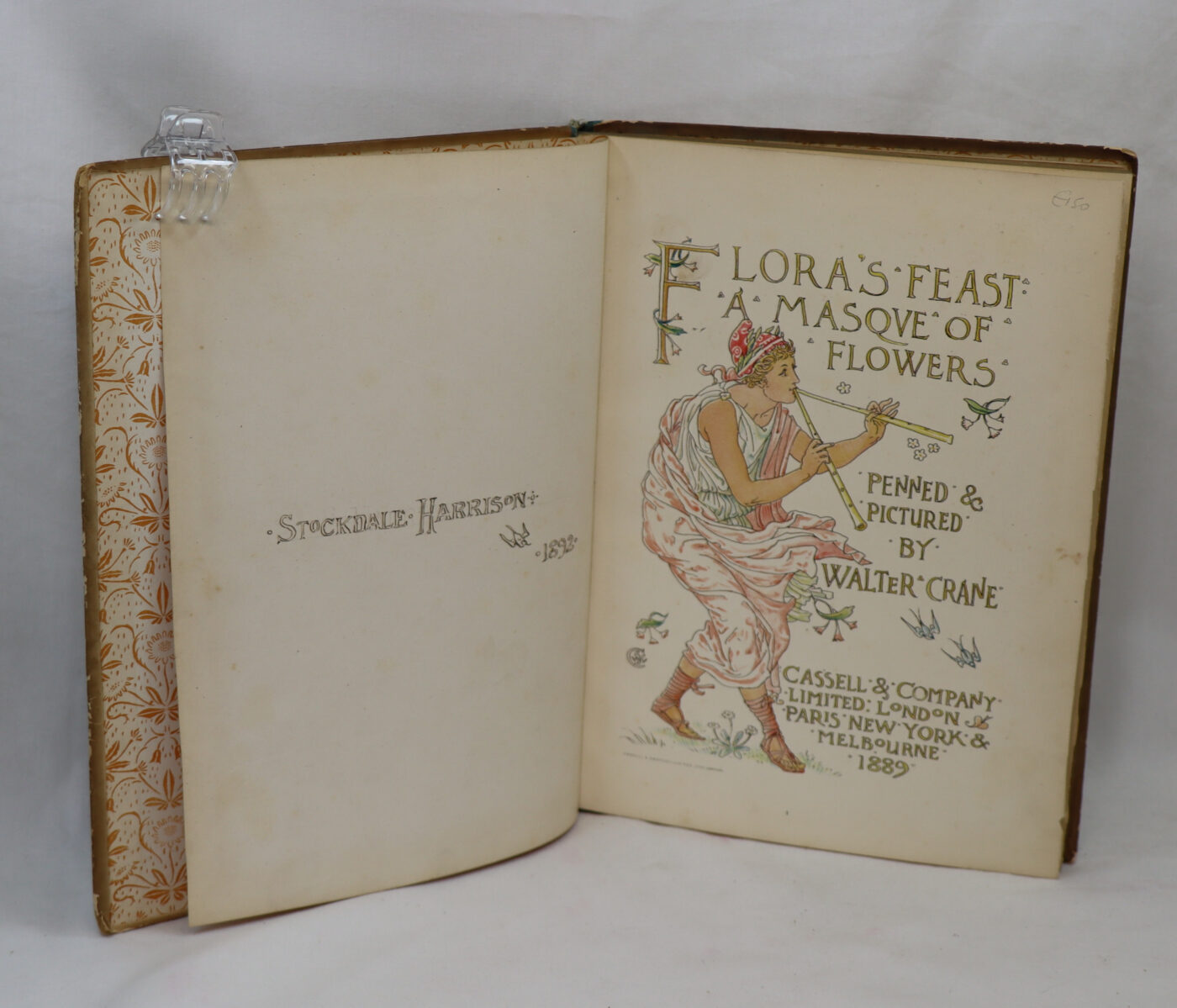
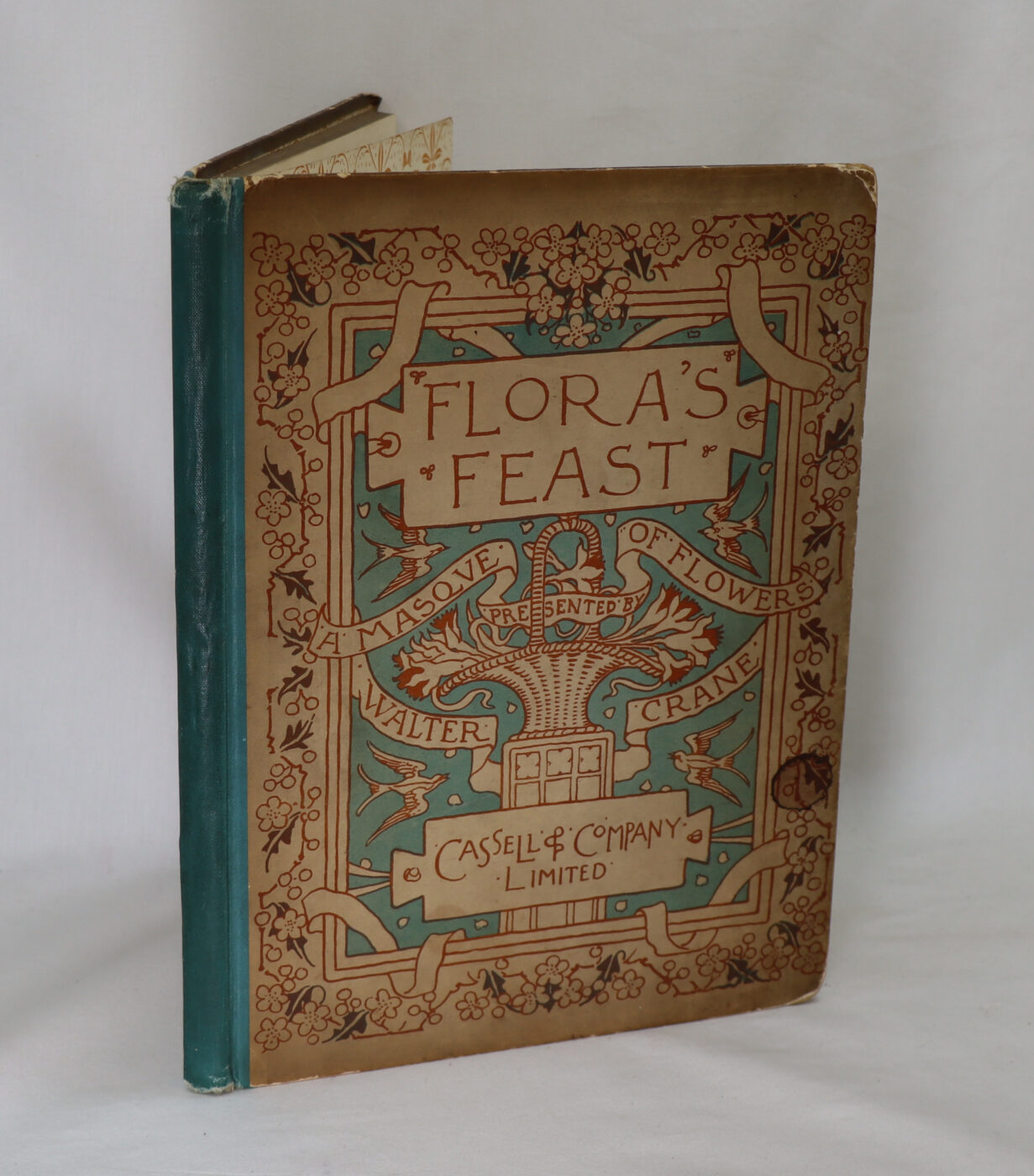
Blue and cream hardboard binding with title on the front board.
-
We provide an in-depth photographic presentation of this item to stimulate your feeling and touch. More traditional book descriptions are immediately available.
-
Note: This book carries a £5.00 discount to those that subscribe to the F.B.A. mailing list
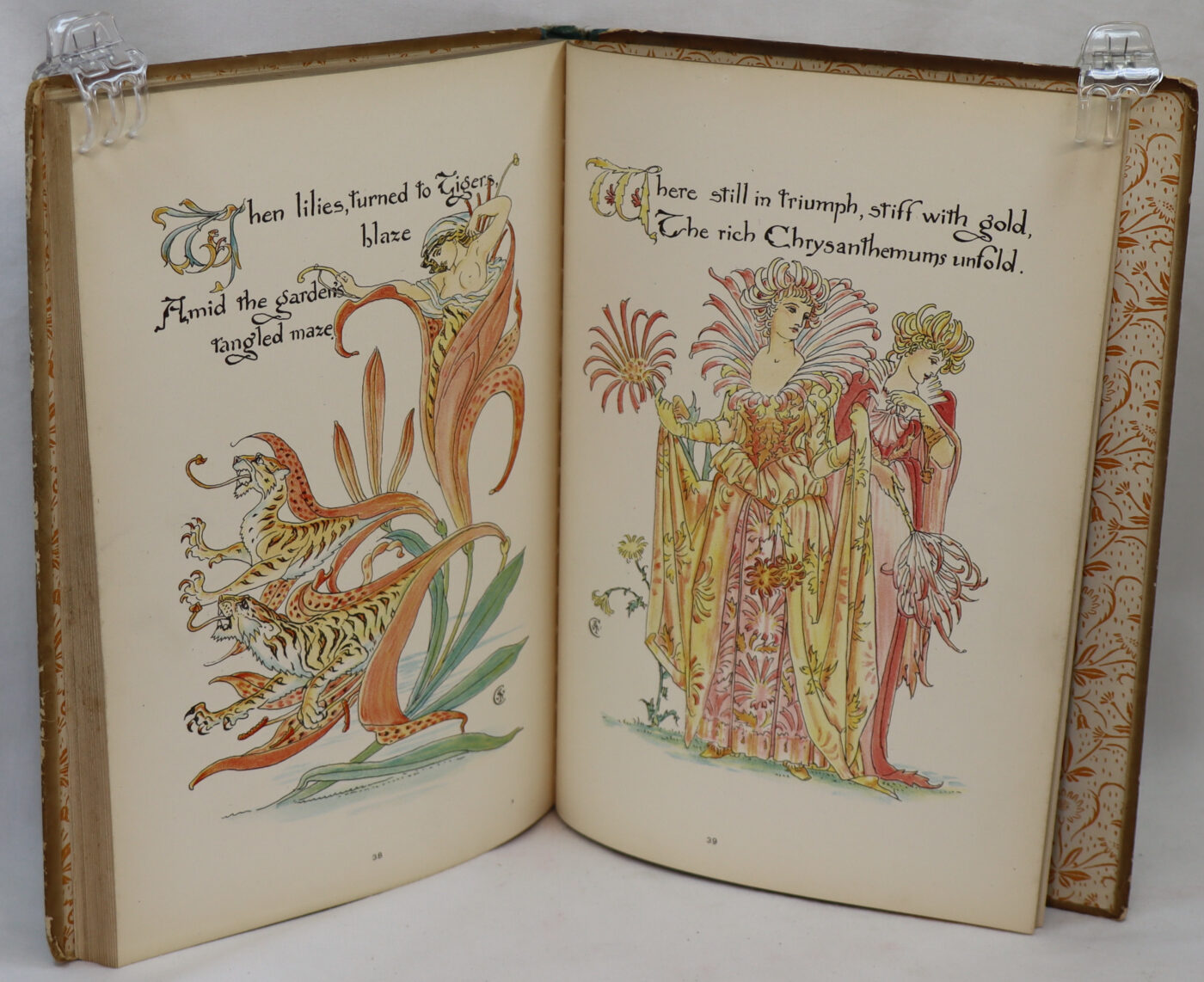
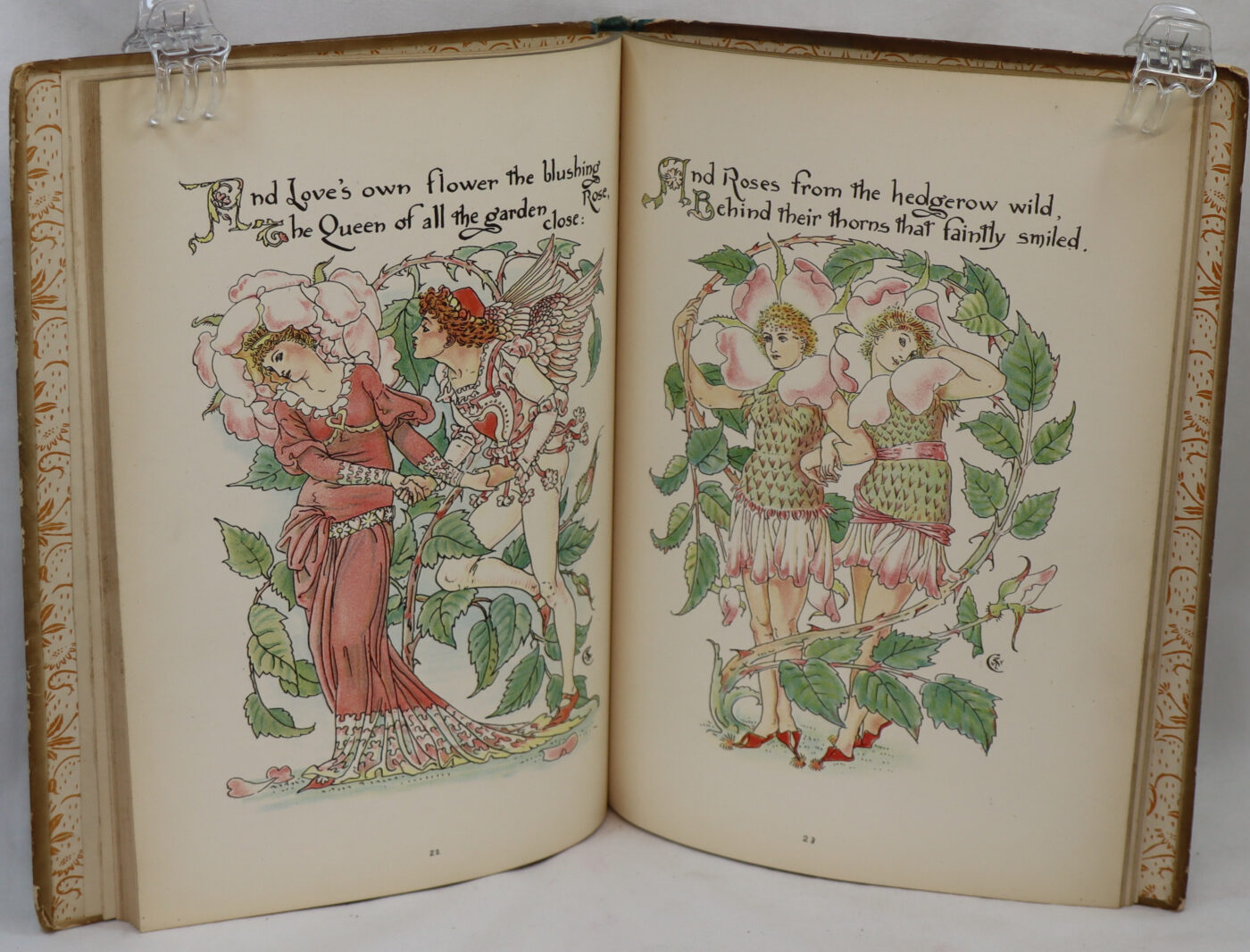
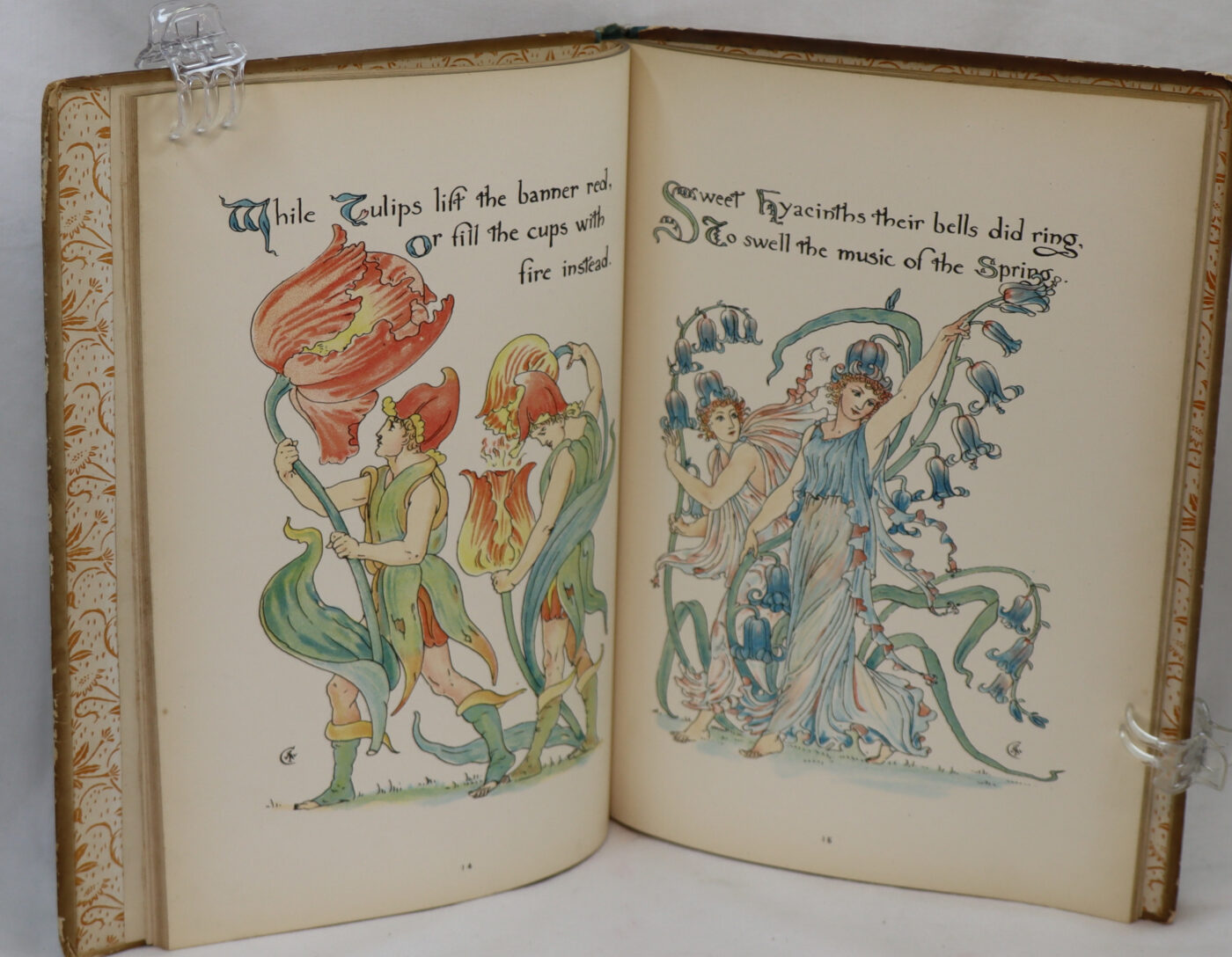
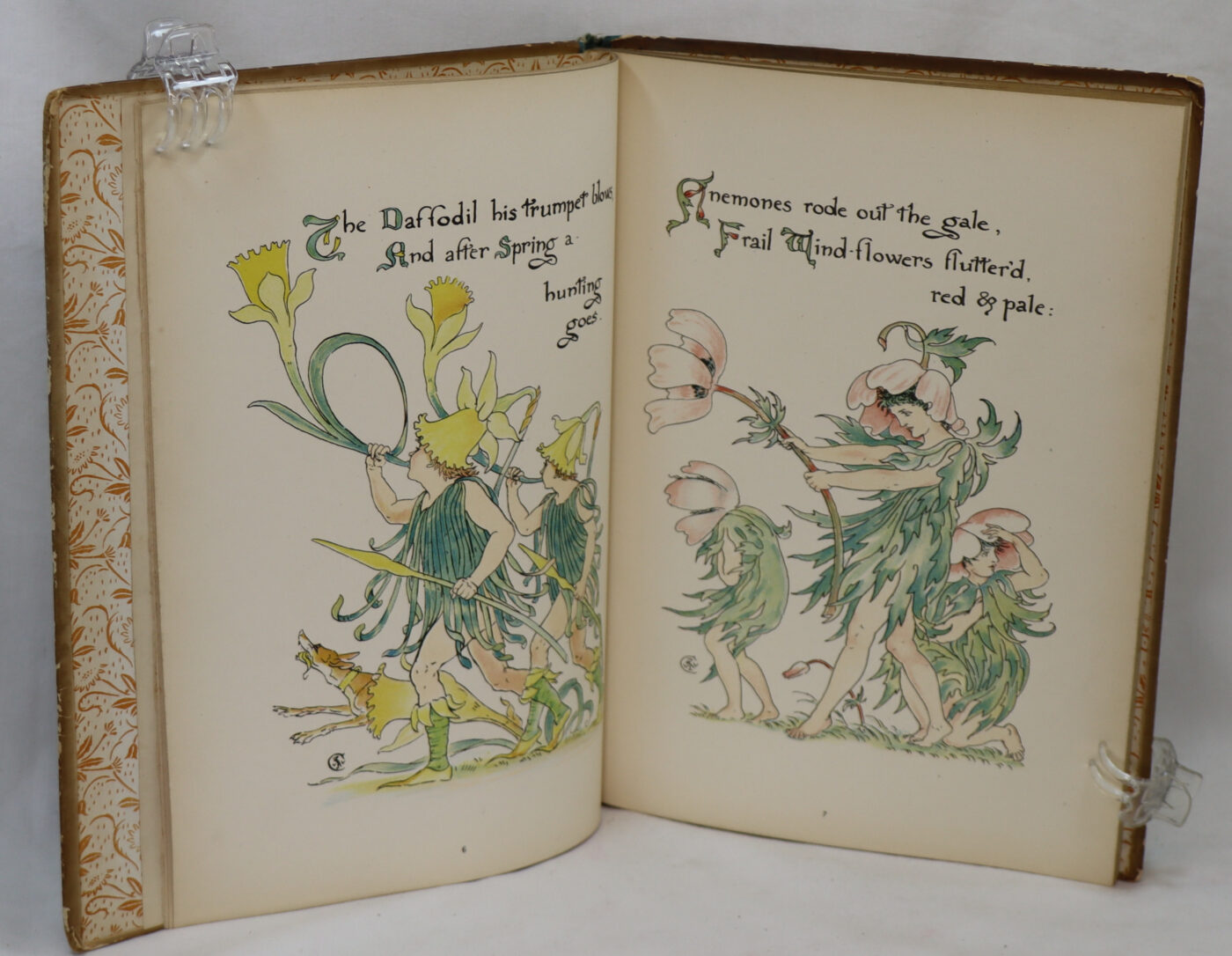
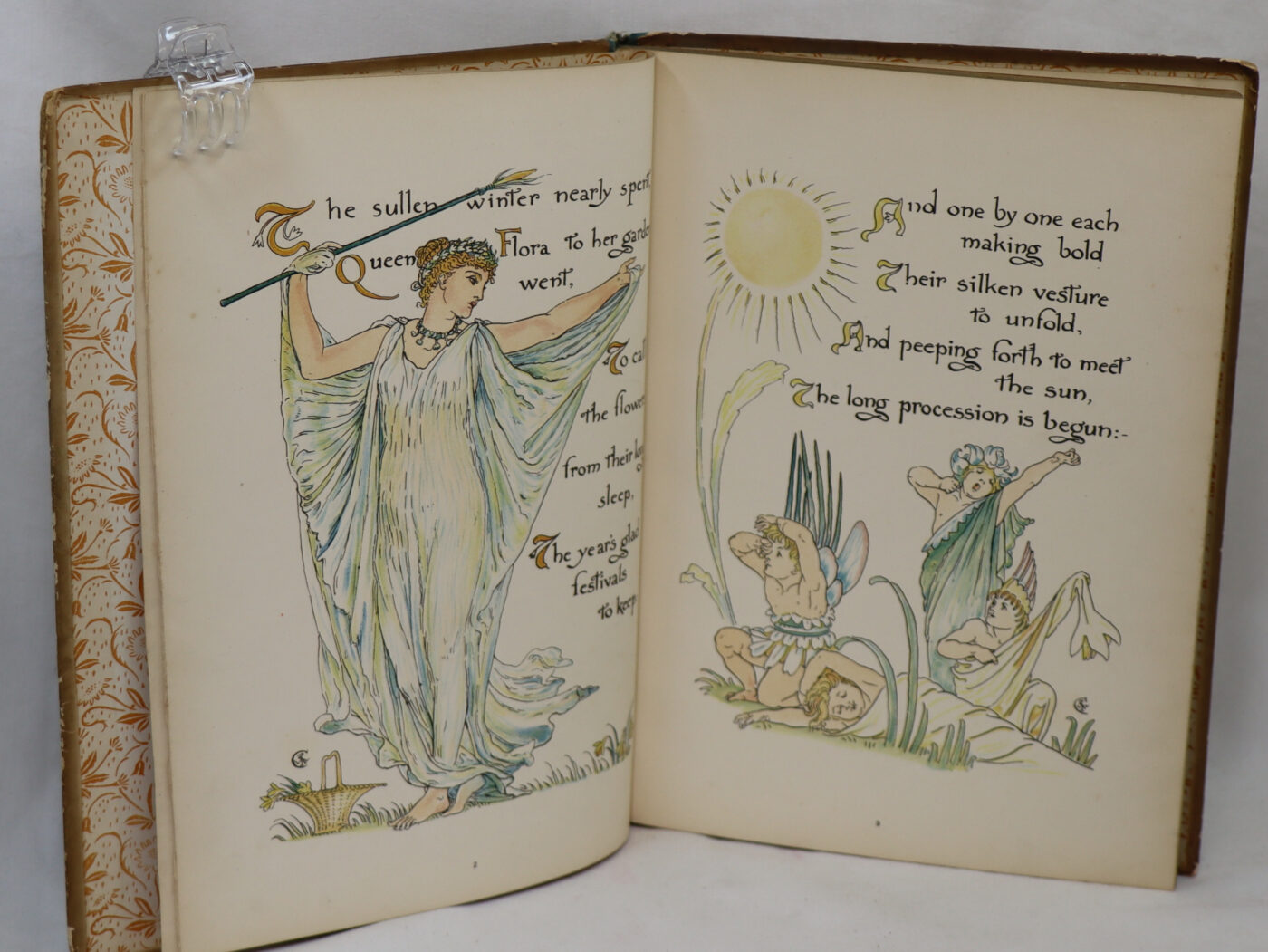
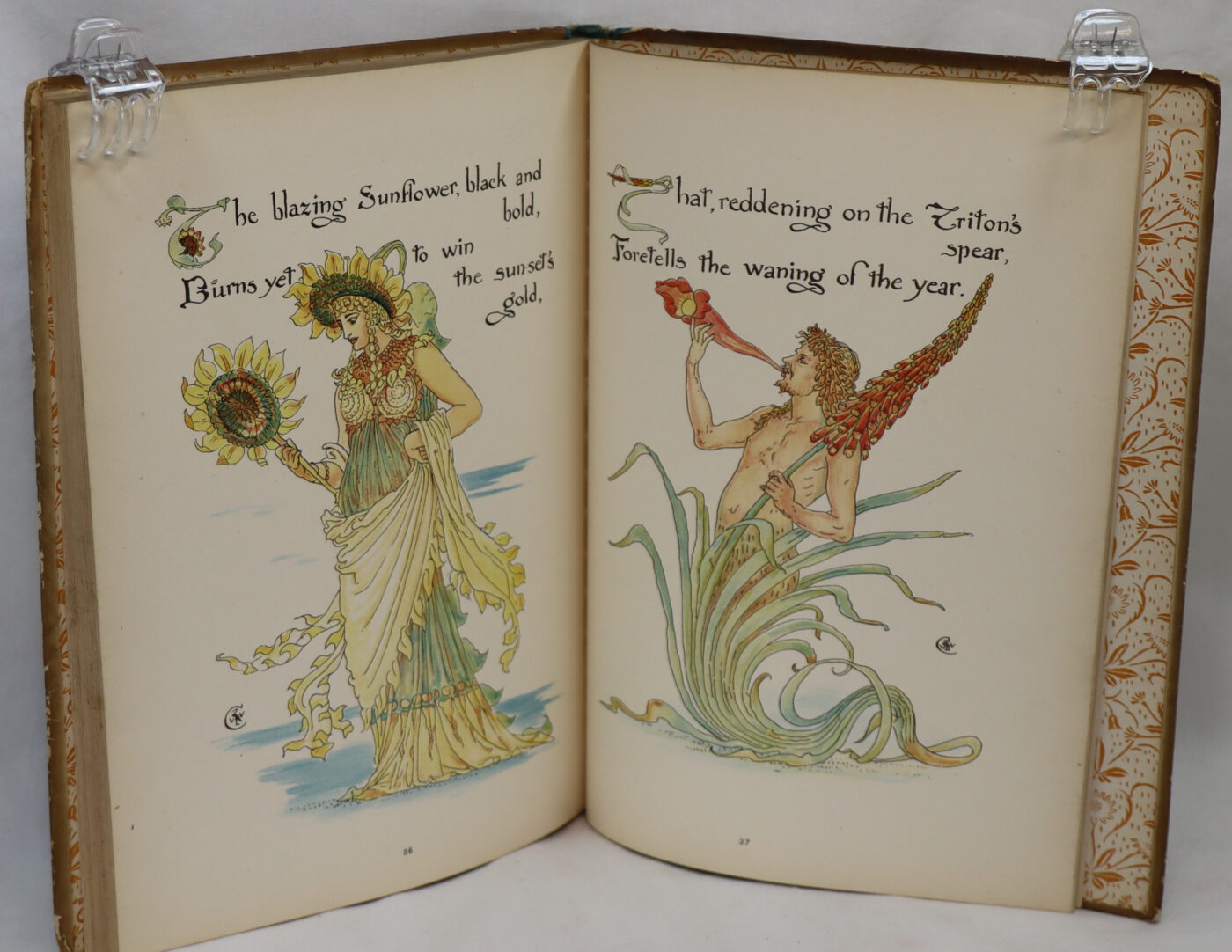
This is a glorious hand painted late 19th century book reflecting the medieval religious celebration of a ‘Masque of Flowers’ once a highly popular festival at weddings and late Spring Celebrations.
First Edition. FLORA’S FEAST A MASQUE OF FLOWERS, Cassell and Company, 1889, first edition, light soiling to the rear cover, light wear to lower fore edge corner tips, light scattered foxing to the page edges, else a bright good copy. Illustrated by Walter Crane with 40 full color, full page plates. A magnificent display of art nouveau.
The ‘original and best known’’ Masque of Flowers was an entertainment on 6 January 1614 to celebrate the marriage of Robert Carr, 1st Earl of Somerset and Frances Howard, Countess of Somerset. Francis Bacon funded the masque to earn favour with King James VI and I and cement his connection with Carr, the King’s favourite.
Masque for a wedding:
The masque was performed by the gentlemen of Gray’s Inn at the Banqueting House at Whitehall Palace. Francis Bacon gave £2000 towards the expenses, refusing an offer of £500 from Henry Yelverton so that he would pay the whole charge and have the honour. Courtiers called it “Mr Attorney’s Masque”. Bacon owed his promotion to Attorney General to Somerset. Flowers was the last of a number of entertainments, including Thomas Campion’s The Somerset Masque, Ben Jonson’s A Challenge at Tilt and The Irish Masque at Court, and Thomas Middleton’s lost Masque of Cupids.
The author is unknown. The masque was published with a dedication to Francis Bacon. The music is attributed to John Coprario and John Wilson. James VI and I, Anne of Denmark, and Prince Charles attended and afterwards held a banquet with the performers.
The theme has the Sun devise a contest between Winter “Invierno” and Spring “Primavera”. That wine was more worthy than tobacco was debated. Men transformed to flowers would be men again.
Silenus, companion of Dionysus the ancient god of wine, entered riding an artificial ass. “Kawasha” dressed with tobacco leaves was carried into the hall by two actors dressed as the inhabitants of Florida, followed by his sergeant carrying a tobacco pipe as big as a caliver rifle. Thirteen masque dancers represented flowers.
Kawasha was the name of a Native American god of tobacco in Virginia, according to Thomas Harriot. Samuel Purchas described the worship of “Kiwasa” in Florida. The wedding entertainments reference colonial enterprise because the bride’s father, Thomas Howard, 1st Earl of Suffolk, was an investor.
Flower costumes
According to the 1614 publication, the flower dancers were “apparelled in doublets and round hose of white satin; long white silk stockings; white satin pumps; the doublet richly embroidered in curious panes with embossed flowers of silver, the panes bordered with embroidery of carnation silk and silver; the hose cut in panes answerable to the embroidery of the doublets; the skirts of the doublets embroidered and cut into lily-flowers, and the wings set forth with flowers of several colours, made in silk and frosted with silver; ruff-bands edged with a lace of carnation silk and silver, spangled very thick, and stuck full of flowers of several kinds; fair vizards and tresses; delicate caps of silk and silver flowers of sundry kinds, with plumes of the same, in the top whereof stuck a great bunch of egrets; every Masker’s pump fastened with a flower suitable to his cap; on their left arms a white scarf fairly embroidered sent them by the Bride, and on their hands a rich pair of embroidered gloves, sent them by the Bridegroom”.
Bacon, probably informed by his experience funding The Masque of Flowers, wrote: “colours that show best by candlelight are white, carnation, and a kind of sea-water green; and oes and spangs as they are of no great cost, so they are of most glory. As for rich embroidery it is lost and not discerned”. Sea green costume was used in the masques of Anne of Denmark and also appears in her wardrobe inventory.
Francis Bacon, 1st Viscount St Alban (22 January 1561 – 9 April 1626) was an English philosopher and statesman who served as Attorney General and Lord Chancellor of England under King James I. Bacon argued for the importance of natural philosophy, guided by the scientific method, and his works remained influential throughout the Scientific Revolution.[6]
Bacon has been called the father of empiricism. He argued for the possibility of scientific knowledge based only upon inductive reasoning and careful observation of events in nature. He believed that science could be achieved by the use of a sceptical and methodical approach whereby scientists aim to avoid misleading themselves. Although his most specific proposals about such a method, the Baconian method, did not have long-lasting influence, the general idea of the importance and possibility of a sceptical methodology makes Bacon one of the founders of the scientific method. His portion of the method based in scepticism was a new rhetorical and theoretical framework for science, whose practical details are still central to debates on science and methodology. He is famous for his role in the scientific revolution, promoting scientific experimentation as a way of glorifying God and fulfilling scripture.
Bacon was a patron of libraries and developed a system for cataloguing books under three categories – history, poetry, and philosophy – which could further be divided into specific subjects and subheadings. About books he wrote: “Some books are to be tasted; others swallowed; and some few to be chewed and digested.” The Baconian theory of Shakespeare authorship, a fringe theory which was first proposed in the mid-19th century, contends that Bacon wrote at least some and possibly all of the plays conventionally attributed to William Shakespeare.
Bacon was educated at Trinity College at the University of Cambridge, where he rigorously followed the medieval curriculum, which was presented largely in Latin. He was the first recipient of the Queen’s counsel designation, conferred in 1597 when Elizabeth I reserved him as her legal advisor. After the accession of James I in 1603, Bacon was knighted, then created Baron Verulam in 1618 and Viscount St Alban in 1621. [b] He had no heirs, and so both titles became extinct on his death in 1626 at the age of 65. He is buried at St Michael’s Church, St Albans, Hertfordshire.
NOTE: This is an original book from the library gathered by the famous Cambridge Don, computer scientist, food and wine connoisseur, Jack Arnold LANG. Note: Jack founded the Michelin Guide ‘Midsummer House’- Cambridge’s paramount restaurant. This dining experience is hidden amongst the grassy pastures and grazing cattle of Midsummer Common and perched on the banks of the River Cam.
In 2008, Jack was one of the co-founders of the Raspberry Pi Foundation, alongside other members of the Department, and acted as the Foundation’s Chair. The project’s original goals were modest: to build and distribute low-cost computers for prospective applicants to our Computer Science degree. Initially the project was a “success disaster”, as Jack would say, as demand far outstripped the low-scale manufacturing plans. Ultimately the Raspberry Pi became the UK’s most successful computer with more than 60 million sold to date. Jack was drawn to the educational possibilities of the Raspberry Pi, its potential uses in emerging economies and the way it could support self-directed learning.
Want to know more about this item?
We are happy to answer any questions you may have about this item. In addition, it is also possible to request more photographs if there is something specific you want illustrated.
Ask a question

Share this Page with a friend
