
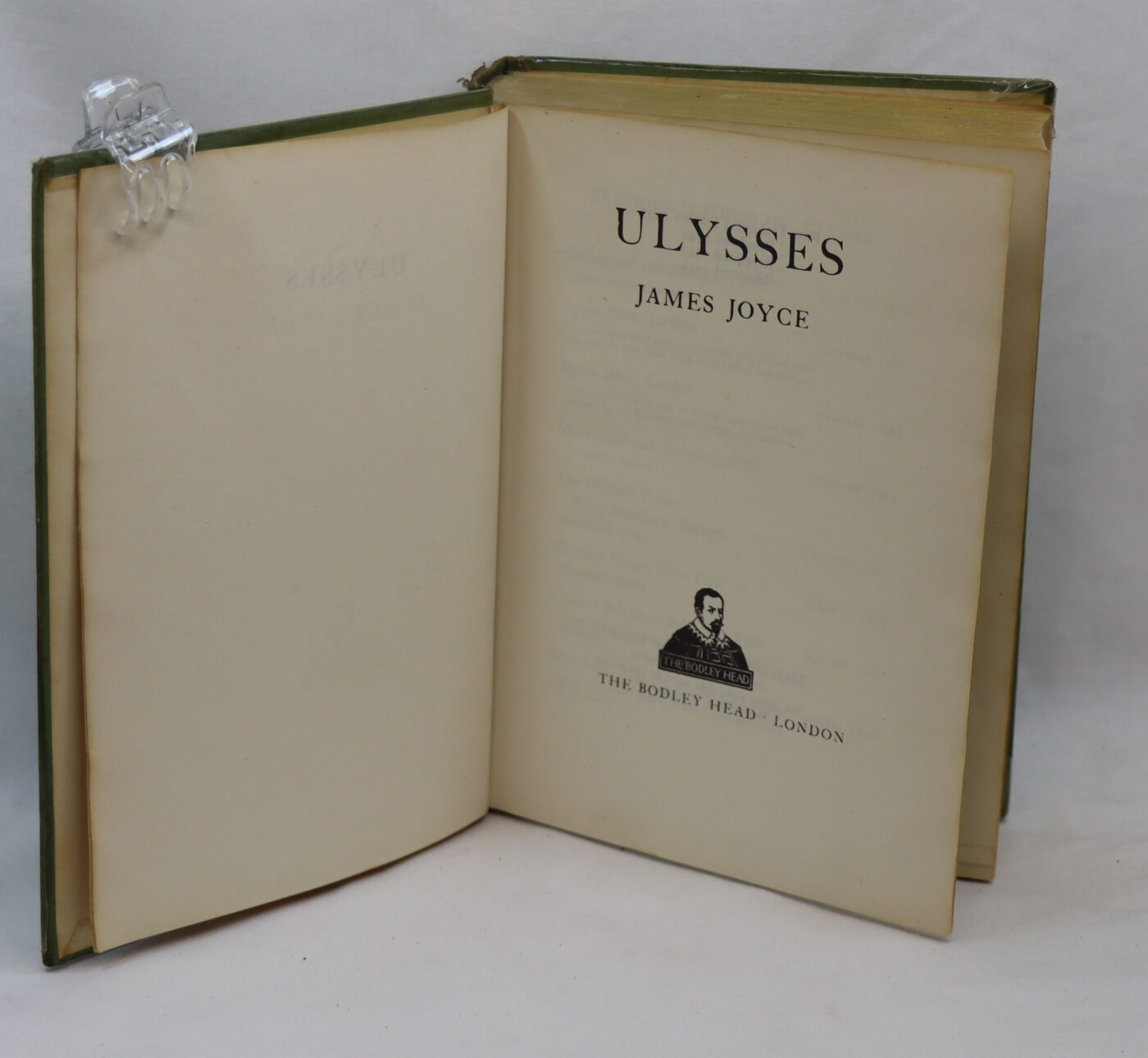
Ulysses.
By James Joyce
Printed: 1949
Publisher: The Bodley Head. London
| Dimensions | 16 × 21 × 4 cm |
|---|---|
| Language |
Language: English
Size (cminches): 16 x 21 x 4
Condition: Good (See explanation of ratings)
£174.00
FREE shipping
Buy Now

Item information
Description
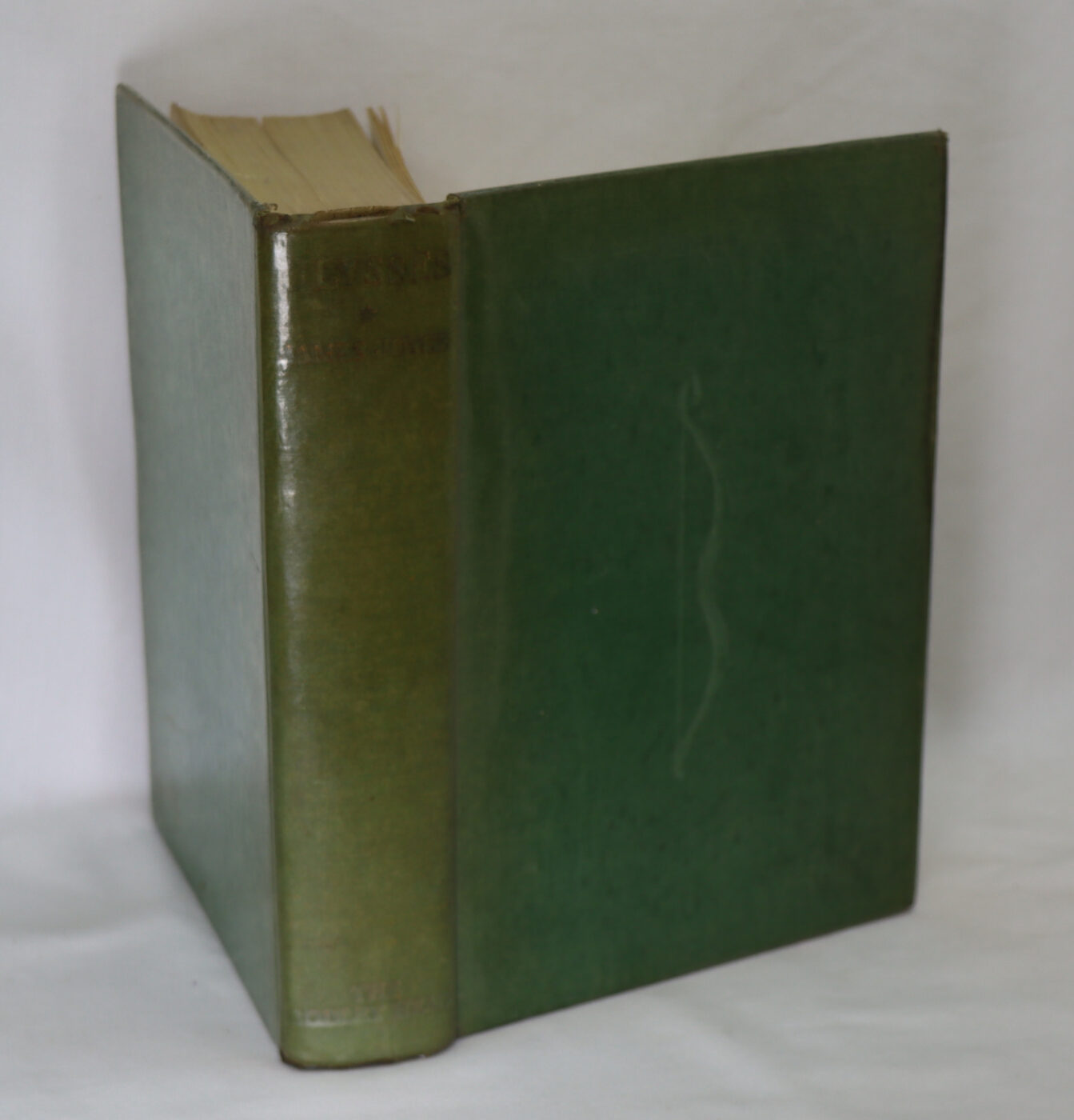
Green cloth binding with gilt title on the spine.
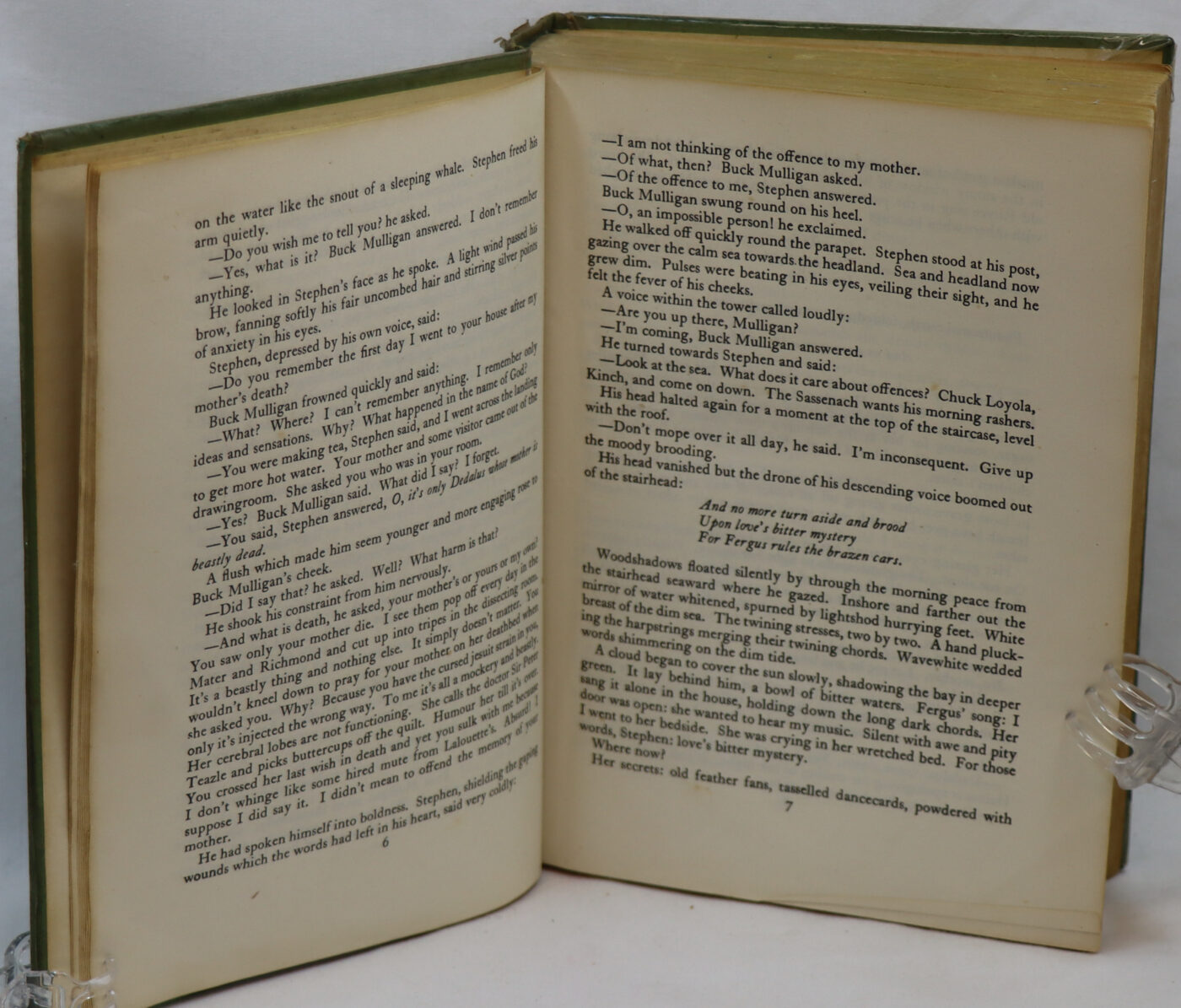
We provide an in-depth photographic presentation of this item to stimulate your feeling and touch. More traditional book descriptions are immediately available.
-
Note: This book carries a £5.00 discount to those that subscribe to the F.B.A. mailing list
This quality copy was purchased by Jack Lang’s father via a library sale. Despite being from a library sale, this edition is a very pleasing copy. Please view our extensive photographs.
Ulysses is a modernist novel by the Irish writer James Joyce. Partially serialised in the American journal The Little Review from March 1918 to December 1920, the entire work was published in Paris by Sylvia Beach on 2 February 1922, Joyce’s fortieth birthday. It is considered one of the most important works of modernist literature and a classic of the genre, having been called “a demonstration and summation of the entire movement”.
Ulysses chronicles the experiences of three Dubliners over the course of a single day, 16 June 1904 (which its fans now celebrate annually as Bloomsday). Ulysses is the Latinised name of Odysseus, the hero of Homer’s epic poem the Odyssey, and the novel establishes a series of parallels between Leopold Bloom and Odysseus, Molly Bloom and Penelope, and Stephen Dedalus and Telemachus. There are also correspondences with William Shakespeare’s play Hamlet and with other literary, religious, and mythological figures, including Jesus, Elijah, Moses, Dante Alighieri and Don Juan. Such themes as antisemitism, human sexuality, British rule in Ireland, Catholicism and Irish nationalism are treated in the context of early-20th-century Dublin. It is highly allusive and written in a variety of styles.
The writer Djuna Barnes quoted Joyce as saying, “The pity is … the public will demand and find a moral in my book—or worse they may take it in some more serious way, and in the honour of a gentleman, there is not one single serious line in it. … In Ulysses I have recorded, simultaneously, what a man says, sees, thinks, and what such seeing, thinking, saying does, to what you Freudians call the subconscious.”
According to the writer Declan Kiberd, “Before Joyce, no writer of fiction had so foregrounded the process of thinking”. Its stream of consciousness technique, careful structuring and prose of an experimental nature—replete with puns, parodies, epiphanies and allusions—as well as its rich characterisation and broad humour have led it to be regarded as one of the greatest literary works. Since its publication it has attracted controversy and scrutiny, ranging from an obscenity trial in the United States in 1921 to protracted disputes about the authoritative version of the text.
Background: Joyce first encountered the figure of Odysseus/Ulysses in Charles Lamb’s Adventures of Ulysses, an adaptation of the Odyssey for children, which seems to have established the Latin name in Joyce’s mind. At school he wrote an essay on the character, titled “My Favourite Hero”. Joyce told Frank Budgen that he considered Ulysses the only all-round character in literature. He considered writing another short story for Dubliners, to be titled “Ulysses” and based on a Jewish Dubliner named Alfred H. Hunter, a putative cuckold. The idea grew from a story in 1906, to a “short book” in 1907, to the vast novel he began in 1914.
James Augustine Aloysius Joyce (born James Augusta Joyce; 2 February 1882 – 13 January 1941) was an Irish novelist, poet, and literary critic. He contributed to the modernist movement and is regarded among the most influential and important writers of the 20th century. Joyce’s novel Ulysses (1922) is a landmark in which the episodes of Homer’s Odyssey are paralleled in a variety of literary styles, particularly stream of consciousness. His other well-known works include the short-story collection Dubliners (1914) and the novels A Portrait of the Artist as a Young Man (1916) and Finnegans Wake (1939). His other writings include two books of poetry, a play, correspondence, and occasional journalism.
Born in Dublin into a middle-class family, Joyce attended the Jesuit Clongowes Wood College in County Kildare, then, briefly, the Christian Brothers–run O’Connell School. Despite the chaotic family life imposed by his father’s unpredictable finances, he excelled at the Jesuit Belvedere College and graduated from University College Dublin in 1902. In 1904, he met his future wife, Nora Barnacle, and they moved to mainland Europe. He briefly worked in Pola (now in Croatia) and then moved to Trieste in Austria-Hungary, working as an English instructor. Except for an eight-month stay in Rome working as a correspondence clerk and three visits to Dublin, Joyce lived there until 1915. In Trieste, he published his book of poems Chamber Music and his short-story collection Dubliners, and began serially publishing A Portrait of the Artist as a Young Man in the English magazine The Egoist. During most of World War I, Joyce lived in Zurich, Switzerland, and worked on Ulysses. After the war, he briefly returned to Trieste and in 1920 moved to Paris, which was his primary residence until 1940.
Ulysses was first published in Paris in 1922, but its publication in the United Kingdom and the United States was prohibited owing to its perceived obscenity. Copies were smuggled into both countries and pirated versions were printed until the mid-1930s, when publication became legal. Ulysses frequently ranks high in lists of the greatest books, and academic literature analysing Joyce’s work is extensive and ongoing. Many writers, film-makers, and other artists have been influenced by his stylistic innovations, such as his meticulous attention to detail, use of interior monologue, wordplay, and the radical transformation of traditional plot and character development.
Though most of his adult life was spent abroad, his fictional universe centres on Dublin and is largely populated by characters who closely resemble family members, enemies and friends from his time there. Ulysses is set in the city’s streets and alleyways. Joyce is quoted as saying: “For myself, I always write about Dublin, because if I can get to the heart of Dublin I can get to the heart of all the cities of the world. In the particular is contained the universal.”
In 1923, Joyce started his next major work, Finnegans Wake. It was published in 1939. Between these years, he travelled widely. He and Nora were married in a civil ceremony in London in 1931. He made several trips to Switzerland, frequently seeking treatment for his increasingly severe eye problems and psychological help for his daughter, Lucia. When Germany occupied France during World War II, Joyce moved back to Zurich in 1940. He died there in 1941 after surgery for a perforated ulcer at age 58.
NOTE: This is an original book from the library gathered by the famous Cambridge Don, computer scientist, food and wine connoisseur, Jack Arnold LANG. Note: Jack founded the Michelin Guide ‘Midsummer House’- Cambridge’s paramount restaurant. This dining experience is hidden amongst the grassy pastures and grazing cattle of Midsummer Common and perched on the banks of the River Cam.
In 2008, Jack was one of the co-founders of the Raspberry Pi Foundation, alongside other members of the Department, and acted as the Foundation’s Chair. The project’s original goals were modest: to build and distribute low-cost computers for prospective applicants to our Computer Science degree. Initially the project was a “success disaster”, as Jack would say, as demand far outstripped the low-scale manufacturing plans. Ultimately the Raspberry Pi became the UK’s most successful computer with more than 60 million sold to date. Jack was drawn to the educational possibilities of the Raspberry Pi, its potential uses in emerging economies and the way it could support self-directed learning.
Condition notes
ex library
Want to know more about this item?
We are happy to answer any questions you may have about this item. In addition, it is also possible to request more photographs if there is something specific you want illustrated.
Ask a question
Related products

Share this Page with a friend
