
Delacroix.
By Phoebe Pool
Printed: 1969
Publisher: Paul Hamlyn. London
| Dimensions | 24 × 27 × 1 cm |
|---|---|
| Language |
Language: English
Size (cminches): 24 x 27 x 1
Condition: Good (See explanation of ratings)
£15.00
Buy Now
Your items

Item information
Description
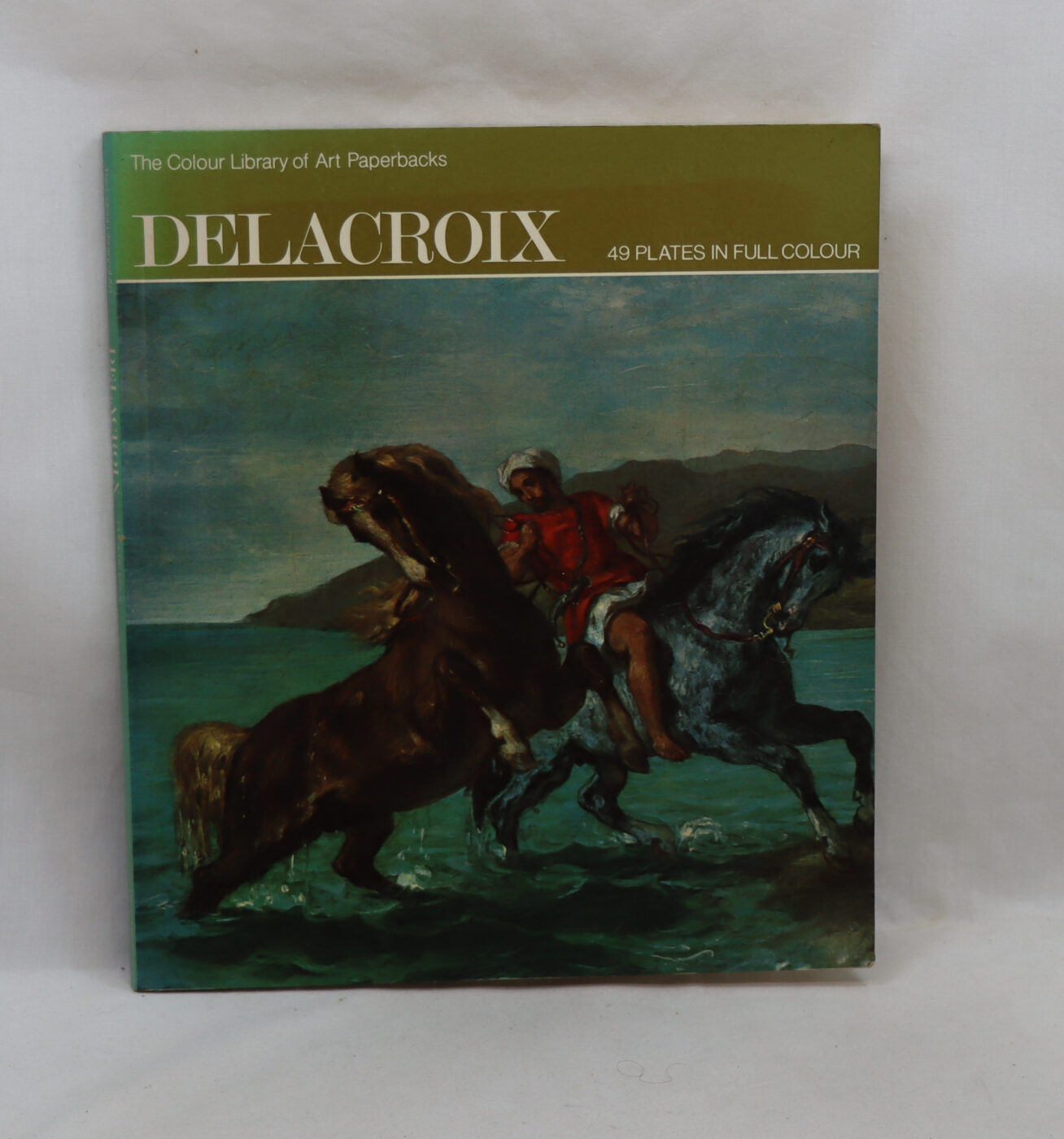
Paperback. Horses painting on the cover with white title.
We provide an in-depth photographic presentation of this item to stimulate your feeling and touch. More traditional book descriptions are immediately available.
- Note: This book carries a £5.00 discount to those that subscribe to the F.B.A. mailing list
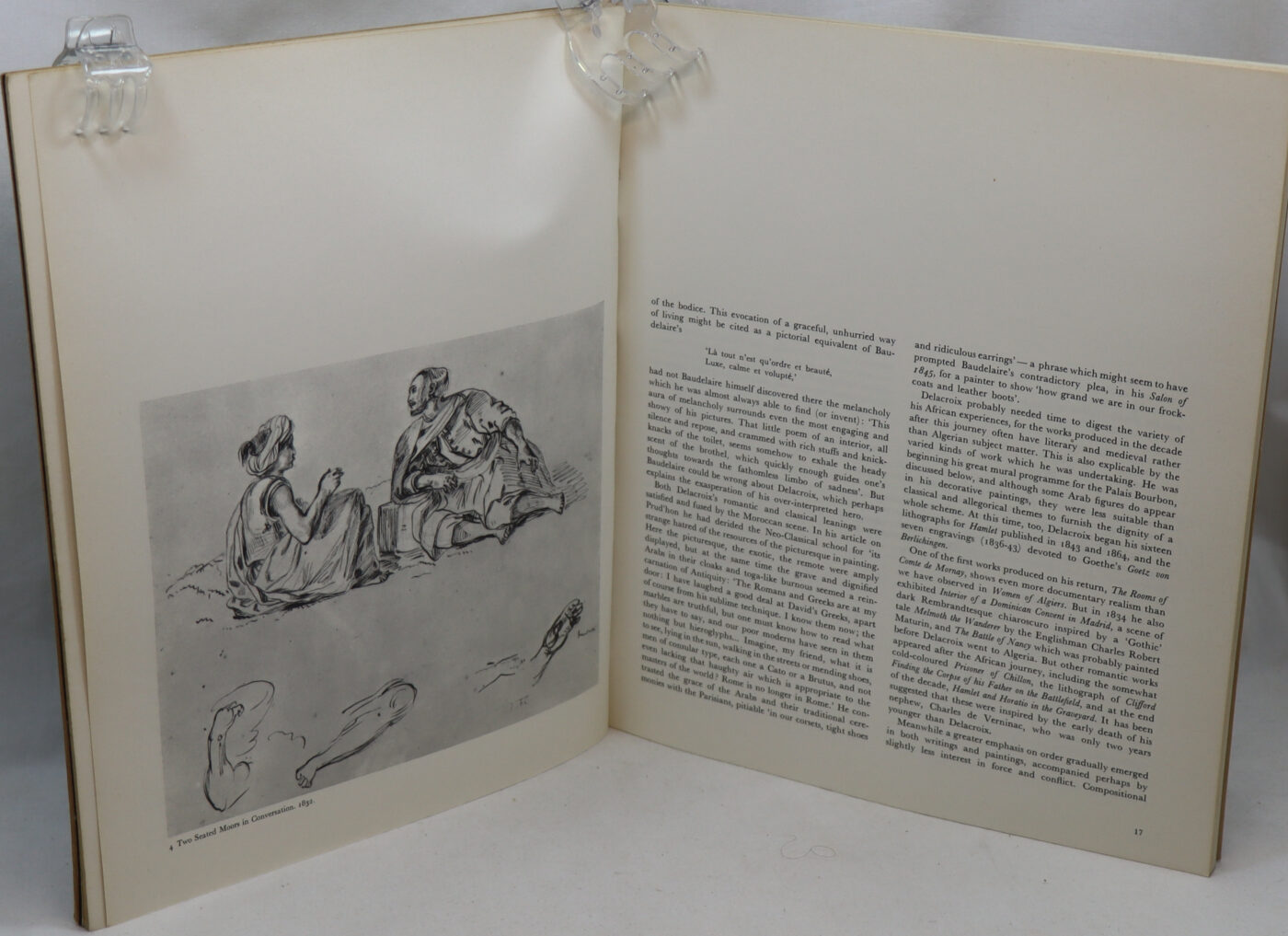
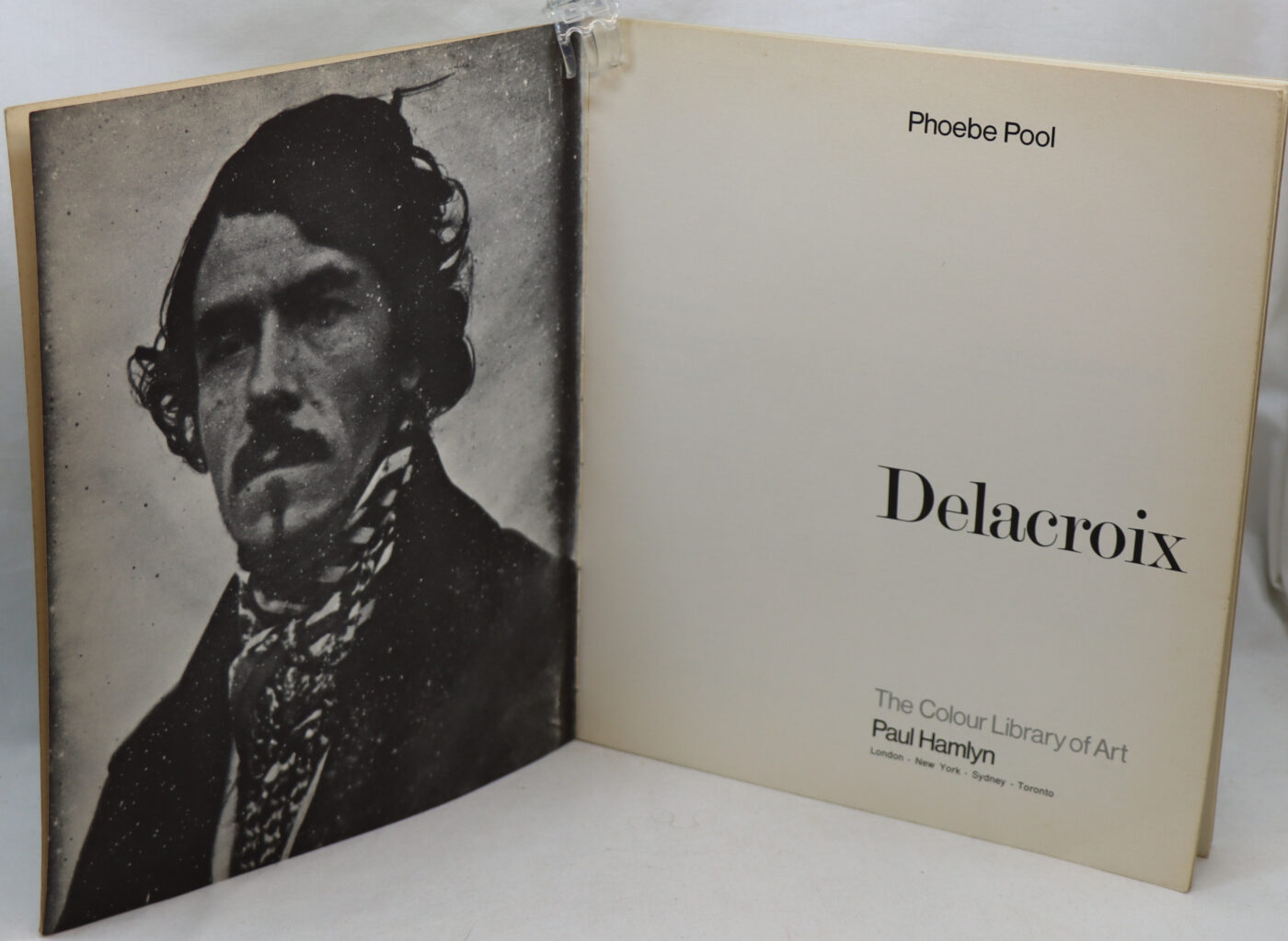
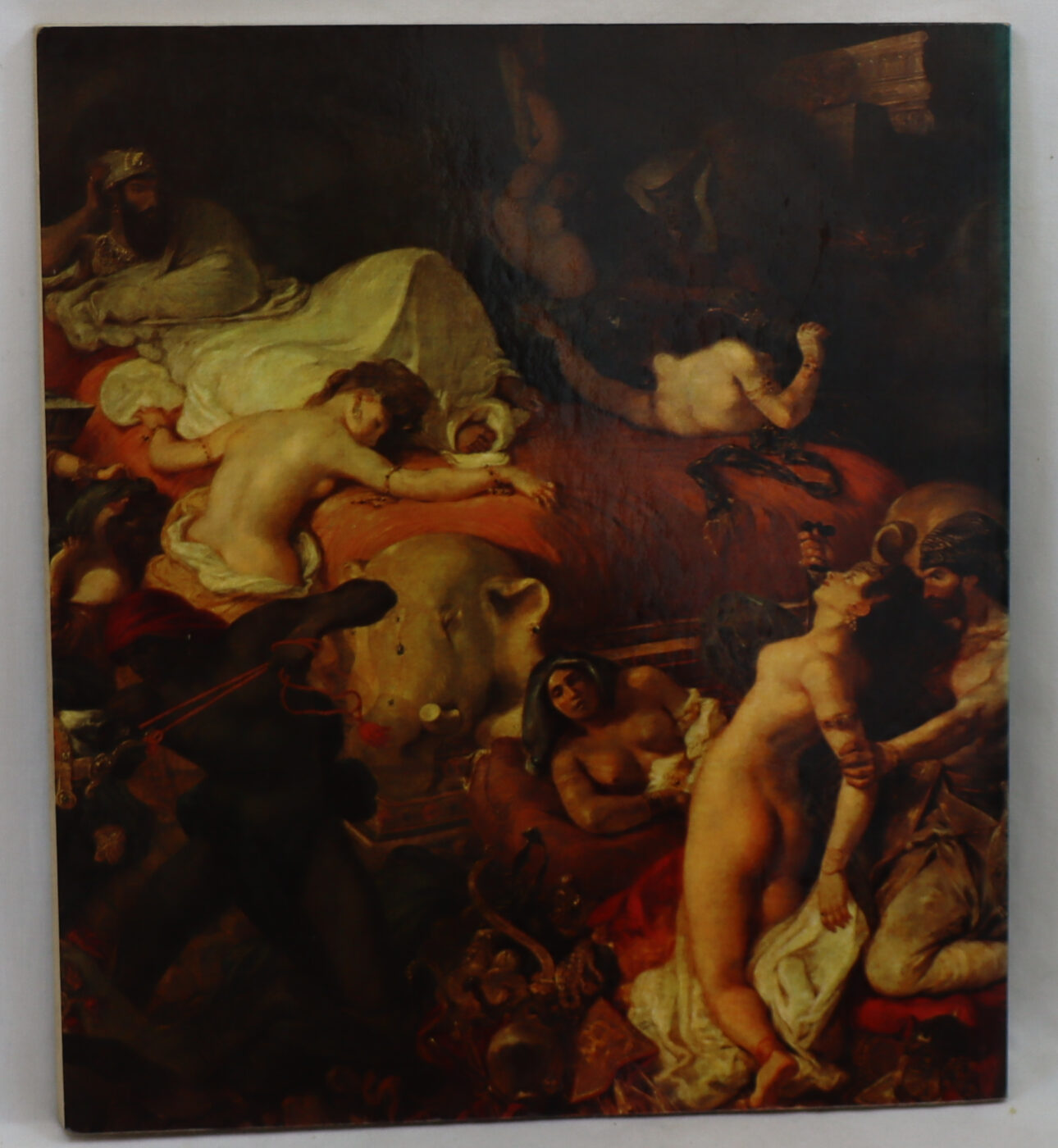
This book on Delacroix, 1798-1863, one of the Hamlyn ‘Colour Library of Art’ series, was first published in 1969 and reprinted in 1985. It contains 5 b/w illustrations, including a n 1842 daguerreotype of the artist, and 49 colour plate reproductions. Textural comments are very clearly related to the relevant reproduction.
The art historian, Phoebe Pool, 1913-71, has written an informative Introduction, that obviously lacks the benefit of the last 4 decades’ scholarship, and the book contains a Biographical Outline and brief excerpts from Delacroix’s Writings on Art [including his comments on Colour, shadow and reflection; Classicism; Poussin; ‘The Last Judgement’ in the Sistine Chapel; Rembrandt; Rubens; Raphael; Titian; English Artists and Edgar Allan Poe] and a somewhat longer text from Baudelaire’s Comments on Delacroix.
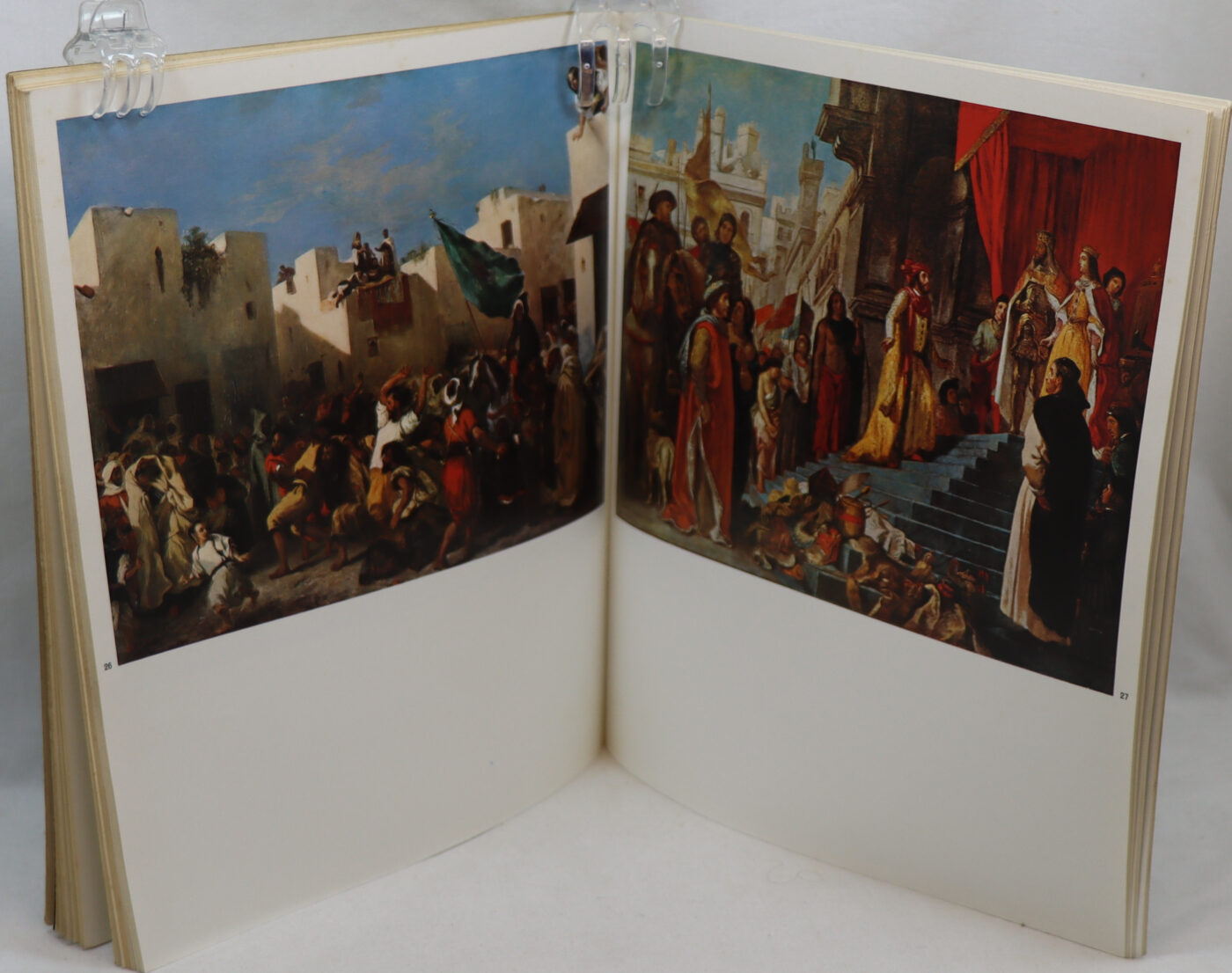
The illustrations and the colour plates are accompanied by brief but informative commentaries that are printed sequentially rather than one accompanying each individual work. The reproduction on the front cover and the front jacket is “Moroccan Caid Visiting a Tribe”, 1837. The selected works are varied and include historical canvases, mural allegories, a seascape, North African scenes, portraits, a still life and animal studies.
The Introduction opens with the sentence ‘Eugène Delacroix was one of those painters like Gauguin whose impact on history was probably greater than their actual artistic achievement.’ Pool points out that not only was Delacroix’s influence on 19th-century Romanticism very significant but the artist’s explorations of the use of colour and light fed into the experimentations of both the Impressionists and later Abstract artists. Even more than the harmony of his painting, Pool considers that was the artist’s ability to capture tremendous excitement and vitality that spoke to later artists.
Amongst the familiar works are “The Barque of Dante”, 1822, the artist’s first Salon painting; “The Massacre of Chios”, 1824, which was poorly received when first shown; “The Death of Sardanapalus”, which includes his most famous nudes and marks the point at which the artist turned towards cooler tones, “Woman with a Parrot”, an odalisque, and “Greece Expiring on the Ruins of Missolonghi”, all 1827; “Liberty Leading the People”, 1830, inspired by the July Revolution in Paris; “Women of Algiers”, 1834, one of the artist’s few scenes without conflict and bloodshed; “Self-Portrait”, c. 1835-37, a painting that the artist kept all his life; “Jewish Wedding in Morocco”, 1837-41, a commission rejected because of its price and motif, and in which one scholar noted ‘a prelude to the geometric construction of Mondrian’; “The Fanatics of Tangier”, 1836-38;“Portrait of George Sand” and “Portrait of Frédéric Chopin”, both 1838; “The Sultan of Morocco Surrounded by his Court”, 1845; “The Lion Hunt”, 1855; “Horses Emerging from the Sea”, 1860, a souvenir of the artist’s visit to Africa three decades earlier, and “Jacob Wrestling with the Angel”, 1856-61, seen by some commentators as symbolic of Delacroix’s artistic struggles
Less familiar are the murals, such as “Orpheus Bringing the Arts of Peace to the Primitive Greeks”, 1843-47, “Virgil Presenting Dante to Homer”, 1845-47, “The Triumph of Apollo”, 1850-51, and “Peace Descends to the Earth Bringing Abundance”, 1852. The earliest works are “Delacroix and his Friends on New Year’s Eve”, a drawing from 1817, and “Portrait of Elizabeth Salter”, c. 1818, which borrows from Ingres. There is one still life, “Study of Fruit and Flowers”, 1848, and a ravishing seascape, “The Sea at Dieppe”, 1852, that anticipates the Impressionists’ handling of light and atmosphere.
Pool’s text is considerably more scholarly than those in other early [1960s/1970s] introductions and the colour reproduction is good. If up-to-date scholarship is not a priority and an inexpensive copy of this book is available then it would certainly be worth considering as an introduction to a very influential 19th-century artist.
NOTE: This is an original book from the library gathered by the famous Cambridge Don, computer scientist, food and wine connoisseur, Jack Arnold LANG. Note: Jack founded the Michelin Guide ‘Midsummer House’- Cambridge’s paramount restaurant. This dining experience is hidden amongst the grassy pastures and grazing cattle of Midsummer Common and perched on the banks of the River Cam.
In 2008, Jack was one of the co-founders of the Raspberry Pi Foundation, alongside other members of the Department, and acted as the Foundation’s Chair. The project’s original goals were modest: to build and distribute low-cost computers for prospective applicants to our Computer Science degree. Initially the project was a “success disaster”, as Jack would say, as demand far outstripped the low-scale manufacturing plans. Ultimately the Raspberry Pi became the UK’s most successful computer with more than 60 million sold to date. Jack was drawn to the educational possibilities of the Raspberry Pi, its potential uses in emerging economies and the way it could support self-directed learning.
Want to know more about this item?
We are happy to answer any questions you may have about this item. In addition, it is also possible to request more photographs if there is something specific you want illustrated.
Ask a question
Related products




Share this Page with a friend
