
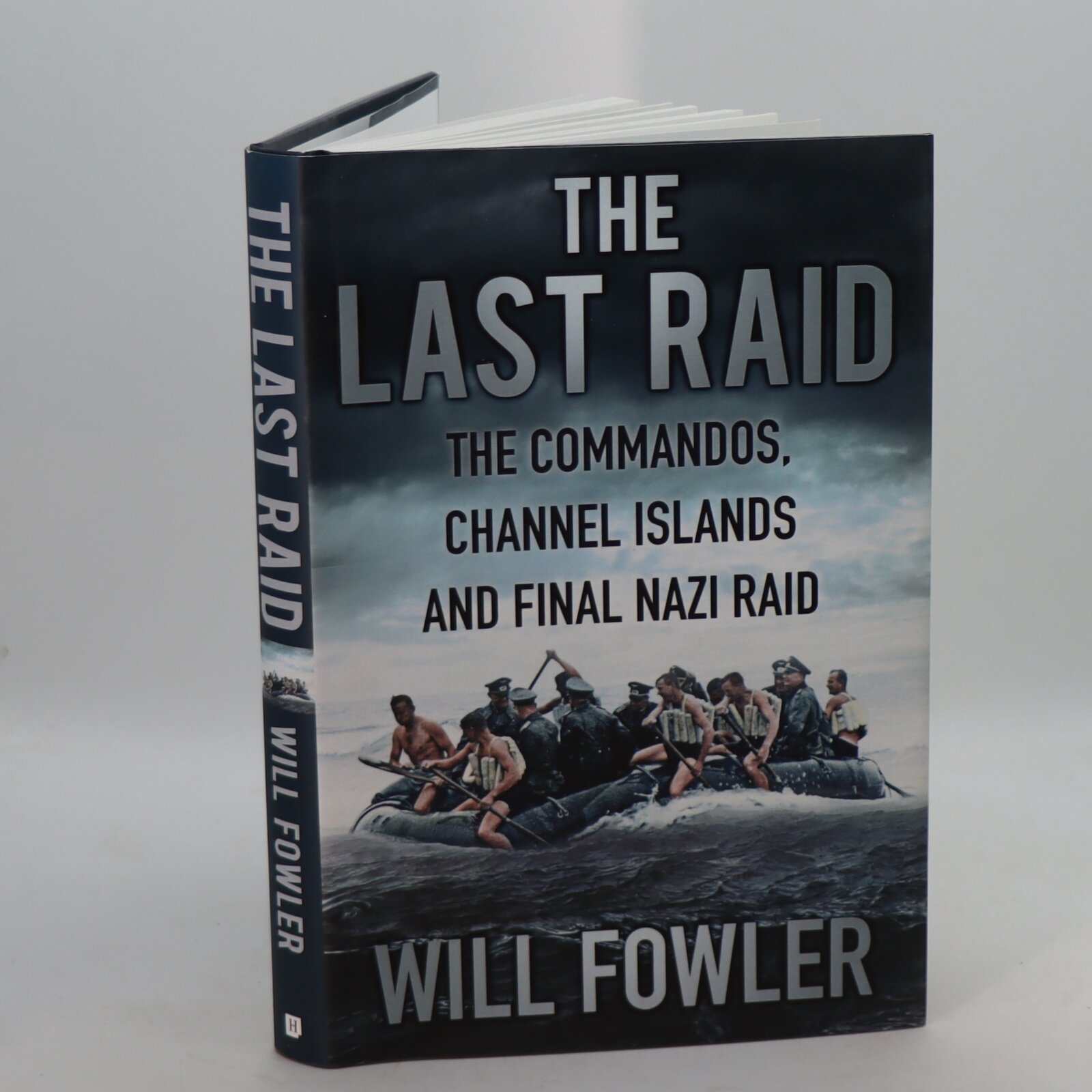
The Last Raid.
By Will Fowler
ISBN: 9780750968799
Printed: 2016
Publisher: The History Press. Stroud
| Dimensions | 17 × 24 × 3 cm |
|---|---|
| Language |
Language: English
Size (cminches): 17 x 24 x 3
Condition: Fine (See explanation of ratings)
£22.00
Buy Now

Item information
Description
In the original dust sheet. Black textured binding with gilt title on the spine.
F.B.A. provides an in-depth photographic presentation of this item to stimulate your feel and touch. More traditional book descriptions are immediately available.
Since the 20th century and World War II in particular, commandos have been set apart from other military units by virtue of their extreme training regimes; these are usually associated with the awarding of green berets which originated with British Commandos. The British Commandos were instrumental in founding many other international commando units during World War II. Some international commando units were formed from members who served as part of or alongside British Commandos, such as the Dutch Korps Commandotroepen (who still wear the recognition flash insignia of the British Fairbairn-Sykes Fighting Knife), the Belgian 5th Special Air Service, or Greek Sacred Band. In 1944 the SAS Brigade was formed from the British 1st and 2nd SAS, the French 3rd and 4th SAS, and the Belgian 5th SAS. The French Army special forces (1er RPIMa) still use the motto Qui Ose Gagne, a translation of the SAS motto “Who Dares Wins”.
In addition, many Commonwealth nations were part of the original British Commando units. They developed their own national traditions, including the Australian Special Air Service Regiment, the New Zealand Special Air Service, and the Rhodesian Special Air Service, all of whom share (or used to) the same insignia and motto as their British counterparts. During the Second World War, the British SAS quickly adopted sand-coloured berets, since they were almost entirely based in the North African theatre; they used these rather than green berets to distinguish themselves from other British Commando units. (See History of the Special Air Service). Other Commonwealth commando units were formed after the Second World War directly based on the British Commando units, such as the Australian Army Reserve 1st Commando Regiment (Australia), distinct from the Regular Army 2nd Commando Regiment (Australia), who originated from the 4th Battalion, Royal Australian Regiment in 1997 .
The US Rangers were founded by Major General Lucian Truscott of the US Army, a liaison officer with the British General Staff. In 1942, he submitted a proposal to General George Marshall that an American unit be set up “along the lines of the British Commandos”. The original US Rangers trained at the British Commandos centre at Achnacarry Castle. The US Navy SEALs’ original formation, the Observer Group, was also trained and influenced by British Commandos. The US Special Forces originated with the First Special Service Force, formed under British Combined Operations. The First Special Service Force was a joint American-Canadian unit and modern Canadian special operations forces also trace their lineage to this unit and through it to British Commandos, despite existing in their modern incarnation only since 2006.
Malaysian green beret special forces PASKAL and Grup Gerak Khas (who still wear the Blue Lanyard of the Royal Marines) were originally trained by British Commandos. The Brazilian marine special operations COMANF also originated with Royal Marines mentoring. Other British units, such as the SAS, led to the development of many international special operations units that are now typically referred to as commandos, including the Bangladeshi Para-Commando Brigade, Pakistani Special Services Group, the Indian MARCOS, Jordanian Special Operation Forces and Philippine National Police Special Action Force.
F.B.A. in its Artifacts section is pleased to host many items of Commando memorabilia
Want to know more about this item?
We are happy to answer any questions you may have about this item. In addition, it is also possible to request more photographs if there is something specific you want illustrated.
Ask a question
Related products

Share this Page with a friend
