
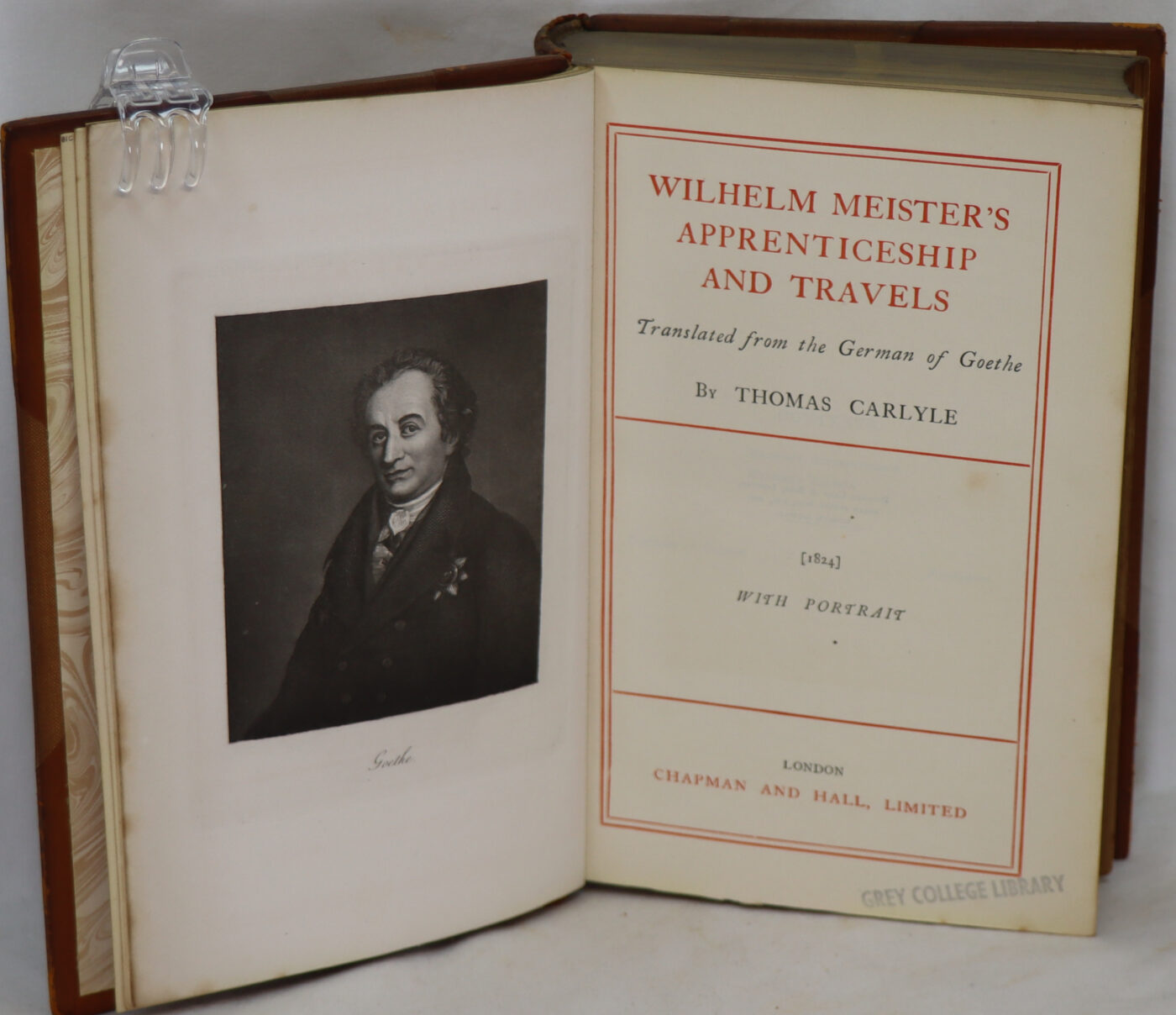
Wilhelm Meister's Apprenticeship and Travels.
By Thomas Carlyle
Printed: Circa 1910
Publisher: Chapman & Hall. London
Edition: The Standard edition
| Dimensions | 15 × 22 × 4 cm |
|---|---|
| Language |
Language: English
Size (cminches): 15 x 22 x 4
Condition: Very good (See explanation of ratings)
£88.00
Buy Now
Your items

Item information
Description
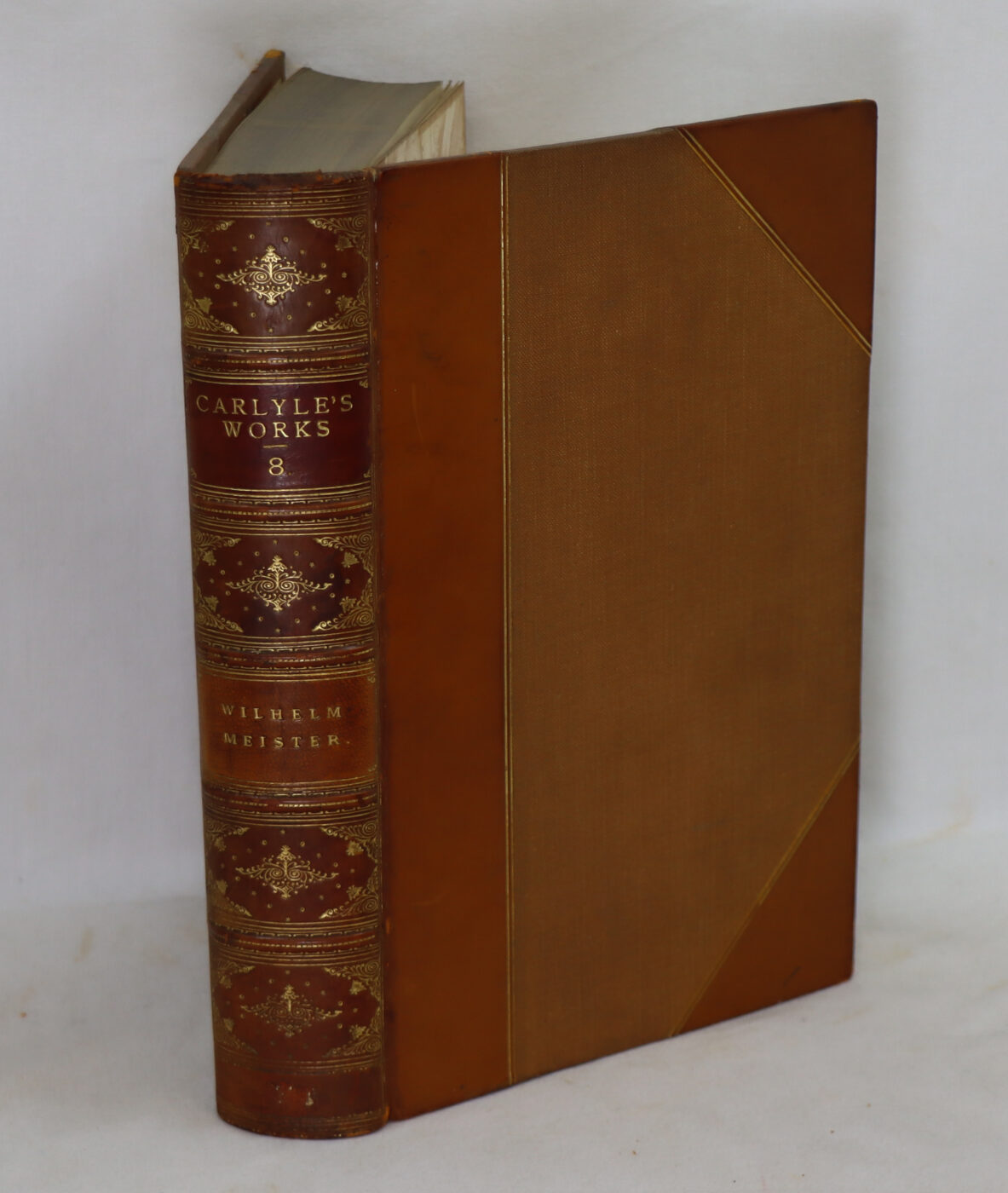
Tan calf spine with brown title plate, raised banding , gilt decoration and title. Tan cloth boards.
(Part of the Standard edition of 18 volumes). Bound by Bickers & Son. Leicester.
We provide an in-depth photographic presentation of this item to stimulate your feeling and touch. More traditional book descriptions are immediately available. For conditions, please view our photographs.
- Note: This book carries a £5.00 discount to those that subscribe to the F.B.A. mailing list
This truly is an important work which greatly impacted German society during the 18th and 19th centuries.
Wilhelm Meister’s – ‘Apprenticeship and Travels’
Translated from the German of Johann Wolfgang von Goethe By Thomas Carlyle
Wilhelm Meister’s Apprenticeship (German: Wilhelm Meisters Lehrjahre) is the second novel by Johann Wolfgang von Goethe, published in 1795–96.
Goethe’s work on the novel began in the 1770s. An early version of the work, unpublished during Goethe’s lifetime, was discovered in the early twentieth century, and published under the title Wilhelm Meister’s Theatrical Calling (Wilhelm Meisters theatralische Sendung). When the Apprenticeship was completed in the mid-1790s, it was to a great extent through the encouragement and criticism of Goethe’s close friend and collaborator Friedrich Schiller that it took its final shape. Wilhelm Meisters Wanderjahre (“Wilhelm Meister’s Journeyman Years”), the sequel to the Apprenticeship, was already planned in the 1790s, but did not appear in its first edition until 1821, and in its final form until 1829.
The novel has had a significant impact on European literature. Romantic critic and theorist Friedrich Schlegel judged it to be of comparable importance for its age as the French Revolution and the philosophy of Johann Gottlieb Fichte. Arthur Schopenhauer cited Wilhelm Meister’s Apprenticeship as one of the four greatest novels ever written. Schopenhauer also mentions the book in his Aphorismen zur Lebensweisheit.
Arguing against chasing transient pleasures, Schopenhauer says, “Where we were looking for pleasure, happiness and joy, we often find instruction, insight and knowledge, a lasting and real benefit in place of a fleeting one. This idea runs like a bass-note through Goethe’s Wilhelm Meister; for this is an intellectual novel and is of a higher order than the rest.”
Wilhelm Meister’s Apprenticeship provided the text for many lieder, among others by Beethoven, for example Sehnsucht: Gedicht von Goethe viermal in Musik gesetzt von L. van Beethoven, four settings of “Nur wer die Sehnsucht kennt”, WoO. 134 (1808), and by Schubert, for example D 877, Gesange aus Wilhelm Meister, Op. 62 (1826).
The 1866 opera Mignon by Ambroise Thomas is based on Wilhelm Meister’s Apprenticeship.
Thomas Carlyle (4 December 1795 – 5 February 1881) was a Scottish essayist, historian and philosopher. Known as the “sage of Chelsea”, his writings strongly influenced the intellectual and artistic culture of the Victorian era. Carlyle was born in Ecclefechan, a village in Dumfriesshire, Scotland. He attended the University of Edinburgh, where he excelled in mathematics and invented the Carlyle circle. After finishing the arts course he prepared to become a minister in the Burgher Church while working as a schoolmaster. He quit these and several other endeavours before settling on literature, writing for the Edinburgh Encyclopædia and working as a translator. He initially gained prominence in English-language literary circles for his extensive writing on German Romantic literature and philosophy. These themes were explored in his first major work, a semi-autobiographical philosophical novel entitled Sartor Resartus (1833–34).
Carlyle eventually relocated to London, where he published The French Revolution: A History (1837). Its popular success made him a celebrity, prompting the collection and reissue of his earlier essays under the title of Miscellanies. His subsequent works were highly regarded throughout Europe and North America, including On Heroes (1841), Past and Present (1843), Cromwell’s Letters (1845), Latter-Day Pamphlets (1850), and Frederick the Great (1858–65). He founded the London Library, helped to establish the National Portrait Galleries in London and in Edinburgh, became Lord Rector of the University of Edinburgh in 1865 and received the Pour le Mérite in 1874, amongst other honours.
Carlyle occupied a central position in Victorian culture, being considered the “undoubted head of English letters” and a “secular prophet”. Posthumously, a series of publications by his friend James Anthony Froude damaged Carlyle’s reputation, provoking controversy about his personal life and his marriage to Jane Welsh Carlyle in particular. His reputation further declined in the aftermaths of the First World War and the Second World War, when his philosophy was seen as a precursor of both Prussianism and fascism. Growing scholarship in the field of Carlyle studies since the 1950s has improved his standing, and although little-read today, he is yet recognised as “one of the enduring monuments of [English] literature”.[
Want to know more about this item?
We are happy to answer any questions you may have about this item. In addition, it is also possible to request more photographs if there is something specific you want illustrated.
Ask a question
Share this Page with a friend
