
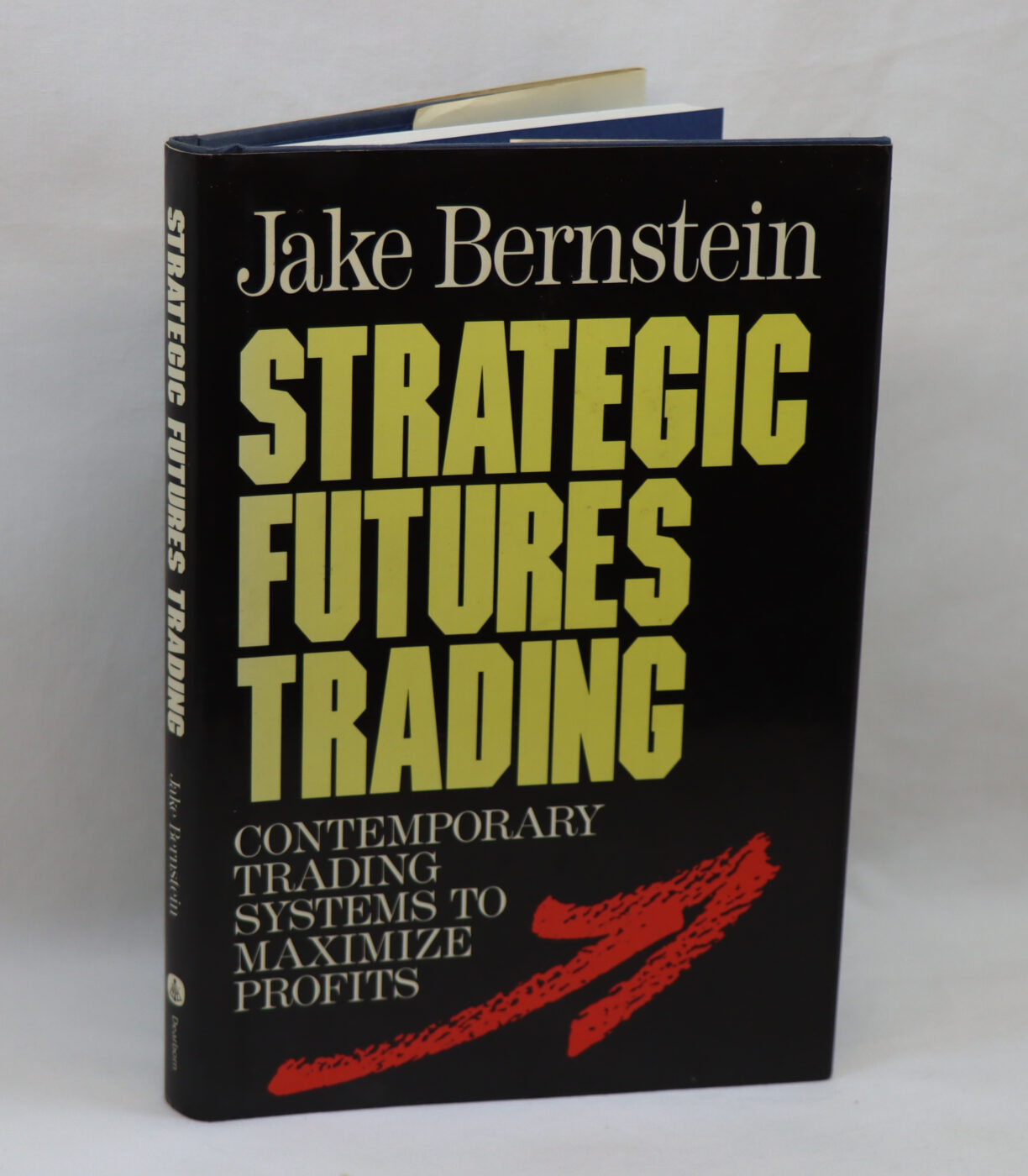
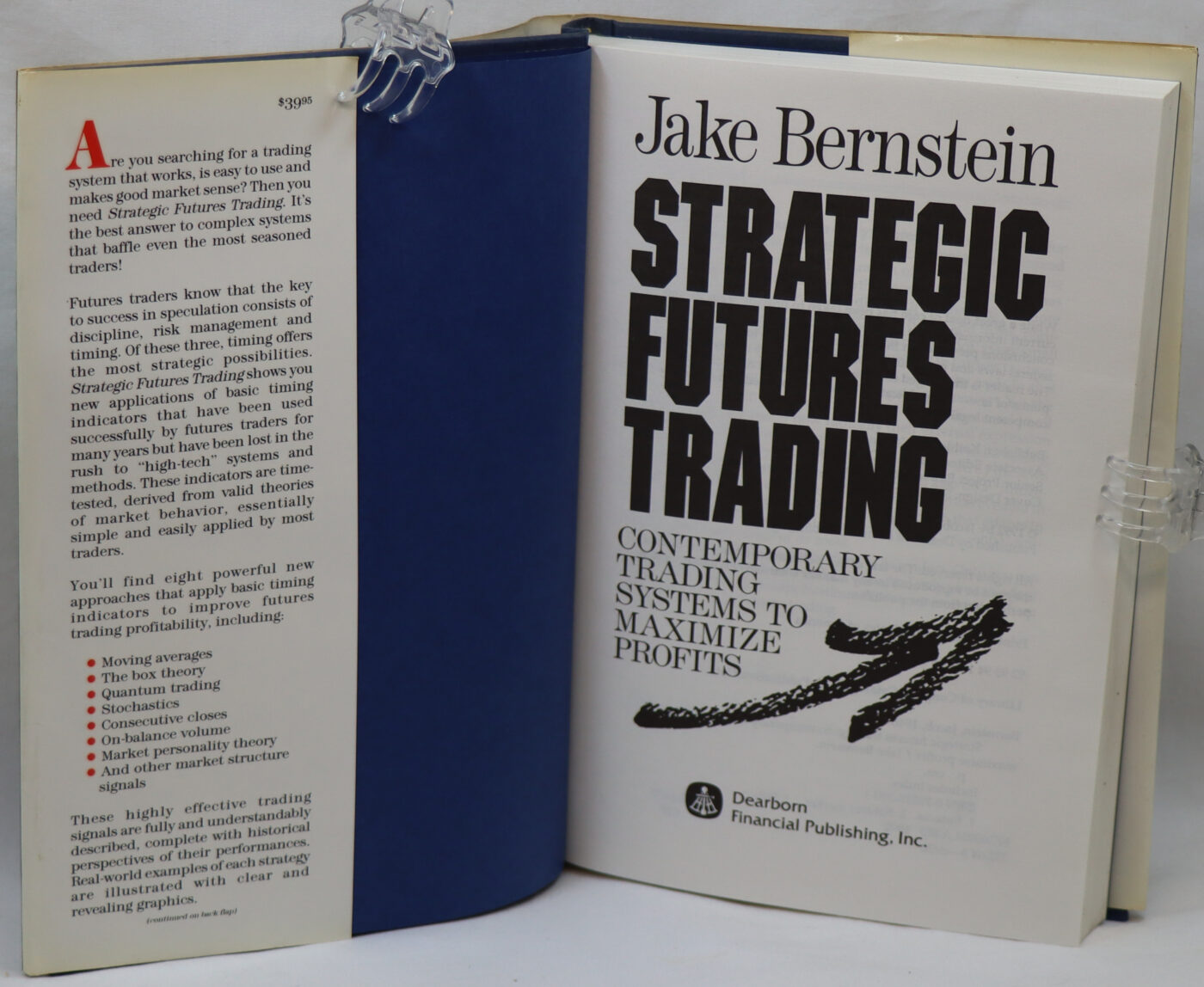
Strategic Futures Trading.
By Jake Bernstein
ISBN: 9780071663892
Printed: 1992
Publisher: Dearborn Finacial Publishing.
| Dimensions | 16 × 23 × 2 cm |
|---|---|
| Language |
Language: English
Size (cminches): 16 x 23 x 2
Condition: Very good (See explanation of ratings)
£41.00
Buy Now

Item information
Description
In the original dust jacket. Navy board binding with gilt title on the spine.
We provide an in-depth photographic presentation of this item to stimulate your feeling and touch. More traditional book descriptions are immediately available.
- Note: This book carries a £5.00 discount to those that subscribe to the F.B.A. mailing list
Strategic futures trading involves utilizing derivative contracts to speculate on price movements or hedge against market volatility, relying on leverage, disciplined risk management, and structured execution. It allows traders to capitalize on commodities, currencies, and indices while strictly managing the inherent risks associated with leveraged positions.
Core Methodologies
- Trend Following: Identifying and riding established market directions using technical tools like moving averages. It is typically a beginner-friendly strategy.
- Swing Point Breakouts: Entering positions when the price breaks above a recent swing high or falls below a recent swing low, utilizing indicators like ZigZag lines.
- Mean Reversion: Betting that asset prices will eventually return to their historical or statistical averages after an extreme deviation.
- Calendar Spreads: Simultaneously buying and selling the same underlying asset with different expiration dates to profit from the narrowing or widening of the price difference.
Risk Management Framework
Because futures use high leverage, a small adverse move can result in significant losses or margin calls. Implementing strict risk rules is mandatory:
- Position Sizing: Calculating risk per trade as a percentage of total trading capital (e.g., adhering to the 3-5-7 rule, which limits overall portfolio exposure).
- Stop-Loss Orders: Automatically exiting a losing trade at a predetermined price point to prevent catastrophic capital depletion.
- Risk-to-Reward Ratios: Aiming for profit targets that are a multiple of your initial risk (e.g., a \(\frac{1}{2}\) or \(\frac{1}{3}\) ratio).
Execution Styles
- Day Trading: Opening and closing all positions within the same trading day to avoid overnight margin requirements and exposure to overnight market gaps.
- Swing Trading: Holding contracts over several days or weeks to capture broader moves and macro-trends, which typically requires a larger margin footprint.
- Scalping: Making dozens of trades a day to capture minute price changes, often utilizing advanced charting and rapid execution.
For a visual breakdown of how various futures trading strategies stack up in terms of complexity and learning curve:
Advanced Futures Trading Strategies: 30 fully tested strategies for multiple trading styles and time frames by Robert Carver (Author)
In Advanced Futures Trading Strategies , Robert Carver provides a complete practical guide to 30 trading strategies for the futures markets.
The strategies cover more than 100 tradable instruments and draw on over 50 years of historic data, and are suitable for both discretionary and systematic traders. The strategies begin with the most basic, and progress to more advanced strategies, including trading calendar spreads, breakouts, trend following, fast mean reversion, and many more.
For each strategy, Robert describes:
– How and why it works.
– Detailed rules for putting the strategy into practice.
– Past performance from historical data.
– Historic strategy behaviour and risk.
And throughout the book, building up step by step, Robert explains other essential aspects of effective futures trading, including:
– How to properly calculate profits and assess performance.
– How to measure and forecast risk.
– How to calculate trading costs.
– The trading capital you need for specific futures instruments.
– How to decide which instrument to trade.
– Diversifying by using multiple strategies together.
And much, much more.
Advanced Futures Trading Strategies is the definitive practical guide to futures trading strategies. No one who intends to seriously trade futures can afford to be without it.
NOTE: This is an original book from the library gathered by the famous Cambridge Don, computer scientist, food and wine connoisseur, Jack Arnold LANG. Note: Jack founded the Michelin Guide ‘Midsummer House’- Cambridge’s paramount restaurant. This dining experience is hidden amongst the grassy pastures and grazing cattle of Midsummer Common and perched on the banks of the River Cam.
In 2008, Jack was one of the co-founders of the Raspberry Pi Foundation, alongside other members of the Department, and acted as the Foundation’s Chair. The project’s original goals were modest: to build and distribute low-cost computers for prospective applicants to our Computer Science degree. Initially the project was a “success disaster”, as Jack would say, as demand far outstripped the low-scale manufacturing plans. Ultimately the Raspberry Pi became the UK’s most successful computer with more than 60 million sold to date. Jack was drawn to the educational possibilities of the Raspberry Pi, its potential uses in emerging economies and the way it could support self-directed learning.
Want to know more about this item?
We are happy to answer any questions you may have about this item. In addition, it is also possible to request more photographs if there is something specific you want illustrated.
Ask a question
Related products






Share this Page with a friend
