
The War that Killed Achilles.
By Caroline Alexander
ISBN: 9781101148853
Printed: 2009
Publisher: Faber & Faber. London
| Dimensions | 12 × 20 × 2 cm |
|---|---|
| Language |
Language: English
Size (cminches): 12 x 20 x 2
Condition: Very good (See explanation of ratings)
£19.00
Buy Now
Your items

Item information
Description
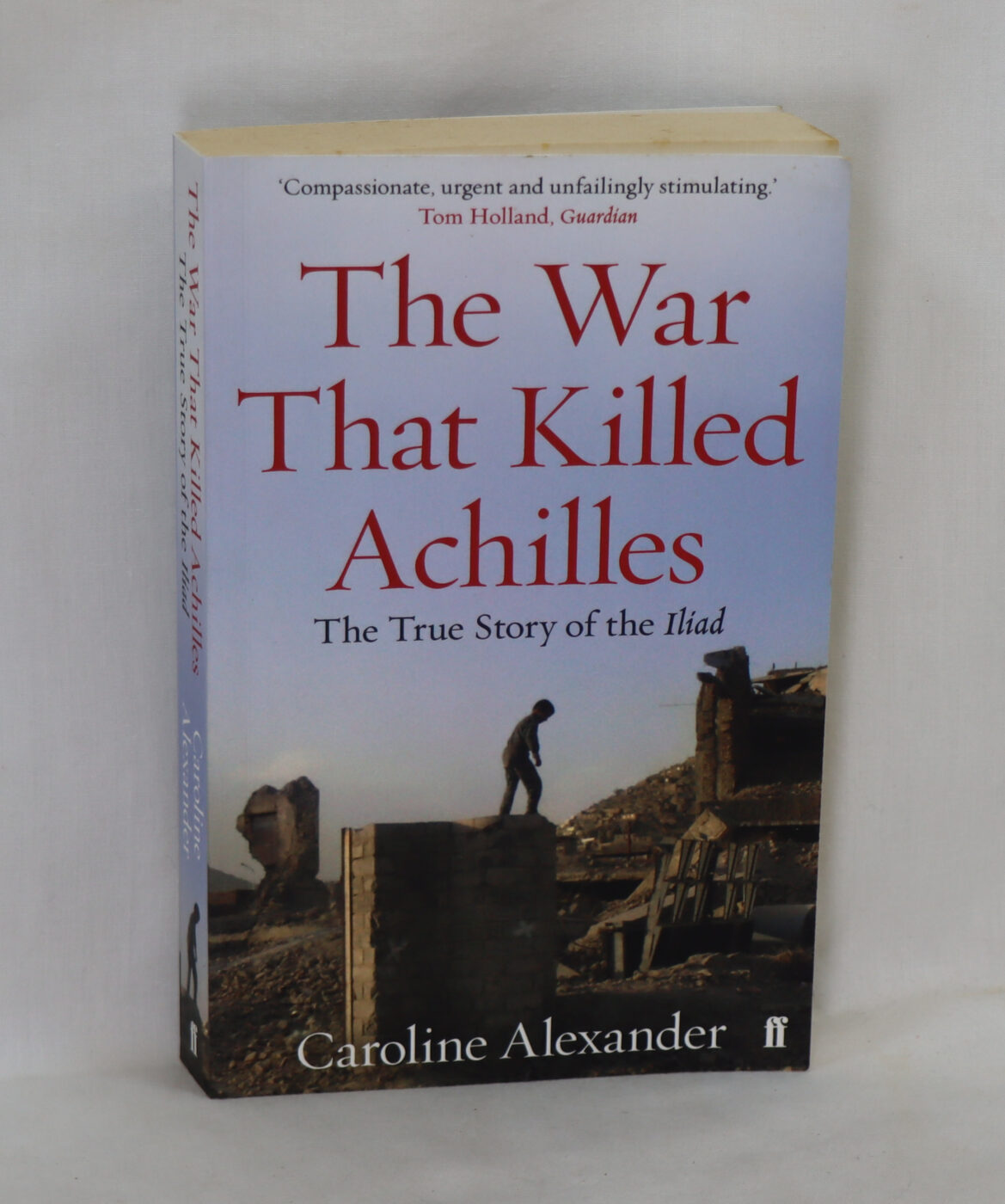
Paperback. White cover with red title.
We provide an in-depth photographic presentation of this item to stimulate your feeling and touch. More traditional book descriptions are immediately available
- Note: This book carries a £5.00 discount to those that subscribe to the F.B.A. mailing list
“Spectacular and constantly surprising.”-Ken Burns
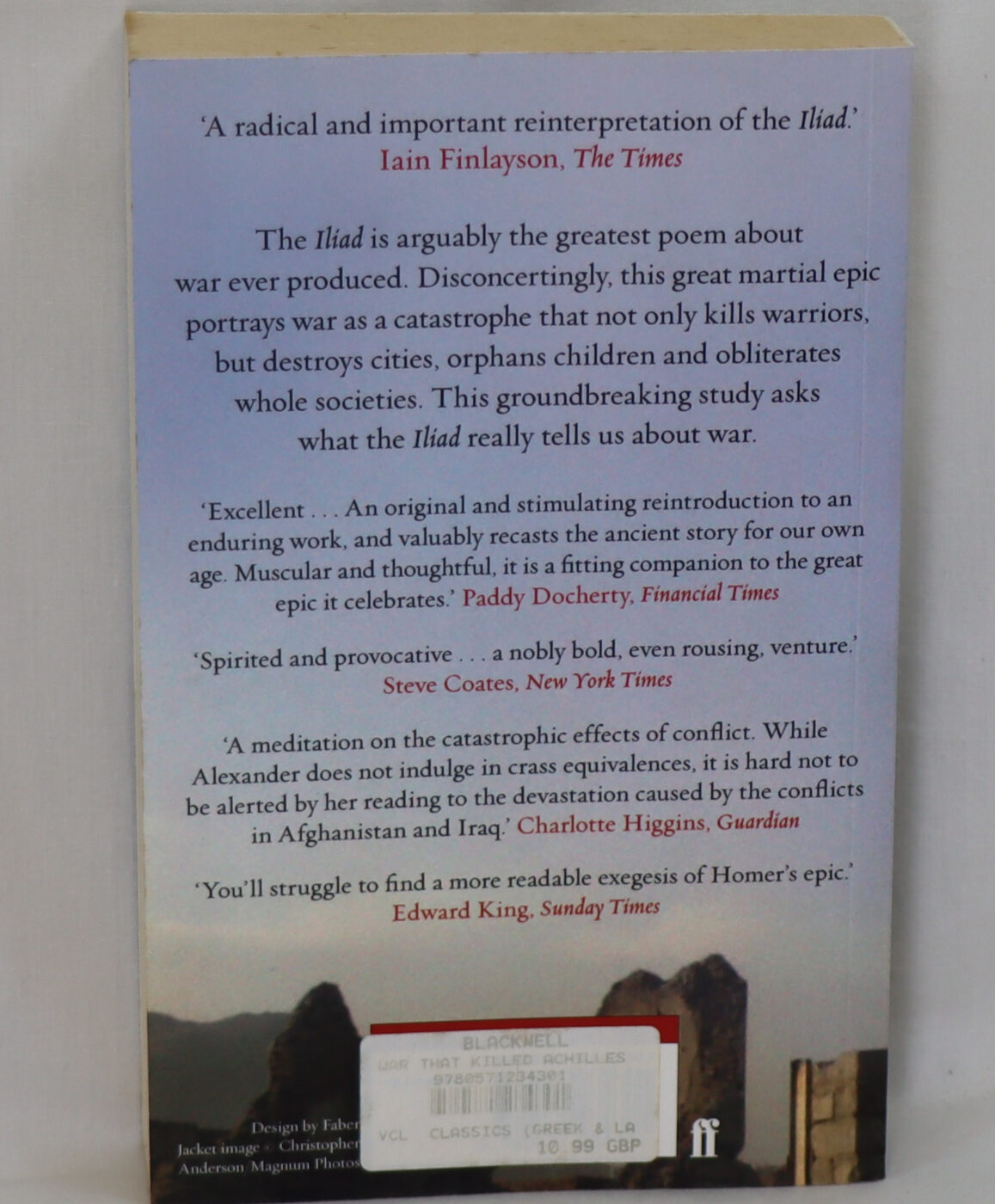
Written with the authority of a scholar and the vigor of a bestselling narrative historian, The War That Killed Achilles is a superb and utterly timely presentation of one of the timeless stories of Western civilization. As she did in The Endurance and The Bounty, New York Times bestselling author Caroline Alexander has taken apart a narrative we think we know and put it back together in a way that lets us see its true power. In the process, she reveals the intended theme of Homer’s masterwork-the tragic lessons of war and its enduring devastation.
Review: When I originally saw this volume, my first reaction was: ‘Oh, no! Not another book about Homer’s `Iliad’ …’ but the thematic pulse is as outlined on the inside of the front cover: ‘Caroline Alexander’s extraordinary book is not about any of the rational concerns that have occupied classicists for centuries. Its focus is both simpler and more radical’ […]; this book is about what the `Iliad’ says of war’.
Basically, it is a concordance to the `Iliad’, – specifically Richmond Lattimore’s well-loved 1951 translation. The clear lucid writing is good enough to make one ignore the American spellings, and Alexander’s apercus draws on both ancient and modern history as well as the textual sources. Although it’s traditionally said Homer was blind, from the visually intense descriptions running through the epic, and the images the poet employs, this is unlikely: the high price of `kleos’ (glory or immortal fame) is iterated and reiterated. Despite the Olympian gods overseeing the conflict at Troy, men die – ‘the mortality of the Homeric warrior is never compromised’ (p. 67), – bar the case of the Trojan Aineias (Virgil’s Aeneas) who, having suffered a severely dislocated hip in Book 5 is still battling on in Bk. 20, which is medically impossible. (Rome would have had to find itself another foundation myth if Homer had killed off Aeneas, but, interestingly, Alexander mentions recent research (2007) which found Etruscan DNA originating from Anatolia.)
There is a clear distinction between history and poetry: while the former describes what took place, the latter sees what might be expressed as events which are `sub specie aeternitatis’. The book rehabilitates the fictional character of Achilles, who has suffered at the hands of writers down the ages, e.g., Wm. Shakespeare’s portrait depicted the Greek hero in an unflattering light – petulant and pathologically arrogant – but Alexander’s study is less of a two-dimensional cardboard cut-out. Like Homer, she teases out the real psychological impact of war and loss on human emotions, conscience and common decency. Her reading of Achilles, reflected in that of her hero, ‘demonstrates profound knowledge of the disposition of men’s souls, including his own’ (p. 210). One thing the work highlights is that scholarly classical research can detach one from human affairs, and in the places where Alexander sees the ‘Iliad’ in the light of other ME wars, Iraq, post-combat stress and total futility she manages to dent, if not actually deflate, some of the loftier academic Oxbridge views regarding Homer’s work.
The notes to the text are exhaustive, though never tedious (no small feat!) Despite the lack of a formal bibliography all the sources are well-documented, plus there is a comprehensive list of further recommended primary and secondary readings.
I was puzzled by Faber and Faber classifying it as a junior title and, having contacted the publishers’ editorial department, was informed the categorization’s the result of a system error which was proving difficult to erase. The book’s aimed at adults and was never intended as a children’s book, although Amazon list the title in their current 40% reduction in children’s section. … How on earth did F&F make an error like this?! However, ‘The War that Killed Achilles’ is an exceptional book, and definitely one for the Homeric shelf.
Caroline Alexander was born in Florida, of British parents and has lived in Europe, Africa and the Caribbean. She studied philosophy and theology at Oxford as a Rhodes scholar and has a doctorate in classics from Columbia University. She is the author of the best-selling The Endurance: Shackleton’s Legendary Antarctic Expedition which has been translated into thirteen languages. She writes frequently for The New Yorker and National Geographic, and she is the author of four other books, including Mrs Chippy’s Last Expedition, the journal of the Endurance’s ship’s cat.
NOTE: This is an original book from the library gathered by the famous Cambridge Don, computer scientist, food and wine connoisseur, Jack Arnold LANG. Note: Jack founded the Michelin Guide ‘Midsummer House’- Cambridge’s paramount restaurant. This dining experience is hidden amongst the grassy pastures and grazing cattle of Midsummer Common and perched on the banks of the River Cam. The Midsummer House experience is imaginatively curated to delight and amaze, so the surprise set menu changes regularly and is ‘Midsummer’s’ playground to showcase.
In 2008, Jack was one of the co-founders of the Raspberry Pi Foundation, alongside other members of the Department, and acted as the Foundation’s Chair. The project’s original goals were modest: to build and distribute low-cost computers for prospective applicants to our Computer Science degree. Initially the project was a “success disaster”, as Jack would say, as demand far outstripped the low-scale manufacturing plans. Ultimately the Raspberry Pi became the UK’s most successful computer with more than 60 million sold to date. Jack was drawn to the educational possibilities of the Raspberry Pi, its potential uses in emerging economies and the way it could support self-directed learning.
Want to know more about this item?
We are happy to answer any questions you may have about this item. In addition, it is also possible to request more photographs if there is something specific you want illustrated.
Ask a question
Related products




Share this Page with a friend
