
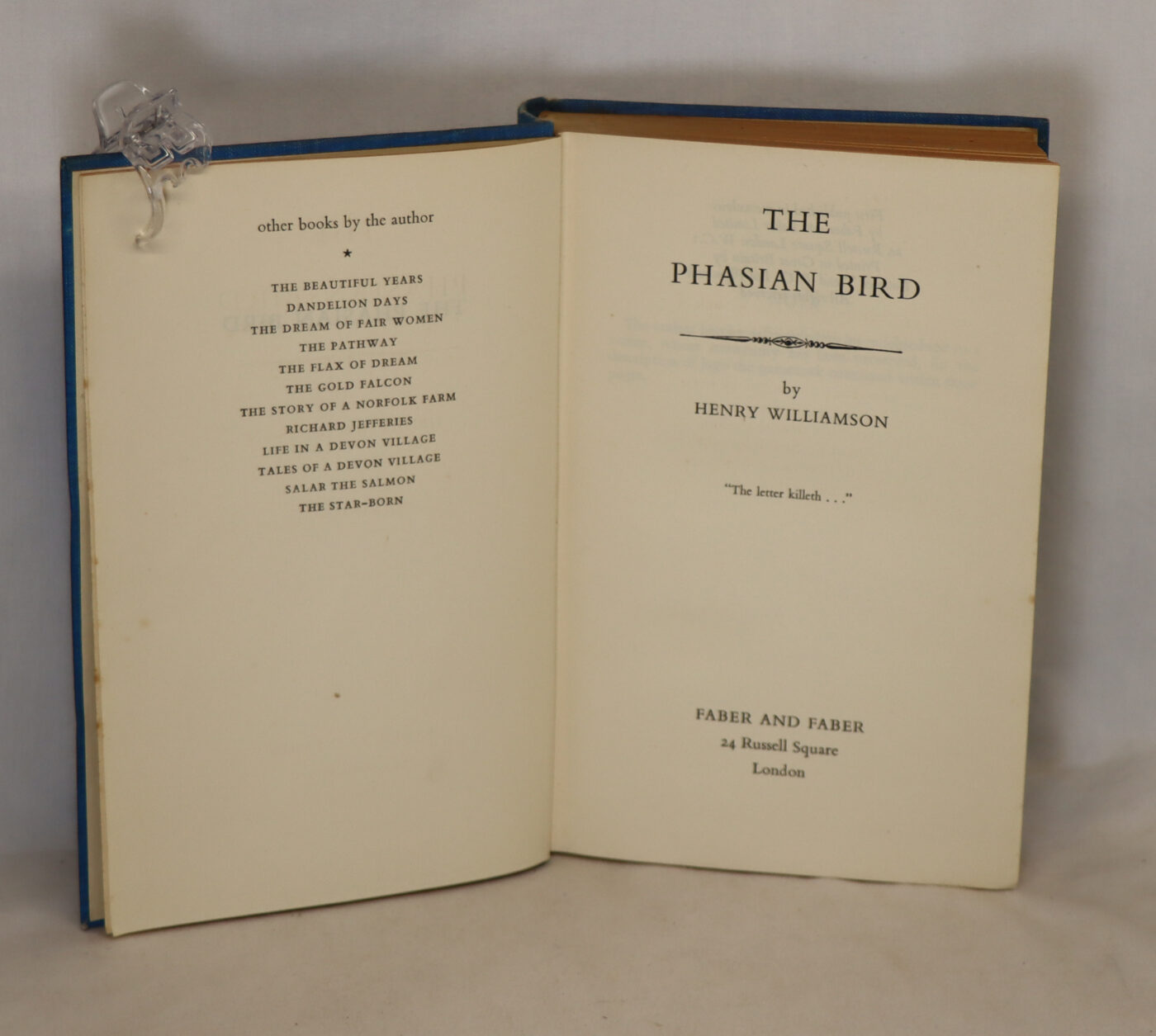
The Phasian Bird.
By Henry Williamson
Printed: 1948
Publisher: Faber & Faber. London
| Dimensions | 17 × 19 × 2 cm |
|---|---|
| Language |
Language: English
Size (cminches): 17 x 19 x 2
Condition: Good (See explanation of ratings)
£18.00
Buy Now


Item information
Description
Blue cloth binding with gilt title on the spine.
We provide an in-depth photographic presentation of this item to stimulate your feeling and touch. More traditional book descriptions are immediately available
- Note: This book carries a £5.00 discount to those that subscribe to the F.B.A. mailing list
The Phasian Bird is a 1948 novel by the English writer Henry Williamson. Set in Norfolk during World War II, the novel interweaves the stories of a hybrid pheasant and an artist-turned-farmer who experiments with new cultivation methods. Kirkus Reviews wrote that “Mr. Williamson writes knowingly but without any particular stimulation and his story rarely comes to life”. Nature wrote that Williamson used his “well-known vivid style” in “a picture of endless effort to cultivate the stern land, of despair and bitter frustration, of endurance and grim determination that win through”.
Review: I knew Henry Williamson, ever so slightly, I knew his son Richard better. This obviously is his Norfolk Farm, covered in his book, The Story of a Norfolk Farm. I have read a lot of Henry Williamson’s books and coming from the village where the Phasian bird was set I can assure you the book is very real.
Henry William Williamson (1 December 1895 – 13 August 1977) was an English writer who wrote novels concerned with wildlife, English social history, ruralism and the First World War. He was awarded the Hawthornden Prize for literature in 1928 for his book Tarka the Otter. He was born in London, and brought up in a semi-rural area where he developed his love of nature, and nature writing. He fought in the First World War and, having witnessed the Christmas truce and the devastation of trench warfare, he developed first a pacifist ideology, then fascist sympathies. He moved to Devon after the Second World War and took up farming and writing; he wrote many other novels. He married twice. He died in a hospice in Ealing in 1977, and was buried in North Devon.
NOTE: This is an original book from the library gathered by the famous Cambridge Don, computer scientist, food and wine connoisseur, Jack Arnold LANG. Note: Jack founded the Michelin Guide ‘Midsummer House’- Cambridge’s paramount restaurant. This dining experience is hidden amongst the grassy pastures and grazing cattle of Midsummer Common and perched on the banks of the River Cam.
In 2008, Jack was one of the co-founders of the Raspberry Pi Foundation, alongside other members of the Department, and acted as the Foundation’s Chair. The project’s original goals were modest: to build and distribute low-cost computers for prospective applicants to our Computer Science degree. Initially the project was a “success disaster”, as Jack would say, as demand far outstripped the low-scale manufacturing plans. Ultimately the Raspberry Pi became the UK’s most successful computer with more than 60 million sold to date. Jack was drawn to the educational possibilities of the Raspberry Pi, its potential uses in emerging economies and the way it could support self-directed learning.
Want to know more about this item?
We are happy to answer any questions you may have about this item. In addition, it is also possible to request more photographs if there is something specific you want illustrated.
Ask a question
Related products
Share this Page with a friend
