
Four Quartets. T S Eliot.
By T S Eliot
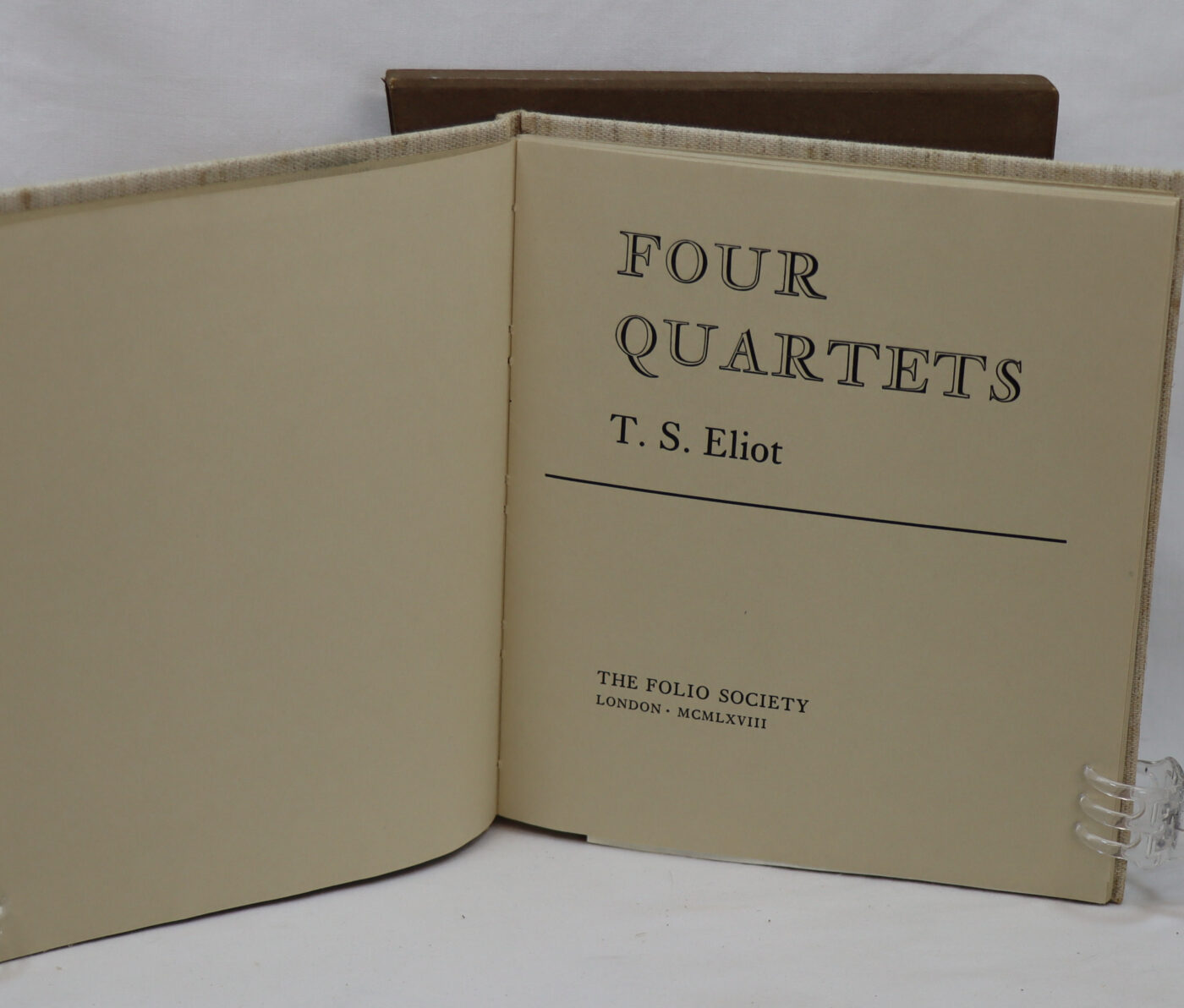
Printed: 1968
Publisher: Folio Books. London
| Dimensions | 17 × 20 × 1.5 cm |
|---|---|
| Language |
Language: English
Size (cminches): 17 x 20 x 1.5
Condition: Good (See explanation of ratings)
£84.00
Buy Now

Item information
Description
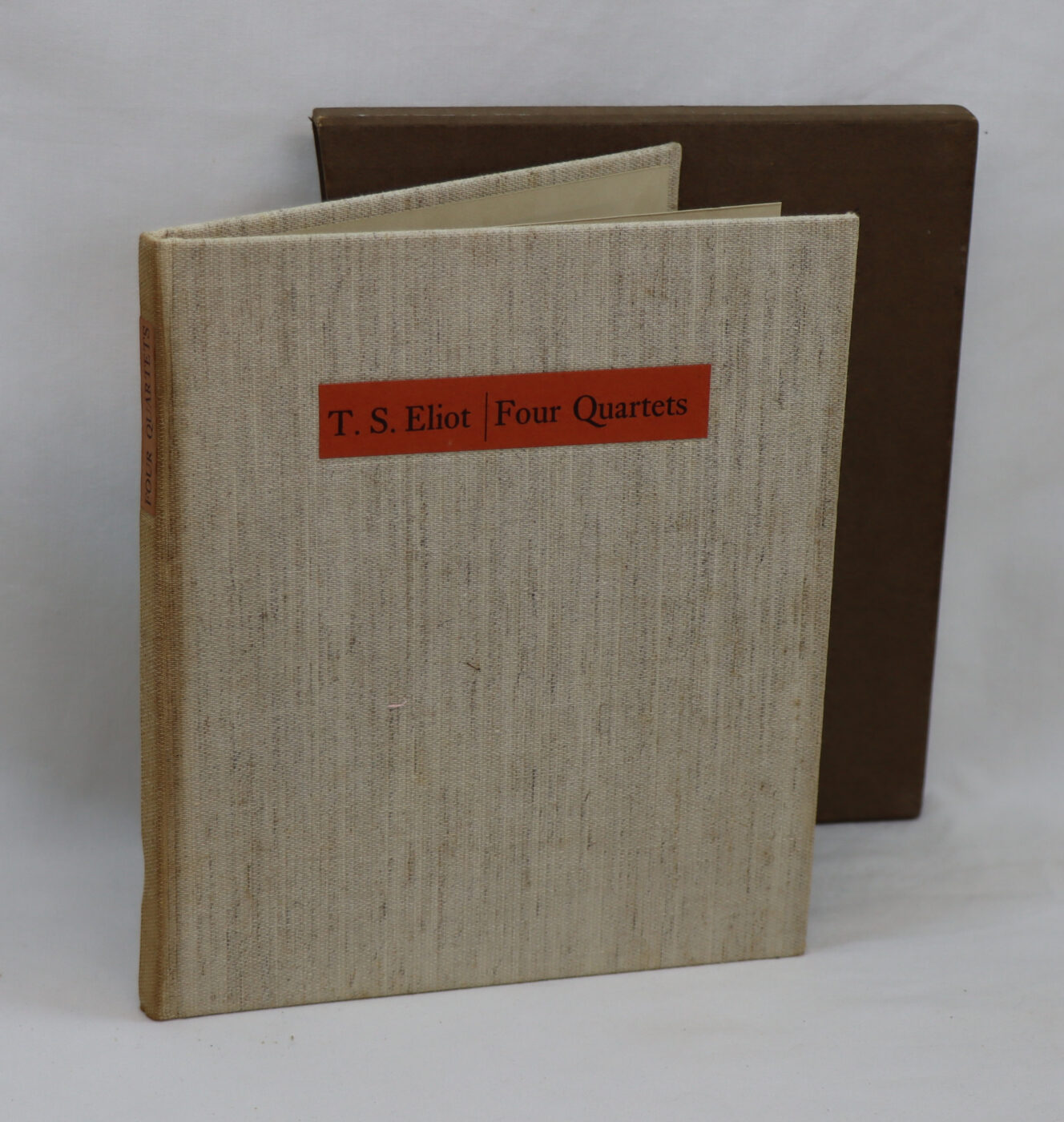
In a slip case. Cream cloth binding with black title on the spine and front board.
We provide an in-depth photographic presentation of this item to stimulate your feeling and touch. More traditional book descriptions are immediately available.
- Note: This book carries a £5.00 discount to those that subscribe to the F.B.A. mailing list
First edition thus. Square 8vo in a brown slipcase. Dark cream cloth board; a lovely clean and fresh copy.
The Four Quartets are a set of four poems written by T. S. Eliot that were published over a six-year period. The first poem, Burnt Norton, was published with a collection of his early works (1936’s Collected Poems 1909–1935).
After a few years, Eliot composed the other three poems, East Coker, The Dry Salvages and Little Gidding, which were written during World War II and the air-raids on Great Britain. They were first published as a series by Faber and Faber in Great Britain between 1940 and 1942 towards the end of Eliot’s poetic career (East Coker in September 1940, Burnt Norton in February 1941, The Dry Salvages in September 1941 and Little Gidding in 1942). The poems were not collected until Eliot’s New York publisher printed them together in 1943.
Four Quartets are four interlinked meditations with the common theme being man’s relationship with time, the universe, and the divine. In describing his understanding of the divine within the poems, Eliot blends his Anglo-Catholicism with mystical, philosophical and poetic works from both Eastern and Western religious and cultural traditions, with references to the Bhagavad-Gita and the Pre-Socratics as well as the Christian mystics, John of the Cross and Julian of Norwich.
Although many critics find the Four Quartets to be Eliot’s last great work, some of his contemporary critics were dissatisfied with his overt religiosity. George Orwell argued that religion was not a worthy topic for Eliot’s poems. Later critics have disagreed with Orwell and argued instead that the religious themes made the poem stronger. Overall, reviews of the poem in Britain were favourable, while those in the United States were split between those who liked Eliot’s later style and others who felt he had abandoned positive aspects of his earlier poetry.
Thomas Stearns Eliot (26 September 1888 – 4 January 1965) was a poet, essayist and playwright. He was a leading figure of modernist poetry in the English language where he reinvigorated the art through his use of language, writing style, and verse structure. He is also noted for his critical essays, which often re-evaluated long-held cultural beliefs. Born in St. Louis, Missouri, United States, to a prominent Boston Brahmin family, he moved to England in 1914 at the age of 25 and went on to settle, work, and marry there. He became a British subject in 1927 at the age of 39 and renounced his American citizenship.
Eliot first attracted widespread attention for “The Love Song of J. Alfred Prufrock” (1915), which, at the time of its publication, was considered outlandish. It was followed by ‘The Waste Land (1922)’, “The Hollow Men” (1925), Ash Wednesday (1930), and Four Quartets (1943). He wrote seven plays, including Murder in the Cathedral (1935) and The Cocktail Party (1949). He was awarded the 1948 Nobel Prize in Literature “for his outstanding, pioneer contribution to present-day poetry”.
NOTE: This is an original book from the library gathered by the famous Cambridge Don, computer scientist, food and wine connoisseur, Jack Arnold LANG. Note: Jack founded the Michelin Guide ‘Midsummer House’- Cambridge’s paramount restaurant. This dining experience is hidden amongst the grassy pastures and grazing cattle of Midsummer Common and perched on the banks of the River Cam.
In 2008, Jack was one of the co-founders of the Raspberry Pi Foundation, alongside other members of the Department, and acted as the Foundation’s Chair. The project’s original goals were modest: to build and distribute low-cost computers for prospective applicants to our Computer Science degree. Initially the project was a “success disaster”, as Jack would say, as demand far outstripped the low-scale manufacturing plans. Ultimately the Raspberry Pi became the UK’s most successful computer with more than 60 million sold to date. Jack was drawn to the educational possibilities of the Raspberry Pi, its potential uses in emerging economies and the way it could support self-directed learning.
Want to know more about this item?
We are happy to answer any questions you may have about this item. In addition, it is also possible to request more photographs if there is something specific you want illustrated.
Ask a question
Related products
Share this Page with a friend
