
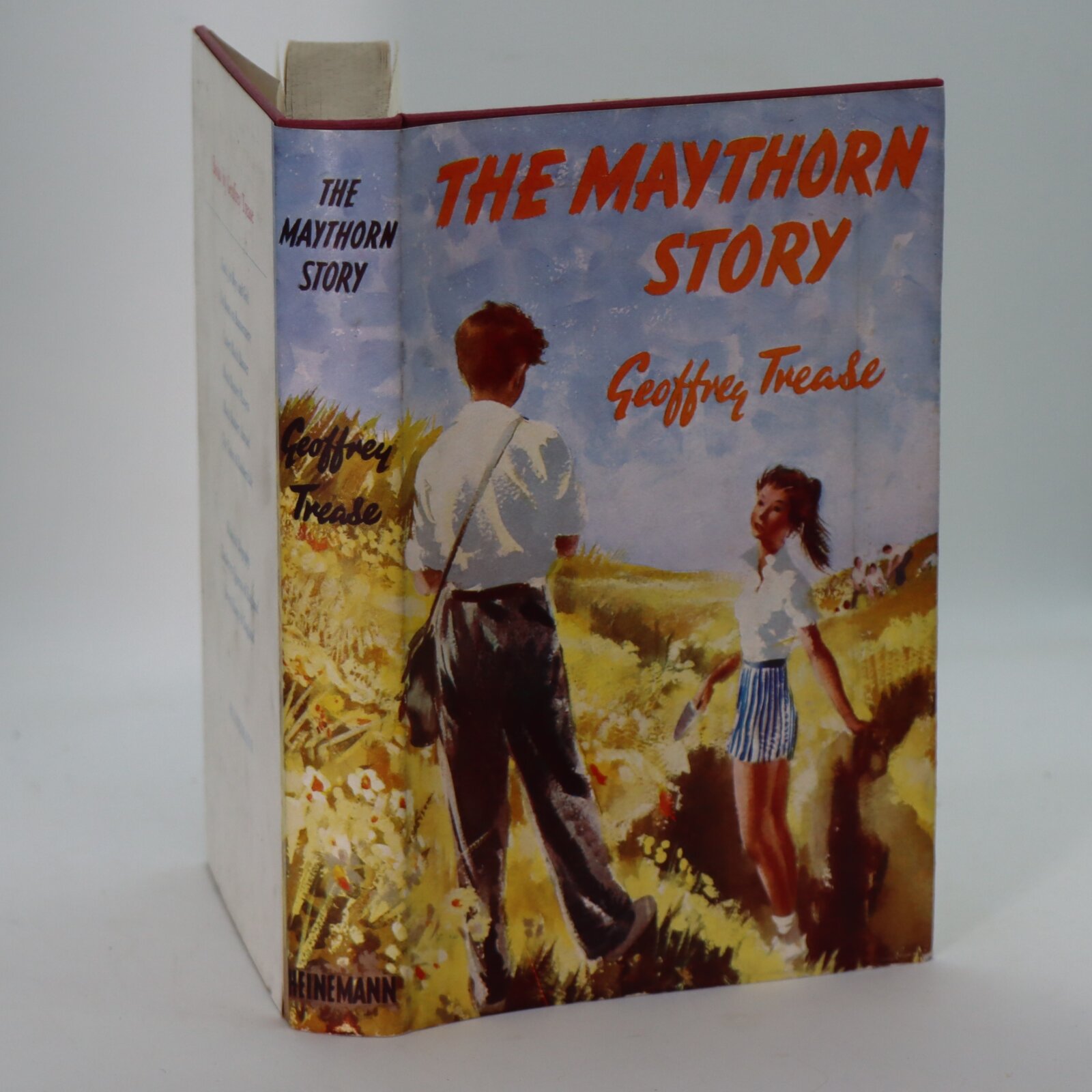
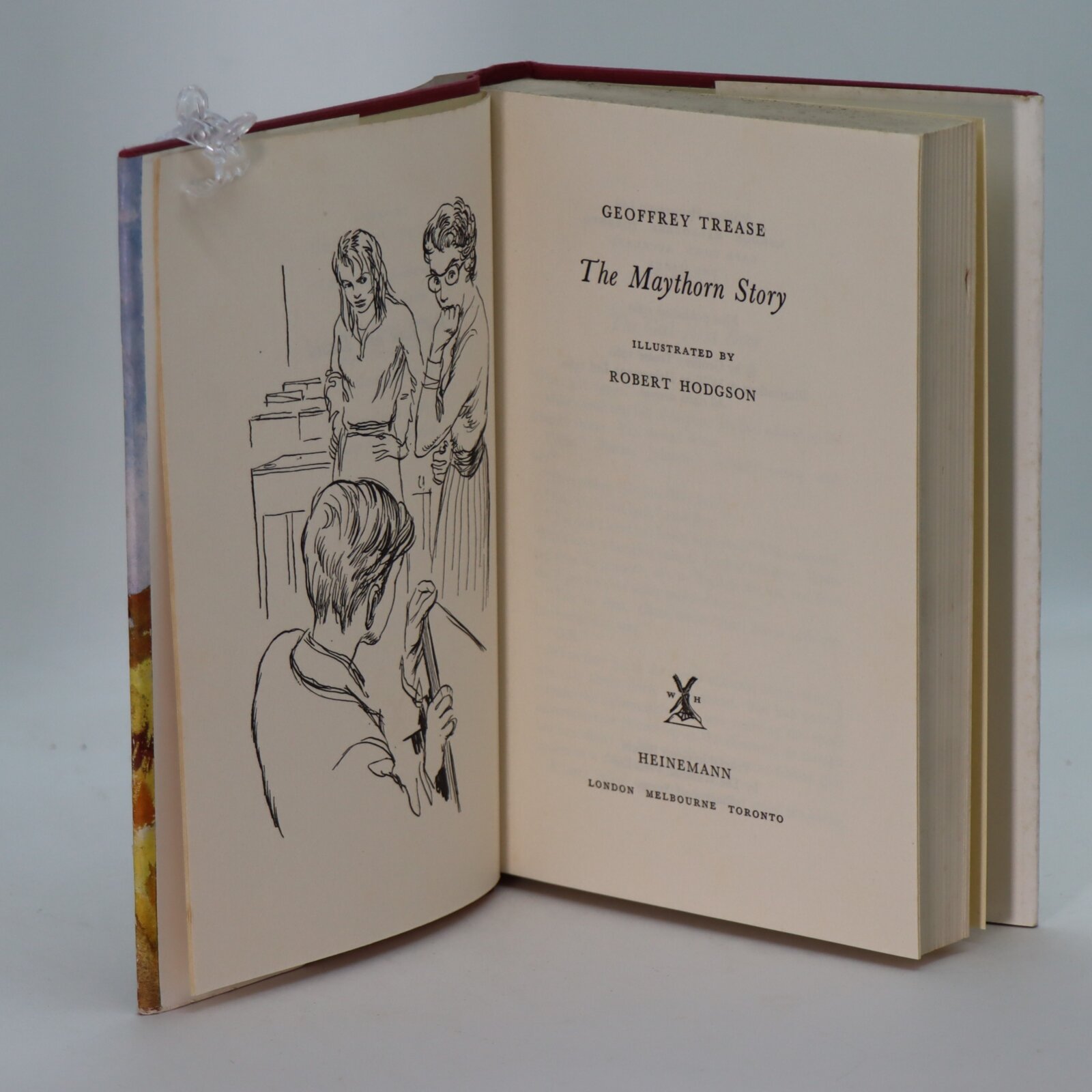
The Maythorn Story.
By Geoffrey Trease
Printed: 1960
Publisher: William Heinemann. London
Edition: First edition
| Dimensions | 13 × 19 × 3 cm |
|---|---|
| Language |
Language: English
Size (cminches): 13 x 19 x 3
Condition: Fine (See explanation of ratings)
SORRY, THIS ITEM HAS SOLD

Item information
Description
In the original dust sheet. Red cloth binding with gilt titles on the spine.
It is the intent of F.B.A. to provide an in-depth photographic presentation of this book offered so to almost stimulate your feel and touch on the book. If requested, more traditional book descriptions are immediately available.
A most interesting read
(Robert) Geoffrey Trease FRSL (11 August 1909 – 27 January 1998) was a prolific British writer who published 113 books, mainly for children, between 1934 and 1997, starting with Bows Against the Barons and ending with Cloak for a Spy in 1997. His work has been translated into 20 languages. His grandfather was a historian, and was one of the main influences on his work. He is best known for the children’s novel Cue for Treason (1940).
Trease’s children’s historical novels reflect his insistence on historically correct backgrounds, which he meticulously researched. His ground-breaking study Tales Out of School (1949) pioneered the idea that children’s literature should be a serious subject for study and debate. When he began his career, his radical viewpoint was a change from the conventional and often jingoistic tone of most children’s literature of the time, and he was one of the first authors who deliberately set out to appeal to both boys and girls and to feature strong leading characters of both sexes.
Trease was born in Nottingham in 1909, third and youngest son of George Trease (1873–1932), a wine merchant, and his wife Florence Dale (1874–1955), a doctor’s daughter. He won a scholarship to Nottingham High School, where he wrote stories, poems, and a three-act play; awarded a Classics scholarship to Oxford University, he found his tutors dull and after a year, left university without a degree and moved to London. Intent on becoming a writer, he also worked with slum children and joined a left-wing group called the “Promethean Society” whose members included Hugh Gordon Porteus and Desmond Hawkins.
Trease described his own childhood reading as “a diet of classist and racist historical adventure” but in 1933, he came across a translation of a Russian book titled Moscow has a Plan, in which a Soviet author dramatised the First five-year plan for young readers. Inspired by this, in 1934 Trease wrote Bows Against the Barons, a left-wing update of Robin Hood that showcased a radical approach to historical literature for young people. This included the use of modern English, rather than linguistic mannerisms, strong male and female characters, often from less privileged levels of society and meticulous attention to detail. An enduring belief in equality and fairness is a theme in many of his books, as are links between the historical settings of his novels and contemporary issues.
Bows Against the Barons was translated into Russian and sold immensely well there; his next work, Comrades for the Charter was less successful but Cue for Treason in 1940 proved enduringly popular and remains his best-known work. His subjects cover a wide range of historical periods, such as The Crown of Violet, set in Ancient Greece, The Red Towers of Granada, Middle Ages, The Hills of Varna, Renaissance Europe, Cue for Treason and Cloak for a Spy, Elizabethan England, Fire on the Wind and Popinjay Stairs, Restoration London, Thunder of Valmy, French Revolution, The White Nights of St Petersburg, the Bolshevik Revolution and Tomorrow Is a Stranger, World War II.
Trease also wrote modern school stories, including the five Black Banner novels set in the Lake District, the first being No Boats on Bannermere), as well as a number of adult novels, history, plays for radio and television, and biographies. He authored a guide aimed at teaching creative writing to young adults, The Young Writer: A Practical Handbook. He wrote three books of autobiography: A Whiff of Burnt Boats (1971), Laughter at the Door (1974), and in the last year of his life, the final part, Farewell the Hills. This was written for his family and friends and published privately after his death.
Trease was an acknowledged influence on author Hester Burton and inspired others, including Rosemary Sutcliff and Leon Garfield. While in some ways they outpaced him, he continued to write and published 113 books before “calling it a day” at the age of 88 because of illness. Many were translated for foreign markets, including Asia and Europe. In the United States he won the New York Herald Tribune Book Award for the Children’s Spring Festival 1966 for This is Your Century.
He married Marian Boyer (1906–1989) in 1933 and they spent most of their marriage in Colwall, near The Downs School, Great Malvern. They had one daughter, Jocelyne, and moved to Bath to be closer to her, shortly before Marian’s death.
Want to know more about this item?
We are happy to answer any questions you may have about this item. In addition, it is also possible to request more photographs if there is something specific you want illustrated.
Ask a question
Related products
Share this Page with a friend
