
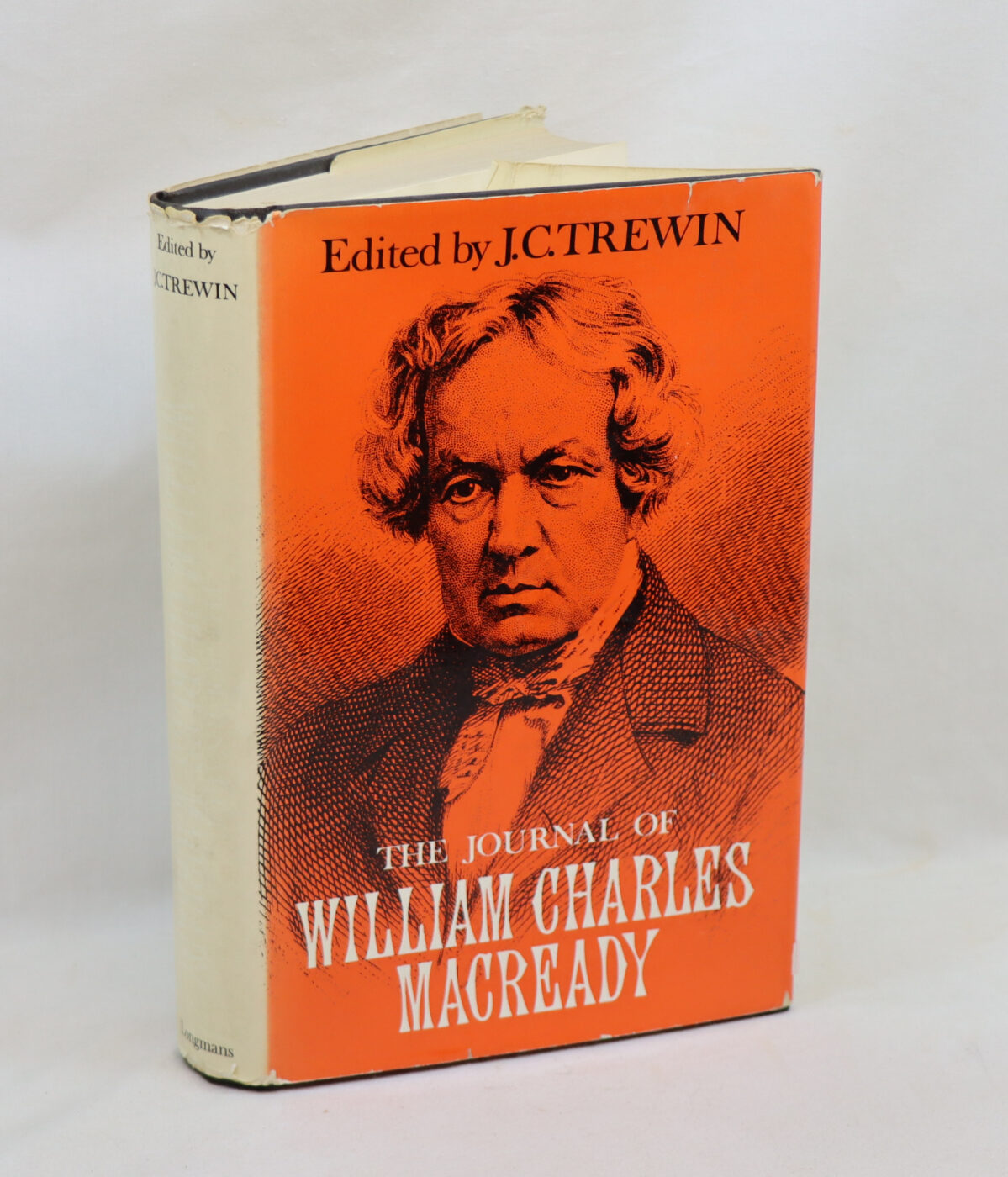
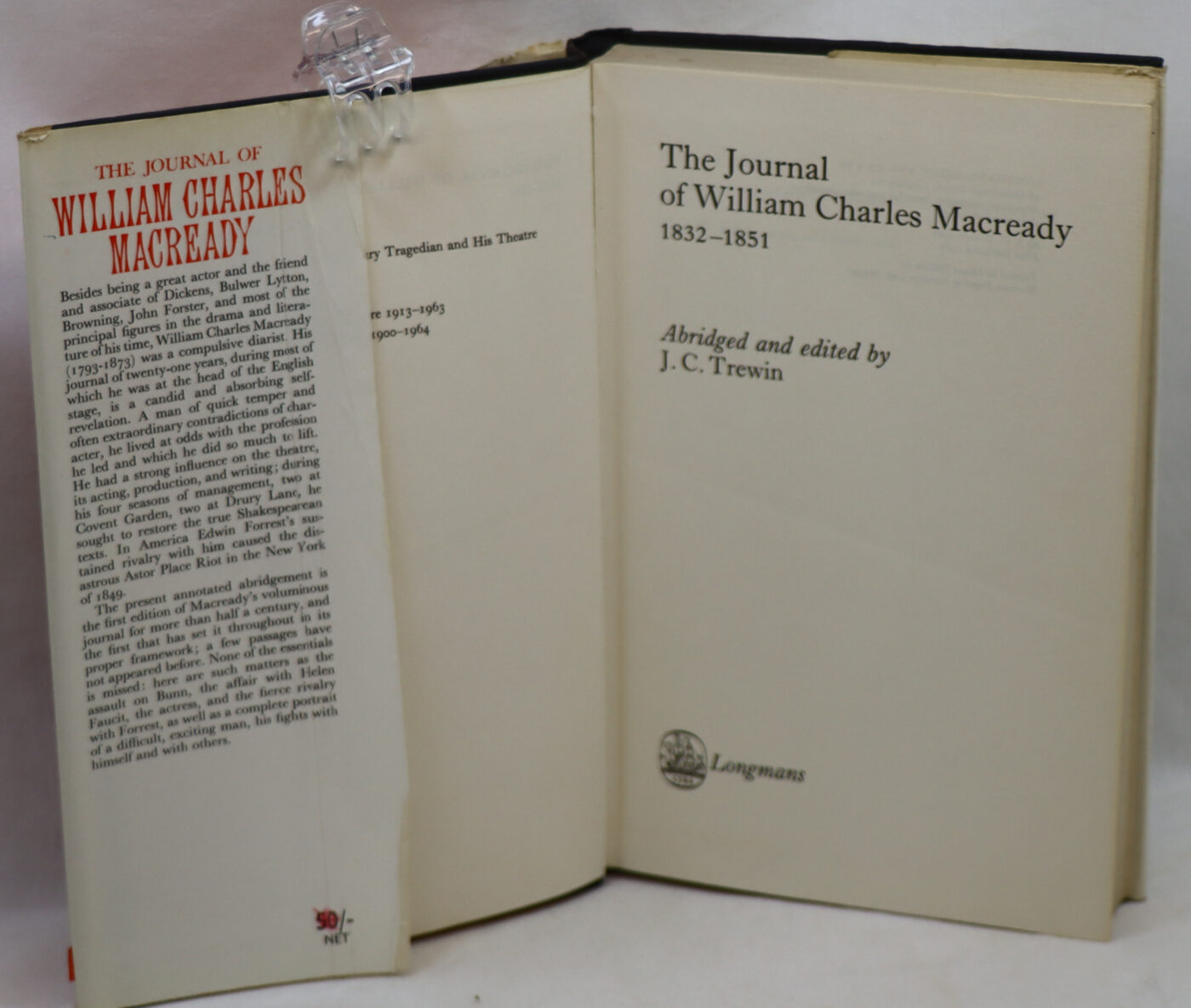
The Journal of William Charles Macready.
By J C Trewin
Printed: 1967
Publisher: Longmans Green & Co. Lonodn
Edition: First edition
| Dimensions | 15 × 22 × 4 cm |
|---|---|
| Language |
Language: English
Size (cminches): 15 x 22 x 4
Condition: Good (See explanation of ratings)
£44.00
Buy Now
Your items

Item information
Description
In the original dust jacket. Black cloth binding with gilt title on the spine.
We provide an in-depth photographic presentation of this item to stimulate your feeling and touch. More traditional book descriptions are immediately available
- Note: This book carries a £5.00 discount to those that subscribe to the F.B.A. mailing list
First edition. 315pp. Please view our photographs for conditions. Journals of the actor and friend of Charles Dickens, who had a major influence on the theater of his time, includes a few passages that had not appeared before.
William Charles Macready (3 March 1793 – 27 April 1873) was an English stage actor. The son of Irish actor-manager William Macready the Elder, he emerged as a leading West End performer during the Regency era. Macready was born in London the son of William Macready the Elder, and actress Christina Ann Birch. Educated at Rugby School where he became head boy, and where now the theatre is named after him, it was his initial intention to go to University of Oxford, but, in 1809, financial problems experienced by his father, the lessee of several provincial theatres, called him to share the responsibilities of theatrical management. On 7 June 1810, he made a successful first appearance as Romeo at Birmingham. Other Shakespearian parts followed, but a serious rupture between father and son resulted in the young man’s departure for Bath in 1814. Here he remained for two years, with occasional professional visits to other provincial towns.
On 16 September 1816, Macready made his first London appearance at Covent Garden as Orestes in The Distressed Mother, a translation of Racine’s Andromaque by Ambrose Philips. Macready’s choice of characters was at first confined chiefly to the romantic drama. In 1818, he won a permanent success in Isaac Pocock’s (1782–1835) adaptation of Scott’s Rob Roy. He showed his capacity for the highest tragedy when he played Richard III at Covent Garden on 25 October 1819.
In 1820, he played the title role in the tragedy Virginius by James Sheridan Knowles. Transferring his services to Drury Lane, he gradually rose in public favour, his most conspicuous success being in the title role of Sheridan Knowles’s William Tell (11 May 1825). In 1826, he completed a successful engagement in the United States, and, in 1828, his performances met with a very flattering reception in Paris. In 1829, he appeared as Othello in Warwick.
On 15 December 1830 he appeared at Drury Lane as Werner, one of his most powerful impersonations. In 1833, he played in Antony and Cleopatra, in Byron’s Sardanapalus, and in King Lear. He was responsible, in 1834, and more fully in 1838, for returning the text of King Lear to Shakespeare’s text (although in a shortened version), after it had been replaced for more than a hundred and fifty years by Nahum Tate’s happy-ending adaptation, The History of King Lear. He performed at the Georgian Wisbech theatre (now Angles Theatre) and other theatres of the Lincoln theatre circuit run by Fanny Robertson.
Already, Macready had done something to encourage the creation of a modern English drama, and after entering on the management of Covent Garden in 1837 he introduced Robert Browning’s Strafford, and in the following year Bulwer-Lytton’s The Lady of Lyons and Richelieu, the principal characters in which were among his most effective parts. On 10 June 1838, he gave a memorable performance of Henry V, for which Stanfield prepared sketches, and the mounting was supervised by Bulwer-Lytton, Dickens, Forster, Maclise, W. J. Fox and other friends.
Dickens wrote to him in 1847: “The multitude of tokens by which I know you for a great man, the swelling within me of my love for you, the pride I have in you, the majestic reflection I see in you of the passions and affections that make up our mystery, throw me into a strange kind of transport that has no expression but in a mute sense of an attachment which in truth and fervency is worthy of its subject.”
The first production of Bulwer-Lytton’s Money took place under the artistic direction of Count d’Orsay on 8 December 1840, Macready winning unmistakable success in the character of Alfred Evelyn. Both in his management of Covent Garden, which he resigned in 1839, and of Drury Lane, which he held from 1841 to 1843, he found his designs for the elevation of the stage frustrated by the absence of adequate public support.
In 1843, he staged Cymbeline. In 1843–44, he made a successful tour in the United States, but his last visit to that country, in 1849, was marred by the Astor Place Riot, in which between 22 and 31 rioters were dead, and more than 120 people injured.
Judge Charles Patrick Daly later presided at the trial. Both Forrest and Macready were playing Macbeth in concurrent, competing productions at the time of the riot, a fact which added to the ominous reputation of that play. Playwright Richard Nelson dramatized the events surrounding the riot in his 1990 play, Two Shakespearean Actors.
Macready took leave of the stage in a farewell performance of Macbeth at Drury Lane on 26 February 1851. The remainder of his life was spent in happy retirement, and he died at Cheltenham on 27 April 1873.
Want to know more about this item?
We are happy to answer any questions you may have about this item. In addition, it is also possible to request more photographs if there is something specific you want illustrated.
Ask a question

Share this Page with a friend
