
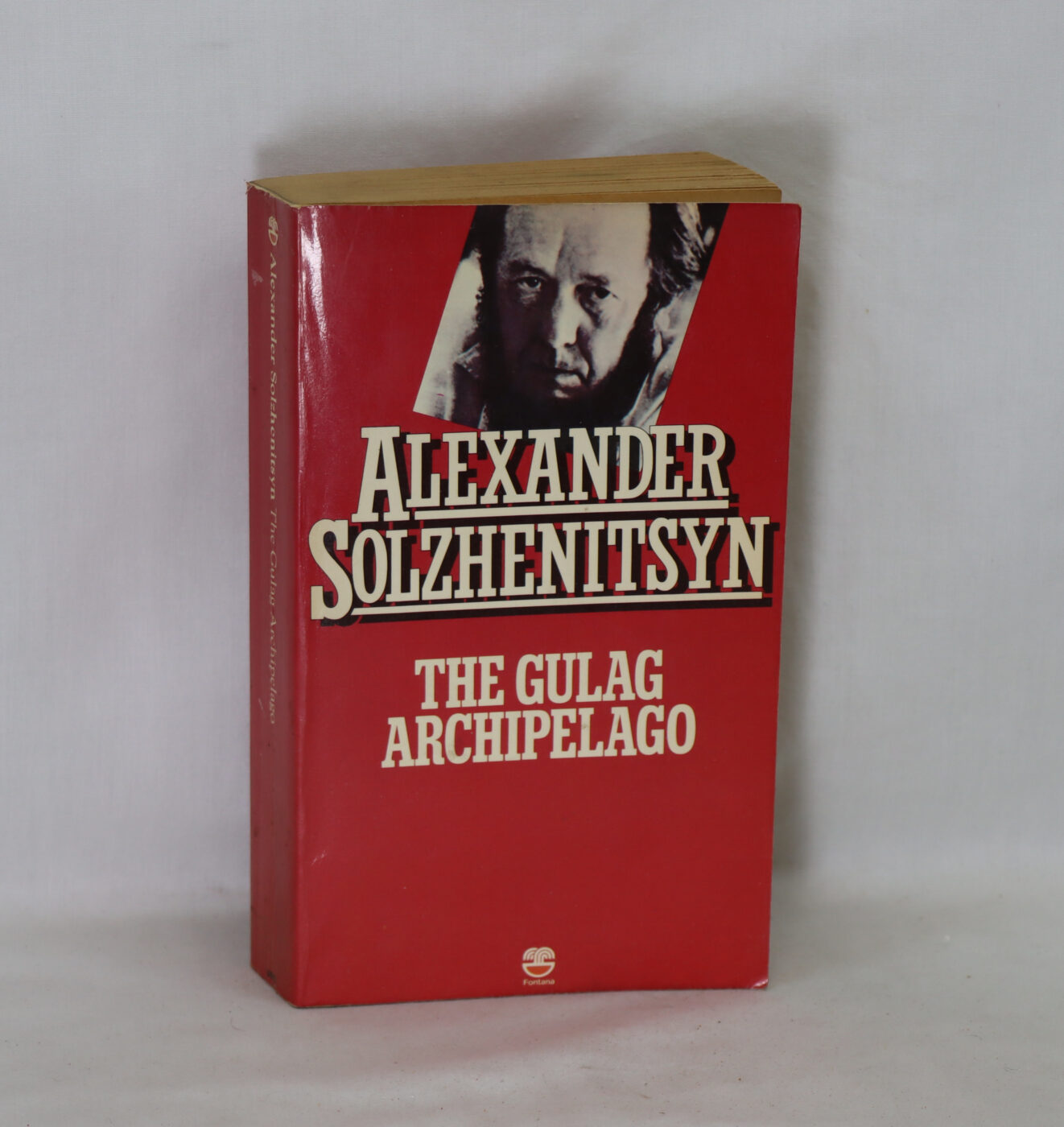
The Gulag Archipelago.
By Alexander Solzenitsyn
ISBN: 9780553247770
Printed: 1974
Publisher: Collins/Fontana. London
| Dimensions | 11 × 18 × 3 cm |
|---|---|
| Language |
Language: English
Size (cminches): 11 x 18 x 3
Condition: Good (See explanation of ratings)
THIS ITEM WILL BE AVAILABLE SOON
SORRY, THIS ITEM HAS SOLD
Item information
Description
Paperback. Red cover with white title.
We provide an in-depth photographic presentation of this item to stimulate your feeling and touch. More traditional book descriptions are immediately available
A FROST PAPERBACK is a loved book which a member of the Frost family has checked for condition, cleanliness, completeness and readability. When the buyer collects their book, the delivery charge of £3.00 is not made
Solzhenitsyn spent eleven years in labour camps and in exile. This book is his masterwork, based on his own experiences as well as the testimony of some 200 survivors. A vast canvas of camps, prisons, transit centres and secret police, of informers and spies and interrogators but also of everyday heroism, it chronicles the story of those who dared to oppose Stalin, and for whom the key to survival lay not in hope but in despair. A thoroughly researched document and a feat of literary and imaginative power, this edition of The Gulag Archipelago was abridged into one volume at the request of the author.
- ‘Helped to bring down an empire. Its importance can hardly be exaggerated’ Doris Lessing, Sunday Telegraph
- ‘Solzhenitsyn’s masterpiece…helped create the world we live in today’ Anne Applebaum
The Gulag Archipelago: An Experiment in Literary Investigation is a three-volume nonfiction series written between 1958 and 1968 by Russian writer Aleksandr Solzhenitsyn, a Soviet dissident. It was first published in 1973 by the Parisian publisher YMCA-Press, and it was translated into English and French the following year. It explores a vision of life in what is often known as the Gulag, the Soviet labour camp system. Solzhenitsyn constructed his highly detailed narrative from various sources including reports, interviews, statements, diaries, legal documents, and his own experience as a Gulag prisoner. Following its publication, the book was initially circulated in the Soviet Union by samizdat underground publication. It was not widely published there until 1989. It appeared that year in the literary journal Novy Mir; a third of the work was published in three issues. Since the dissolution of the Soviet Union, The Gulag Archipelago has been officially published in Russia.
Aleksandr Isayevich Solzhenitsyn (11 December 1918 – 3 August 2008) was a Soviet and Russian author and dissident who helped to raise global awareness of political repression in the Soviet Union, especially the Gulag prison system. He was awarded the 1970 Nobel Prize in Literature “for the ethical force with which he has pursued the indispensable traditions of Russian literature”. His non-fiction work The Gulag Archipelago “amounted to a head-on challenge to the Soviet state” and sold tens of millions of copies.
Solzhenitsyn was born into a family that defied the Soviet anti-religious campaign in the 1920s and remained devout members of the Russian Orthodox Church. However, he initially lost his faith in Christianity, became an atheist, and embraced Marxism–Leninism. While serving as a captain in the Red Army during World War II, Solzhenitsyn was arrested by SMERSH and sentenced to eight years in the Gulag and then internal exile for calling for the overthrow of the Soviet regime in private correspondence with another field officer. As a result of his experience in prison and the camps, he gradually became a philosophically minded Eastern Orthodox Christian.
As a result of the Khrushchev Thaw, Solzhenitsyn was released and exonerated. He pursued writing novels about repression in the Soviet Union and his experiences. In 1962, he published his first novel, One Day in the Life of Ivan Denisovich—an account of Stalinist repressions—with approval from Soviet leader Nikita Khrushchev. His last work to be published in the Soviet Union was Matryona’s Place in 1963. Following the removal of Khrushchev from power, the Soviet authorities attempted to discourage Solzhenitsyn from continuing to write. He continued to work on additional novels and their publication in other countries including Cancer Ward in 1966, In the First Circle in 1968, August 1914 in 1971 and The Gulag Archipelago—which outraged the Soviet authorities—in 1973. In 1974, he was stripped of his Soviet citizenship and flown to West Germany. He initially moved to Switzerland and then moved to Vermont in the United States with his family in 1976 and continued to write there. His Soviet citizenship was restored in 1990. He returned to Russia four years later and remained there until his death in 2008.
Want to know more about this item?
We are happy to answer any questions you may have about this item. In addition, it is also possible to request more photographs if there is something specific you want illustrated.
Ask a question
Related products


Share this Page with a friend
