
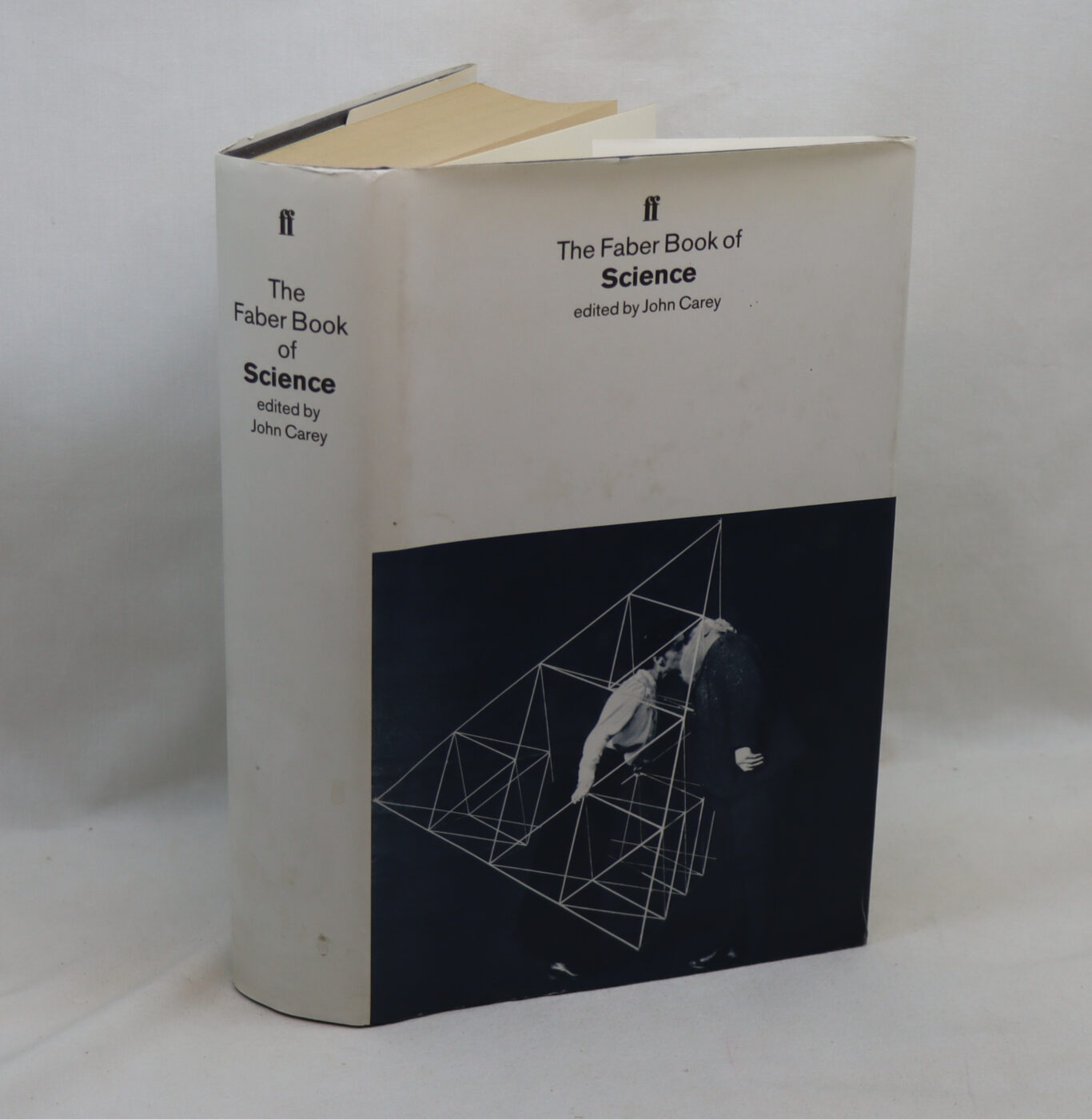
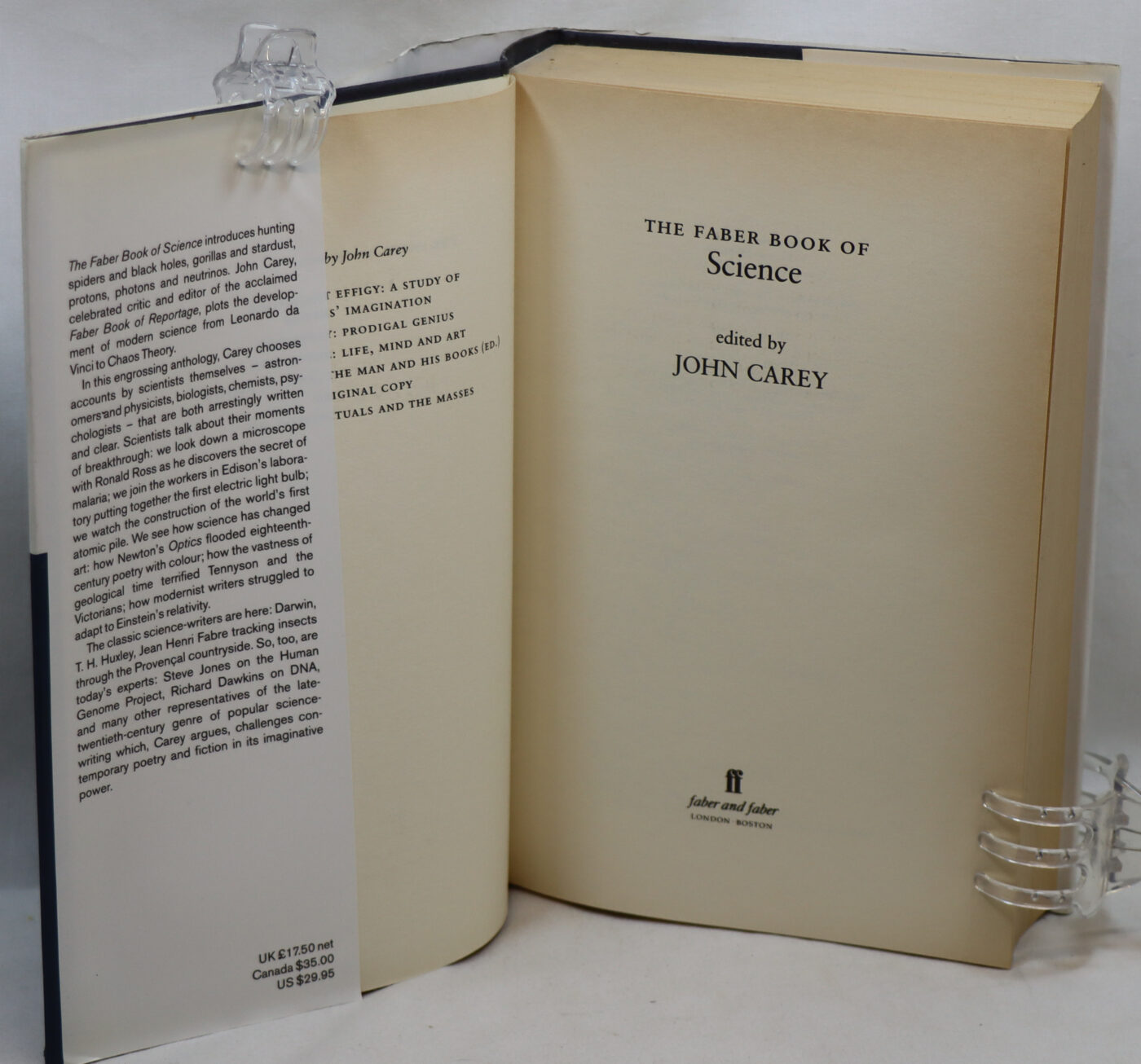
The Faber Book of Science.
By Edited by John Carey
Printed: 1995
Publisher: Faber & Faber. London
Edition: First edition
| Dimensions | 17 × 24 × 5 cm |
|---|---|
| Language |
Language: English
Size (cminches): 17 x 24 x 5
Condition: Good (See explanation of ratings)
£23.00
Buy Now
Your items

Item information
Description
In the original dust cover. Black cloth binding with silver title on the spine.
We provide an in-depth photographic presentation of this item to stimulate your feeling and touch. More traditional book descriptions are immediately available
Note: This book carries a £5.00 discount to those that subscribe to the F.B.A. mailing list
A great book in all senses. Has excellent articles for both the student and expert.
Review: This is a collection of scientific writings spanning several hundred years from the Renaissance to modern times. John Carey has obviously read very widely to compile the entries, which range over many topics in the physical and biological sciences, and, as befitting a professor of English, he has made his choice not only on the importance of the topic, but also on the quality of the writing. The contributions vary from a single page to several pages; some have extensive commentaries from the editor, others just a note on the source reference. They also vary in style. There are classic pieces of writing about seminal discoveries such as radioactivity, X-rays, and the atomic nucleus, by the discoverers themselves; commentaries by eyewitnesses or later interpreters and biographers; and personal accounts by eminent scientists about how their ideas evolved with time. One of the longest entries of the latter type is Darwin on evolution. There are also occasional lighter pieces, such as the story of how Bird’s Custard Powder came to be invented, and even a few contributions, including poems, from well-known literary names who were also amateur observers of nature. I enjoyed reading this collection. It is of course a personal selection and one can think of many other possible entries, but most are well written and informative and their length means that one can dip into the book and read some of them when one has a few minutes to spare.
NOTE: This is an original book from the library gathered by the famous Cambridge Don, computer scientist, food and wine connoisseur, Jack Arnold LANG. Note: Jack founded the Michelin Guide ‘Midsummer House’- Cambridge’s paramount restaurant. This dining experience is hidden amongst the grassy pastures and grazing cattle of Midsummer Common and perched on the banks of the River Cam.
In 2008, Jack was one of the co-founders of the Raspberry Pi Foundation, alongside other members of the Department, and acted as the Foundation’s Chair. The project’s original goals were modest: to build and distribute low-cost computers for prospective applicants to our Computer Science degree. Initially the project was a “success disaster”, as Jack would say, as demand far outstripped the low-scale manufacturing plans. Ultimately the Raspberry Pi became the UK’s most successful computer with more than 60 million sold to date. Jack was drawn to the educational possibilities of the Raspberry Pi, its potential uses in emerging economies and the way it could support self-directed learning.
Want to know more about this item?
We are happy to answer any questions you may have about this item. In addition, it is also possible to request more photographs if there is something specific you want illustrated.
Ask a question
Related products







Share this Page with a friend
