
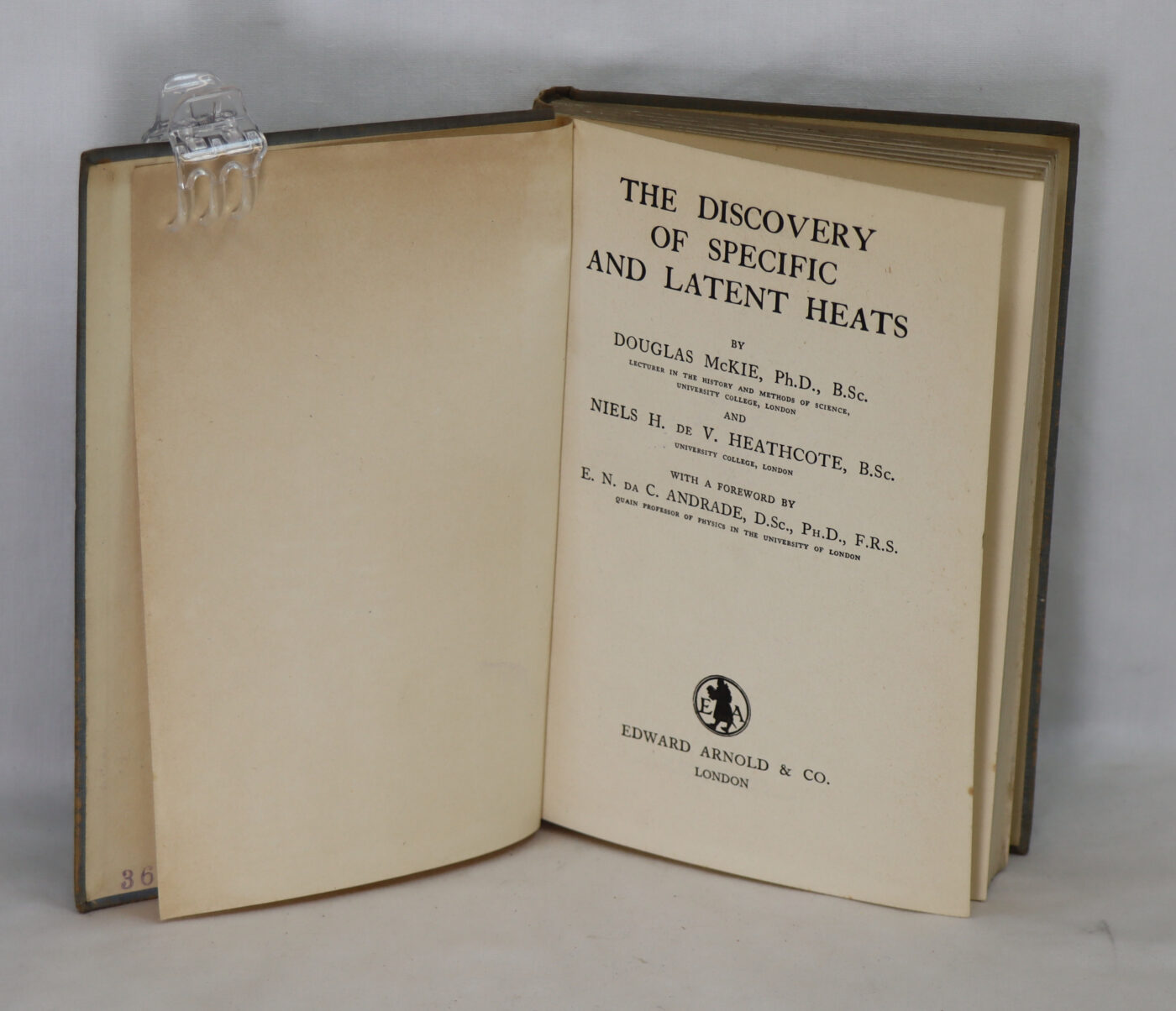
The Discovery of Specific and Latent Heats.
By Douglas McKie & Niels H de V Heathcote
Printed: 1935
Publisher: Edward Arnold & Co. London
Edition: First edition
| Dimensions | 13 × 19 × 2 cm |
|---|---|
| Language |
Language: English
Size (cminches): 13 x 19 x 2
Condition: Good (See explanation of ratings)
£16.00
Buy Now
Your items
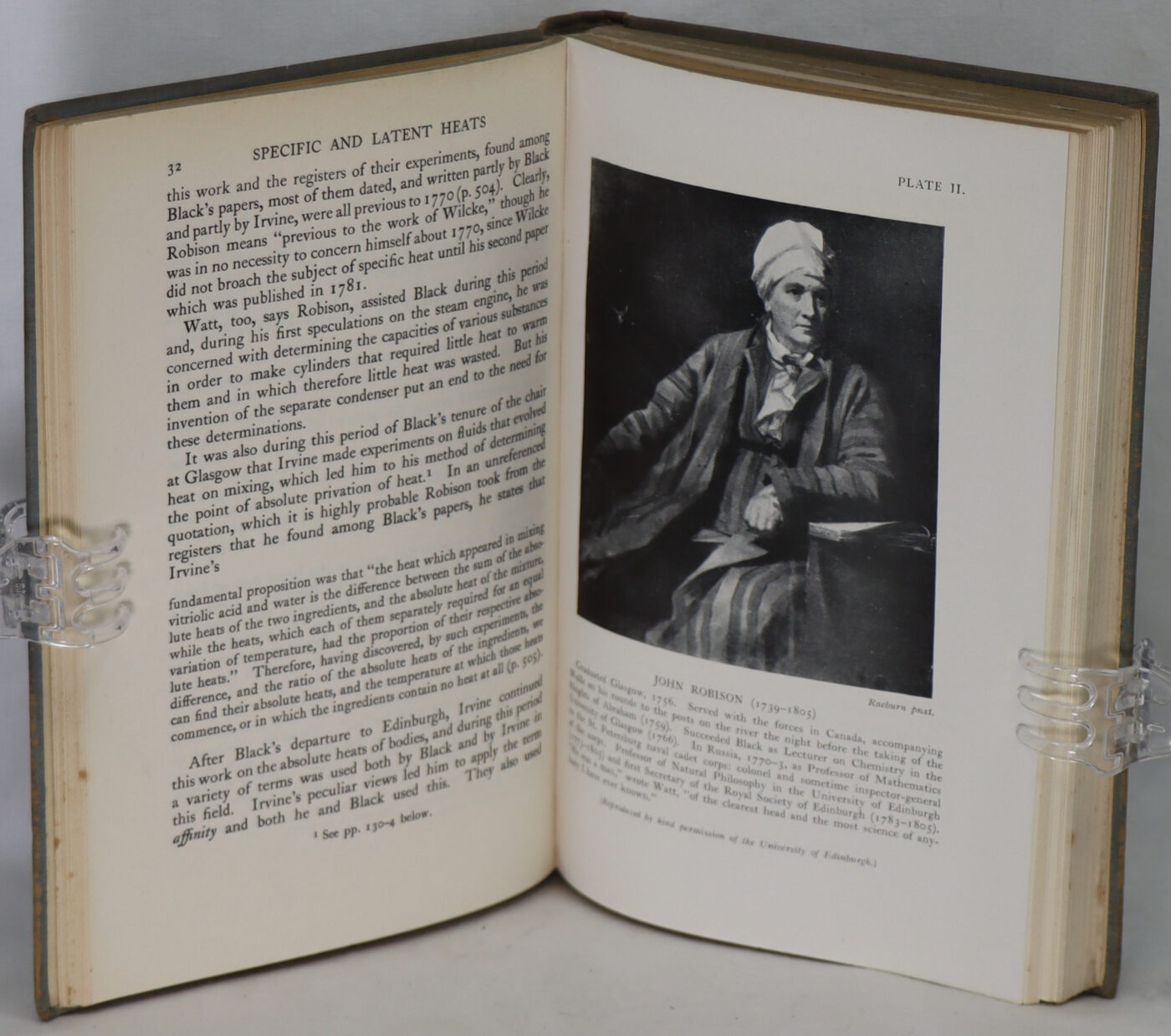

Item information
Description
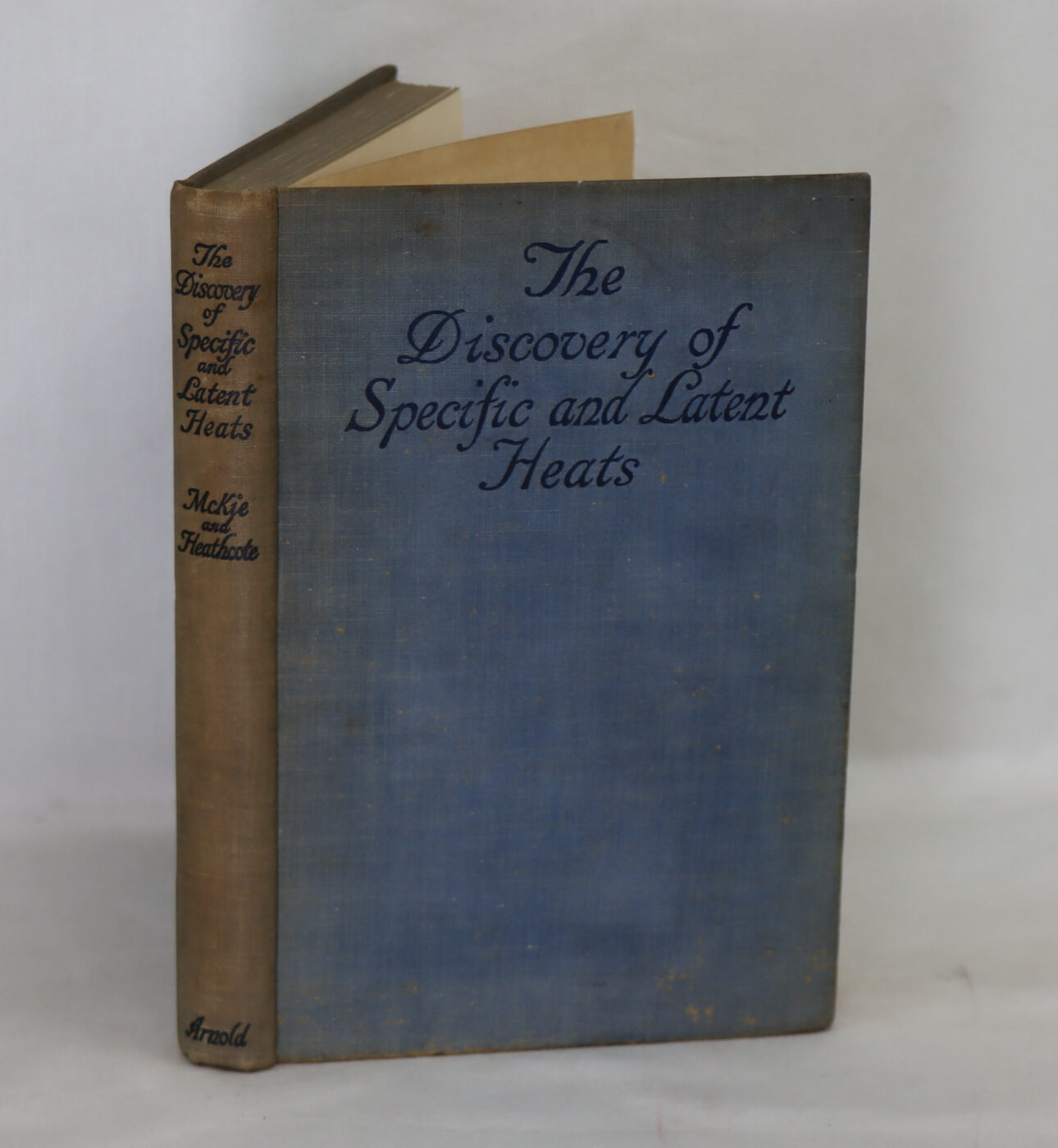
Blue cloth binding with black title on the spine and front board. Binding faded.
We provide an in-depth photographic presentation of this item to stimulate your feeling and touch. More traditional book descriptions are immediately available
-
Note: This book carries a £5.00 discount to those that subscribe to the F.B.A. mailing list
For conditions, please view our photographs.The discovery of specific and latent heat is largely attributed to the 18th-century Scottish chemist and physicist Joseph Black, who formalized these concepts through his extensive work in calorimetry. Black defined specific heat as the heat capacity of different substances and latent heat as the hidden heat energy absorbed or released during a change of state, like melting or boiling, without a change in temperature.
-
Specific Heat: Black observed that different materials require different amounts of heat to achieve the same temperature change. He introduced the concept of “capacity for heat,” which we now call specific heat capacity.
-
Latent Heat: Black recognized that when ice melts into water, heat is absorbed without a rise in temperature. He termed this energy “latent” (hidden) because it’s used to break bonds between molecules rather than to increase their kinetic energy. This discovery helped explain phenomena like the slow melting of ice.
-
Quantitative Measurement: Black improved on existing methods, like the method of mixtures, to quantitatively measure heat transfer and the specific and latent heats of various substances.
-
Publication and Influence: Though he published little, his lectures and student notes disseminated his ideas, influencing his friend James Watt and contributing to advancements in industrial chemistry and the development of the steam engine.
-
Specific Heat: refers to the heat required to raise the temperature of a substance.
-
Latent Heat: is the energy absorbed or released during a change of state (e.g., melting, boiling, freezing) at a constant temperature.
Want to know more about this item?
We are happy to answer any questions you may have about this item. In addition, it is also possible to request more photographs if there is something specific you want illustrated.
Ask a question
Related products








Share this Page with a friend
