
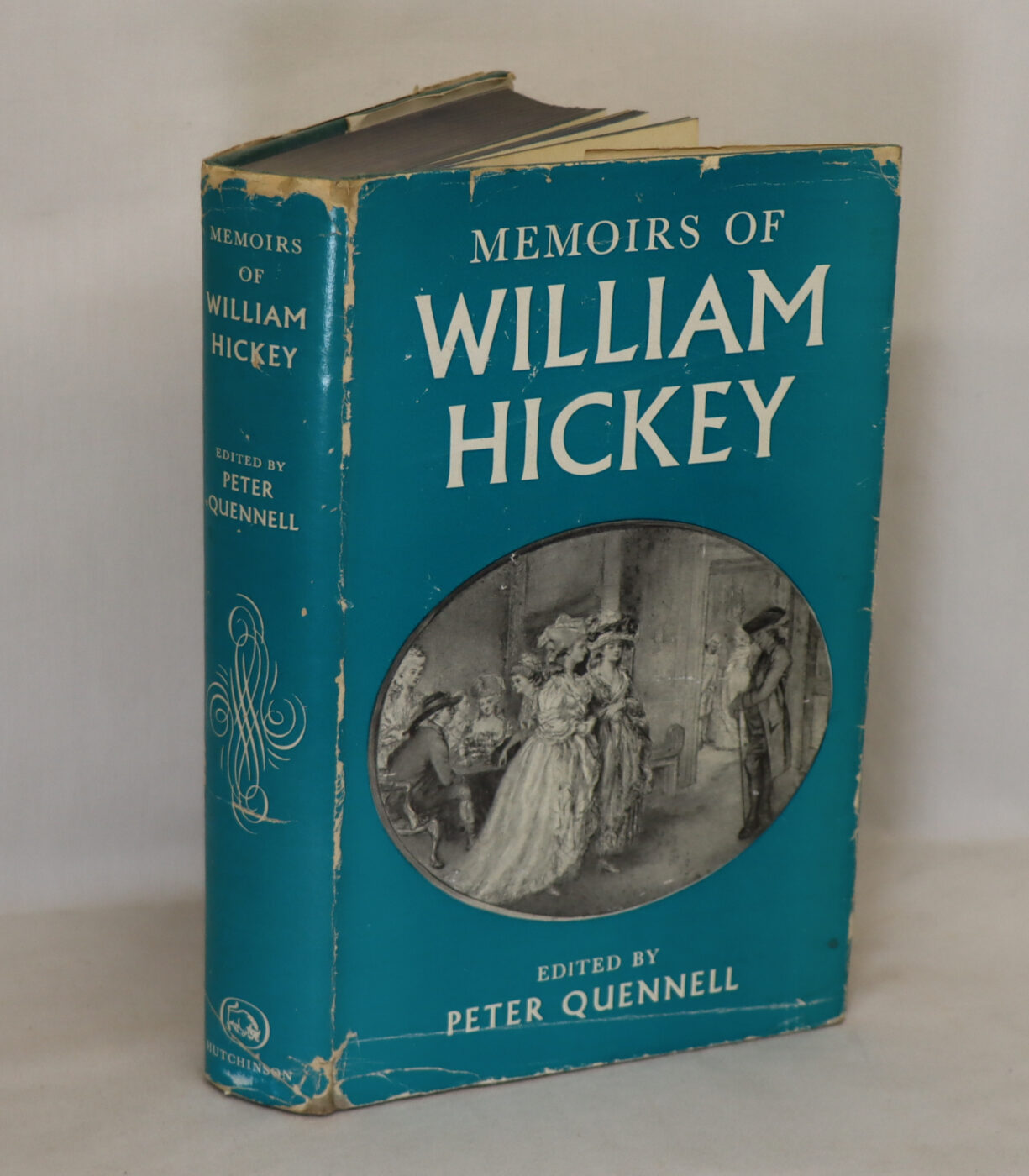
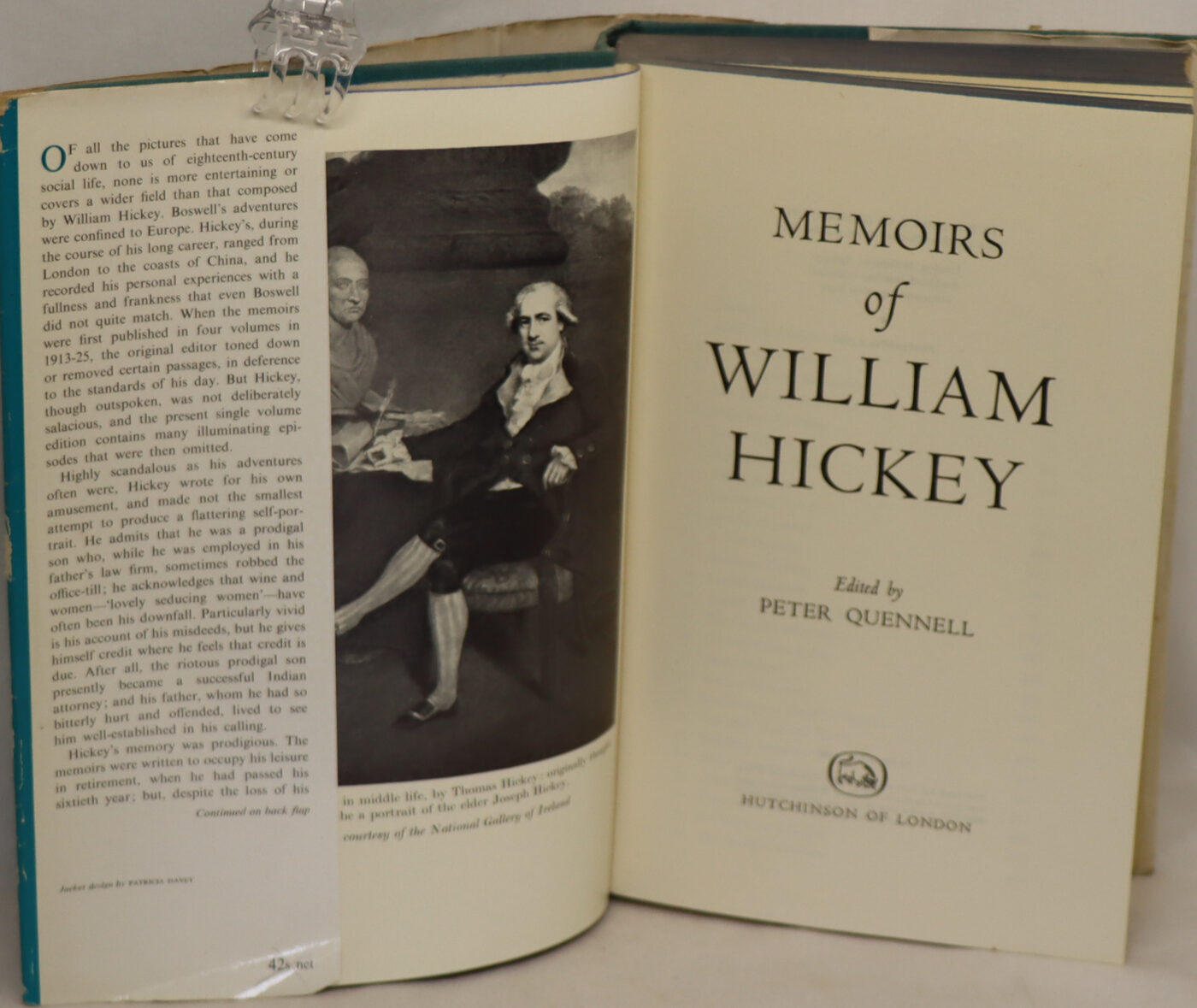
Memoirs of William Hickey.
By Peter Quennell
Printed: 1960
Publisher: Hutchinson & Co. London
| Dimensions | 16 × 24 × 4 cm |
|---|---|
| Language |
Language: English
Size (cminches): 16 x 24 x 4
Condition: Good (See explanation of ratings)
£44.00
Buy Now
Your items

Item information
Description
In the original dust cover. Blue cloth binding with gilt title on the spine.
We provide an in-depth photographic presentation of this item to stimulate your feeling and touch. More traditional book descriptions are immediately available
- Note: This book carries a £5.00 discount to those that subscribe to the F.B.A. mailing list
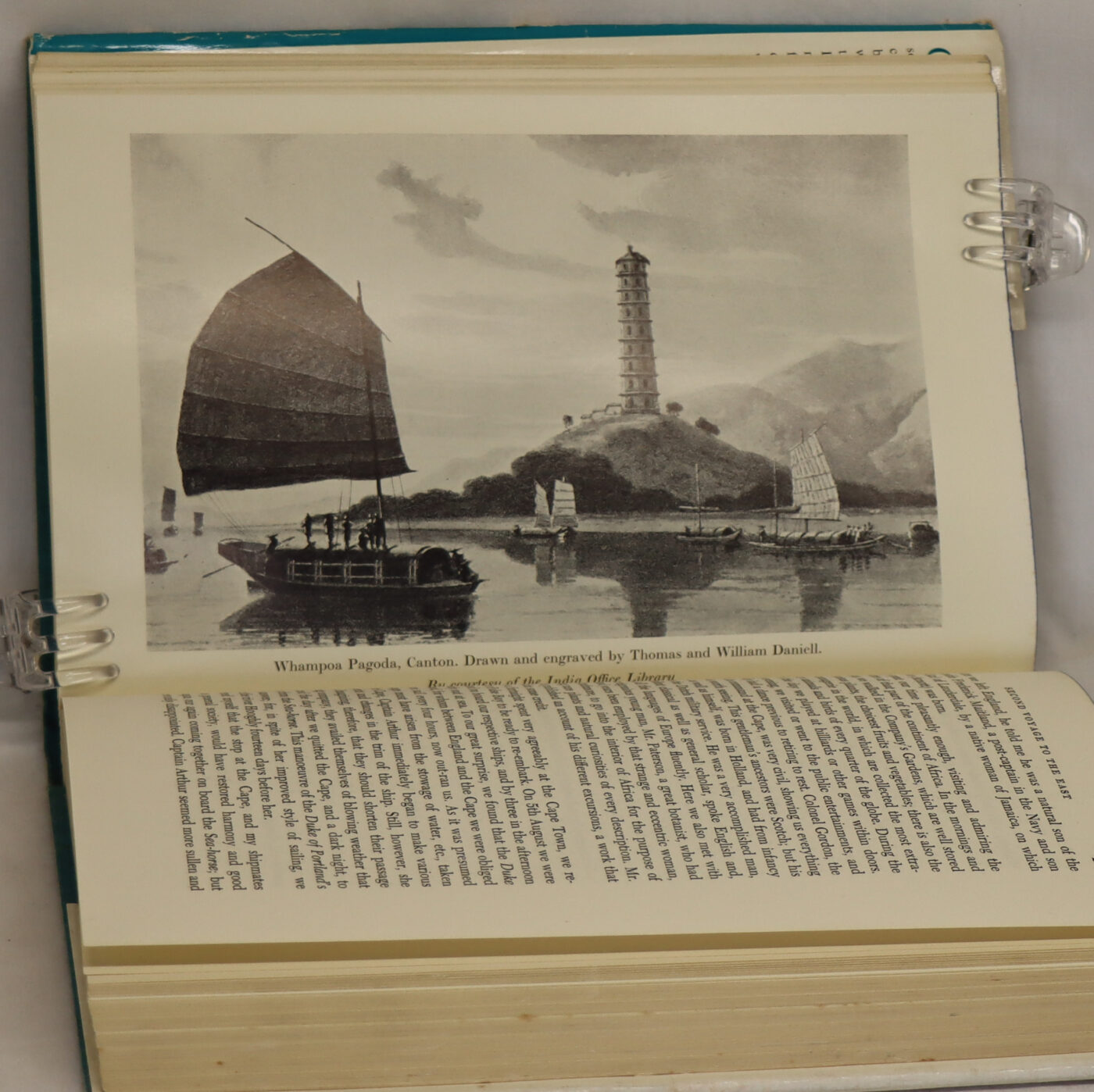
First Edition. Good copy in original gilt-blocked buckram with some wear and tear as with age. Remains well-preserved overall; bright and clean. Physical description; 452 p., 8 p. of plates ; Notes; Includes index. Subjects; Hickey, William L. Lawyers India ; Biography. India History 18th century. Genres; Biography. Illustrated.
A fascinating story of life lived by an English society cruiser at the time of the American Revolution. We follow him to Jamaica, back to London, to Calcutta, back to London and finally on his way back to India. His descriptions of life, love and especially meals on land and sea are informative and highly entertaining.
Review: I approached these memoirs expecting to learn intriguing details about the seamier sides of life in 18th century London. Hickey (1749-1830) provides plenty of detail, but “intriguing” is about the last word I would apply to this narrative of debauchery. What we get instead is a series of misadventures and lucky escapes from follies mostly of his own contriving. While he exhibits much remorse, there is little improvement, as after each hangover he simply returns to his life of dissipation and foolishness. Rather amazing that he lived to the age of 81. Surprisingly (at least to me), it is the descriptions of his experiences abroad that are the most interesting, as he sailed to the Far East, the Caribbean, and many islands in between (including St. Helena, a generation before Napoleon arrived). South African wines, now so highly prized, come off rather badly. His first destination was India, where even before landing the climate was enough to carry off a healthy Englishman without any previous symptoms of illness at all. Upon arrival at their destination, they did not land at a port, as I naively expected, but rather put upon a beach with sand so hot it burned their feet. In his description, India is an abominable place filled with swarms of mosquitoes. Some of his companions soon die of apoplexy, others commit suicide. He takes the first opportunity to sail on to Canton, where at least the winter is sharp and cold. His descriptions of storms at sea are exciting, though the nautical terminology he uses goes largely unexplained. The most thrilling scenes involve a riot by “Musselmen” interrupting a trial in Calcutta.
Alas, after each excursion abroad Hickey returns to London, where he resumes his life filled with petty jealousies, dissoluteness and drinking so excessive that it results in vomiting on the dinner table. He is saved from his utter lack of prudence only by his father’s forbearance, his friends’ influence, and undeserved good luck.
William Hickey (30 June 1749 – 31 May 1830) was an English lawyer, but is best known for his vast Memoirs, composed in 1808–10 and published between 1913 and 1925, which in their manuscript form cover 750 closely-written folio pages. Described by Peter Quennell as “One of the most remarkable books of its kind ever published in the English Language”, Hickey’s Memoirs give an extraordinarily vivid picture of life in late 18th-century London, Calcutta, Madras and Jamaica which stands comparison with the best of his near-contemporary James Boswell. Hickey was born in St. Albans Street, Pall Mall, Westminster, England, on 30 June 1749, the seventh son of Joseph Hickey, a successful Irish solicitor, and Mary Boulton, from a Yorkshire gentry family. He began his education at Westminster School, but was removed “in high disgrace” in December 1763 after neglecting his studies, frequenting public houses and leading, in his own words, a life of “idleness and dissipation”. He was sent to a private school at Streatham in Surrey, where he was able to study Arithmetic, Writing, French, Drawing and Dancing in addition to the Classical Studies which had failed to engage him at Westminster. In January 1766, he left school and began his legal training at his father’s law firm, but he continued to lead an extremely debauched existence, visiting the prostitutes of Covent Garden and drinking heavily. On more than one occasion, he was caught embezzling funds from the firm; finally, his father decided to send his son to India to see if he could make good. Accordingly, Hickey embarked on the ship Plassey, a fast East Indiaman, at Dungeness on 4 January 1769. Upon arriving in India, Hickey was expected to join the British East India Company army as an officer cadet, but he was put off when he learned that the pay was “too contemptible to afford the common necessaries of life”. He got back on the Plassey to return to England. The ship travelled first to China, of which he gives an account in his memoirs. His father was less than pleased at his return and, after Hickey reverted to his old ways, sent him to Jamaica to work as a lawyer, with a warning that if he failed he could expect no further help — indeed, his father would no longer even receive him. Upon his arrival in Jamaica, Hickey discovered that there were limits imposed on the numbers of attorneys allowed to practice, and he would not be able to make a living as a lawyer there. He returned to England, “with considerable regret”, leaving about five months after his arrival, on 17 April 1776, arriving back on 14 June. Through his various connections, including Edmund Burke, he arranged to be accepted as a lawyer in Bengal, a feat which restored his father’s goodwill towards him. He departed for Bengal from Portsmouth on 1 May 1777 and called in, en route, at Cape Town. On 12 November 1777 Hickey, aged 28, was “entered on the Roll” as “Solicitor, Attorney, and Proctor of the Supreme Court” in Bengal. He prospered in those roles. In April 1779 he set out to return to England, charged by the English inhabitants of Calcutta to deliver, at their expense, a petition to Parliament in England that they should be entitled to trial by jury. In October he first met and later took up with a demi-mondaine, Charlotte Barry, who was then aged 18 and with whom he fell in love. He offered to marry her; she refused marriage, but agreed to live with him as his partner. The couple then travelled together to India when Hickey was 32 in 1783. Charlotte did not survive long, dying on Christmas Day 1783, aged 21. Hickey established himself in the legal profession, managing to obtain a series of lucrative posts, including Under-Sheriff and Clerk to the Chief Justice. Some time after Charlotte’s death he took an Indian mistress, Jemdanee, who was locally considered to be his wife. They had a son in 1796, but Jemdanee died in childbirth. The couple’s son died a few months after her. Hickey retired to the Buckinghamshire town of Beaconsfield in late 1808, having left India after becoming ill. He brought with him “a pair of elderly unmarried sisters, his favourite Indian servant Munnoo and a large parti-coloured English dog.”[ The dullness of what he called a “trifling” place “with a very limited society”, encouraged him to occupy his mind by writing his memoirs, which eventually extended to over 700 pages of handwritten text taking his life up to 1810, at which point he stopped. The details of his life after 1810 are sketchy, but he seems to have moved to London with his sisters, Sarah and Ann, who died in 1824 and 1826 respectively. He died in 1830.
NOTE: This is an original book from the library gathered by the famous Cambridge Don, computer scientist, food and wine connoisseur, Jack Arnold LANG. Note: Jack founded the Michelin Guide ‘Midsummer House’- Cambridge’s paramount restaurant. This dining experience is hidden amongst the grassy pastures and grazing cattle of Midsummer Common and perched on the banks of the River Cam.
In 2008, Jack was one of the co-founders of the Raspberry Pi Foundation, alongside other members of the Department, and acted as the Foundation’s Chair. The project’s original goals were modest: to build and distribute low-cost computers for prospective applicants to our Computer Science degree. Initially the project was a “success disaster”, as Jack would say, as demand far outstripped the low-scale manufacturing plans. Ultimately the Raspberry Pi became the UK’s most successful computer with more than 60 million sold to date. Jack was drawn to the educational possibilities of the Raspberry Pi, its potential uses in emerging economies and the way it could support self-directed learning.
Want to know more about this item?
We are happy to answer any questions you may have about this item. In addition, it is also possible to request more photographs if there is something specific you want illustrated.
Ask a question
Related products
Share this Page with a friend
