
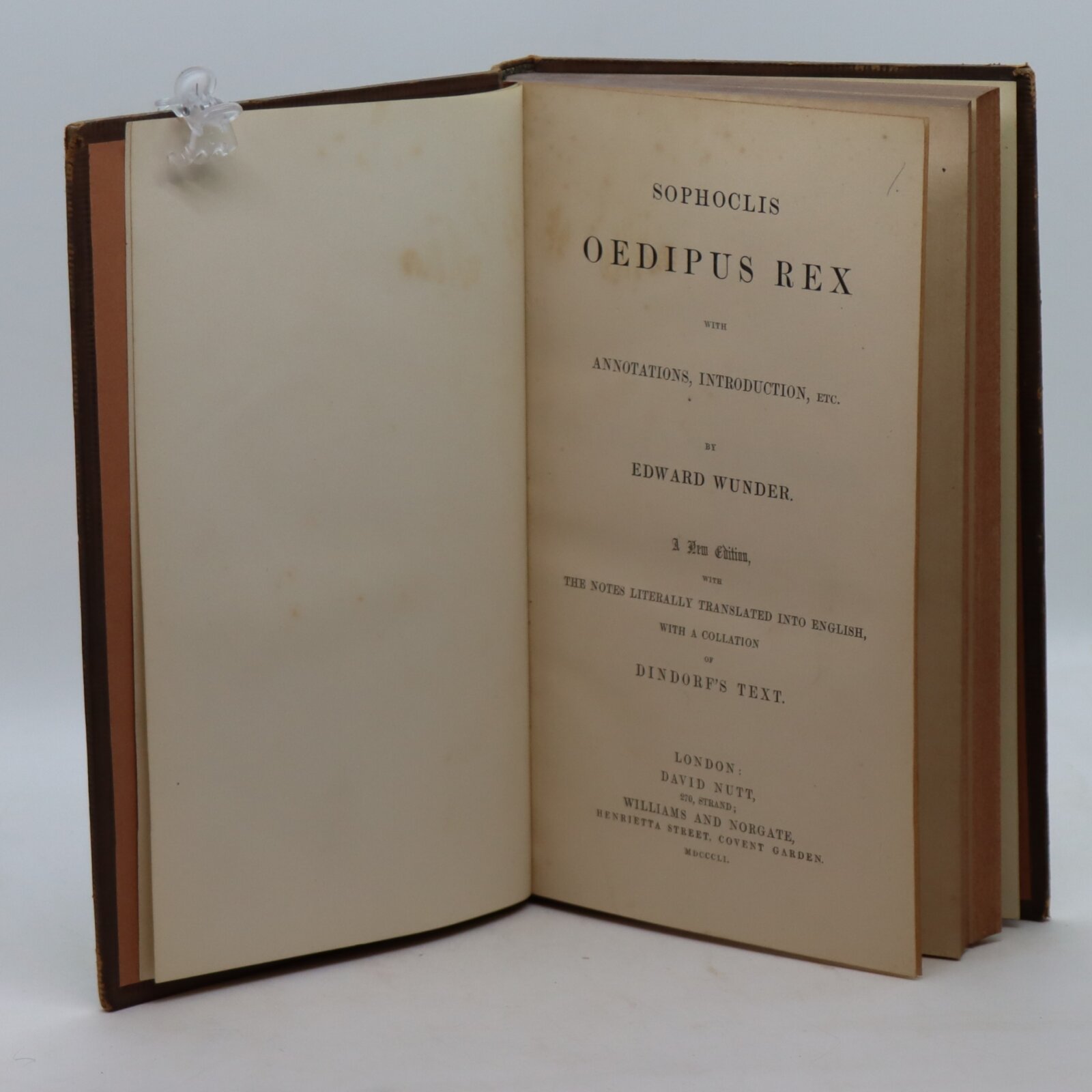
Sophocles. Wunder. Oedipus Rex.
By Edward Wunder
Printed: 1851
Publisher: David Nutt.London
| Dimensions | 14 × 22 × 2.5 cm |
|---|---|
| Language |
Language: English
Size (cminches): 14 x 22 x 2.5
Condition: Fine (See explanation of ratings)
£37.00
Buy Now
Your items

Item information
Description
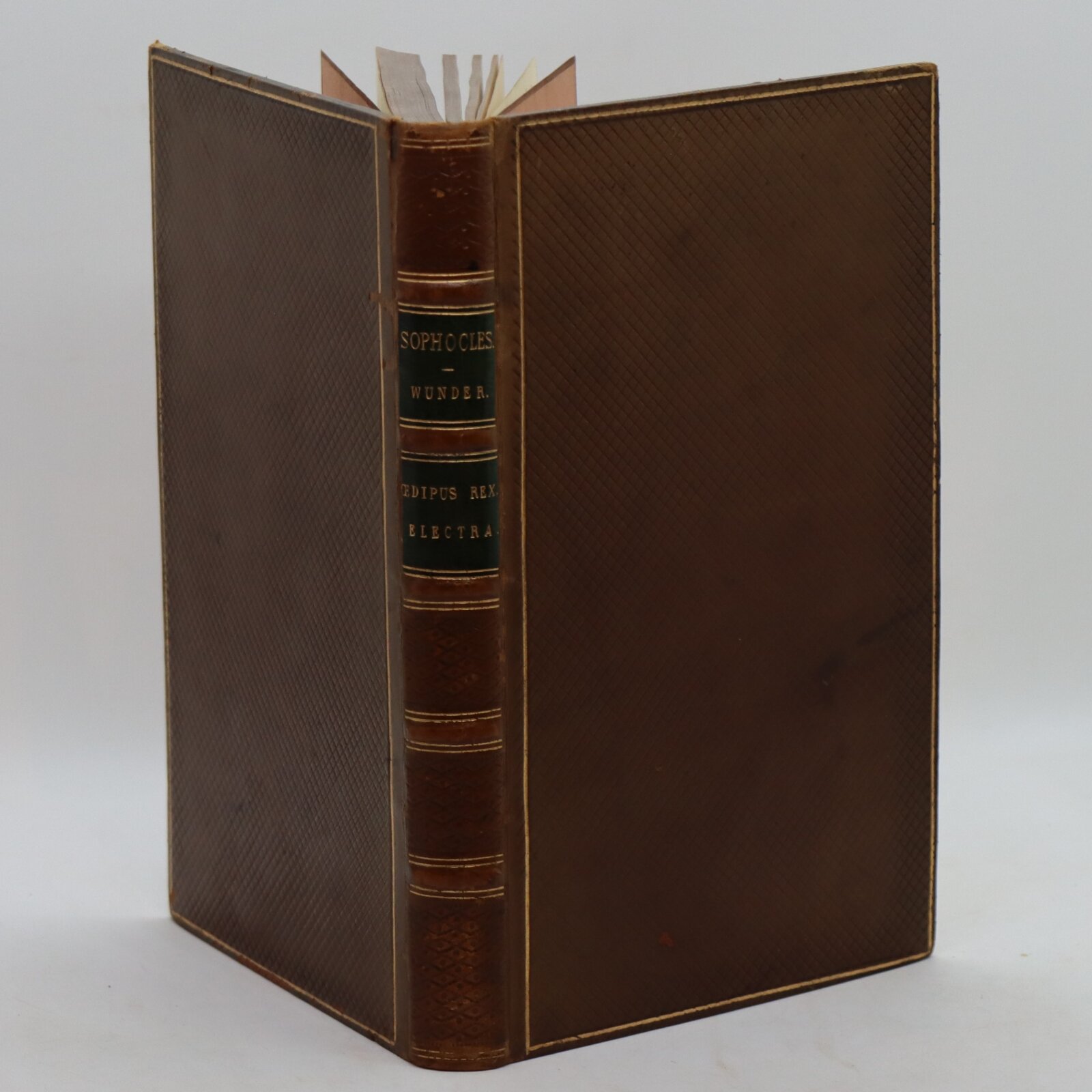
Full tan embossed leather binding. Green title plates with gilt lettering and banding on the spine.
Eduard Wunder (1800–1869) was a German philologist, and from 1843 to 1866 Rector of the Fürstenschule Grimma in Saxony. Wunder was born at Wittenberg on May 4, 1800, the son of Karl Friedrich Wunder, deacon and later archdeacon of the Stadtkirche Wittenberg, and his wife, Christiane Friederike Ebert, daughter of Johann Jacob Ebert, a notable mathematician and astronomer. At the age of twelve, he was sent to the lyceum at Wittenberg, where in 1814 he witnessed the siege and capture of the town from the French by the Prussian general Tauentzien. From 1816 to 1818, he studied at the Fürstliche Landesschule at Meissen. In 1818, he entered the University of Leipzig, where he studied philology under Gottfried Hermann, Christian Daniel Beck, and Friedrich August Wilhelm Spohn. He earned his Doctorate in Philosophy in 1823, and that spring was named Adjunct Professor at the Fürstenschule in Grimma.
Wunder advanced through the ranks of the teachers at Grimma, becoming a Full Professor in 1826, and First Professor in 1843, becoming the twentieth rector of the school. He held the post until his retirement in 1866, teaching at Grimma for forty-three years. He was regarded as an innovative leader, and his personality was seen as the embodiment of Christian humanism. His work came to the attention of the state government at Dresden, and in 1849 he was named a Knight of the Civil Order of Saxony. He was named a Commander Second Class of the order upon his retirement. Wunder was forced to retire in 1866 due to poor health, as he suffered from an influenza-like illness. He never recovered, and died at Grimma on the night of March 24–25, 1869.
Wunder was survived by his wife, the former Antonia Amalia Bär (d. 1871), whom he married in 1826. She was the daughter of Friedrich Gotthold Bär, the mayor of Königstein. Eduard and Antonia had two children: Hermann Wunder (1829–1905), who also taught at Grimma, and Doris Wunder (1834–1908).
Wunder was particularly notable for his work on Sophocles, which was popular both in Germany and abroad. From 1831 to 1850, he published an explanatory edition of the playwright’s work. He also published a critical edition of Cicero’s oration Pro Plancio in 1830, which was highly influential for its insight on Cicero’s use of language.

Oedipus at Colonus by Jean-Antoine-Théodore Giroust (1788), Dallas Museum of Art
Oedipus Rex, also known by its Greek title, Oedipus Tyrannus (Ancient Greek: Οἰδίπους Τύραννος, or Oedipus the King, is an Athenian tragedy by Sophocles that was first performed around 429 BC. Originally, to the ancient Greeks, the title was simply Oedipus (Οἰδίπους), as it is referred to by Aristotle in the Poetics. It is thought to have been renamed Oedipus Tyrannus to distinguish it from Oedipus at Colonus, a later play by Sophocles. In antiquity, the term “tyrant” referred to a ruler with no legitimate claim to rule, but it did not necessarily have a negative connotation.
Of Sophocles’ three Theban plays that have survived, and that deal with the story of Oedipus, Oedipus Rex was the second to be written, following Antigone by about a dozen years. However, in terms of the chronology of events described by the plays, it comes first, followed by Oedipus at Colonus and then Antigone.
Prior to the start of Oedipus Rex, Oedipus has become the king of Thebes while unwittingly fulfilling a prophecy that he would kill his father, Laius (the previous king), and marry his mother, Jocasta (whom Oedipus took as his queen after solving the riddle of the Sphinx). The action of Sophocles’s play concerns Oedipus’s search for the murderer of Laius in order to end a plague ravaging Thebes, unaware that the killer he is looking for is none other than himself. At the end of the play, after the truth finally comes to light, Jocasta hangs herself while Oedipus, horrified at his patricide and incest, proceeds to gouge out his own eyes in despair.
In his Poetics, Aristotle refers several times to the play in order to exemplify aspects of the genre.

Sophocles (c. 497/496 – winter 406/405 BC) was an ancient Greek tragedian, known as one of three from whom at least one play has survived in full. His first plays were written later than, or contemporary with, those of Aeschylus; and earlier than, or contemporary with, those of Euripides. Sophocles wrote over 120 plays, but only seven have survived in a complete form: Ajax, Antigone, Women of Trachis, Oedipus Rex, Electra, Philoctetes, and Oedipus at Colonus. For almost fifty years, Sophocles was the most celebrated playwright in the dramatic competitions of the city-state of Athens which took place during the religious festivals of the Lenaea and the Dionysia. He competed in thirty competitions, won twenty-four, and was never judged lower than second place. Aeschylus won thirteen competitions, and was sometimes defeated by Sophocles; Euripides won four.
The most famous tragedies of Sophocles feature Oedipus and Antigone: they are generally known as the Theban plays, though each was part of a different tetralogy (the other members of which are now lost). Sophocles influenced the development of drama, most importantly by adding a third actor (attributed to Sophocles by Aristotle; to Aeschylus by Themistius), thereby reducing the importance of the chorus in the presentation of the plot. He also developed his characters to a greater extent than earlier playwrights.
Want to know more about this item?
We are happy to answer any questions you may have about this item. In addition, it is also possible to request more photographs if there is something specific you want illustrated.
Ask a question
Related products





Share this Page with a friend
