
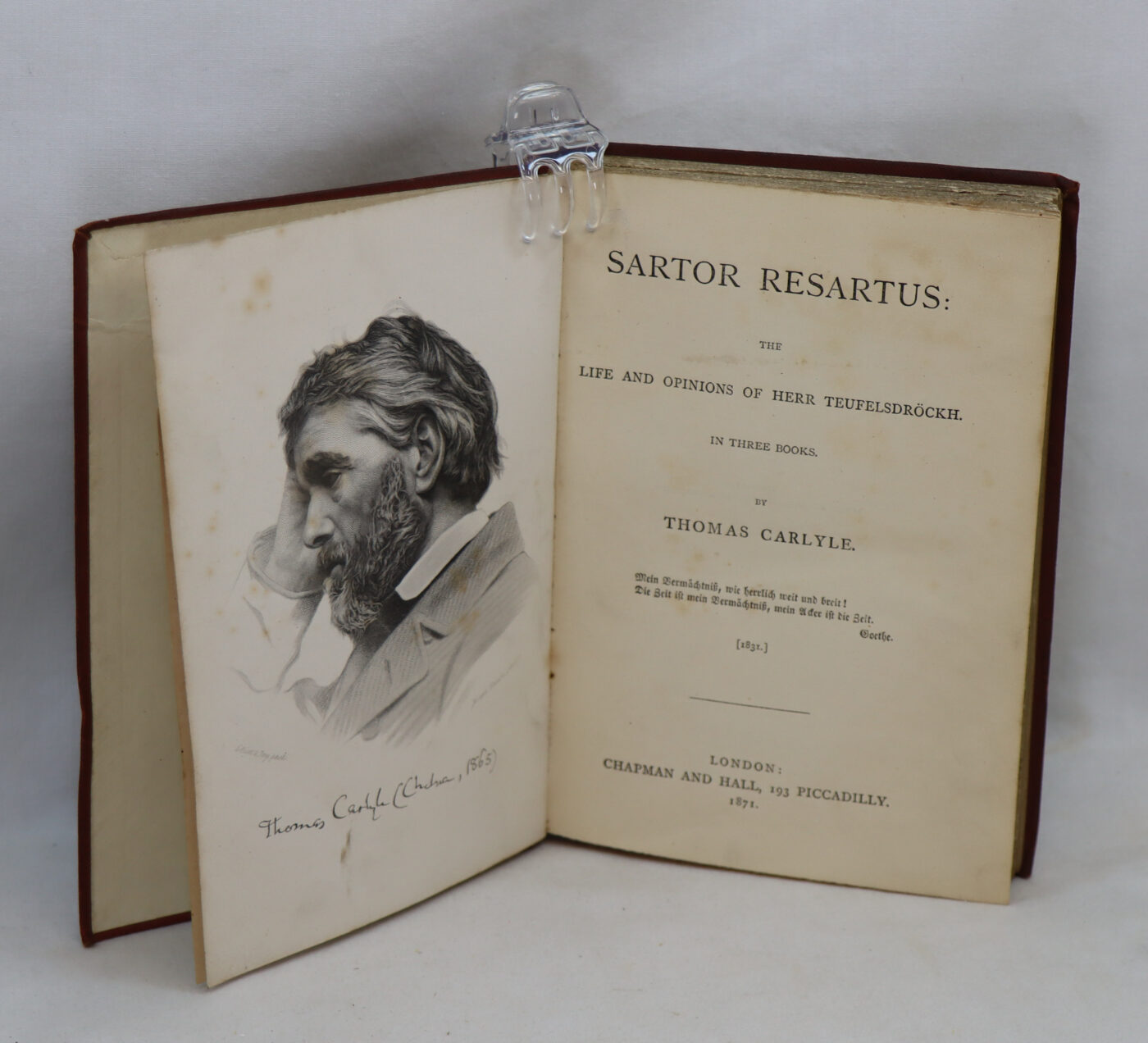
Sartor Resartus. Thomas Carlyle.The Life and Opinions of Herr Teufelsdrockh in Three Books.
By Thomas Carlyle
Printed: 1871
Publisher: Chapman & Hall. London
| Dimensions | 13 × 18 × 2 cm |
|---|---|
| Language |
Language: English
Size (cminches): 13 x 18 x 2
Condition: Fair (See explanation of ratings)
£159.00
FREE shipping
Buy Now
Your items

Item information
Description
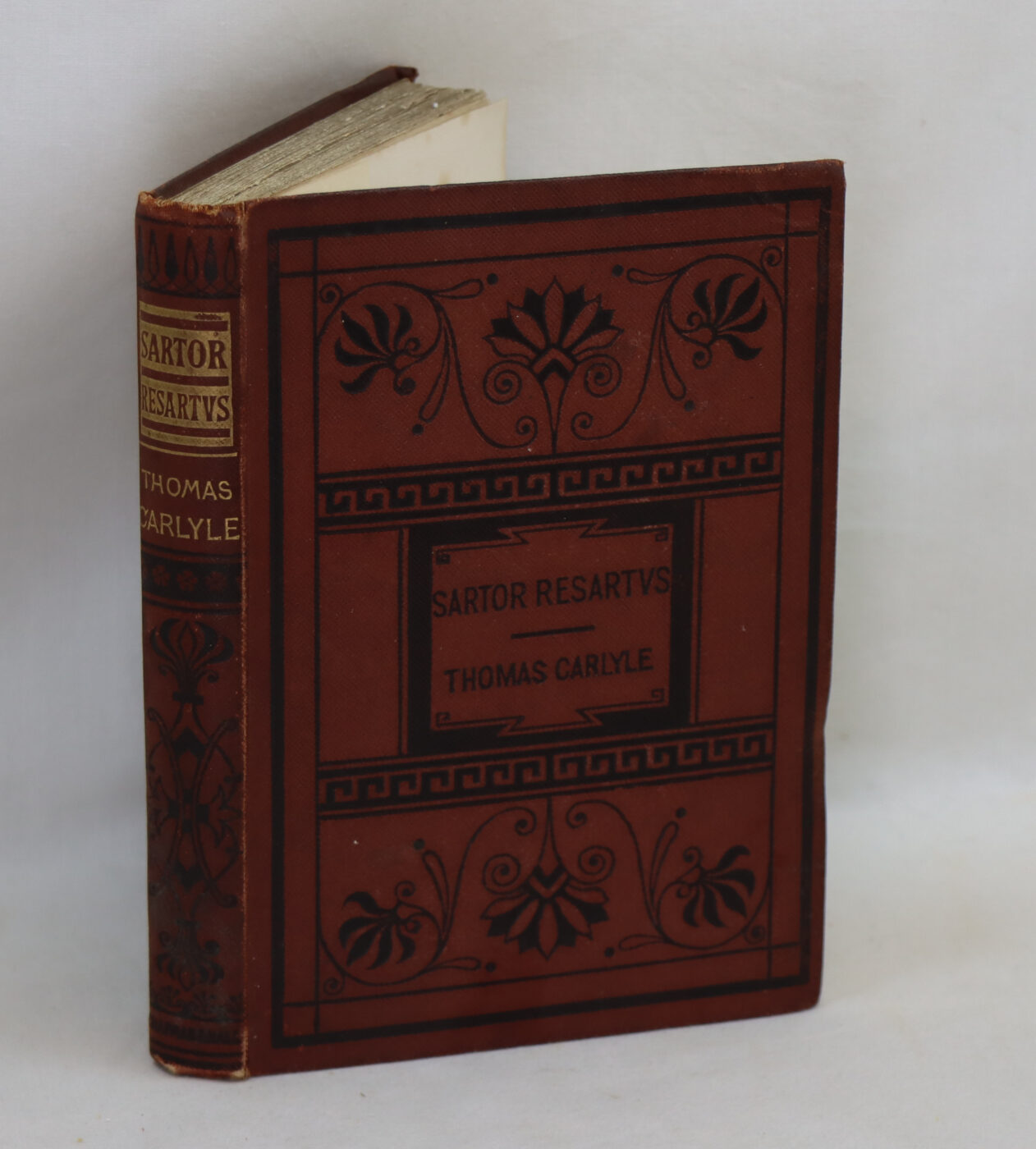
Brown cloth binding with gilt and black title on the spine and front board.
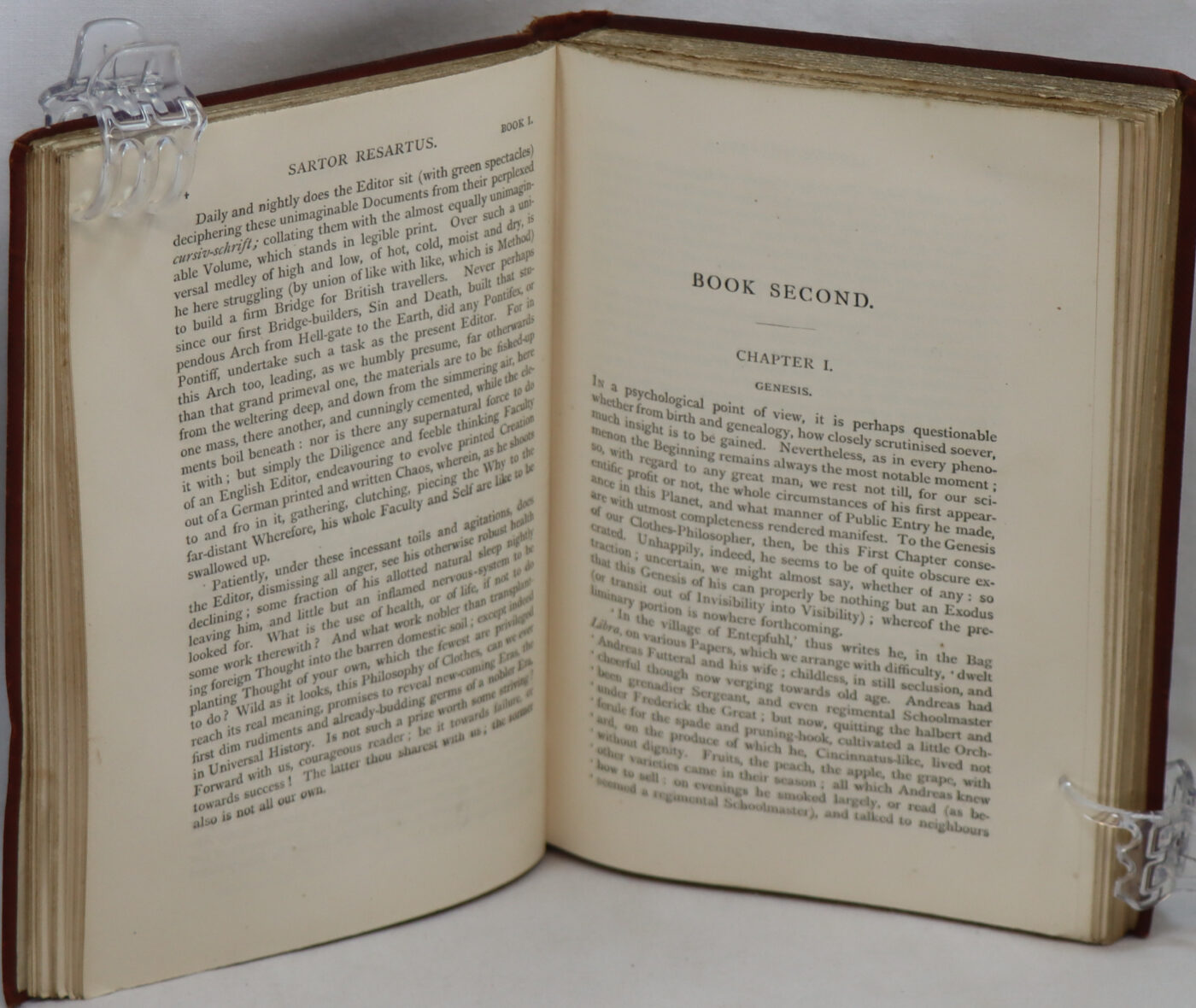
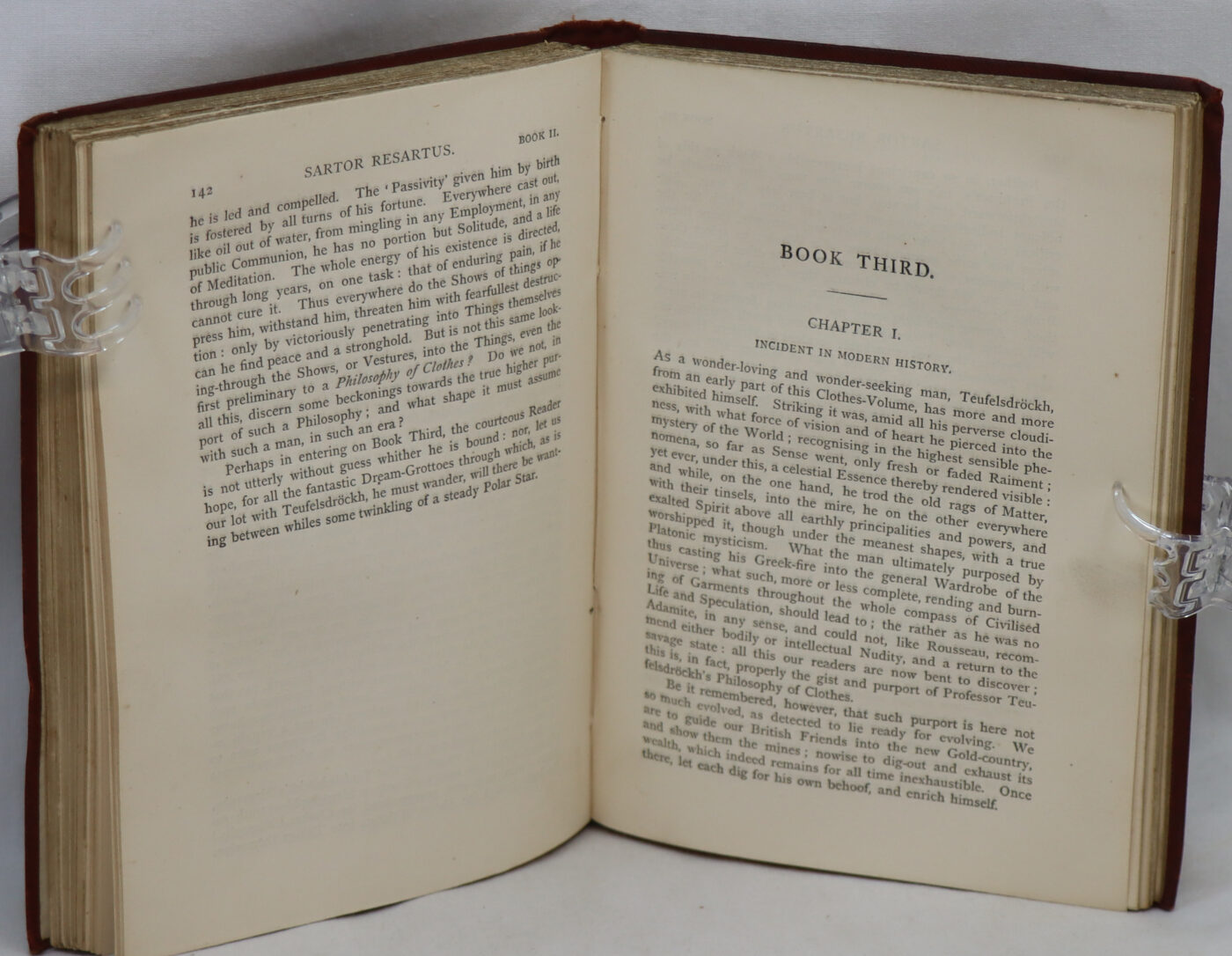
We provide an in-depth photographic presentation of this item to stimulate your feeling and touch. More traditional book descriptions are immediately available
- Note: This book carries a £5.00 discount to those that subscribe to the F.B.A. mailing list
The Life and Opinions of Herr Teufelsdrockh in Three Books
This is a rare, fair to good copy, providing Carlyle’s quality revisions to his original draft. All in all a very worthwhile edition though a difficult to read for those with a little understanding of Hegel.
In the publisher’s original brick red cloth covered boards, blocked and lettered. The work is, in part, a parody of Hegel, and of German Idealism more generally, Carlyle had difficulty finding a publisher for the novel, and began composing it as an article in October 1831 in Fraser’s serialised Magazine in 1833-1834. The text would first appear in book form in Boston in 1836, its publication arranged by Ralph Waldo Emerson, who much admired the book and also Carlyle. Emerson’s savvy dealing with the overseas publishers would ensure Carlyle received high compensation, which the novel did not attain in Britain which was first published in London in 1838.
Reviews:
- Written by Carlyle in the 1830’s, this is a slightly odd novel that sort of straddles several genres. The central metaphor is clothes: the old ones tattered and needing to be torn off and replaced with new ones (a startlingly radical thing to say at a time of national disturbance and civil strife) and the need for people to trust tailors, learn to distinguish what clothes are important and what not (metaphors for civil society reorganizing itself at a time of strife) and behind it all the children’s story of the emperor’s new clothes – which only the outsider(the child, naif) could bring himself to identify properly – worthless – while custom and fear kept others in thrall.It also anticipates many ideas about language and structure and narrative that were to come in the 20th century with the likes of Joyce and Woolfe. It gets five stars for being an important book, exceedingly clever and many, many years ahead of its time.
- I stumbled on this outstanding work and have devoured it in one long long read. It could have been written only yesterday in its commentary on the human condition. Carlyle skewers and roasts the establishment, the church in its guises and fashion. Yet, he displays a great empathy for the have-nots and withering contempt for the wealthy, particularly, inherited wealth. Here is an author, sure footed at the top of his game. He now joins my relatively short list of authors such as JP Donleavy, Rabelais,,Pynchon, Spike Milligan et al. I RECOMMEND that it be read whilst dressed in your red leather one piece and ocelot dressing gown.
Thomas Carlyle (4 December 1795 – 5 February 1881) was a Scottish essayist, historian and philosopher. Known as the “sage of Chelsea”, his writings strongly influenced the intellectual and artistic culture of the Victorian era.mCarlyle was born in Ecclefechan, a village in Dumfriesshire, Scotland. He attended the University of Edinburgh, where he excelled in mathematics and invented the Carlyle circle. After finishing the arts course he prepared to become a minister in the Burgher Church while working as a schoolmaster. He quit these and several other endeavours before settling on literature, writing for the Edinburgh Encyclopædia and working as a translator. He initially gained prominence in English-language literary circles for his extensive writing on German Romantic literature and philosophy. These themes were explored in his first major work, a semi-autobiographical philosophical novel entitled Sartor Resartus (1833–34).mCarlyle eventually relocated to London, where he published The French Revolution: A History (1837). Its popular success made him a celebrity, prompting the collection and reissue of his earlier essays under the title of Critical and Miscellaneous Essays (1838-39). His subsequent works were highly regarded throughout Europe and North America, including On Heroes (1841), Past and Present (1843), Cromwell’s Letters (1845), Latter-Day Pamphlets (1850), and Frederick the Great (1858–65). He founded the London Library, helped to establish the National Portrait Galleries in London and in Edinburgh, became Lord Rector of the University of Edinburgh in 1865 and received the Pour le Mérite in 1874, amongst other honours. Carlyle occupied a central position in Victorian culture, being considered the “undoubted head of English letters” and a “secular prophet”. Posthumously, a series of publications by his friend James Anthony Froude damaged Carlyle’s reputation, provoking controversy about his personal life and his marriage to Jane Welsh Carlyle in particular. His reputation further declined in the aftermaths of the First World War and the Second World War, when his philosophy was seen as a precursor of both Prussianism and fascism. Growing scholarship in the field of Carlyle studies since the 1950s has improved his standing, and although little-read today, he is yet recognised as “one of the enduring monuments of [English] literature”.
NOTE: This is an original book from the library gathered by the famous Cambridge Don, computer scientist, food and wine connoisseur, Jack Arnold LANG. Note: Jack founded the Michelin Guide ‘Midsummer House’- Cambridge’s paramount restaurant. This dining experience is hidden amongst the grassy pastures and grazing cattle of Midsummer Common and perched on the banks of the River Cam.
In 2008, Jack was one of the co-founders of the Raspberry Pi Foundation, alongside other members of the Department, and acted as the Foundation’s Chair. The project’s original goals were modest: to build and distribute low-cost computers for prospective applicants to our Computer Science degree. Initially the project was a “success disaster”, as Jack would say, as demand far outstripped the low-scale manufacturing plans. Ultimately the Raspberry Pi became the UK’s most successful computer with more than 60 million sold to date. Jack was drawn to the educational possibilities of the Raspberry Pi, its potential uses in emerging economies and the way it could support self-directed learning.
Want to know more about this item?
We are happy to answer any questions you may have about this item. In addition, it is also possible to request more photographs if there is something specific you want illustrated.
Ask a question
Share this Page with a friend
