
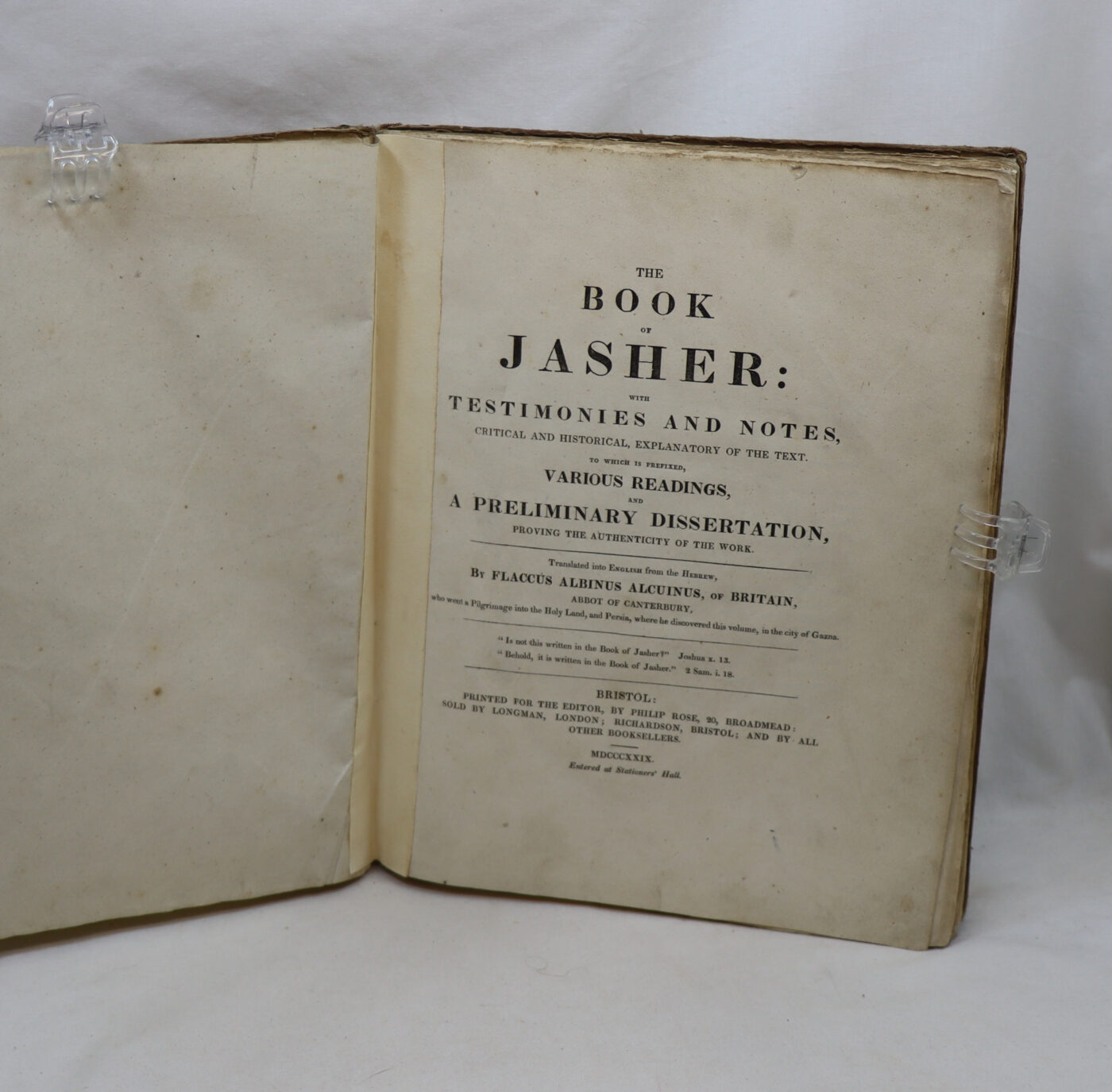
The Book of Jasher: with Testimonies and Notes.
By Flaccus Albinus Alcuinus. Abbot of Canterbury.
Printed: 1829
Publisher: Flaccus Albinus Alcuinus. Abbot of Canterbury.
| Dimensions | 23 × 30 × 1 cm |
|---|---|
| Language |
Language: English
Size (cminches): 23 x 30 x 1
Condition: Fair (See explanation of ratings)
£444.00
FREE shipping
Buy Now
Your items

Item information
Description
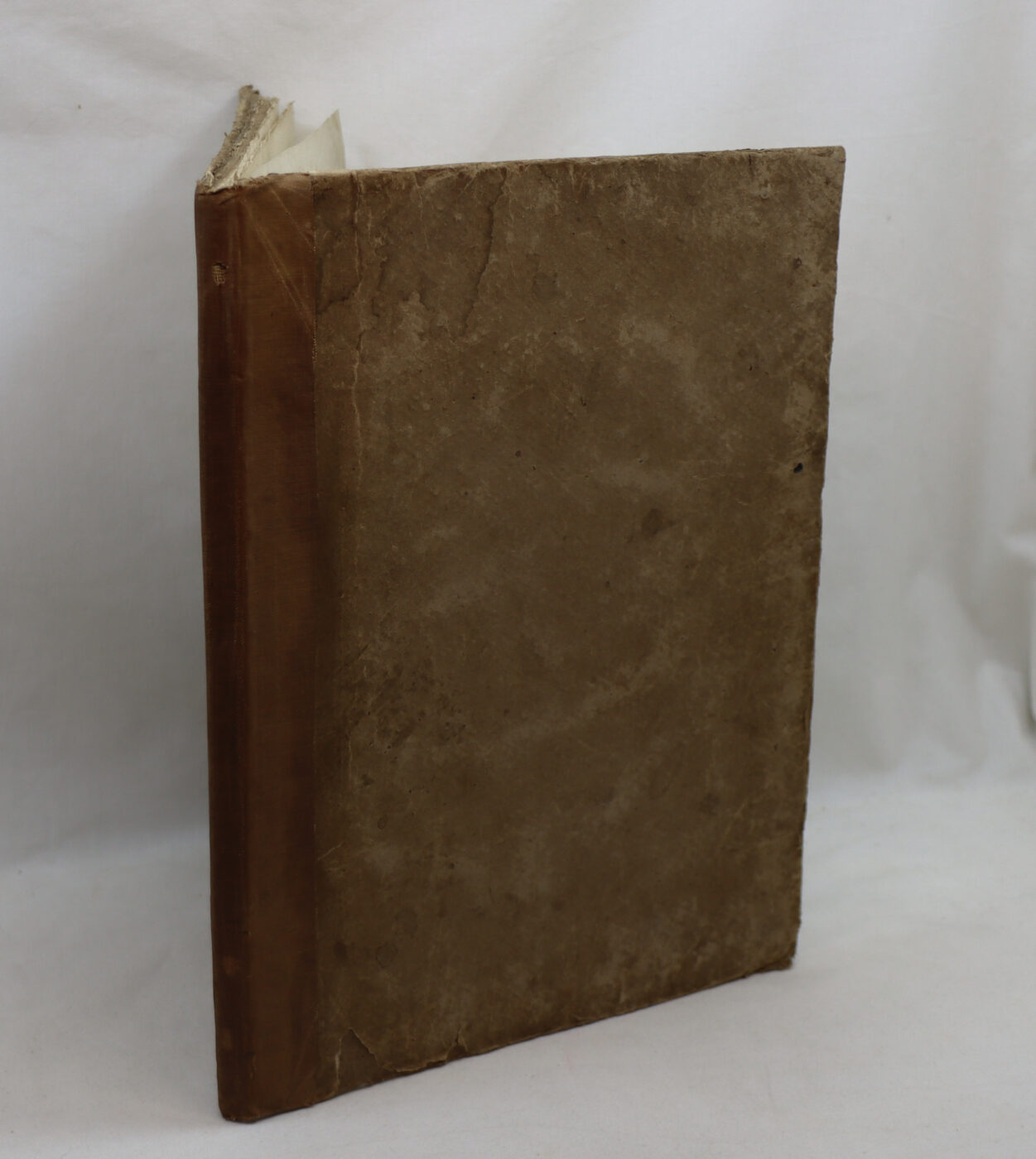
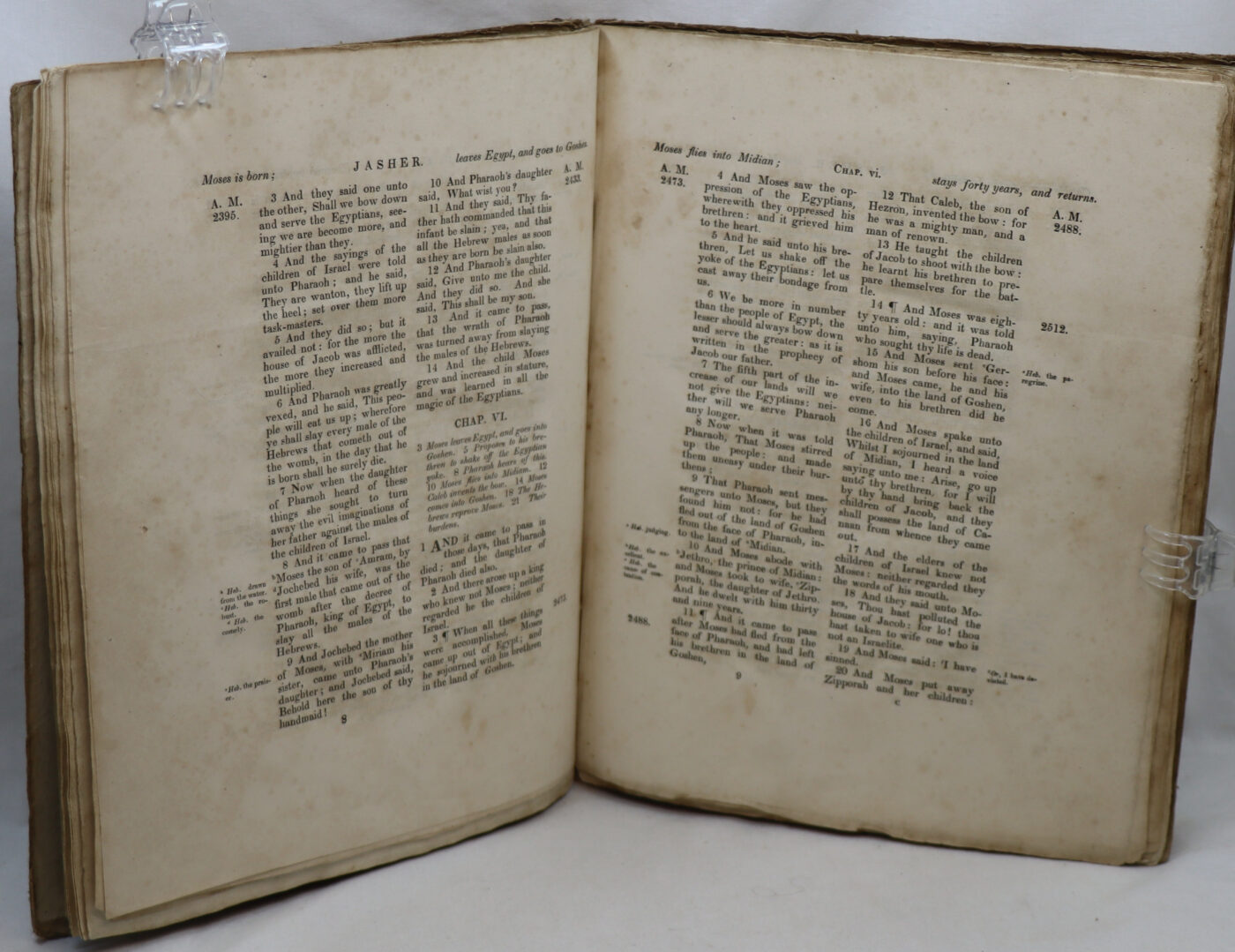
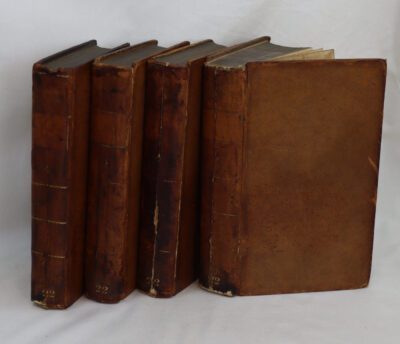
Brown hard board binding with brown cloth spine. No title.
We provide an in-depth photographic presentation of this item to stimulate your feeling and touch. More traditional book descriptions are immediately available.
- Note: This book carries a £5.00 discount to those that subscribe to the F.B.A. mailing list
This is an extremely rare original 19th century fabrication of an 18th century creation. The surprising thing is that today an increasing number of people wish it, or believe it to be true. Consequently, from the early 20th century, many have adopted this book as biblical.
XXXXXXXXXXXXXXXXXXXXXXXXXXXXXXXX
History has given us two very different books by the same name. One of these could be the book of records mentioned in the Holy Bible. The Book Of Jasher, or Sefer Ha Yashar, is referred to in the books of Joshua and Second Samuel.
“Behold it is written in the Book of Jasher.”–II Samuel, i. 18
“Is not this written in the Book of Jasher?”–Joshua, x. 13.
The value of The Book of Jasher is seen in the large quantity of additional detail revealed in the period between divine creation and the time of Joshua’s leadership over Israel when the Israelites enter into the land of Canaan.
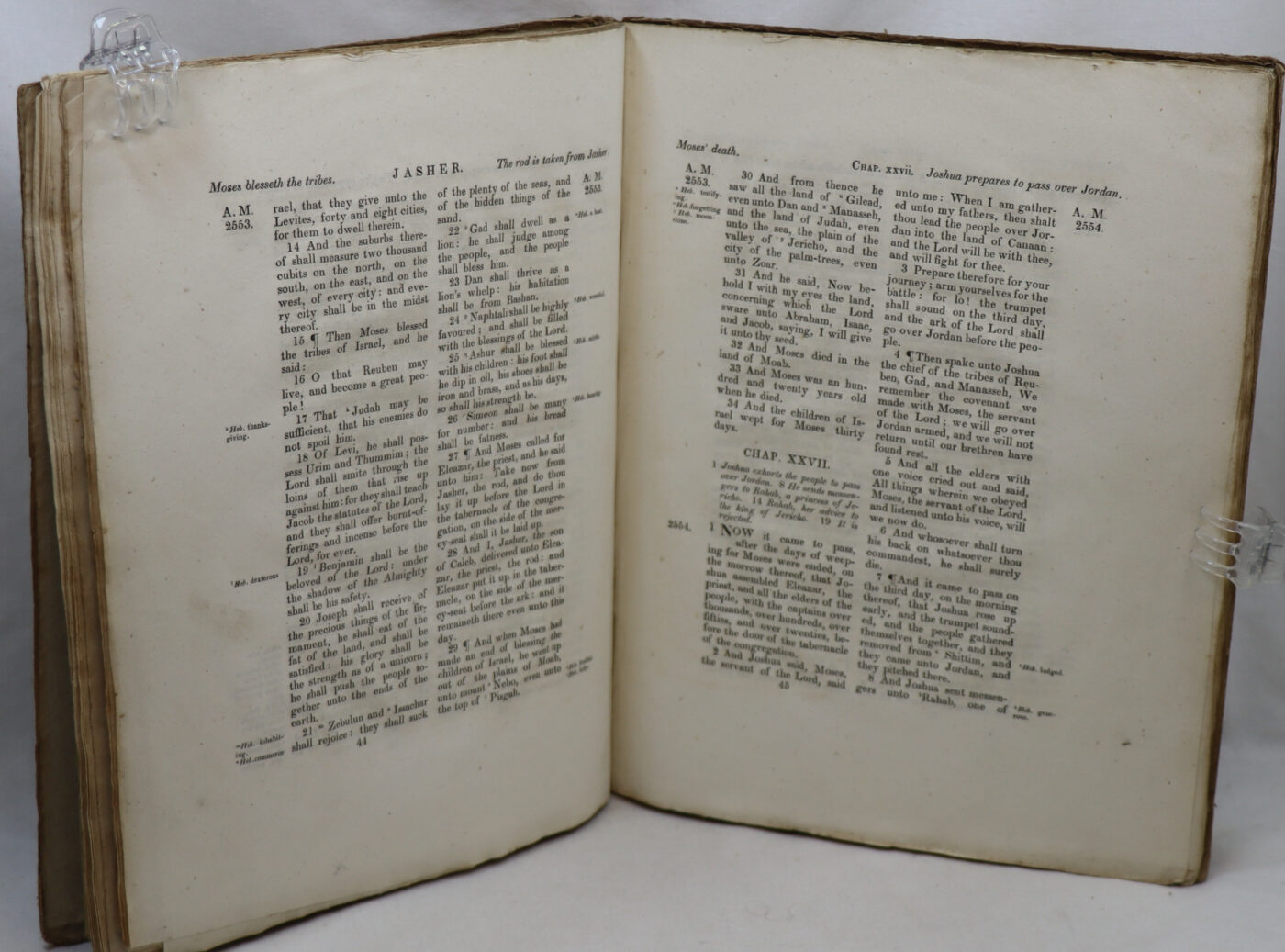
The Books of Jasher includes details about the antediluvian patriarchs, the institution of the Ten Commandments, the establishment of the priesthood, angels, watchers, the flood, the tower of Babel, and many other events mentioned in the Bible. The tales are expanded and infused with detail not previously available.
XXXXXXXXXXXXXXXXXXXXXXXXXXXXXXXXX
This Book of Jasher, also called Pseudo-Jasher, is an eighteenth-century literary forgery by Jacob Ilive. It purports to be an English translation by Flaccus Albinus Alcuinus of the lost Book of Jasher. It is sometimes called Pseudo-Jasher to distinguish it from the midrashic Sefer haYashar (Book of the Upright, Naples, 1552), which incorporates genuine Jewish legend.
Published in November 1750, the title page of the book says: “translated into English by Flaccus Albinus Alcuinus, of Britain, Abbot of Canterbury, who went on a pilgrimage into the Holy Land and Persia, where he discovered this volume in the city of Gazna.” The book claims to be written by Jasher, son of Caleb, one of Moses’s lieutenants, who later judged Israel at Shiloh. The book covers biblical history from the creation down to Jasher’s own day and was represented as the Lost Book of Jasher mentioned in the Bible.
The Book of Jasher contained naturalistic explanations for the miracles of the Old Testament.
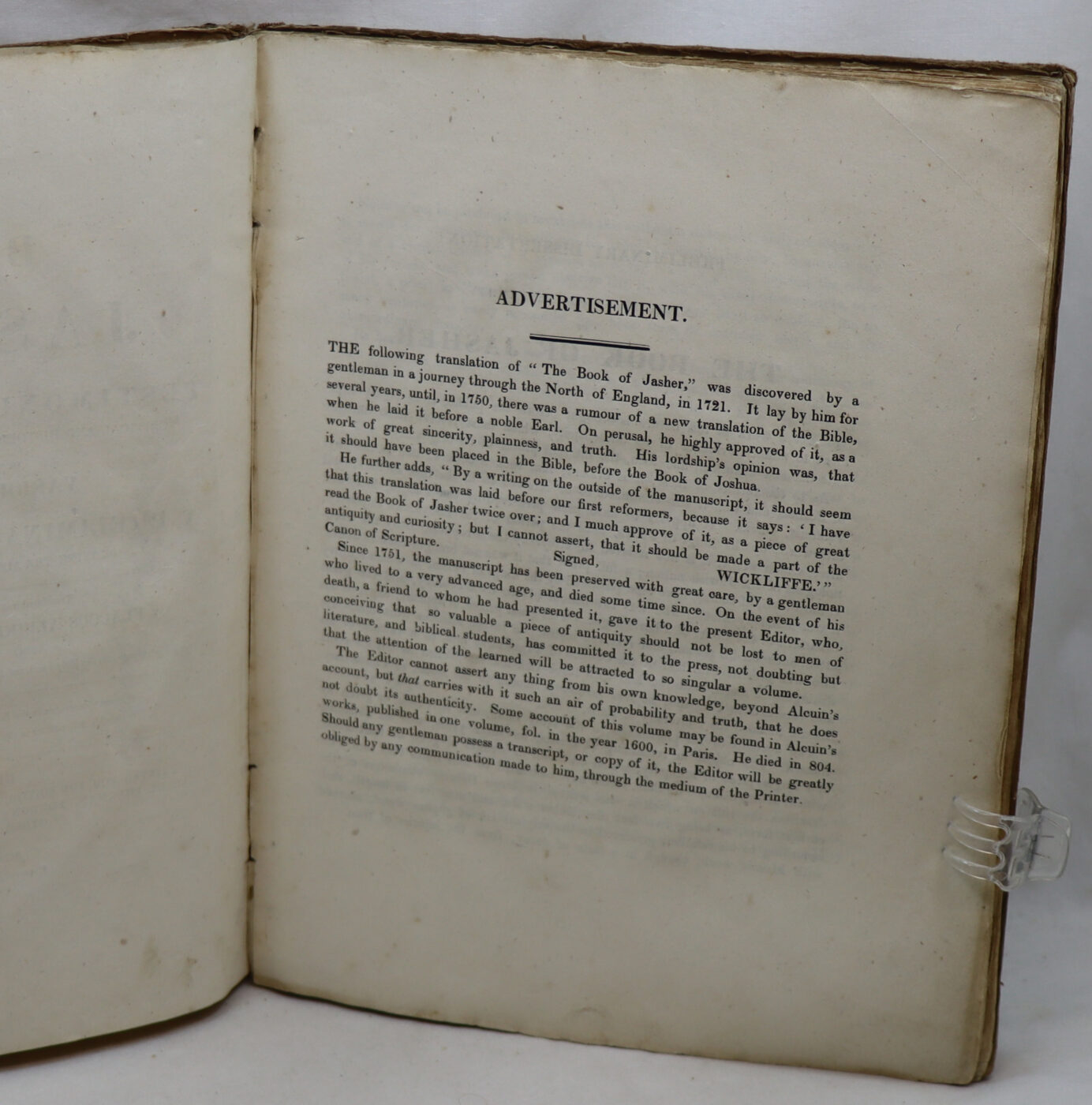
The provenance of the text was immediately suspect: the eighth-century cleric Alcuin could not have produced a translation in the English of the King James Bible. There is an introductory account by Alcuin of his discovery of the manuscript in Persia and its history since the time of Jasher, and a commendation by John Wycliffe.
Reception: The supposed lost book was declared an obvious hoax by the Monthly Review in the December of the year of publication.The printer Jacob Ilive was sentenced in 1756 to three years’ imprisonment with hard labour in the House of Correction at Clerkenwell, for writing, printing, and publishing the anonymous pamphlet Some Remarks on the excellent Discourses lately published by a very worthy Prelate by a Searcher after Religious Truth (1754). The pamphlet was declared to be “a most blasphemous book”, for denying the divinity of Jesus Christ and revealed religion. Ilive remained in jail until 1758, spending time writing.
In 1829, a slightly revised and enlarged edition of the Book of Jasher was published in Bristol, provoking attacks against it. Photographic reproduction of this 1829 edition was published in 1934 by the Rosicrucians in San Jose, California, who declared it an inspired work.
———————————————
Jacob Ilive (1705–1763) was an English type-founder, printer and author. He was a religious radical, who developed neognostic views based on deism. He spent time in prison, convicted of blasphemy. He was the son of Thomas Ilive (died 1724), a London printer of Aldersgate Street, and his wife Jane James (1669–daughter of Thomas James, another printer. Two brothers, Abraham and Isaac, were also printers. He was apprenticed to his father, and freed from the bond in 1726, by his mother. Around 1730, Ilive carried on both a type foundry and a printing business. In 1734 he lived by Aldersgate coffee house. From January 1736 to 1738 he published a rival to Edward Cave’s Gentleman’s Magazine. He sold the foundry in 1740, but kept the printing side going for the rest of his life. He went to live in “London House”, the former residence of Christopher Rawlinson. Ilive died in 1763, aged 58. The printer John Nichols considered him “somewhat disordered in his mind”. Views and gaol sentence: Ilive delivered at Brewers’ Hall on 10 September 1733, and at Joiners’ Hall two weeks later, an Oration on the plurality of worlds and against the doctrine of eternal punishment. He hired Carpenters’ Hall, London Wall, and lectured there on the natural religion. In 1738 he brought out another Oration, for which the venue was Trinity Hall, in Aldersgate Street, on 9 January 1738; it was directed against Henry Felton’s True Discourses, on personal identity in the resurrection of the dead. In 1751 Ilive printed anonymously the Book of Jasher, a purported translation by Alcuin. It was reissued with additions by Rev. Charles Rogers Bond, Bristol, 1829. Behind unconvincing stories of its origin, the book contained naturalistic explanations of Old Testament miracles. On 20 June 1756 Ilive was sentenced to three years’ imprisonment with hard labour in the House of Correction at Clerkenwell, for writing, printing, and publishing an anonymous pamphlet in 1754. Aimed at Thomas Sherlock, it was entitled Some Remarks on the excellent Discourses lately published by a very worthy Prelate by a Searcher after Religious Truth. It was rewritten and enlarged as Remarks on the two Volumes of excellent Discourses lately published by the Bishop of London, 1755. It was declared to be “a most blasphemous book” denying the divinity of Jesus Christ as well as revealed religion. He remained in gaol until 10 June 1758, spending time writing. The sceptical line Ilive took towards the Genesis creation account had something in common with ideas found earlier in Charles Blount and Charles Gildon. A strong influence came from the writings of William Derham, in particular Astro-Theology (1715). In what was a tolerant epoch of the Church of England, Ilive was in a select group, with Peter Annet and Thomas Woolston, of those against whom blasphemy charges were successfully brought. Sherlock, by legal action, sought to discourage Ilive from publishing other deist writers.
Works: In 1730 Ilive printed his major book, The Layman’s Vindication of the Christian Religion, in 2 pts. The parts were:
- The Layman’s general Vindication of Christianity
- The Layman’s Plain Answer to a late Book, a reply to the Grounds and Reasons of Anthony Collins.
His Oration was written in 1729, and published in 1733 (2nd edit. 1736), at the wish of his mother Jane. A Dialogue between a Doctor of the Church of England and Mr. Jacob Ilive upon the subject of the Oration spoke at Joyners’ Hall, wherein is proved that the Miracles said to be wrought by Moses were artificial acts only, followed in the same year, in support of the Oration.
In relation to his profession, Ilive wrote:
- Speech to his Brethren the Master Printers on the great Utility of the Art of Printing at a General Meeting 18th July 1750, London, no date.
- The Charter and Grants of the Company of Stationers, with Observations and Remarks thereon, 1762, a pamphlet. It dealt with Ilive’s grievances against the management of the Stationers’ Company, and he called a meeting on 3 July. A committee was appointed to inquire into the state of the company, and a new master and wardens elected.
Two further pamphlets were:
- Reasons Offered for the Reformation of the House of Correction in Clerkenwell … To which is Prefixed, a Plan of the Said Prison, … (1757)
- A Scheme (1759) for the employment of persons sent to prison as disorderly.
XXXXXXXXXXXXXXXXXXXXXXXXXXXXXXXXXXXXXXXXXX
The Book of Jasher (also spelled Jashar), which means the Book of the Upright or the Book of the Just Man, is a lost book mentioned in the Hebrew Bible, often interpreted as a lost non-canonical book. Numerous forgeries purporting to be rediscovered copies of this lost book have been written. A different interpretation identifies it as a reference to the Pentateuch, specifically the Book of Genesis, an interpretation which is notably favored by the Jewish scholar Rashi in his commentary on the Hebrew Bible (see below his commentary on Joshua).
The title “Book of the Just Man” is the traditional Greek and Latin translation.
Biblical references
The book is mentioned twice in the Hebrew Bible. A possible third reference exists with a variant spelling.
In Joshua
According to the Book of Joshua, while Joshua was winning a battle against Adonizedek (king of Jerusalem) and his allies, Joshua prayed for the sun and moon to stand still. Joshua 10:13 then states:
And the Sun stood still, and the Moon stayed,
until the people had avenged themselves on their enemies.
Is this not written in Sefer HaYashar?
— Joshua 10:13
The presence of this event in a book of poetry has been interpreted as a poetic description of the prolonged battle.
According to the medieval Jewish scholar Rashi, “Sefer HaYashar” in this verse refers to the Pentateuch: Jacob‘s prophecy regarding Joshua’s ancestor Ephraim—”His seed will fill the nations” —was fulfilled when Joshua’s victory gave him renown among the various nations who heard of the victory.
In Samuel
According to the Book of Samuel, when David spoke his lament over the deaths of Saul and Jonathan, he began as follows:
To teach the sons of Judah [the use of] the bow. Behold, it is written in the book of Jasher.
— 2 Samuel 1:18
The King James Version of the English Bible includes the words “the use of” in italics, material which its translator(s) added in order to render the text into what they considered understandable and comfortable English. According to some other translations such as the English Standard Version “The Bow” which David taught is hypothesised as a poetic lament over the deaths of Saul and Jonathan. According to this interpretation, this “Bow” refers to a lament or a tune in the Book of Jashar which that book also says was taught to the Israelites.
The Septuagint translation renders Sefer haYashar in both cases as the “Book of the Just”. It also misses the reference to “the bow”. It reads:
And he gave orders to teach it to the sons of Judah: behold, it is written in the book of the just.
— 2 Samuel 1:18, Septuagint
In Kings
A possible third reference appears in 1 Kings 8. In the Septuagint (though not in the Hebrew text or most translations), verse 8:53 says that the preceding prayer of Solomon is written “in the book of song”. The Hebrew version of “book of song”, which is the same as Sefer HaYashar with two letters transposed. According to Alexander Rofeh, this suggests that the name Sefer HaYashar could be related to its function as a hymnal, and the second word might have originally been שיר (shir, “song”) or ישיר (yashir, “he will sing”).
—————————————————-
NOTE: This is an original book from the library gathered by the famous Cambridge Don, computer scientist, food and wine connoisseur, Jack Arnold LANG. Note: Jack founded the Michelin Guide ‘Midsummer House’- Cambridge’s paramount restaurant. This dining experience is hidden amongst the grassy pastures and grazing cattle of Midsummer Common and perched on the banks of the River Cam.
In 2008, Jack was one of the co-founders of the Raspberry Pi Foundation, alongside other members of the Department, and acted as the Foundation’s Chair. The project’s original goals were modest: to build and distribute low-cost computers for prospective applicants to our Computer Science degree. Initially the project was a “success disaster”, as Jack would say, as demand far outstripped the low-scale manufacturing plans. Ultimately the Raspberry Pi became the UK’s most successful computer with more than 60 million sold to date. Jack was drawn to the educational possibilities of the Raspberry Pi, its potential uses in emerging economies and the way it could support self-directed learning
Want to know more about this item?
We are happy to answer any questions you may have about this item. In addition, it is also possible to request more photographs if there is something specific you want illustrated.
Ask a question
Related products

Share this Page with a friend
