
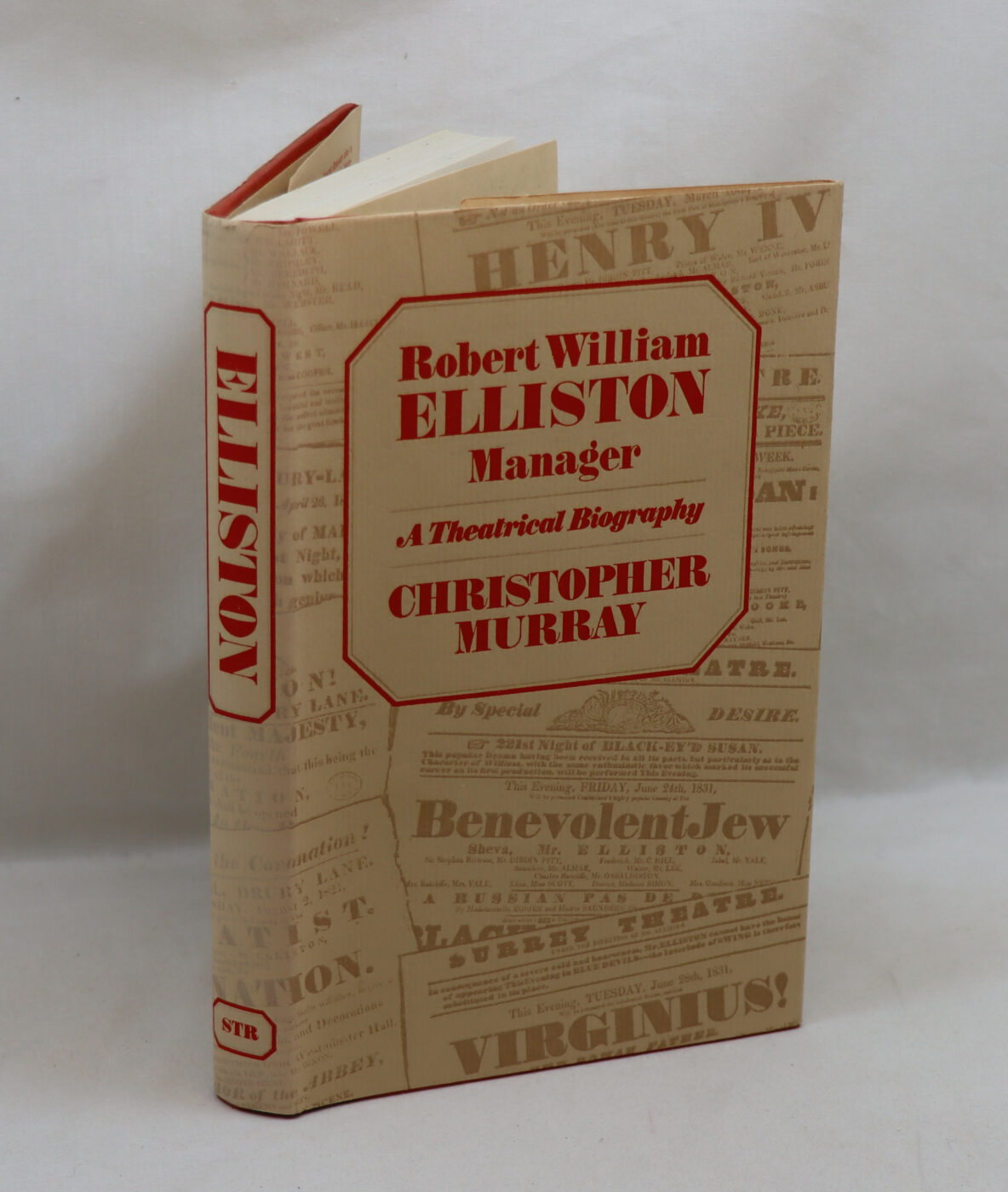
Robert William Elliston. Manager.
By Christopher Murray
Printed: 1975
Publisher: The Society for Theatre Research. London
Edition: First edition
| Dimensions | 15 × 22 × 2 cm |
|---|---|
| Language |
Language: English
Size (cminches): 15 x 22 x 2
Condition: Very good (See explanation of ratings)
£44.00
Buy Now
Your items

Item information
Description
In the original dust jacket. Red cloth binding with gilt title on the spine.
We provide an in-depth photographic presentation of this item to stimulate your feeling and touch. More traditional book descriptions are immediately available
- Note: This book carries a £5.00 discount to those that subscribe to the F.B.A. mailing list
For conditions, please view our photographs. An original book from the library gathered by the famous Cambridge Don, computer scientist, food and wine connoisseur, Jack Arnold LANG.
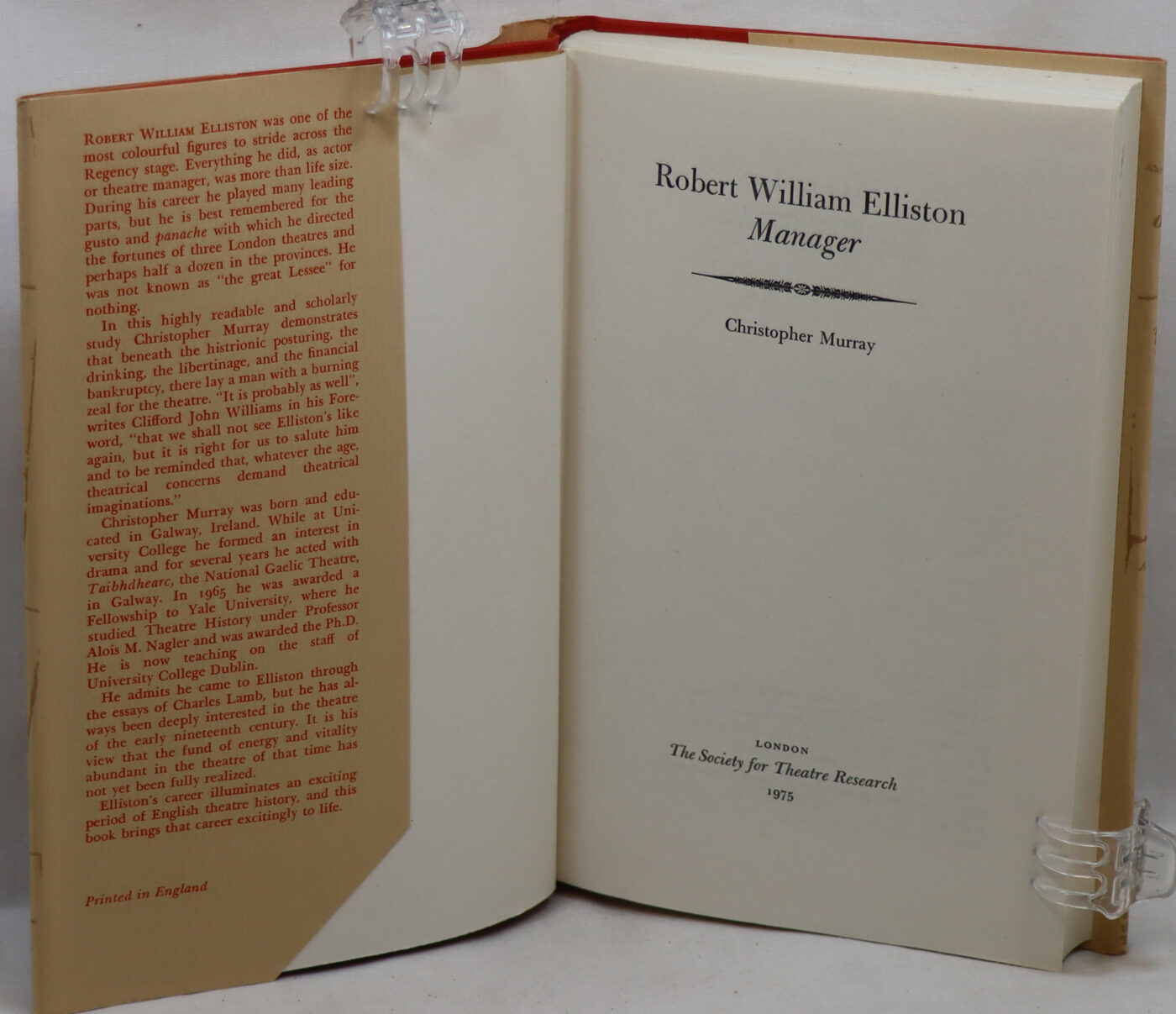
Once the property of Jack’s mother, a collector’s edition of a very well kept first edition. Still contains much useful information. Well worth the read. Please view the dustflap for more details.
This text describes an academic thesis re-evaluating actor/manager Robert William Elliston’s crucial role in challenging London’s theatrical “patent” monopolies (Covent Garden & Drury Lane) in the 1810s, arguing his fight democratized theatre by ending the monopoly, allowing more accessible performance of “legitimate” plays for all classes, a significant shift from earlier scholarship that underplayed his impact.
Here’s a breakdown:
-
Subject: Robert William Elliston, a prominent actor and theatre manager.
-
Historical Context: The “patent” cartel (two major patent theatres holding monopoly rights to all plays) in London theatre.
-
Elliston’s Role: He was a key figure in fighting this monopoly, a struggle noted in 1926 but under-researched since.
-
Thesis Goal: To re-assess Elliston’s influence in breaking the cartel and the broader impact (ideological/social) of abolishing the monopoly.
-
Outcome: After the monopoly ended, theatre became more open, allowing different social classes to see traditional (legitimate) plays.
This book reveals the complexity of relationships inherent in a system of theatre governance shaped by exclusive rights. Royal patents granted in 1662 entrusted sole guardianship of the ‘national’ or ‘regular’ drama to two ‘patent’ or ‘legitimate’ theatres (ultimately, established as The Theatres Royal Drury Lane and Covent Garden). These held privileged access to the traditional canon of serious, literary drama, including Shakespeare. The monopoly regime’s power, re-affirmed in The Theatre Licensing Act 1737, prevented all other playhouses, labelled ‘minor’, from producing the national corpus of plays, and from employing ‘the spoken word’: continuous speech unaccompanied by music. ‘Minor’ theatres were restricted to exhibitions of movement, music, and rhyme, commonly termed ‘burletta’. By the early 1800s a consensus held the ‘patent’ regime responsible for degrading rather than preserving dramatic standards. Actor/manager Robert William Elliston purchased his first London ‘minor’ theatre in February 1809. From that moment he began a largely self-interested campaign to overthrow the monopoly. Seeking an equitable footing, Elliston made a series of formal challenges, but when they failed he abandoned official channels. Thereafter, while remaining within the law, he adopted subversive means to gain his goal of a free stage. The Times’s review of
Elliston’s pioneering role in the struggle for reform, recorded in 1926, has been little researched since. Elliston’s agency in the ‘patent’ cartel’s demise, so contributing to a re-assessment of the narrative of the monopoly regime, and the ideological and social significance of its abolition. Once free competition was achieved, the theatre became a space in which the ‘legitimate’ canon could be accessed by every class of theatre-goer.
Want to know more about this item?
We are happy to answer any questions you may have about this item. In addition, it is also possible to request more photographs if there is something specific you want illustrated.
Ask a question
Share this Page with a friend
