
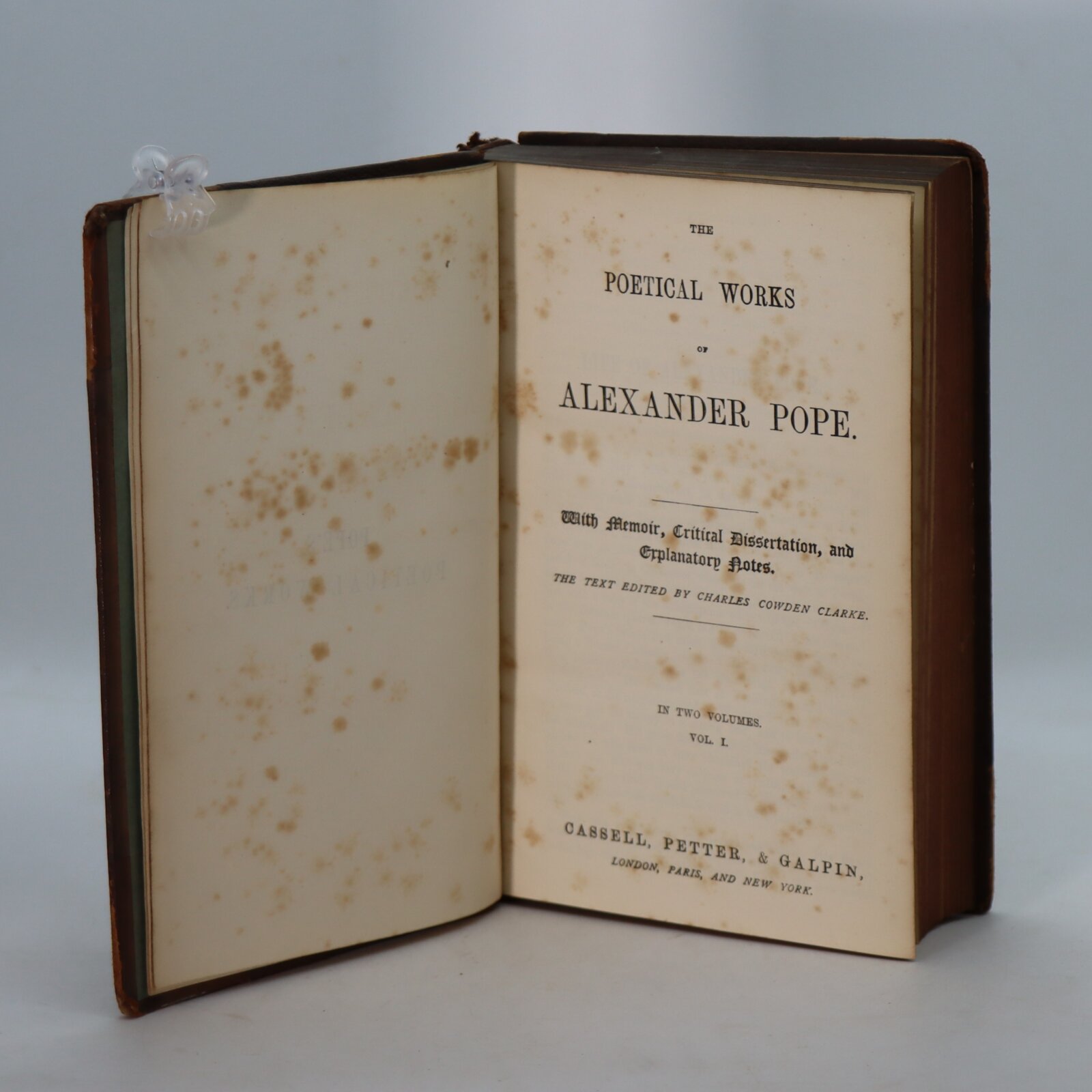
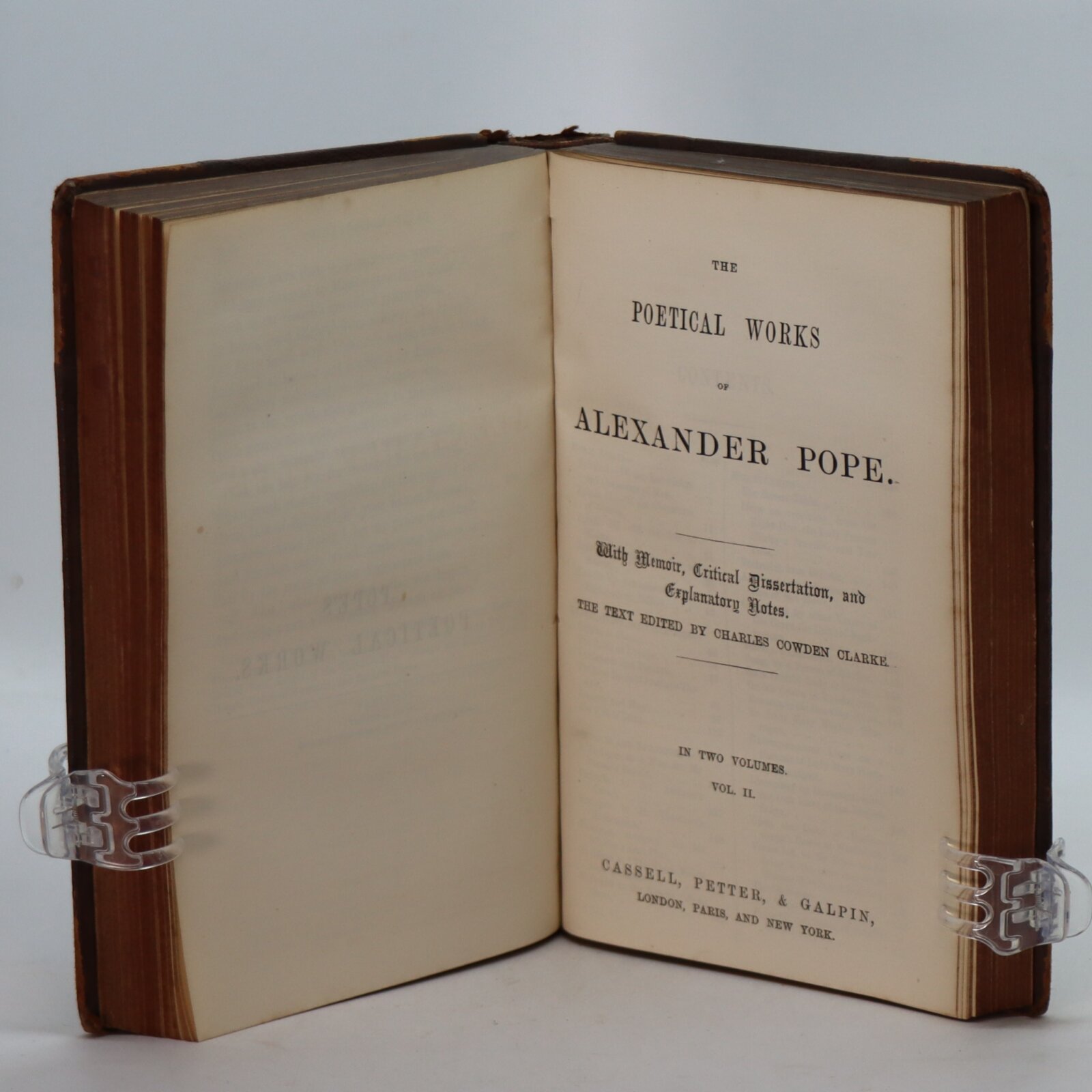
Pope's Poetical Works. ( Vol. I & II as one).
By Alexander Pope
Printed: Circa 1850
Publisher: Cassell Petter & Galpin. London
| Dimensions | 14 × 20 × 3.5 cm |
|---|---|
| Language |
Language: English
Size (cminches): 14 x 20 x 3.5
Condition: Fine (See explanation of ratings)
£95.00
Buy Now
Your items

Item information
Description
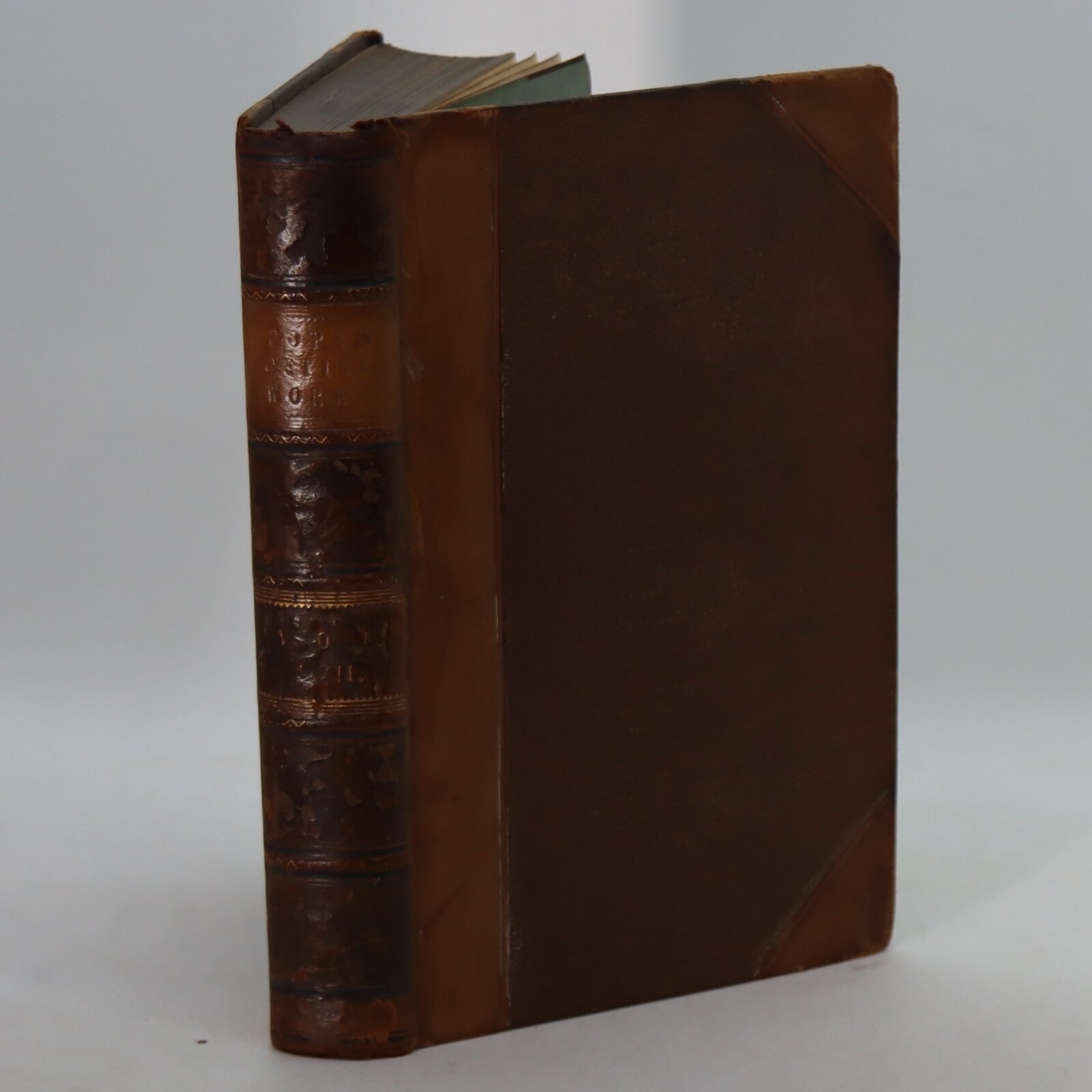
Brown leather spine with gilt banding and tan title plate. Textured brown boards. Two volumes in one book.
F.B.A. provides an in-depth photographic presentation of this item to stimulate your feel and touch. More traditional book descriptions are immediately available.
A little foxing on the front page of volume I, hence the price
Alexander Pope (21 May 1688 – 30 May 1744) was an English poet, translator, and satirist of the Augustan period and one of its greatest artistic exponents. Considered the foremost English poet of the early 18th century and a master of the heroic couplet, he is best known for satirical and discursive poetry, including The Rape of the Lock, The Dunciad, and An Essay on Criticism, and for his translation of Homer. After Shakespeare, he is the second-most quoted author in The Oxford Dictionary of Quotations, some of his verses having entered common parlance (e.g. “damning with faint praise” or “to err is human; to forgive, divine”).
By the mid-18th century, new fashions in poetry emerged. A decade after Pope’s death, Joseph Warton claimed that Pope’s style was not the most excellent form of the art. The Romantic movement that rose to prominence in early 19th-century England was more ambivalent about his work. Though Lord Byron identified Pope as one of his chief influences – believing his own scathing satire of contemporary English literature English Bards and Scotch Reviewers to be a continuance of Pope’s tradition – William Wordsworth found Pope’s style too decadent to represent the human condition. George Gilfillan in an 1856 study called Pope’s talent “a rose peering into the summer air, fine, rather than powerful”.
Pope’s reputation revived in the 20th century. His work was full of references to the people and places of his time, which aided people’s understanding of the past. The post-war period stressed the power of Pope’s poetry, recognising that Pope’s immersion in Christian and Biblical culture lent depth to his poetry. For example, Maynard Mack, in the late 20th-century, argued that Pope’s moral vision demanded as much respect as his technical excellence. Between 1953 and 1967 the definitive Twickenham edition of Pope’s poems appeared in ten volumes, including an index volume.
Charles Cowden Clarke (15 December 1787 – 13 March 1877), English author and Shakespearian scholar, was born in Enfield, Middlesex.
Condition notes
spine scuffed
Want to know more about this item?
We are happy to answer any questions you may have about this item. In addition, it is also possible to request more photographs if there is something specific you want illustrated.
Ask a question
Related products



Share this Page with a friend
