
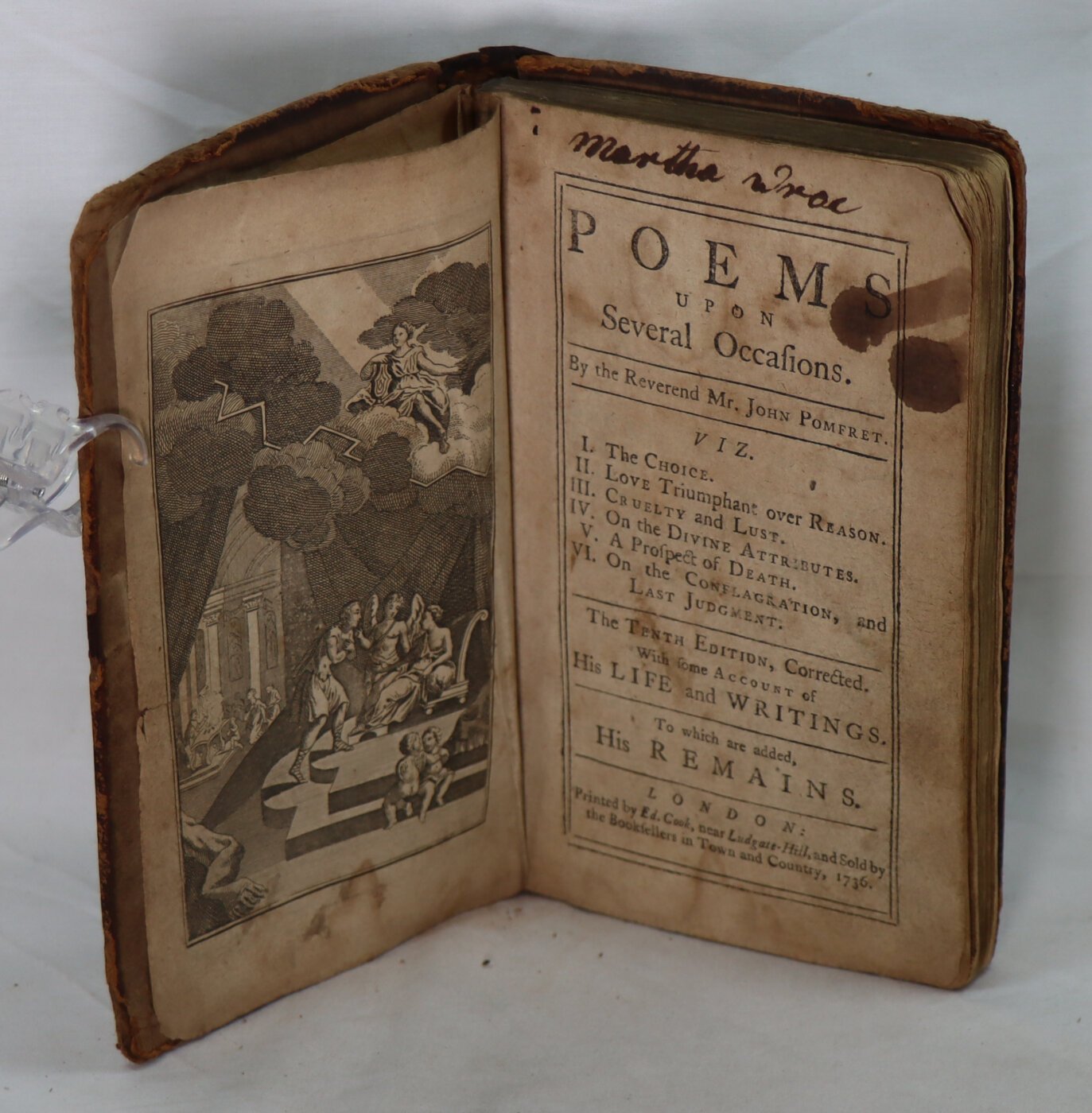
Poems upon Several Occasions.
By Rev John Pomfret
Printed: 1736
Publisher: The Booksellers. London
| Dimensions | 11 × 16 × 2 cm |
|---|---|
| Language |
Language: English
Size (cminches): 11 x 16 x 2
Condition: Good (See explanation of ratings)
£108.00
Buy Now
Your items

Item information
Description
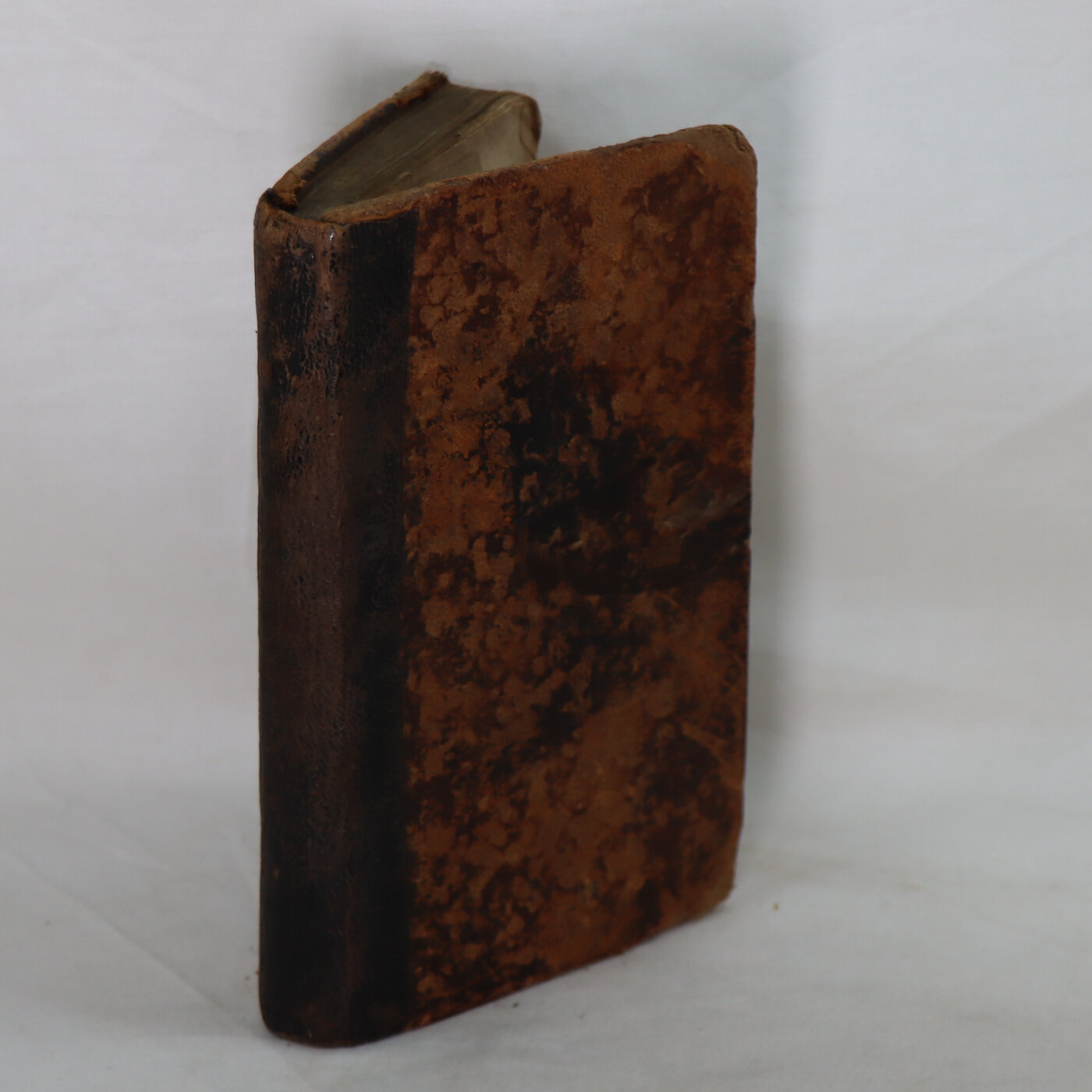
Black leather spine, Tan leather boards.
F.B.A. provides an in-depth photographic presentation of this item to stimulate your feeling and touch. More traditional book descriptions are immediately available
Note: This book carries the £5.00 discount to those that subscribe to the F.B.A. mailing list.
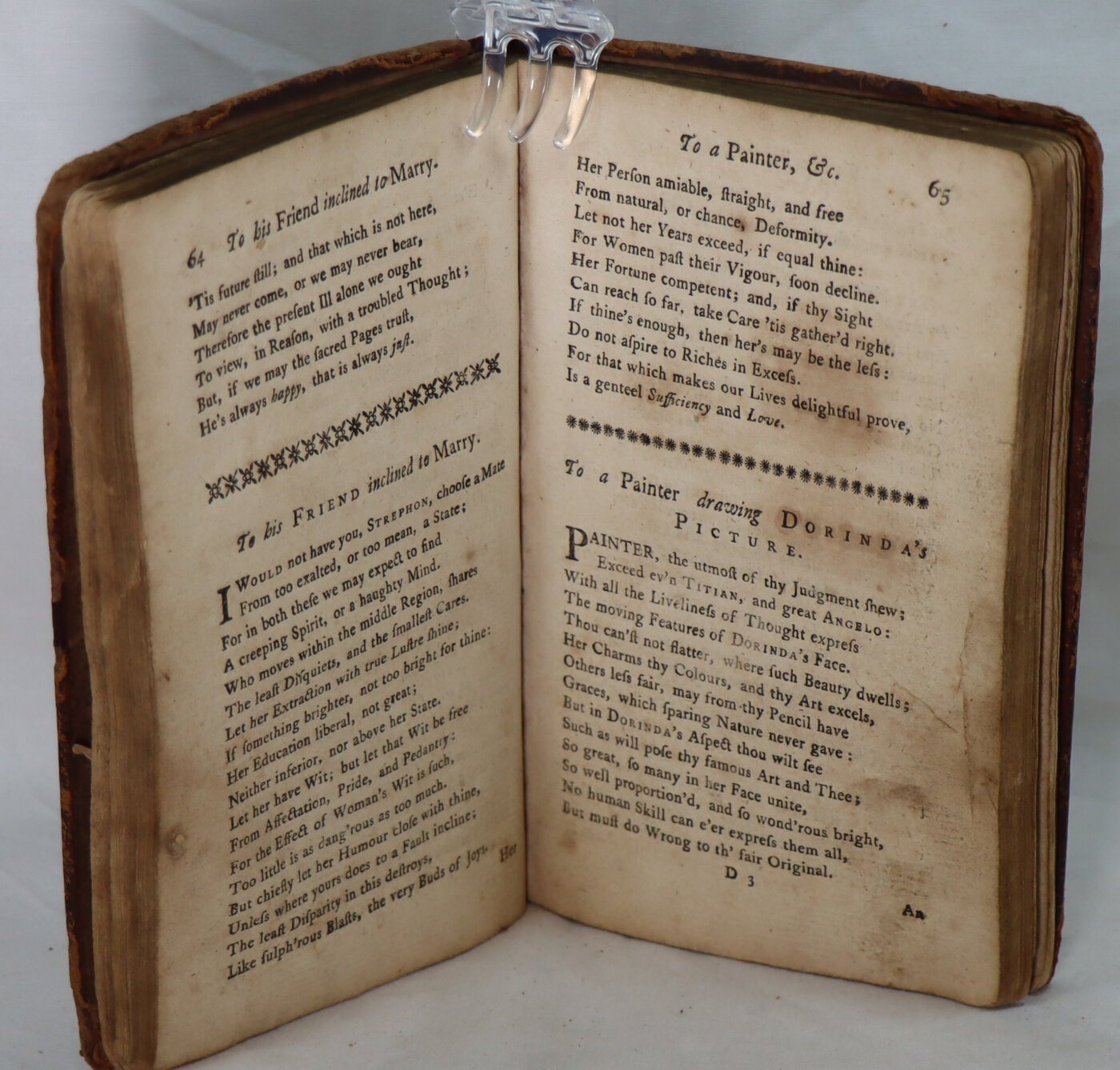
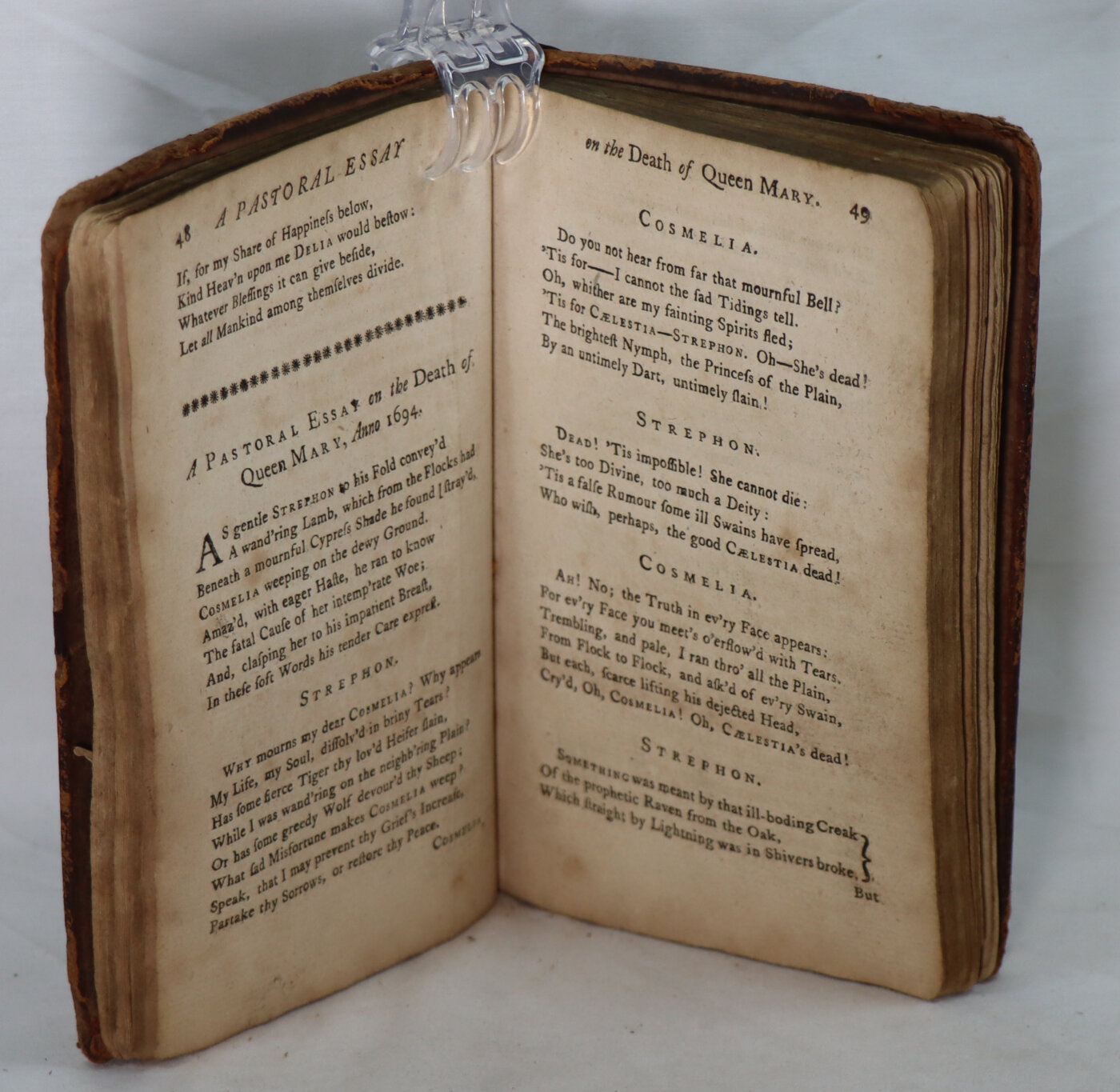
In a full calf binding. Externally, worn but internally, generally in fine condition apart from the front plate. This book is firmly bound though some pages are age toned, particularly to the edges. Pomfret 1667-1702, poet & clergyman, best remembered for The Choice in which he praised the country life of a bachelor, with witty male friends and a ‘witty nymph’ living nearby. When seeking preferment from the Bishop of London in 1702, the bishop kept him waiting believing Pomfret was an advocate of keeping a mistress. While waiting, Pomfret caught the smallpox and died.
To understand Pomfret and 18th century England I post an article by Jack Thomas written on December 1st, 2015.
The 18th Century – Nature Methodised, the Age of Reason & Elegance – Here is the longest poem I have inflicted on you, some 156 lines. It is written in 1700 by John Pomfret of whom you will have never heard. Unless of course you read English at Cambridge University as I did. I well remember my first lecture which I attended in Silver street in October, 1949. It was given by Dr. George Rylands of King’s, always known as Dadie. In our brand new undergraduate gowns, with notebooks and pens at the ready on the desk, we sat expectantly waiting for Dadie to begin. He kept us waiting as he stood on the dais poring over his text. He had founded the Arts Theatre in Cambridge with John Maynard Keynes and had taught famous actors like Michael Redgrave and Peggy Ashcroft how to speak Shakespeare. Just when we were beginning to become restless, Dadie began to read The Choice in that famous fruity, exquisitely articulated voice of his. For ten minutes or so he enchanted us with Pomfret’s heroic couplets. When he had finished he explained to us that The Choice is the first poem to be printed in the Oxford Book of 18th Century Verse. It is a perfect introduction to all the values and beliefs held dear in the 18th century. But first of all, who was John Pomfret? Born in the reign of Charles II, he was educated at Bedford School and Queens’ College, Cambridge, before being ordained and becoming vicar of Maulden in Bedfordshire. He wrote poetry and was deemed good enough by Dr. Johnson to be included in his Lives of the Poets.
The Choice is deemed to be Pomfret’s masterpiece, a poem which celebrates an ideal life of genteel moderation in the country. Although Pomfret was married, The Choice suggests the ideal life to be that of a bachelor, who can spend his days among the classics in his library and drinking (moderately) with two ‘brave, gen’rous and witty’ friends. However, he would also like there to be a ‘witty nymph’ living nearby whose ‘conversation’ would give his life a keen edge. Unfortunately for Pomfret this last sentiment led indirectly to his death at the young age of 35. He had travelled to London to seek preferment from Compton who was Bishop of London, but the Bishop had been informed that in The Choice Pomfret had advocated the keeping of a mistress. He therefore kept Pomfret waiting in London. It was here that Pomfret caught the smallpox which killed him. He was only 35 years old. There is a moral here for us to read, mark, learn and keep taking the pills..Choice is deemed to be Pomfret’s masterpiece, a poem which celebrates an ideal life of genteel moderation in the country. Although Pomfret was married, The Choice suggests the ideal life to be that of a bachelor, who can spend his days among the classics in his library and drinking (moderately) with two ‘brave, gen’rous and witty’ friends. However, he would also like there to be a ‘witty nymph’ living nearby whose ‘conversation’ would give his life a keen edge.
Unfortunately for Pomfret this last sentiment led indirectly to his death at the young age of 35. He had travelled to London to seek preferment from Compton who was Bishop of London, but the Bishop had been informed that in The Choice Pomfret had advocated the keeping of a mistress. He therefore kept Pomfret waiting in London. It was here that Pomfret caught the smallpox which killed him. He was only 35 years old. There is a moral here for us to read, mark, learn and keep taking the pills..
The 18th century has endowed us with gracious, attractive, well designed aspects of literature, conversation, architecture, painting, music and landscape gardening. Think Daniel Defoe, Henry Fielding and Swift for literature; Johnson talking to Boswell for incomparable conversation; Christopher Wren finishing St. Paul’s Cathedral while Vanbrugh is building Castle Howard and Blenheim Palace; young Gainsborough represents art – Mr and Mrs Andrews in their Suffolk landscape fits the bill for painting; Handel gives us The Messiah; and Capability Brown designs new landscapes for the great country houses. The 18th century is an age of Reason and Elegance. If you were stranded on a desert island for seven years, you just got on with it and made the best of a bad job. Robinson Crusoe is the first great exponent of the do-it-yourself syndrome. Capability Brown ‘methodises’ Nature, bringing it to heel and making it behave in a proper classical fashion. Swift gives us satire of astonishing cruelty and wit. “Last week I saw a woman flayed alive and you will hardly believe how much it altered her appearance for the worse.” Handel is ravishing us with his evangelical music, inviting us to worship as we listen to Unto us a son is given. In poetry Pope lords over all with the wit in his heroic couplets.
All of this is reflected in Pomfret’s bland, yet comforting apothegms like a nice mug of hot chocolate before bed. Incidentally apothegm which can also be spelt apophthegm (honestly) means a short, pithy maxim. It’s all there in Pomfret’s poem, written with elegance, common sense and reason. Dr Johnson said of The Choice ‘perhaps no composition in our language has been more often perused.’ I do hope you will read the whole poem perhaps with a glass of vintage Madeira to hand without skipping any verses. If you do, you should as Pomfret suggests find all your joys refin’d, sincere and great, particularly if you throw away your mobile phone and i-Pad. The Choice is yours.
Condition notes
Spine detached
Want to know more about this item?
We are happy to answer any questions you may have about this item. In addition, it is also possible to request more photographs if there is something specific you want illustrated.
Ask a question
Related products



Share this Page with a friend
