
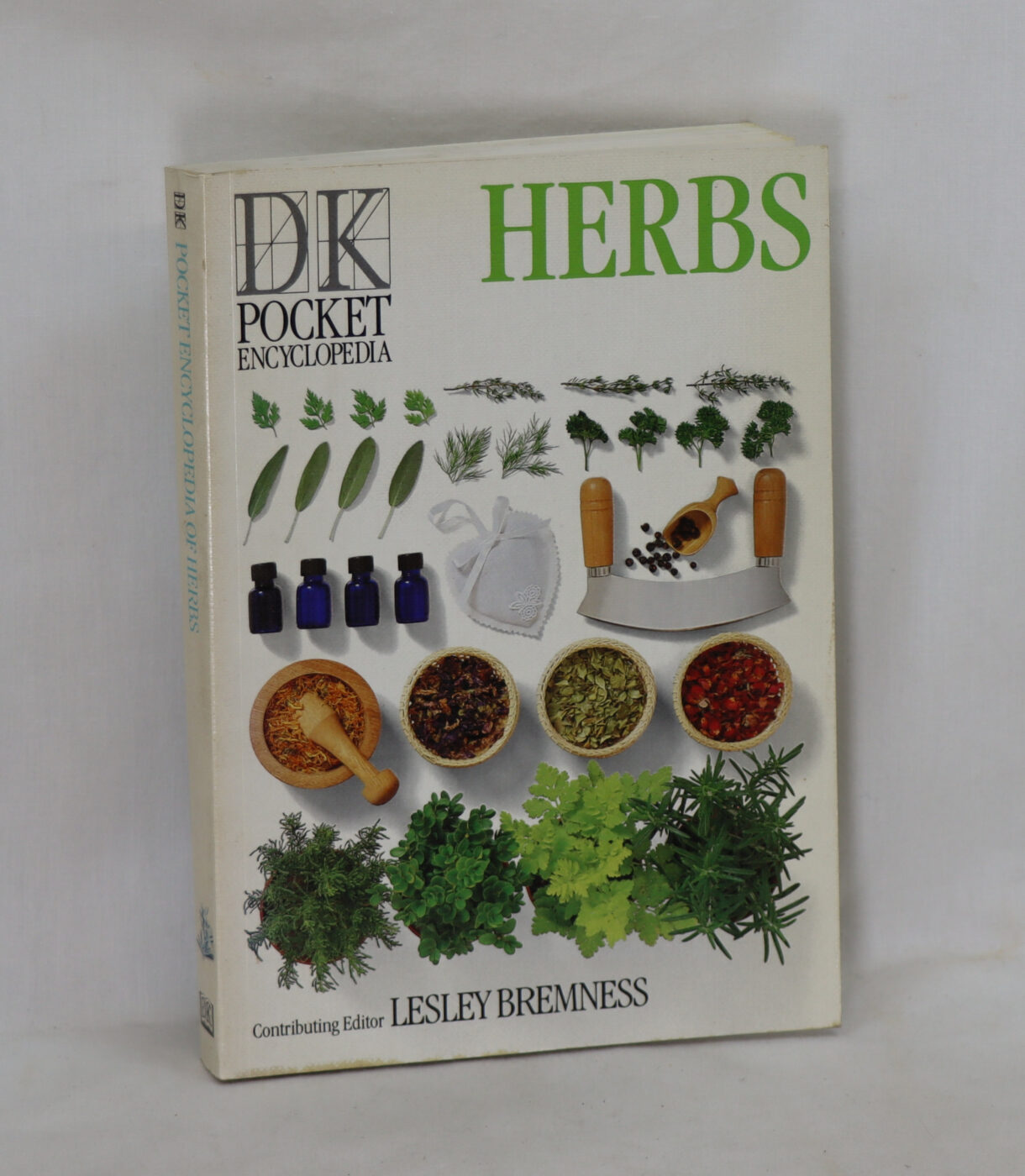
Pocket Encyclopedia of Herbs.
By Lesley Bremness
Printed: 1990
Publisher: Dorling Kindersley. London
| Dimensions | 15 × 21 × 2 cm |
|---|---|
| Language |
Language: English
Size (cminches): 15 x 21 x 2
Condition: Very good (See explanation of ratings)
£5.00
Buy Now
Your items
Item information
Description
Paperback. White cover with green title.
We provide an in-depth photographic presentation of this item to stimulate your feeling and touch. More traditional book descriptions are immediately available
- A £2 reduction when collected from FBA shop
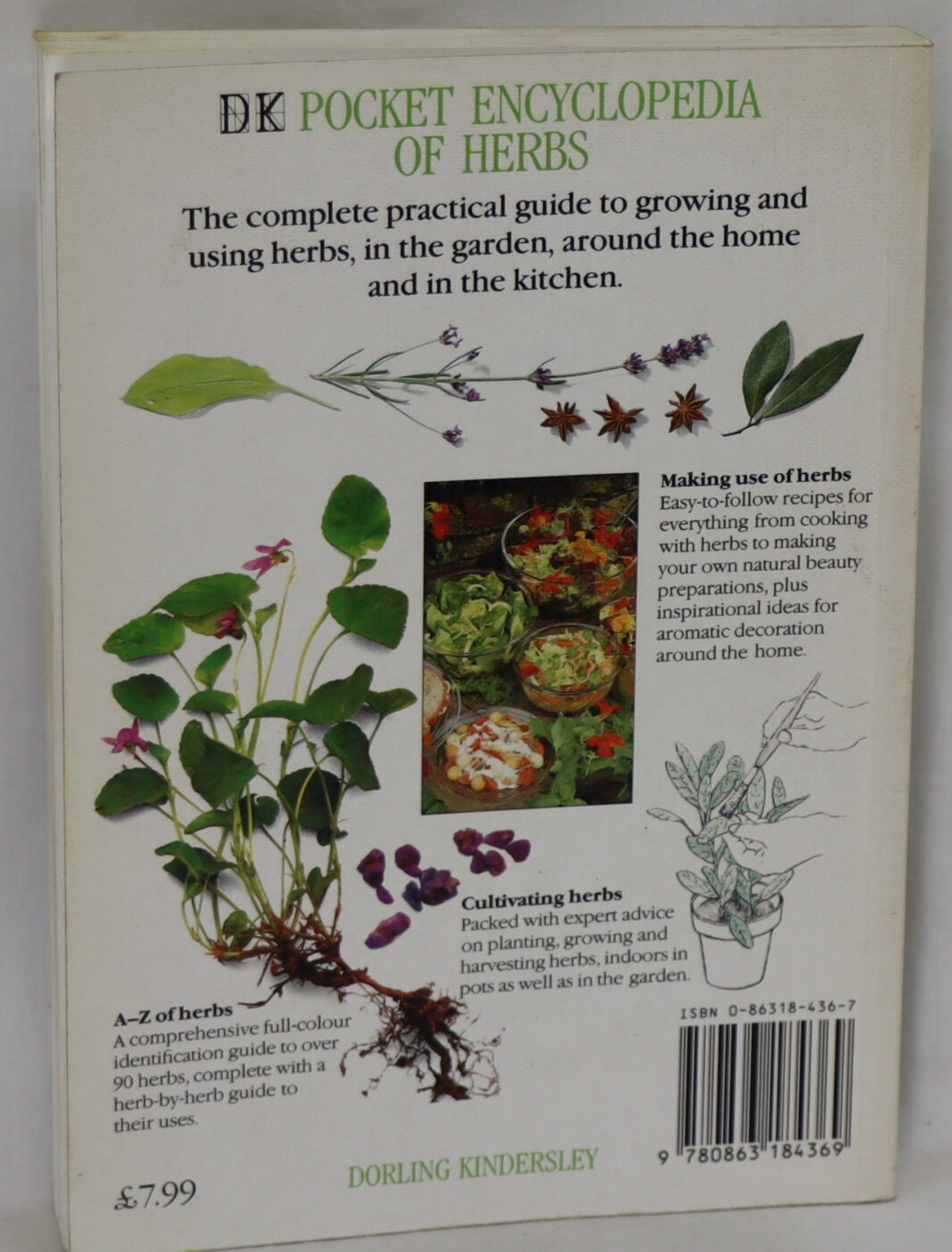
The Pocket Encyclopedia series is a highly practical mini-reference library that covers every aspect of a wide range of popular topics. All the equipment and ingredients needed to carry out the wide range of tasks featured in this book are fully covered and clear step-by-step photographs and thorough instructions take the reader systematically through every technique. Throughout key hints and tips charts directories and diagrams are used to supplement the instructions. Presented in a handy flexible format the books are easy to use and sturdy enough to be carried out easily for instant access. Armed with a Pocket Encyclopedia the reader will need no other book.
Review: Such a small book that one would expect it to be trivial and slight; instead it is packed with splendid stuff which will be useful as a ready reference to the expert enthusiast as well as the beginner.
The first section is an alphabetical guide by Latin name; the common names are given prominently and any difficulty in finding what you want is covered by a comprehensive index. Each plant is illustrated with “cut-out” photos against a white background, with accompanying description, reminiscent of botanical illustrations. Dried leaves, seeds and roots are shown as well as the living plant. A snippet of history is given and a textbox adds the uses.
This takes up about 40% of the book. There follows a chapter on Cooking With Herbs with a selection of varied recipes, well laid out and illustrated with some good photos. The recipes are out of the usual and feature the herbs as a main flavouring, for example “Tagliatelli with marigold sauce aurore” and “Gooseberry and elderflower cream”.
“Herbs in the Home” comes next with fresh and dried arrangements, “tussie mussies” (scented posies), wreaths, garlands, pot pourri, and such miscellania as herb pillows, furniture polishes and ways of repelling pests. “Herbs for beauty” has skin creams and lotions, herb baths, face packs and hair care as well as recipes for mouthwash, and so on.
“Herbs for health” has an introductory section on preparing herbal medicines, followed by a modest A-Z of treatments arranged by the disorder or illness. This section has been edited with care and an eye to safety; it is intended to be used by the untrained and there is nothing here to frighten the horses. I have tried several of the remedies and found them useful.
The last section covers growing herbs, and opens with an alphabetical guide to cultivation, arranged again by Latin name. A very brief description of soil preparation, growing from seeds and cuttings, herbs in containers and so on is well-written if compact. Finally harvesting, preserving and storing herbs get a page or so each.
This is a POCKET encyclopaedia and one cannot ask for everything in 238 fairly small pages. However the clear layout, well-edited text and good use of illustrations means it achieves a remarkable amount. If you aren’t amassing a library of herbal books, and want just one to use on a daily basis, this is the best I’ve seen.
NOTE: This is an original book from the library gathered by the famous Cambridge Don, computer scientist, food and wine connoisseur, Jack Arnold LANG. Note: Jack founded the Michelin Guide ‘Midsummer House’- Cambridge’s paramount restaurant. This dining experience is hidden amongst the grassy pastures and grazing cattle of Midsummer Common and perched on the banks of the River Cam. The Midsummer House experience is imaginatively curated to delight and amaze, so the surprise set menu changes regularly and is ‘Midsummer’s’ playground to showcase.
In 2008, Jack was one of the co-founders of the Raspberry Pi Foundation, alongside other members of the Department, and acted as the Foundation’s Chair. The project’s original goals were modest: to build and distribute low-cost computers for prospective applicants to our Computer Science degree. Initially the project was a “success disaster”, as Jack would say, as demand far outstripped the low-scale manufacturing plans. Ultimately the Raspberry Pi became the UK’s most successful computer with more than 60 million sold to date. Jack was drawn to the educational possibilities of the Raspberry Pi, its potential uses in emerging economies and the way it could support self-directed learning.
Want to know more about this item?
We are happy to answer any questions you may have about this item. In addition, it is also possible to request more photographs if there is something specific you want illustrated.
Ask a question
Related products


Share this Page with a friend
