
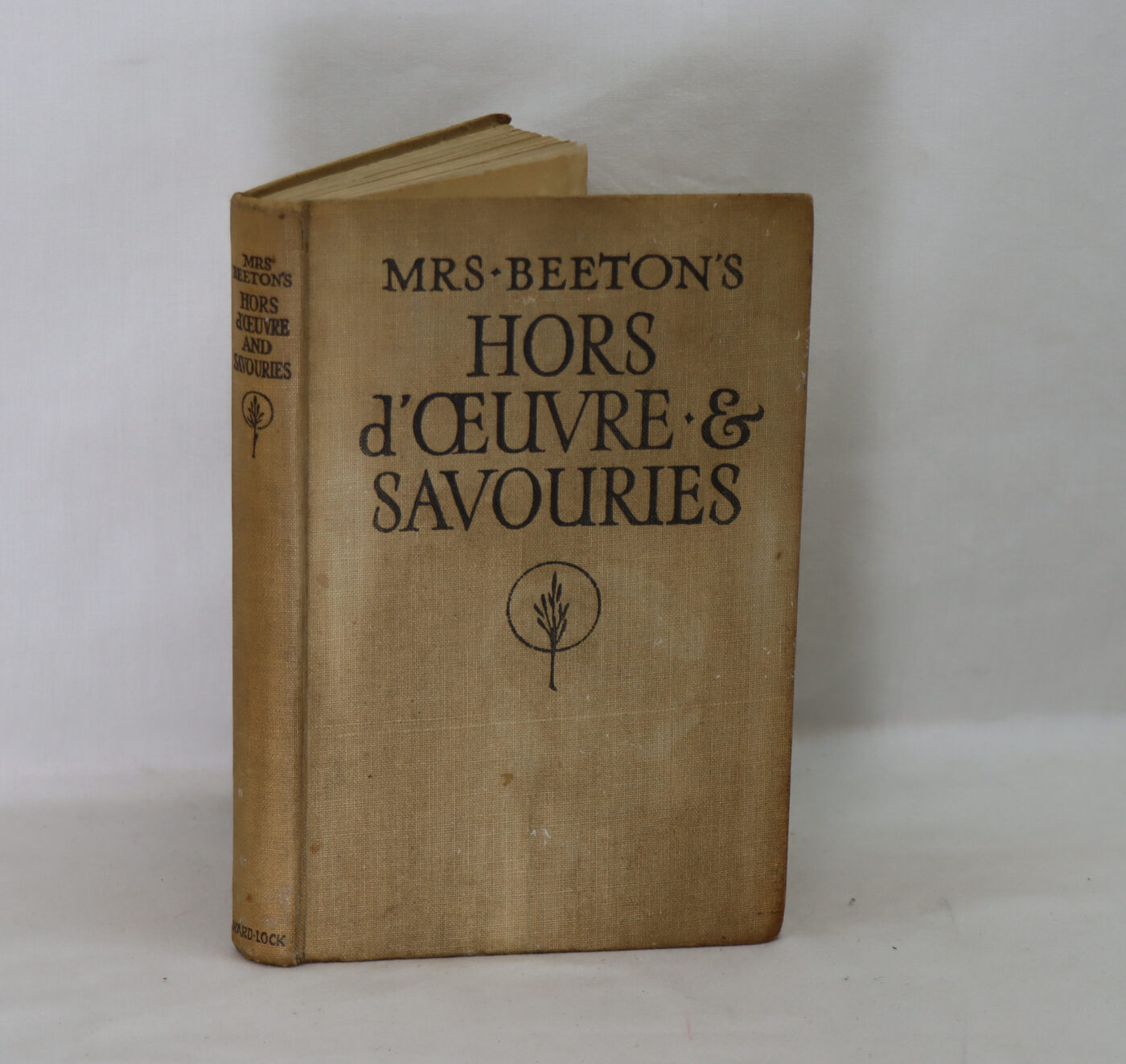
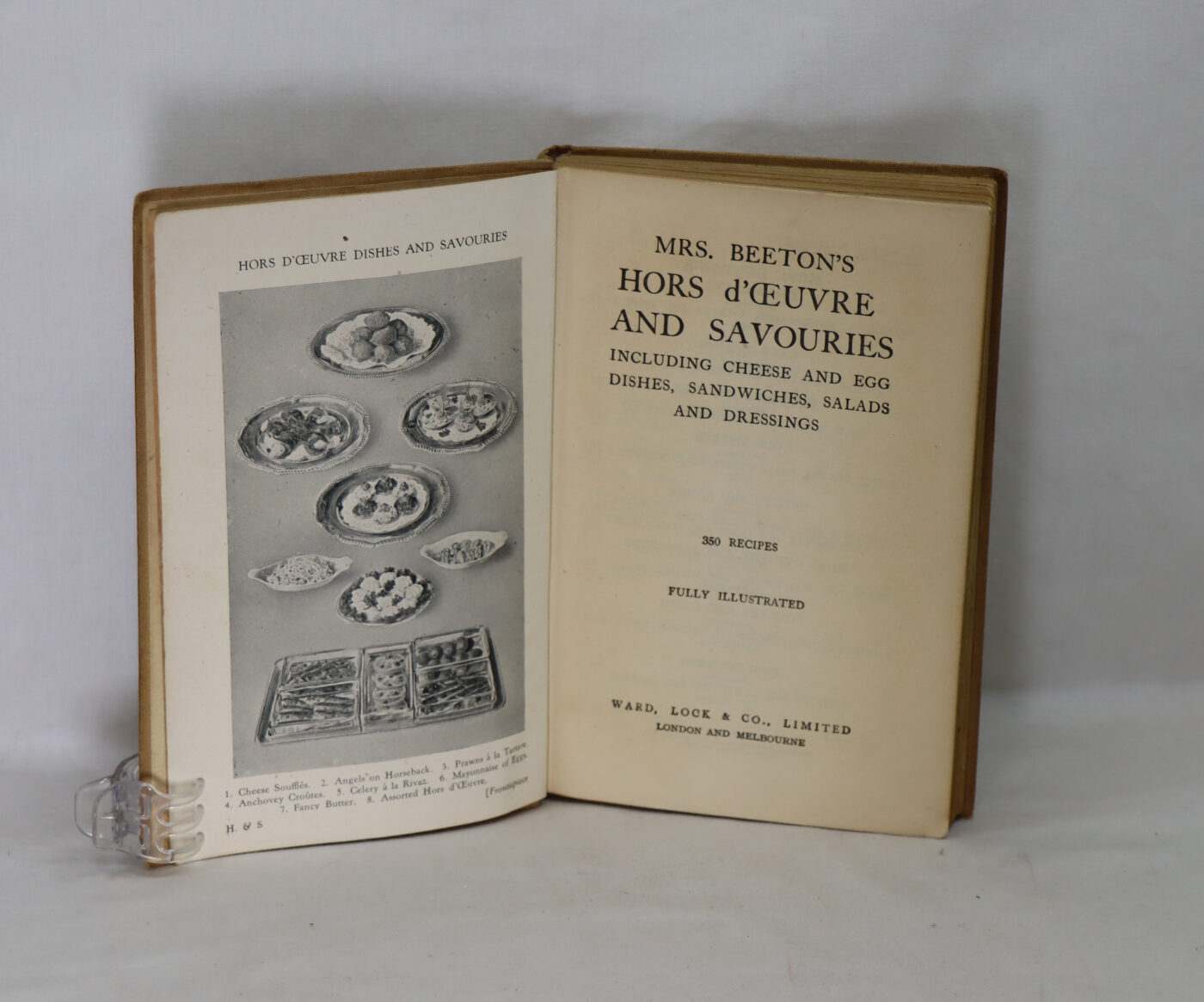
Mrs Beeton's Hors d'Oeuvre & Savouries.
Printed: Circa 1930
Publisher: Ward Lock & Co. London
| Dimensions | 13 × 19 × 2 cm |
|---|---|
| Language |
Language: English
Size (cminches): 13 x 19 x 2
Condition: Fair (See explanation of ratings)
£28.00
Buy Now

Item information
Description
Tan cloth binding with black title on the spine and front board
We provide an in-depth photographic presentation of this item to stimulate your feeling and touch. More traditional book descriptions are immediately available
Note: This book carries a £5.00 discount to those that subscribe to the F.B.A. mailing list
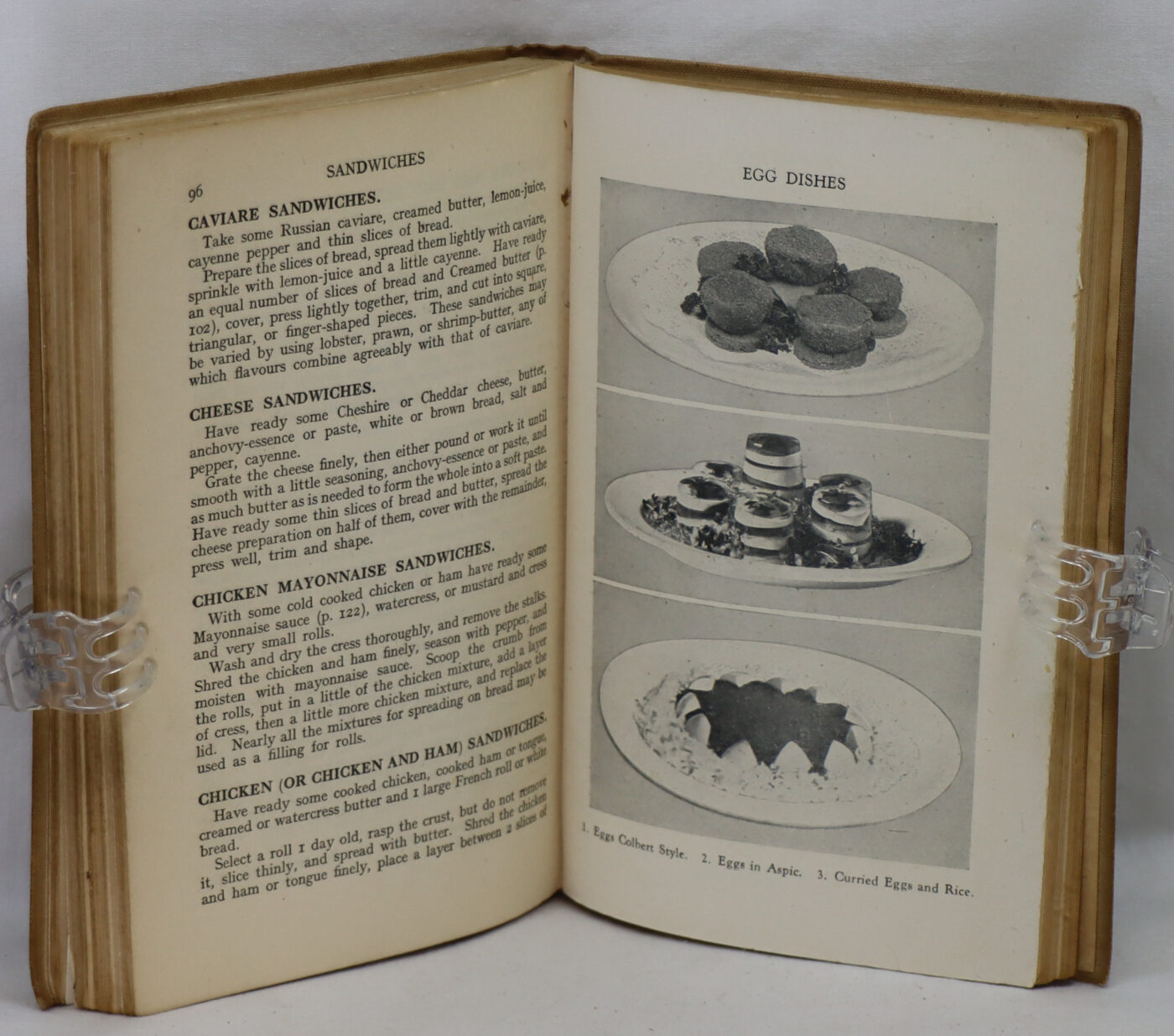
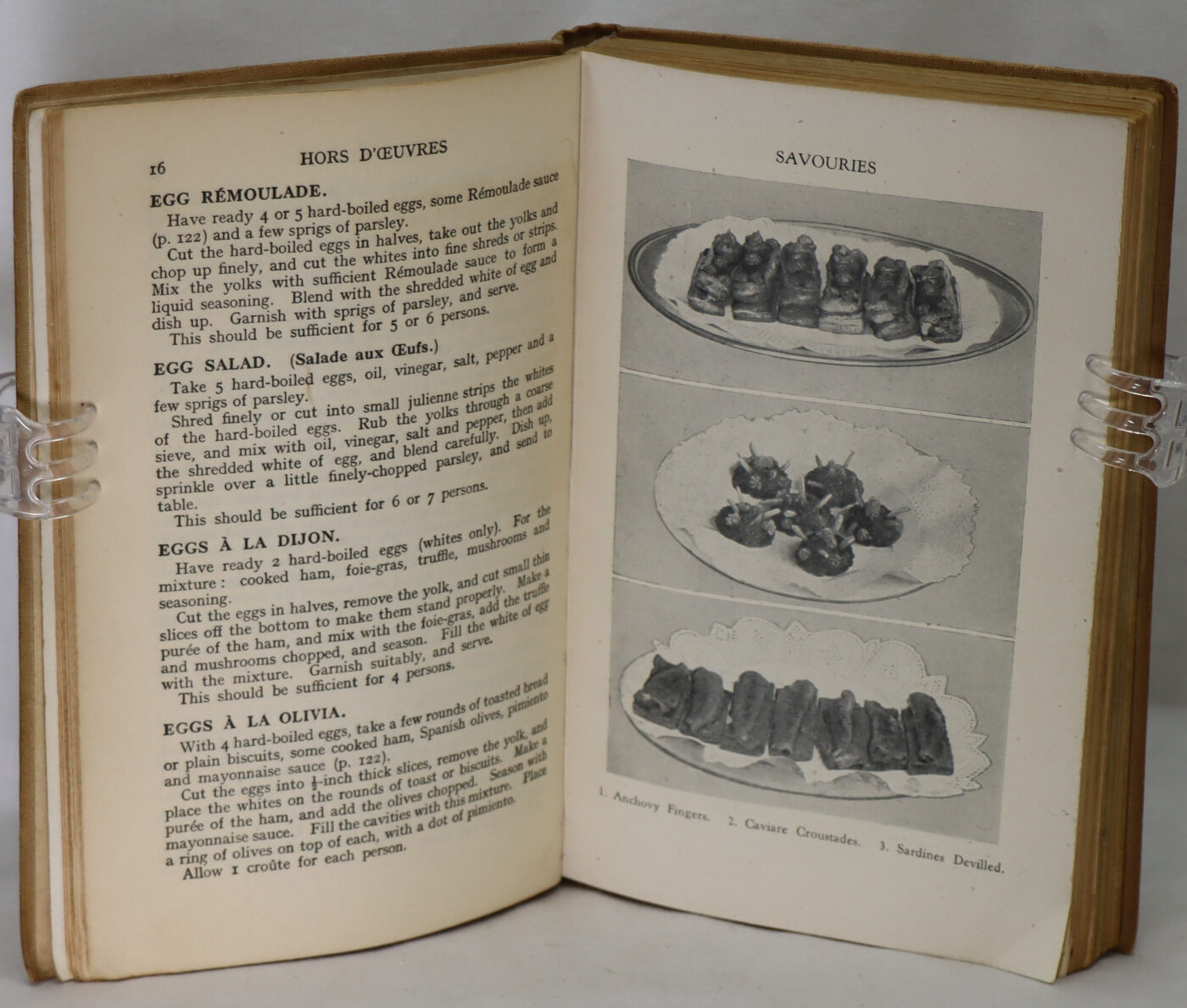
For conditions, please view our photographs. Hardcover. First edition, [1925], 128pp + adverts, illustrations, light brown cloth boards. The contents are in good condition. The boards are in very good condition, with just a little bumping to the top and bottom of the spine. From a series of 8 titles, which included jam making, cold sweets and fish cookery. COPAC suggests it was published in 1925, hence the dating. A rare but not the best copy.
Isabella Mary Beeton (née Mayson; 14 March 1836 – 6 February 1865), known as Mrs Beeton, was an English journalist, editor and writer. Her name is particularly associated with her first book, the 1861 work Mrs Beeton’s Book of Household Management. She was born in London and, after schooling in Islington, north London, and Heidelberg, Germany, she married Samuel Orchart Beeton, an ambitious publisher and magazine editor.
In 1857, less than a year after the wedding, Beeton began writing for one of her husband’s publications, The Englishwoman’s Domestic Magazine. She translated French fiction and wrote the cookery column, though all the recipes were plagiarised from other works or sent in by the magazine’s readers. In 1859 the Beetons launched a series of 48-page monthly supplements to The Englishwoman’s Domestic Magazine; the 24 installments were published in one volume as Mrs Beeton’s Book of Household Management in October 1861, which sold 60,000 copies in the first year. Beeton was working on an abridged version of her book, which was to be titled The Dictionary of Every-Day Cookery, when she died of puerperal fever in February 1865 at the age of 28. She gave birth to four children, two of whom died in infancy, and had several miscarriages. Two of her biographers, Nancy Spain and Kathryn Hughes, posit the theory that Samuel had unknowingly contracted syphilis in a premarital liaison with a prostitute, and had unwittingly passed the disease on to his wife.
The Book of Household Management has been edited, revised and enlarged several times since Beeton’s death and is still in print. Food writers have stated that the subsequent editions of the work were far removed from and inferior to the original version. Several cookery writers, including Elizabeth David and Clarissa Dickson Wright, have criticised Beeton’s work, particularly her use of other people’s recipes. Others, such as the food writer Bee Wilson, consider the censure overstated, and that Beeton and her work should be thought extraordinary and admirable. Her name has become associated with knowledge and authority on Victorian cooking and home management, and the Oxford English Dictionary states that by 1891 the term Mrs Beeton had become used as a generic name for a domestic authority. She is also considered a strong influence in the building or shaping of a middle-class identity of the Victorian era.
In May 1866, following a severe downturn in his financial fortunes, Samuel sold the rights to the Book of Household Management to Ward, Lock and Tyler (later Ward Lock & Co). The writer Nancy Spain, in her biography of Isabella, reports that, given the money the company made from the Beetons’ work, “surely no man ever made a worse or more impractical bargain” than Samuel did. In subsequent publications Ward Lock suppressed the details of the lives of the Beetons—especially the death of Isabella—in order to protect their investment by letting readers think she was still alive and creating recipes—what Hughes considers to be “intentional censorship”. Those later editions continued to make the connection to Beeton in what Beetham considers to be a “fairly ruthless marketing policy which was begun by Beeton but carried on vigorously by Ward, Lock, and Tyler”. Those subsequent volumes bearing Beeton’s name became less reflective of the original. Since its initial publication the Book of Household Management has been issued in numerous hardback and paperback editions, translated into several languages and has never been out of print.
Want to know more about this item?
We are happy to answer any questions you may have about this item. In addition, it is also possible to request more photographs if there is something specific you want illustrated.
Ask a question
Related products




Share this Page with a friend
