
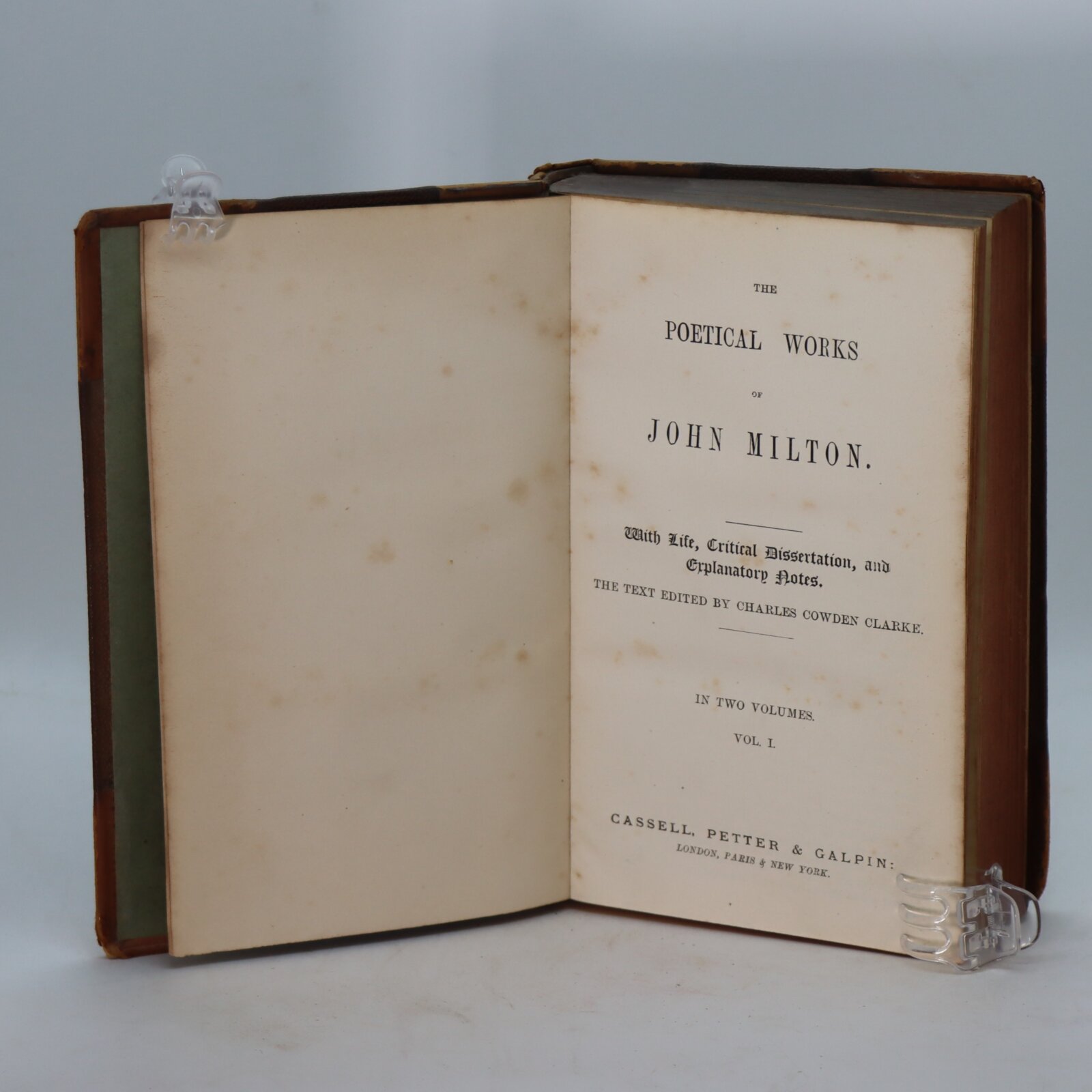
Milton's Poetical Works. Volume I.
By John Milton
Printed: Circa 1890
Publisher: Cassell, Petter & Galpin. London
| Dimensions | 13 × 20 × 4 cm |
|---|---|
| Language |
Language: English
Size (cminches): 13 x 20 x 4
Condition: Fine (See explanation of ratings)
£95.00
Buy Now
Your items

Item information
Description
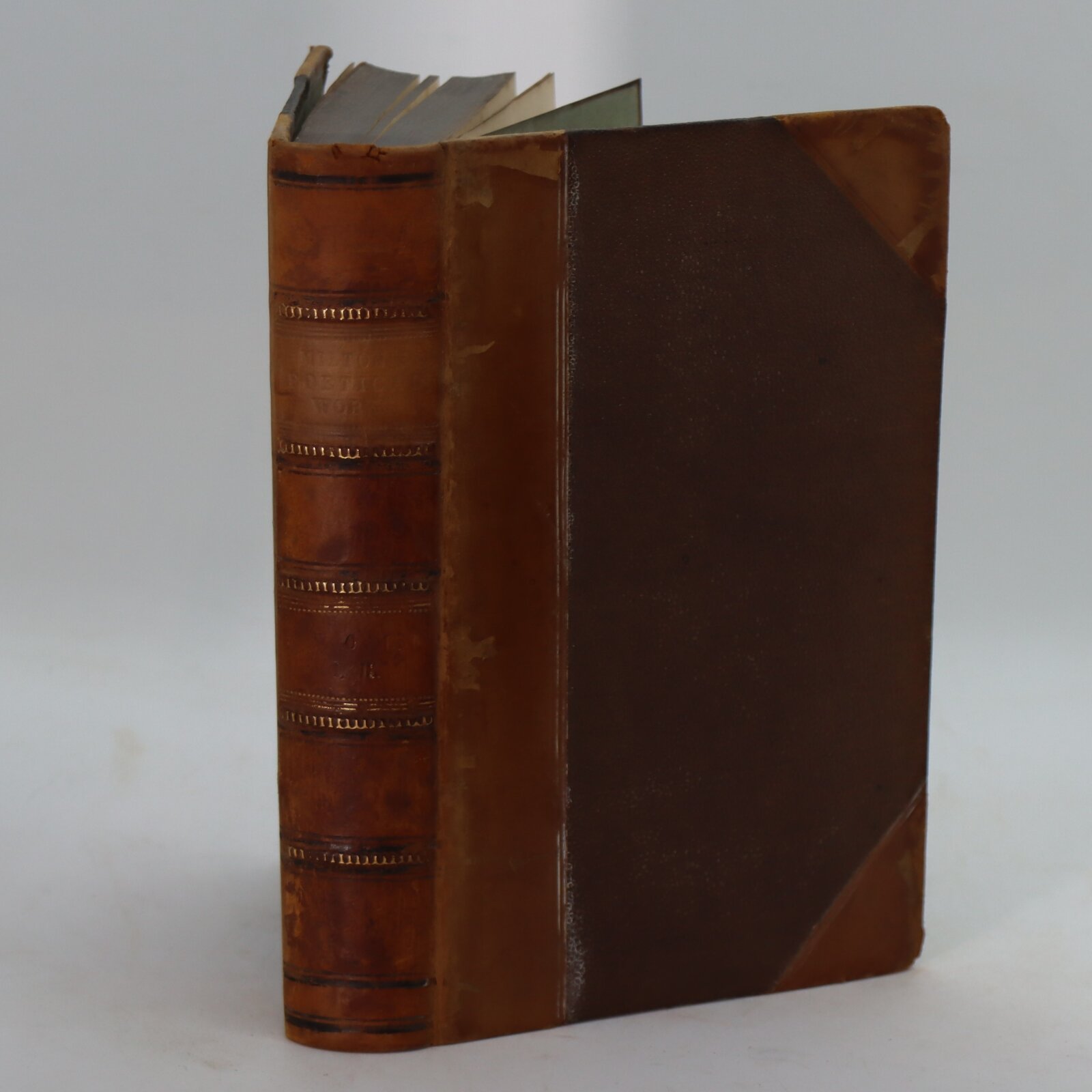
Tan calf spine and corners. Brown textured boards. Gilt banding on the spine with the title plate missing.
It is the intent of F.B.A. to provide an in-depth photographic presentation of this book offered so to almost stimulate your feel and touch on the book. If requested, more traditional book descriptions are immediately available.
First Volume of a two-volume set
Milton’s poetry was slow to see the light of day, at least under his name. His first published poem was “On Shakespeare” (1630), anonymously included in the Second Folio edition of William Shakespeare’s plays in 1632. An annotated copy of the First Folio has been suggested to contain marginal notes by Milton.[53] Milton collected his work in 1645 Poems during the excitement attending the possibility of establishing a new English government. The anonymous edition of Comus was published in 1637, and the publication of Lycidas in 1638 in Justa Edouardo King Naufrago was signed J. M. Otherwise. The 1645 collection was the only poetry of his to see print until Paradise Lost appeared in 1667.
John Milton (9 December 1608 – 8 November 1674) was an English poet and intellectual who served as a civil servant for the Commonwealth of England under its Council of State and later under Oliver Cromwell. He wrote at a time of religious flux and political upheaval and is best known for his epic poem Paradise Lost (1667). Written in blank verse, Paradise Lost is widely considered to be one of the greatest works of literature ever written.
Writing in English, Latin, and Italian, he achieved international renown within his lifetime; his celebrated Areopagitica (1644), written in condemnation of pre-publication censorship, is among history’s most influential and impassioned defences of freedom of speech and freedom of the press. His desire for freedom extended into his style: he introduced new words (coined from Latin and Ancient Greek) to the English language and was the first modern writer to employ unrhymed verse outside of the theatre or translations.
William Hayley’s 1796 biography called him the “greatest English author”, and he remains generally regarded “as one of the pre-eminent writers in the English language”, though critical reception has oscillated in the centuries since his death (often on account of his republicanism). Samuel Johnson praised Paradise Lost as “a poem which … with respect to design may claim the first place, and with respect to performance, the second, among the productions of the human mind”, though he (a Tory) described Milton’s politics as those of an “acrimonious and surly republican”. Poets such as William Blake, William Wordsworth and Thomas Hardy revered him.
Condition notes
missing title plate
Want to know more about this item?
We are happy to answer any questions you may have about this item. In addition, it is also possible to request more photographs if there is something specific you want illustrated.
Ask a question
Related products



Share this Page with a friend
