
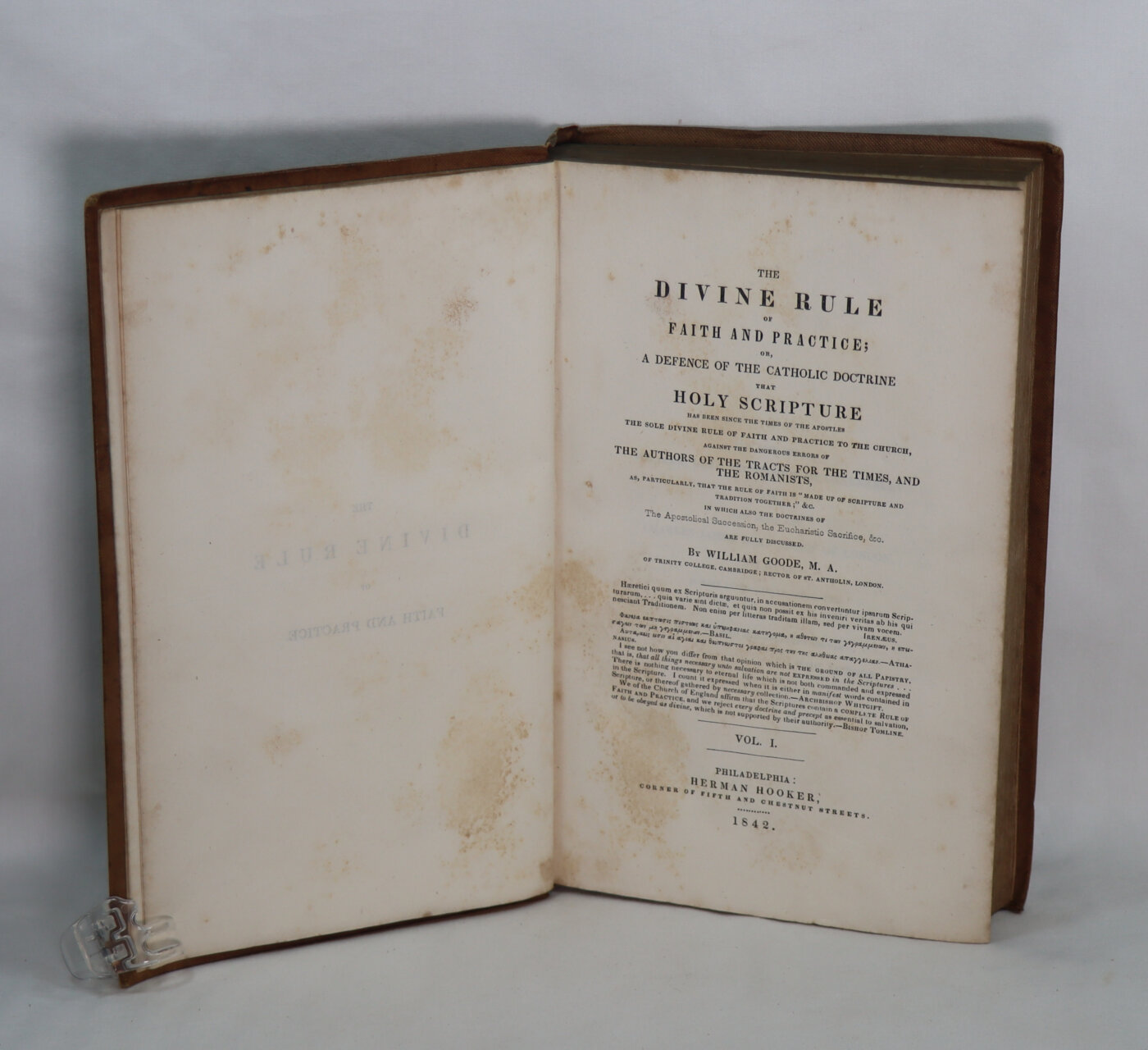
Goode's Divine Rule of Faith & Practice.
By William Goode
Printed: 1842
Publisher: Herman Hooker. Philadelphia
| Dimensions | 16 × 24 × 3 cm |
|---|---|
| Language |
Language: English
Size (cminches): 16 x 24 x 3
Condition: Very good (See explanation of ratings)
£44.00
Buy Now
Your items

Item information
Description
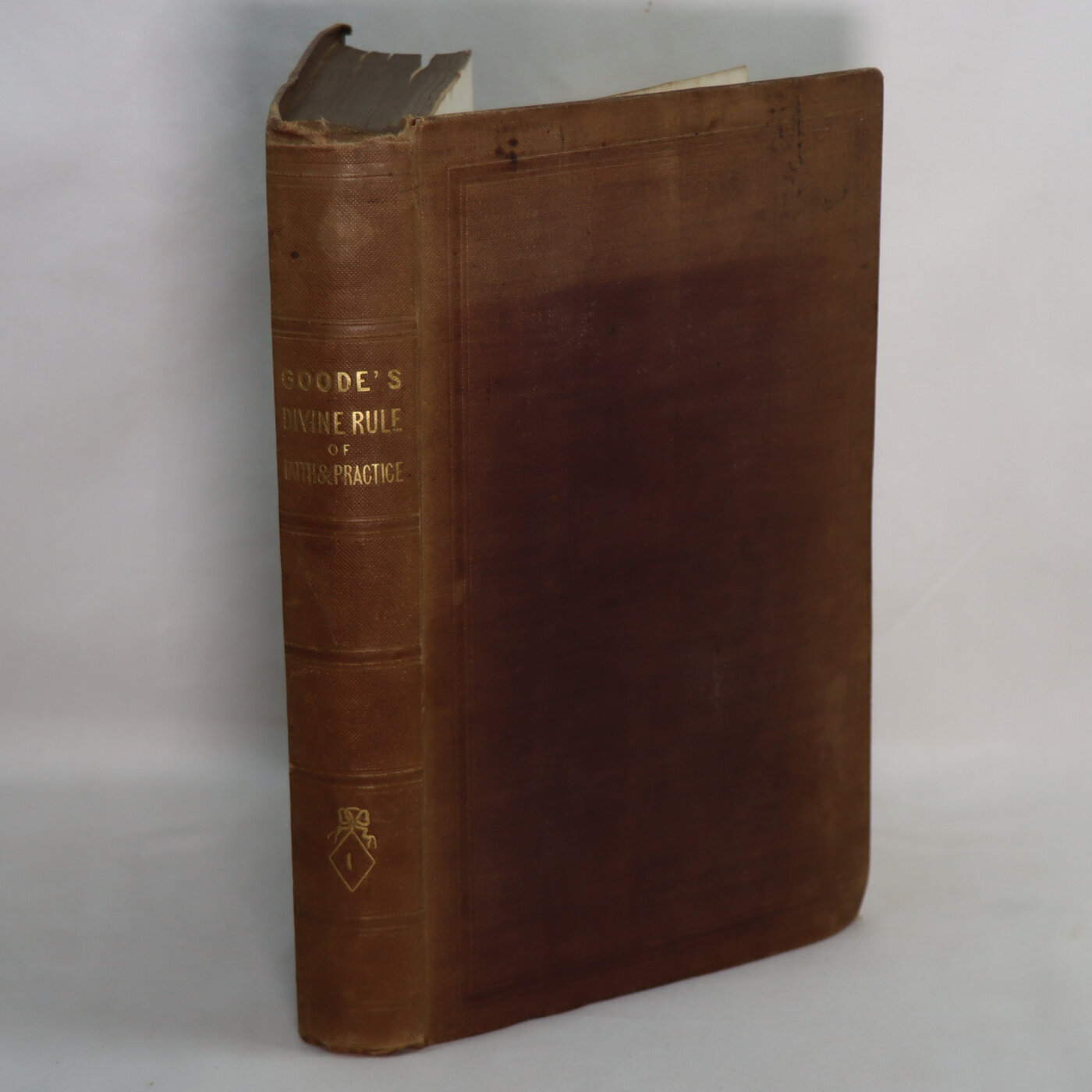
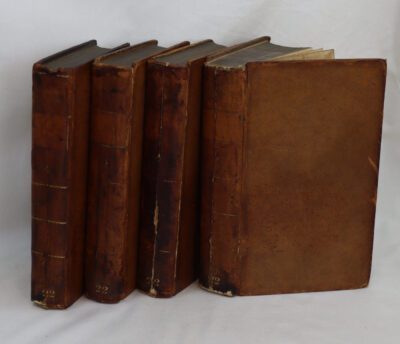
Tan cloth binding with gilt title on the spine.
We provide an in-depth photographic presentation of this item to stimulate your feeling and touch. More traditional book descriptions are immediately available.
Note: This book carries the £5.00 discount to those that subscribe to the F.B.A. mailing list.
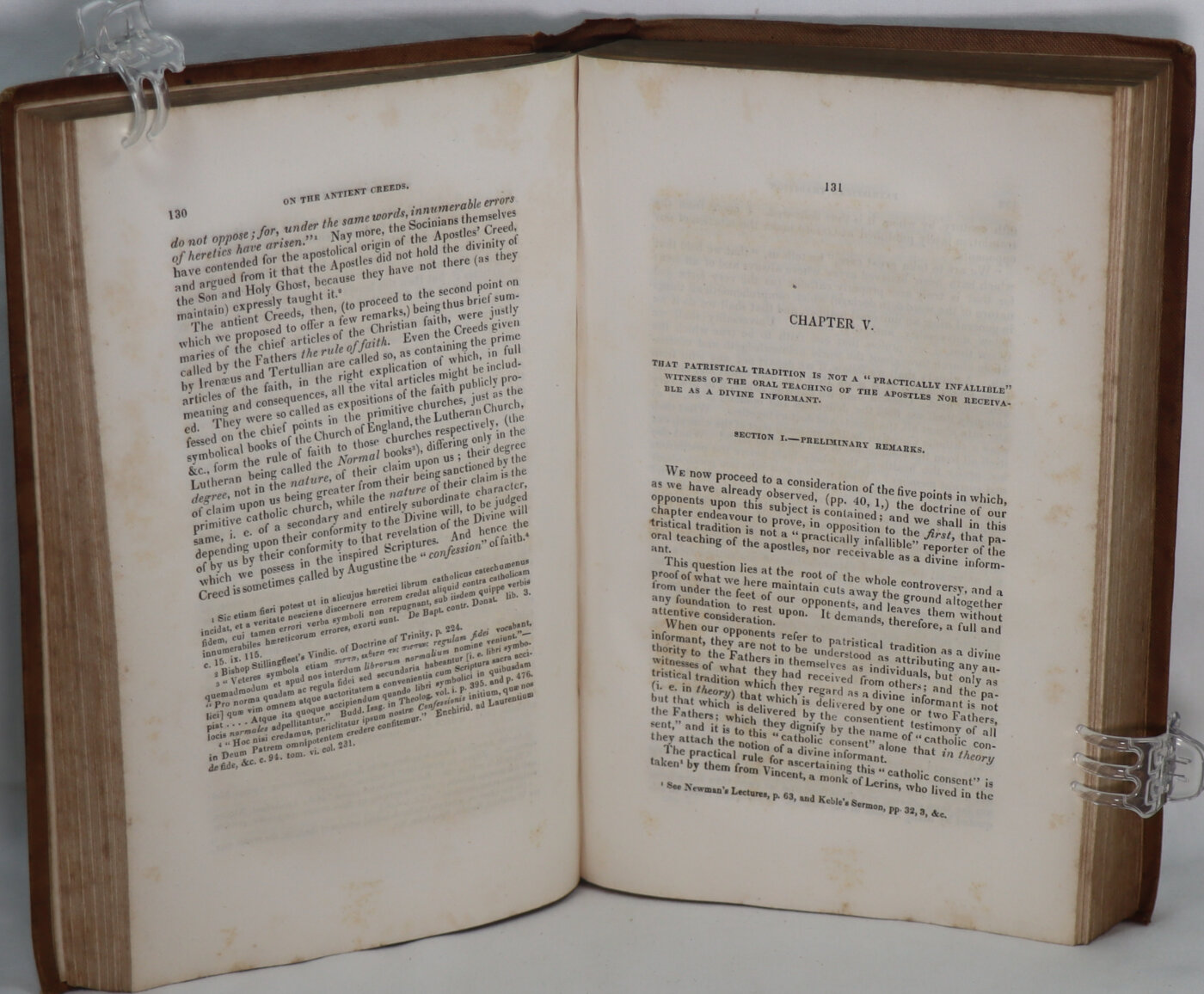
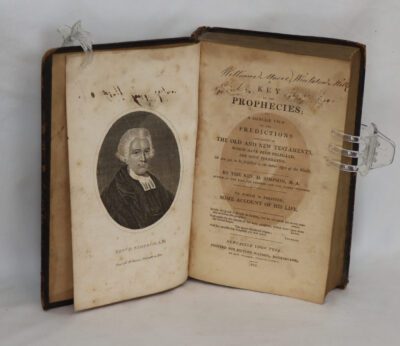
First Edition: this rare first volume is of the two published in 1842.The books were reissued in 1853 with a third volume. In essence this first edition contains the thrust of Goode’s argument as to the influence of Pyrrhonism on modern religious thinking. This book is in good condition though there is a little foxing throughout the contents.
William Goode the younger (1801–1868) was an English cleric, a leader of the evangelicals of the Church of England and from 1860 the Dean of Ripon. The son of the Revd William Goode, the elder, he was born on 10 November 1801 and educated at St Paul’s School, London, and Trinity College, Cambridge. He graduated BA in 1825 with a first class in classics.
Goode was ordained deacon and priest in 1825, becoming curate to his father’s friend, Samuel Crowther, the incumbent of Christ Church, Newgate Street. In 1835 he was appointed rector of St Antholin Watling Street, a post which he held until 1849 when the Archbishop of Canterbury presented him to the rectory of Allhallows the Great, Thames Street. In 1856 the lord chancellor presented him to the rectory of St. Margaret Lothbury, which he held until 1860, when Lord Palmerston advanced him to the deanery of Ripon. For some years Goode was editor of the Christian Observer. He was Warburtonian lecturer from 1853 to 1857. He died suddenly on 13 August 1868. He was the author of a large number of tracts, pamphlets, letters, and speeches on the church-rate question, the Gorham case, and the Tractarian movement.
The Divine Rule of Faith and Practice,’ 2 vols. 1842, and again revised and enlarged in 3 vols. 1853. This is an expansion of William Chillingworth’s doctrine that “the Bible alone is the religion of protestants”, supported by a collection of church authorities, as an exposition of evangelical theology.
William Chillingworth (12 October 1602 – 30 January 1644) was a controversial English churchman. He was born in Oxford, where his father served as mayor; William Laud was his godfather. In June 1618 he became a scholar of Trinity College, Oxford, of which he was made a fellow in June 1628. He gained a reputation as a skilful debater, excelled in mathematics, and also became known as a poet. He associated with Sir Lucius Cary, John Hales, and Gilbert Sheldon.
Interested in religious controversy and not yet in orders, Chillingworth took on the Jesuit John Percy (alias “John Fisher”). Percy succeeded in converting Chillingworth, and persuaded him to go to the Jesuit college at Douai, in 1630. There he wrote an account of his reasons for leaving Protestantism, but kept in touch with Laud. In 1631, however, he thought again, and left Douai. He did not immediately return to the orthodox positions of the Church of England, but was drawn into controversy with Catholics including John Floyd, and in a disputation with Thomas White before Lord Digby and Sir Kenelm Digby. He was substantially influenced by Pyrrhonism, and said to “have delighted in Sextus Empiricus.” His theology was a kind of probabilism based on an ultimate Pyrrhonism.
Pyrrhonism is an Ancient Greek school of philosophical skepticism which rejects dogma and advocates the suspension of judgement over the truth of all beliefs. It was founded by Aenesidemus in the first century BCE, and said to have been inspired by the teachings of Pyrrho and Timon of Phlius in the fourth century BCE. Pyrrhonism is best known today through the surviving works of Sextus Empiricus, writing in the late second century or early third century CE. The publication of Sextus’ works in the Renaissance ignited a revival of interest in Skepticism and played a major role in Reformation thought and the development of early modern philosophy.
Condition notes
Slight foxing
Want to know more about this item?
We are happy to answer any questions you may have about this item. In addition, it is also possible to request more photographs if there is something specific you want illustrated.
Ask a question
Related products

Share this Page with a friend
