
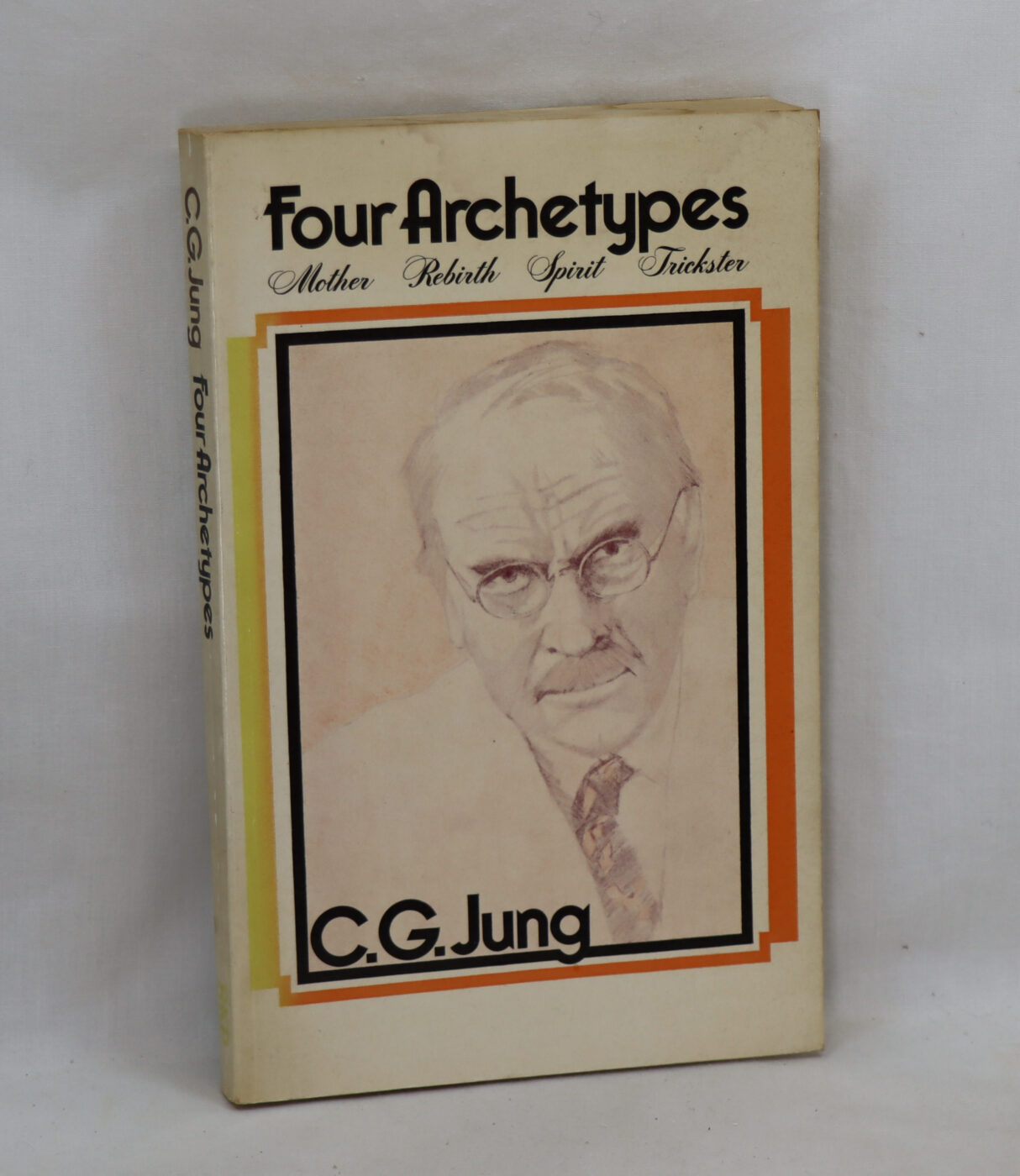
Four Archetypes.
By C G Jung
ISBN: 9781317526339
Printed: 1974
Publisher: Routledge. London
| Dimensions | 14 × 22 × 1.5 cm |
|---|---|
| Language |
Language: English
Size (cminches): 14 x 22 x 1.5
Condition: Good (See explanation of ratings)
£144.00
Buy Now
Your items

Item information
Description
Paperback. White cover with black title.
We provide an in-depth photographic presentation of this item to stimulate your feeling and touch. More traditional book descriptions are immediately available
- Note: This book carries a £5.00 discount to those that subscribe to the F.B.A. mailing list
Now, an increasingly rare book with an enhanced popularity.
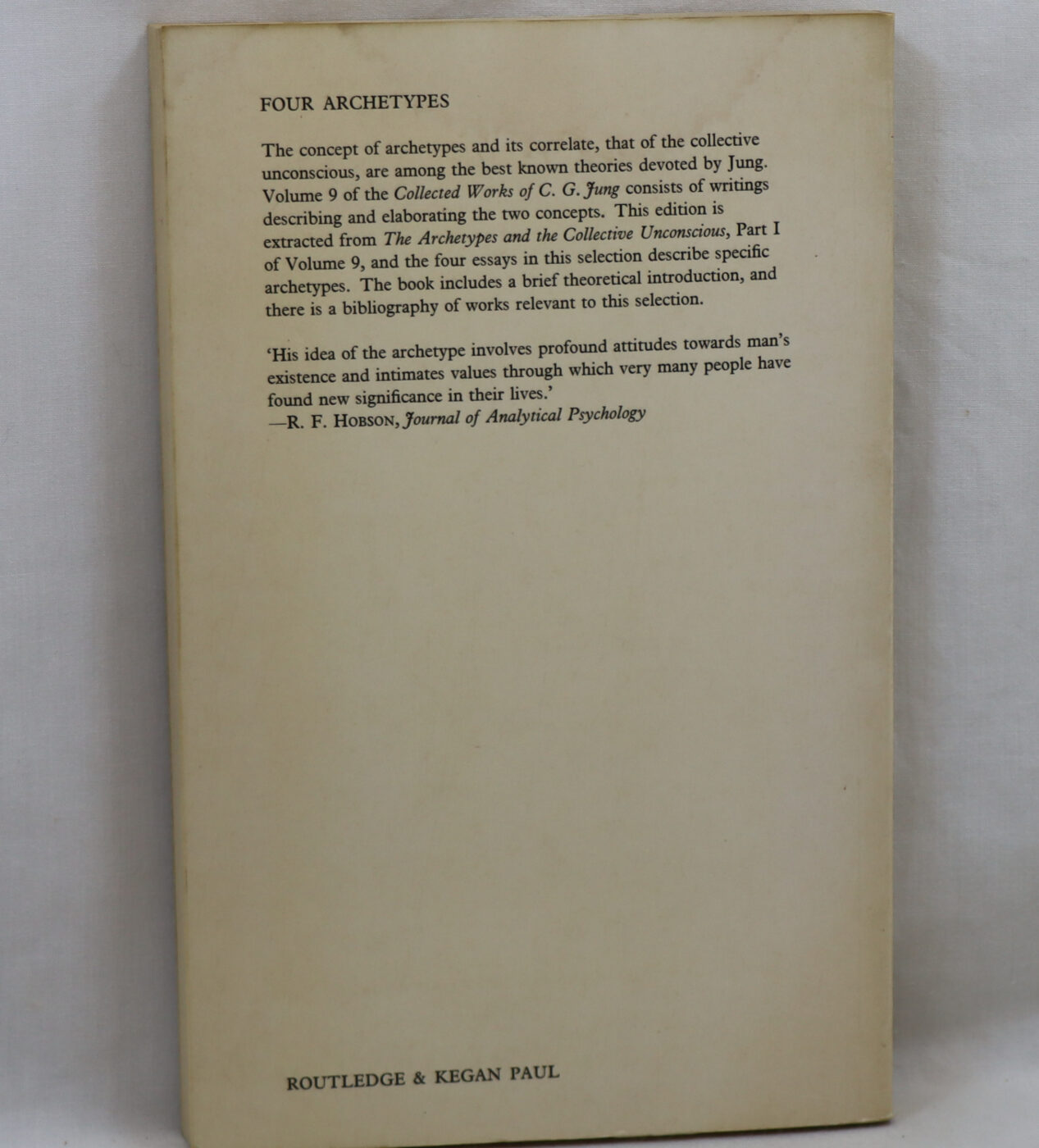
The concept of the archetype is crucial to Jung’s radical interpretation of the human mind. Jung believed that every person partakes of a universal or collective unconscious that persists through generations. The origins of the concept can be traced to his very first publication in 1902 and it remained central to his thought throughout his life. As well as explaining the theoretical background behind the idea, in Four Archetypes Jung describes the four archetypes that he considers fundamental to the psychological make-up of every individual: mother, rebirth, spirit and trickster. Exploring their role in myth, fairytale and scripture, Jung engages the reader in discoveries that challenge and enlighten the ways we perceive ourselves and others.
Review: Other reviewers have made general statements about the four archetypes – Mother, Rebirth, Spirit, Trickster – covered in this volume of C.G. Jung’s work. For the purpose of this review and as a way of conveying the richness of Jung’s archetypes, I will focus on one specific aspect of the Rebirth archetype: Enlargement of Personality.
Jung begins this section with the sentence, “The personality is seldom, in the beginning, what it will be later on.” Thus, a kind of metamorphosis is at the very core of our being. This is clear when we reflect on the various stages of childhood and adolescence, most specifically, when we think about the transformation in males from boyhood to manhood and a female’s transformation from girlhood into womanhood. Cultural anthropologists have written extensively on the rituals surrounding this life-transforming event within traditional societies.
Here is Jung’s next sentence, “For this reason the possibility of enlarging it (personality) exists, at least during the first half of life.” Why the first half of life? Simple biology. The most obvious example is the enlargement of personality a baby makes in the first few years, from being an infant to being a walking, talking toddler. And so biology propels the toddler thru the phases of childhood and adolescence right up until the time when the person becomes an adult.
But what about the second half of life, where the enlargements are less biological and more psychic and subtle? Here are Jung’s words on the topic, “Therefore, if some great idea takes hold of us from outside, we must understand that it takes hold of us only because something in us responds to it and goes out to meet it.” Ultimately, the key to enlargement as an adult is our responding, our own internal movement to what we encounter in our world. This internal movement is underscored when Jung writes, “Richness of mind consists in mental receptivity, not in the accumulation of possessions.” I am reminded of one of my spiritual teachers who said, “Don’t plateau.”, which is a warning against being complacent, being unwilling to go out to meet the great ideas, the great ongoing challenges we as adults are given in our lives.
Keeping on this topic, a man who has spent many years as a Jungian-trained counselor told me that when the soul cries out for enlargement and one does not heed this internal call, there is a change, a shift, but the shifting and changing can manifest physically. Perhaps this is why we have an epidemic of obesity in the United States: a large portion of the population will not rise to the challenge to enlarge spiritually and thus the body responds by enlarging physically.
Nietzsche speaks again and again on how the arts, creativity and the spiritual path pose challenges to the individual soul. If an artist is truly an artist, one will expand and enlarge one’s personality, continually redefining oneself, a series of rebirths, one after another. Of course, one need not be a Picasso or Mondrian; rather, one is called to be an artist of one’s own life. And what of those people who lives are smug and self-satisfied, refusing to transform? Here are Jung’s words, “He who is truly and hopelessly little will always drag the revelation of the greater down to the level of his littleness . . . ” And when one finally sees one’s own life in need of transformation? Perhaps this lies behind the mid-life crisis so common in the modern world.
Again, I have focused on but one aspect of the Rebirth archetype. The others are: Diminution of personality, Change of internal structure, Identification with a group, Magical procedures, Technical transformation, Natural transformation (individuation). I’ve made a few modest comments to convey the richness of what one can find in C.G. Jung and how we can apply his ideas and insights to our own lives and the lives of others.
- ‘Jung believed that the unconscious is not merely the hiding place of demons but the province of angels and ministers of grace, which he called the ‘archetypes’, symbols of all the inner forces that work toward unity, health, fullness of life, and purposeful conscious development.’ – Lewis Mumford, The New Yorker
- ‘His idea of the archetype involves profound attitudes towards man’s existence and intimate values through which very many people have found a new significance in their lives.’ – R.F. Hobson, Journal of Analytical Psychology
Carl Gustav Jung (1875-1961). Founded the analytical school of psychology and developed a radical new theory of the unconscious.
NOTE: This is an original book from the library gathered by the famous Cambridge Don, computer scientist, food and wine connoisseur, Jack Arnold LANG. Note: Jack founded the Michelin Guide ‘Midsummer House’- Cambridge’s paramount restaurant. This dining experience is hidden amongst the grassy pastures and grazing cattle of Midsummer Common and perched on the banks of the River Cam. The Midsummer House experience is imaginatively curated to delight and amaze, so the surprise set menu changes regularly and is ‘Midsummer’s’ playground to showcase.
In 2008, Jack was one of the co-founders of the Raspberry Pi Foundation, alongside other members of the Department, and acted as the Foundation’s Chair. The project’s original goals were modest: to build and distribute low-cost computers for prospective applicants to our Computer Science degree. Initially the project was a “success disaster”, as Jack would say, as demand far outstripped the low-scale manufacturing plans. Ultimately the Raspberry Pi became the UK’s most successful computer with more than 60 million sold to date. Jack was drawn to the educational possibilities of the Raspberry Pi, its potential uses in emerging economies and the way it could support self-directed learning.
Want to know more about this item?
We are happy to answer any questions you may have about this item. In addition, it is also possible to request more photographs if there is something specific you want illustrated.
Ask a question
Related products



Share this Page with a friend
