
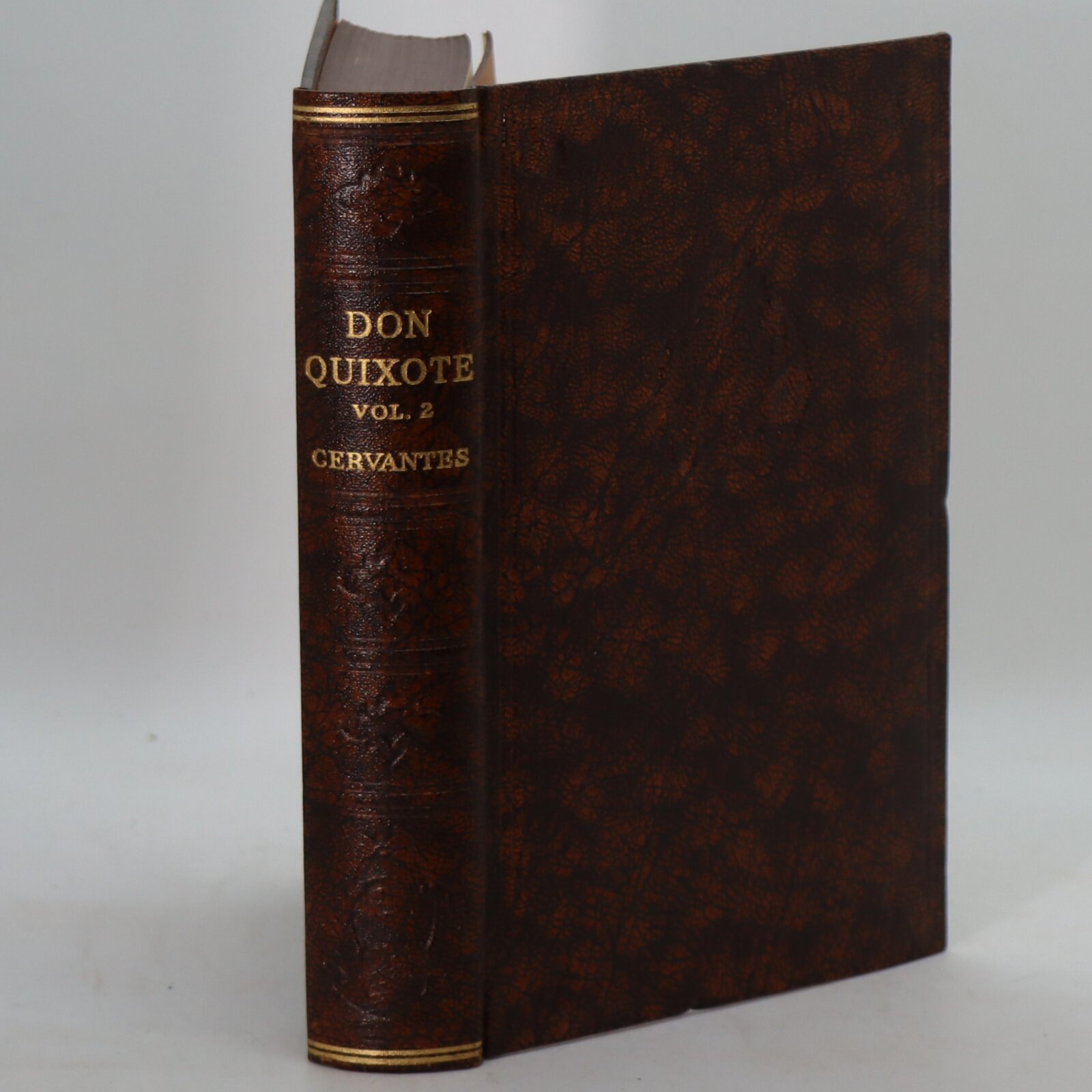
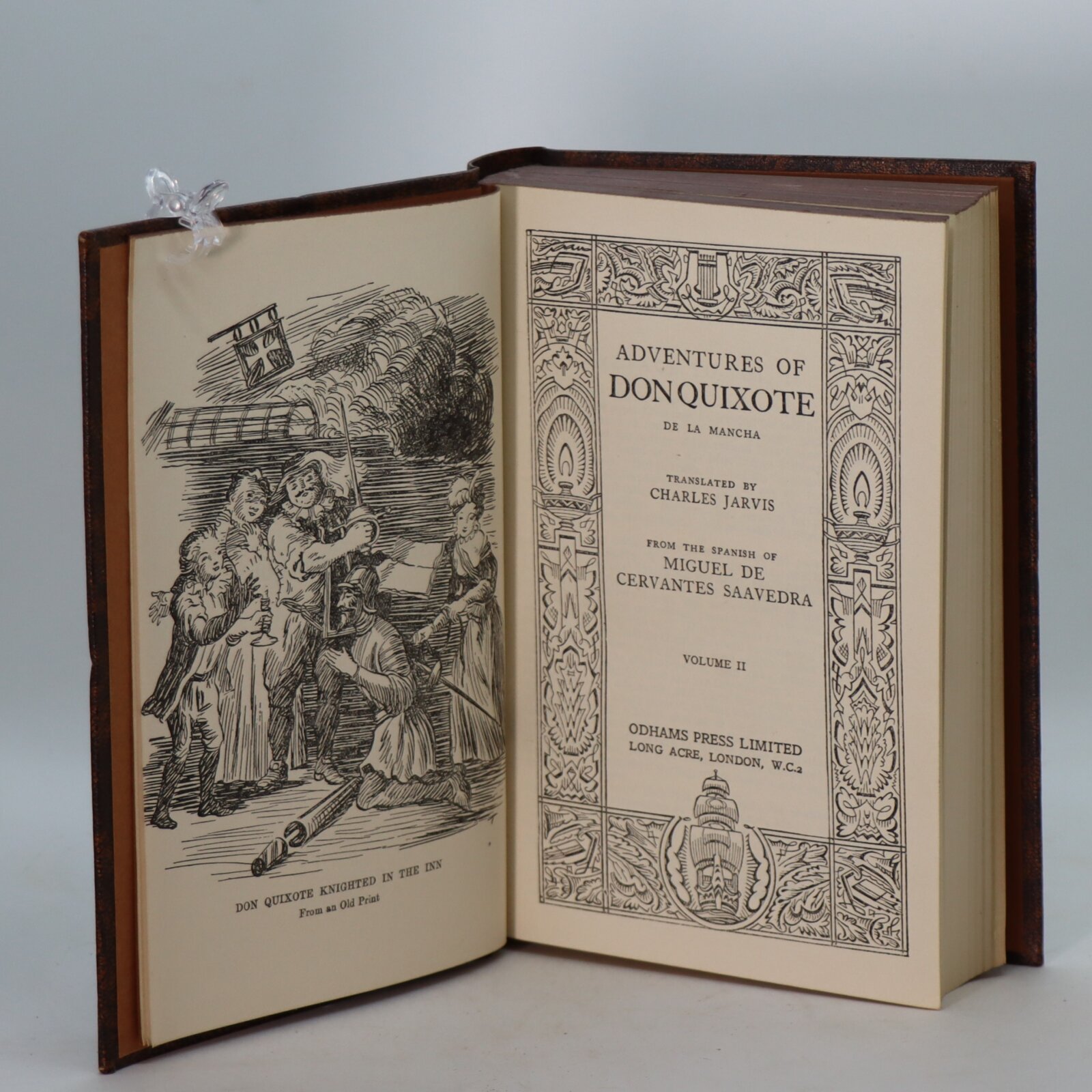
Don Quixote. Volume 2.
By Minguel De Cervantes Saavedra
Printed: Circa 1930
Publisher: Odhams Press. London
| Dimensions | 14 × 19 × 3 cm |
|---|---|
| Language |
Language: English
Size (cminches): 14 x 19 x 3
Condition: Fine (See explanation of ratings)
£25.00
Buy Now
Your items

Item information
Description
Brown and tan patterned cloth binding. Gilt title and banding on the spine.
F.B.A. provides an in-depth photographic presentation of this item to stimulate your feel and touch. More traditional book descriptions are immediately available.
A good copy from a broken set
Don Quixote is a Spanish novel by Miguel de Cervantes. Its full title is The Ingenious Gentleman Don Quixote of La Mancha (Modern Spanish: El ingenioso hidalgo (in Part 2, caballero) don Quijote de la Mancha.
It was originally published in two parts, in 1605 and 1615. A founding work of Western literature, it is often labelled as the first modern novel and is considered one of the greatest works ever written. Don Quixote also holds the distinction of being one of the most-translated books in the world
The plot revolves around the adventures of a member of the very lowest nobility or hidalgo (“Son of Someone”) from La Mancha named Alonso Quixano, who reads so many chivalric romances that he either loses or pretends to have lost his mind in order to become a knight-errant (caballero andante) to revive chivalry and serve his nation, under the name Don Quixote de la Mancha. He recruits a simple farmer, Sancho Panza, as his squire, who often employs a unique, earthy wit in dealing with Don Quixote’s rhetorical monologues on knighthood, already considered old-fashioned at the time, and representing the most vivid realism in contrast to his master’s idealism. Don Quixote, in the first part of the book, does not see the world for what it is and prefers to imagine that he is living out a knightly story.
The book had a major influence on the literary community, as evidenced by direct references in Alexandre Dumas’ The Three Musketeers (1844), Mark Twain’s Adventures of Huckleberry Finn (1884), and Edmond Rostand’s Cyrano de Bergerac (1897), as well as the word quixotic and the epithet Lothario; the latter refers to a character in “El curioso impertinente” (“The Impertinently Curious Man”), an intercalated story that appears in Part One, chapters 33–35.
When first published, Don Quixote was usually interpreted as a comic novel. After the French Revolution, it was better known for its central ethic that individuals can be right while society is quite wrong and seen as disenchanting. In the 19th century, it was seen as a social commentary, but no one could easily tell “whose side Cervantes was on”. Many critics came to view the work as a tragedy in which Don Quixote’s idealism and nobility are viewed by the post-chivalric world as insane, and are defeated and rendered useless by common reality. By the 20th century, the novel had come to occupy a canonical space as one of the foundations of modern literature.
Want to know more about this item?
We are happy to answer any questions you may have about this item. In addition, it is also possible to request more photographs if there is something specific you want illustrated.
Ask a question
Related products


Share this Page with a friend
