
Basic Writings.
By Martin Heidegger
ISBN: 9780415101615
Printed: 1978
Publisher: Routledge. London
| Dimensions | 14 × 21 × 3 cm |
|---|---|
| Language |
Language: English
Size (cminches): 14 x 21 x 3
Condition: Very good (See explanation of ratings)
£34.00
Buy Now
Your items

Item information
Description
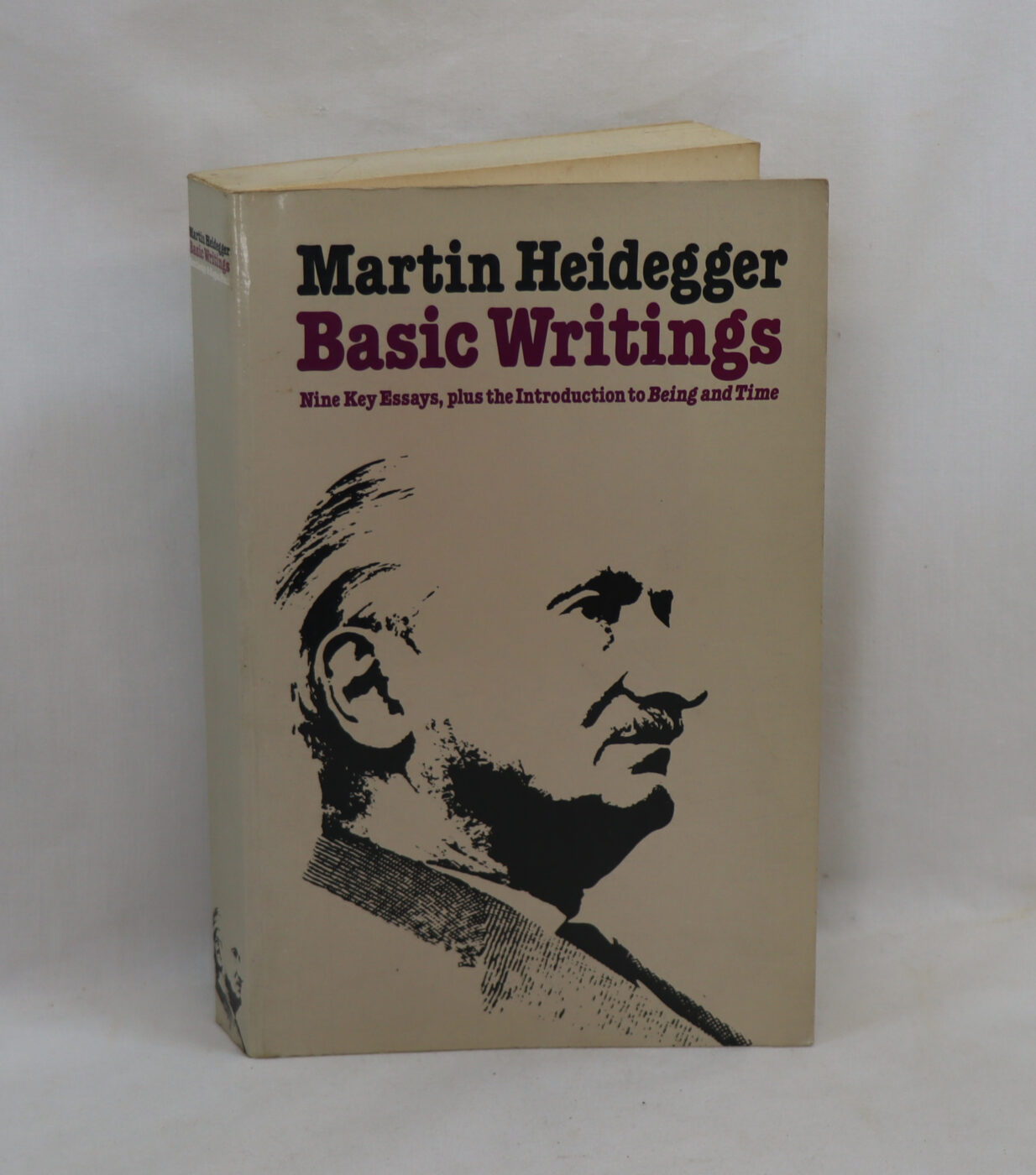
Paperback. Beige cover with black and purple title.
We provide an in-depth photographic presentation of this item to stimulate your feeling and touch. More traditional book descriptions are immediately available
- Note: This book carries a £5.00 discount to those that subscribe to the F.B.A. mailing list
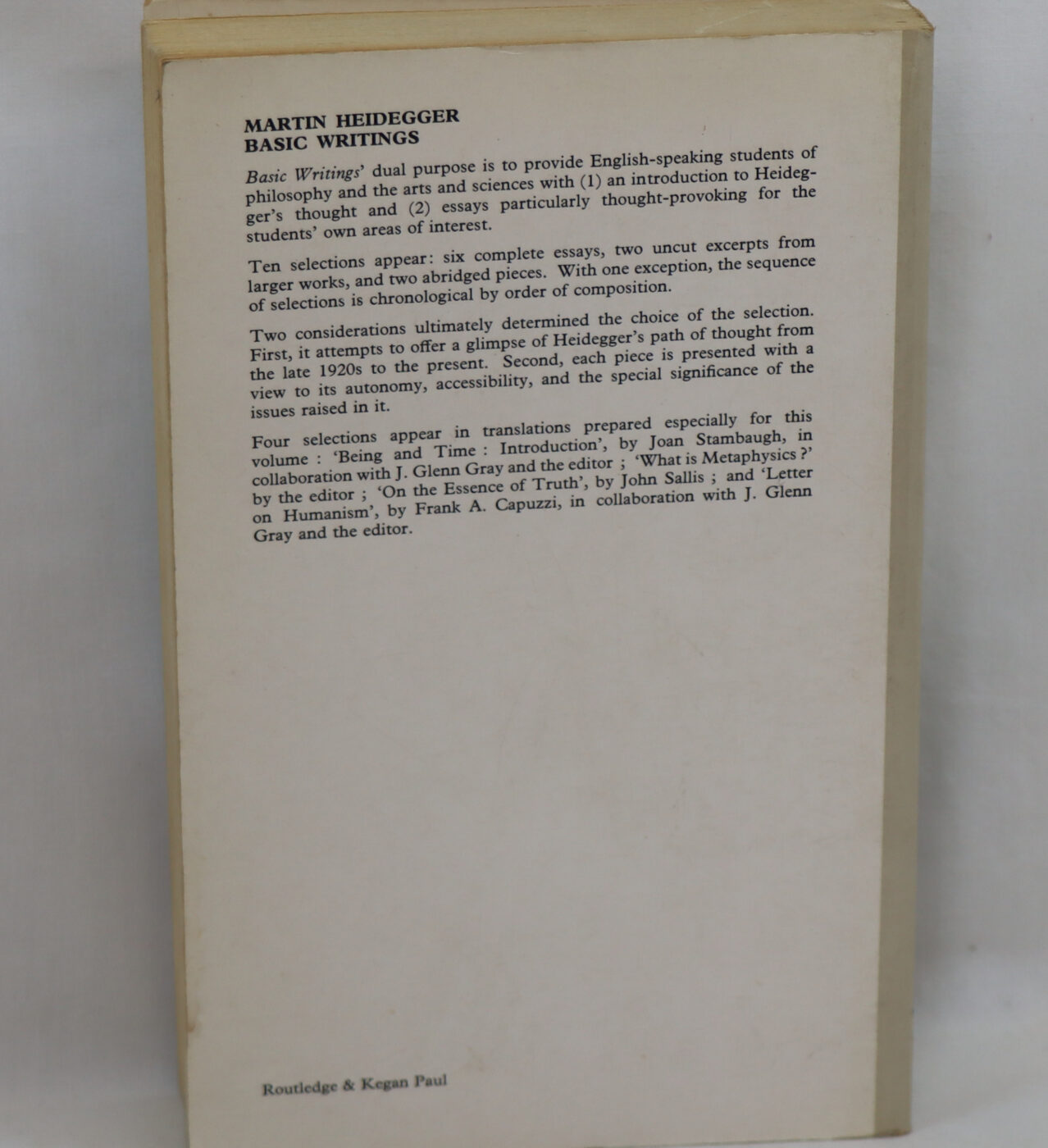
This revised and expanded edition of Martin Heidegger’s Basic Writings includes ten key essays and the Introduction to Being and Time. Basic Writings is a concise introduction to the thought of this controversial and important twentieth-century philosopher. David Farrell Krell has expanded and improved this collection by adding `The Way to Language’ and including the complete version of `The Origin of the Work of Art’. The complete selection is: Being and Time: Introduction What is Metaphysics? On the Essence of Truth The Origin of the Work of Art Letter on Humanism Modern Science, Metaphysics, and Mathematics The Question Concerning Technology Building Dwelling Thinking What Calls for Thinking? The Way to Language The End of Philosophy and the Task of Thinking
Review: I am a sociology academic reasonably well versed in philosophy but was almost completely lost when I first tried to read this due to the density of the text. In my opinion it is not a good starting point for Heidegger’s work. I ended up listening to Dreyfus’ lectures on B&T and reading his book discussing Div1 of said book. I then discovered Greg Sadler’s excellent lectures (on YouTube) in which he walks the viewer through several of the chapters in this volume. Since then I have got a handle on Heidegger’s writing style and use of language and read and re-read several of the chapters Sadler looks at as well as a couple of the ones he hasn’t yet lectured on. I still find much of it confusing but also extremely stimulating, and at times exhilarating. The introductions (two at the start and one for each chapter) also get clearer and more helpful the more you understand the main text. So, on balance, I think this is a superb book but, for me at least, it required an extraordinary amount of commitment just to get started, and there are still a couple of chapters (over a year after buying it) that I haven’t had the energy to read yet!
Martin Heidegger (26 September 1889 – 26 May 1976) was a German philosopher whose work was central to the development of phenomenology, hermeneutics, and existentialism. He has had significant impact within subsequent philosophy, social sciences and humanities, and theology.
Heidegger’s magnum opus, Being and Time (1927), is widely considered one of the most significant works of modern philosophy. In it, he introduced the concept of Dasein (“being-there”) to describe the distinctive character of human existence, arguing that humans possess a “pre-ontological” understanding of being that shapes how they live and act, which he analyzed in terms of the unitary structure of “being-in-the-world”. Through his analysis of Dasein, Heidegger sought to reawaken what he called “the question of being“: the fundamental inquiry into what makes entities intelligible as the entities they are. In other words, Heidegger’s governing “question of being” is concerned with what makes beings intelligible as beings. This question, he believed, had been neglected or obscured throughout the history of Western philosophy since the ancient Greeks.
His later work turned increasingly to questions of technology, language, art, and poetry, developing themes of human “dwelling” in the world and critiquing what he saw as the nihilistic trajectory of modern technological civilization. Thinkers as varied as Jean-Paul Sartre, Hans-Georg Gadamer, Hannah Arendt, Jacques Derrida, and Richard Rorty were substantially shaped by engagement with his thought, whether in agreement or opposition.
Heidegger’s legacy has been complicated and shadowed by his involvement with National Socialism. In April 1933, he was elected rector of the University of Freiburg and joined the Nazi Party, a membership he retained until 1945. The nature and extent of his commitment to Nazism, and the question of whether his philosophy is inherently connected to his political choices, remain subjects of significant scholarly controversy. After the war, he was banned from teaching following denazification proceedings, a ban later lifted in 1949, after which he returned to lecturing at the University of Freiburg. During this period of enforced withdrawal, he nevertheless continued to exert influence through private seminars and audiences at his home. His refusal to publicly repudiate his Nazi involvements or express remorse in unambiguous terms has continued to trouble interpreters of his work.
NOTE: This is an original book from the library gathered by the famous Cambridge Don, computer scientist, food and wine connoisseur, Jack Arnold LANG. Note: Jack founded the Michelin Guide ‘Midsummer House’- Cambridge’s paramount restaurant. This dining experience is hidden amongst the grassy pastures and grazing cattle of Midsummer Common and perched on the banks of the River Cam.
In 2008, Jack was one of the co-founders of the Raspberry Pi Foundation, alongside other members of the Department, and acted as the Foundation’s Chair. The project’s original goals were modest: to build and distribute low-cost computers for prospective applicants to our Computer Science degree. Initially the project was a “success disaster”, as Jack would say, as demand far outstripped the low-scale manufacturing plans. Ultimately the Raspberry Pi became the UK’s most successful computer with more than 60 million sold to date. Jack was drawn to the educational possibilities of the Raspberry Pi, its potential uses in emerging economies and the way it could support self-directed learning.
Want to know more about this item?
We are happy to answer any questions you may have about this item. In addition, it is also possible to request more photographs if there is something specific you want illustrated.
Ask a question
Related products







Share this Page with a friend
