
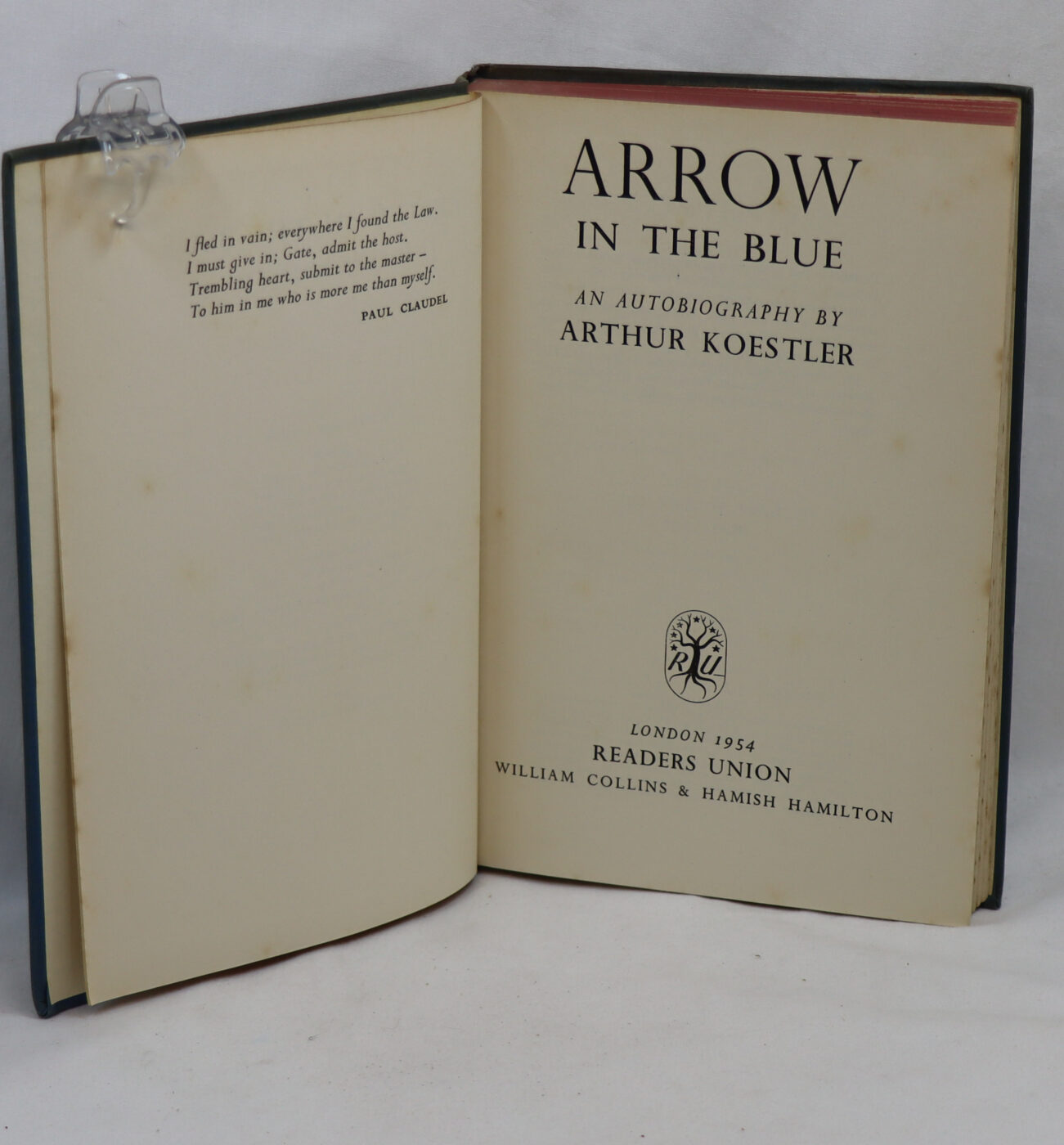
Arrow in the Blue (autobiography).
By Authur Koestler
Printed: 1954
Publisher: Readers Union. London
| Dimensions | 15 × 22 × 2 cm |
|---|---|
| Language |
Language: English
Size (cminches): 15 x 22 x 2
Condition: Good (See explanation of ratings)
£16.00
Buy Now

Item information
Description
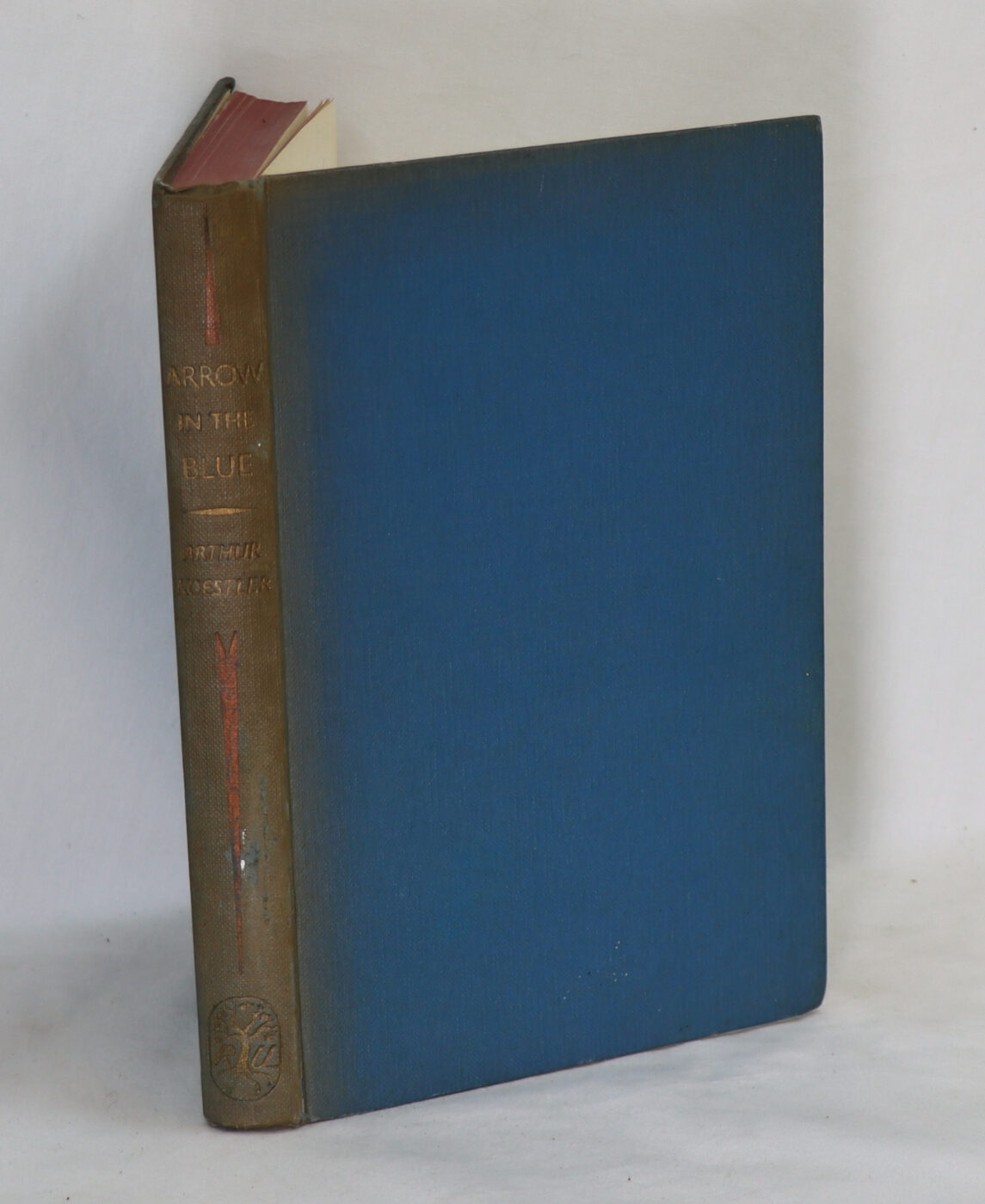
Red cloth binding with gilt title on the spine.
We provide an in-depth photographic presentation of this item to stimulate your feeling and touch. More traditional book descriptions are immediately available.
- Note: This book carries a £5.00 discount to those that subscribe to the F.B.A. mailing list
Please view our photographs. The market value for a 1954 Readers Union edition of Arthur Koestler’s Arrow in the Blue in “Good” condition is roughly £14 to £18.
Because the Readers Union was a book-buying club that issued subscriber editions, it is generally valued lower by antiquarian collectors than the original 1952 true first edition printed by Collins and Hamish Hamilton. Copies on the secondhand market from platforms like AbeBooks.co.uk and eBay UK frequently fall into this pricing tier.
Key Details & Identification
- Historical Context: This is the first volume of Koestler’s definitive autobiography, covering his early 26 years, his nomadic travels across Galilee and Cairo, and leading up to his decision to join the Communist Party in 1931.
- Condition Notes: For book-club editions from this era, a “Good” rating typically implies minor shelf wear to the cloth boards, slight spine tanning, and aged or foxed page edges.
Content
Arrow in the Blue is the first volume of Arthur Koestler’s autobiography, chronicling his life from his birth in 1905 to 1931. It is widely regarded as a “psychological self-analysis” as much as a historical record.
- Time Period: 1905–1931 (ending at age 26).
- Key Events: The narrative covers his youth in Vienna, his time as a member of a Zionist duelling fraternity, his work as a collective farm worker in Galilee, and his years as a foreign correspondent in the Middle East, Paris, and Berlin.
- Climax: The book concludes with his pivotal decision to join the Communist Party in December 1931, an event he describes as second in importance only to his birth.
- Themes: The text explores the political and intellectual currents of early 20th-century Europe, his “thirst for the absolute,” and the psychological roots of his eventual embrace of totalitarian ideology.
Condition notes
Spine faded
Want to know more about this item?
We are happy to answer any questions you may have about this item. In addition, it is also possible to request more photographs if there is something specific you want illustrated.
Ask a question
Share this Page with a friend
