
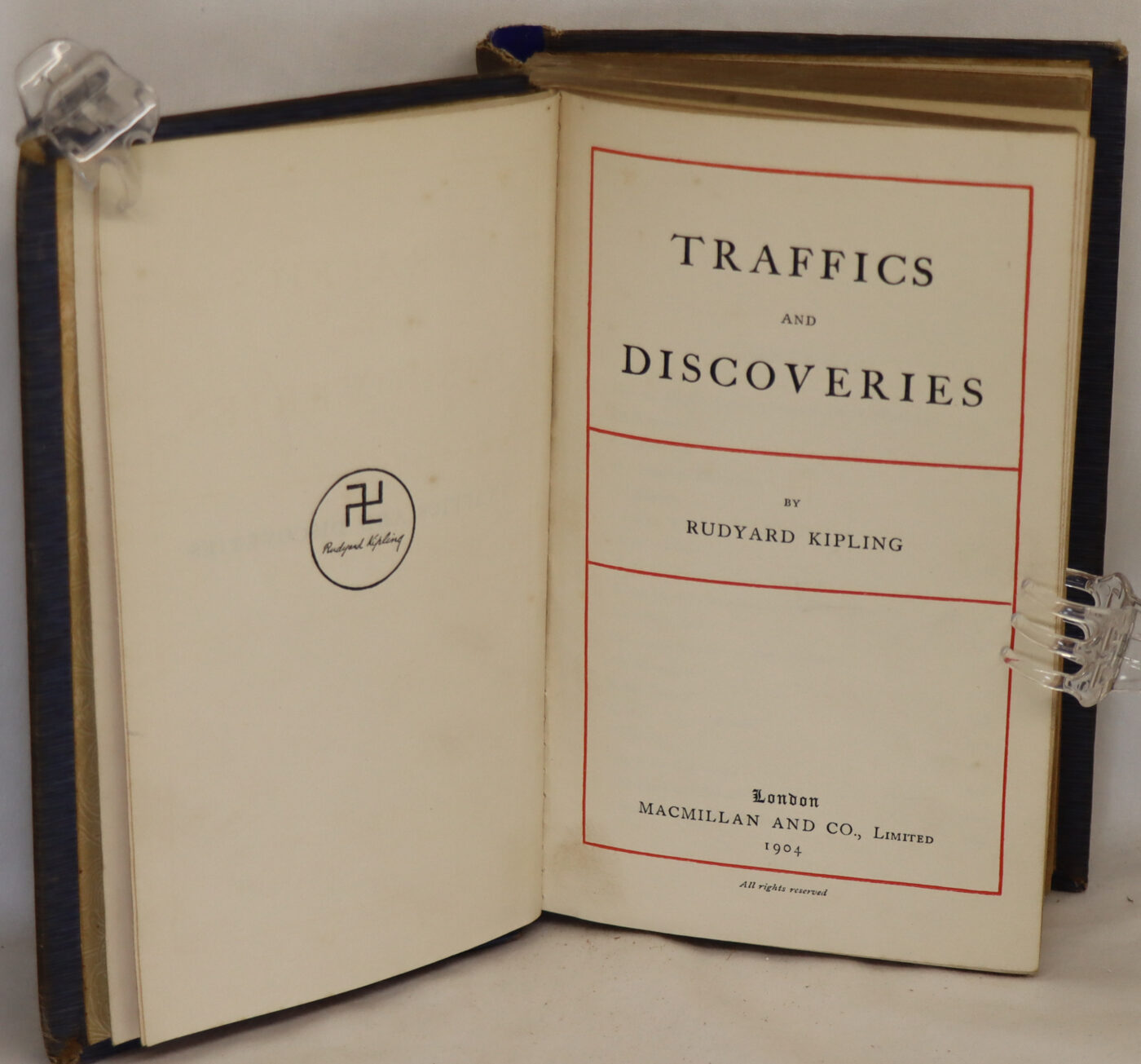
Traffic and Discoveries.
By Rudyard Kipling
Printed: 1904
Publisher: Macmillan & Co. London
| Dimensions | 14 × 20 × 3 cm |
|---|---|
| Language |
Language: English
Size (cminches): 14 x 20 x 3
Condition: Fair (See explanation of ratings)
£48.00
Buy Now

Item information
Description
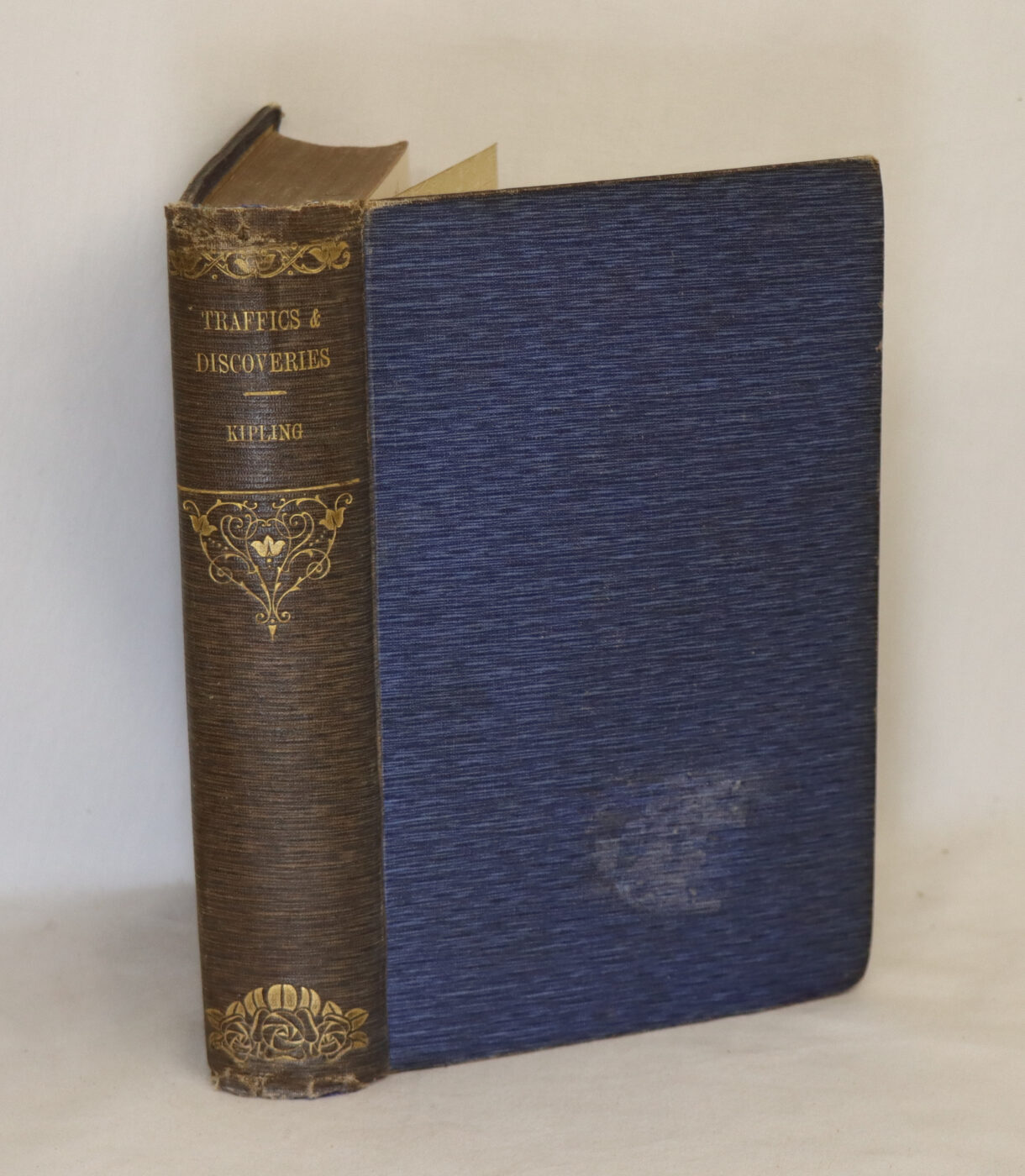
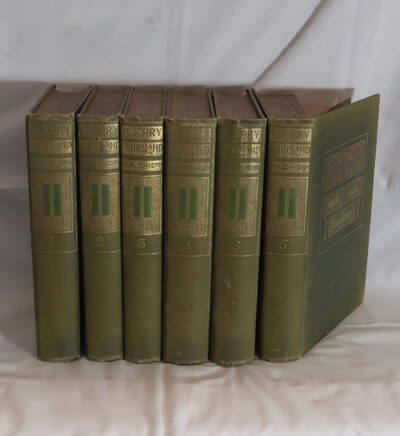
Navy cloth binding with gilt title and decoration on the spine.
We provide an in-depth photographic presentation of this item to stimulate your feeling and touch. More traditional book descriptions are immediately available.
- Note: This book carries a £5.00 discount to those that subscribe to the F.B.A. mailing list
This is a 1904 UK First Edition of Traffics and Discoveries by Rudyard Kipling. Published in London by Macmillan & Co., this collection contains eleven short stories and accompanying poems, including well-known works such as “They” and “Wireless”.
Key Edition Identifiers
To confirm the exact printing state and value of this copy, check the following physical details:
- Cover and Binding. The standard UK first edition is bound in red cloth with a gilt elephant medallion stamped on the front board, gilt spine lettering, and a gilt top page edge. Your dimensions of 5.6 x 8 inches match the standard octavo (8vo) format of the original Macmillan release.
- First Issue Points. Look at the very last page of the publisher’s advertisements at the back of the book. The true first issue features a printing date code misprinted as “35.8.04”, which was later corrected to “25.8.04” and “20.9.04” in subsequent issues.
- Page Count. A complete copy contains 393 numbered text pages preceded by 6 preliminary pages (vi), followed by 16 to 22 pages of Macmillan advertisements.
Estimated Market Value
In Fair condition without its original dust jacket, a 1904 copy typically holds modest collector value, generally sitting at the lower end of the market. Comparable copies on the UK market show how condition and completeness impact pricing:
- Very Good Condition (No Jacket). Clean, solid first-edition copies without dust wrappers frequently sell between £21 and £30 on AbeBooks.co.uk.
- Very Good Condition (With Jacket). Adding an original 1904 printed dust wrapper increases value significantly, with listings such as a second-issue copy at Fosters’ Bookshop priced around £95 and fine copies reaching £550 at West Hull Rare Books.
- Fair Condition Impact. Because copies in very good shape without a jacket are readily available around £20–£30, a copy in Fair condition (usually indicating loose hinges, heavy wear, foxing, or missing endpapers) typically commands under £15 to £20, unless it bears a notable provenance or author signature.
Biography of Rudyard Kipling
Joseph Rudyard Kipling (1865–1936) was an English journalist, short-story writer, poet, and novelist who became one of the most popular writers in the United Kingdom during the late 19th and early 20th centuries. In 1907, he became the first English-language writer to receive the Nobel Prize in Literature, and at age 41, he remains its youngest recipient.
Early Life and Education
- Birth in India. Kipling was born on 30 December 1865 in Bombay (now Mumbai) in British India, to Alice MacDonald and John Lockwood Kipling, a sculptor and pottery designer. His early childhood in India deeply shaped his sensory memory and lifelong fascination with the country.
- Schooling in England. At age five, Kipling and his sister were sent to England to board with a foster family in Southsea, an unhappy six-year period he later described as the “House of Desolation”. He went on to attend the United Services College in Devon, a boarding school whose harsh environment inspired his 1899 schoolboy novel Stalky & Co.
Return to India and Rise to Fame
- Journalism Career. Returning to India at age 16 in 1882, Kipling worked as a reporter and assistant editor for the Civil and Military Gazette in Lahore and The Pioneer in Allahabad. These roles gave him wide exposure to Anglo-Indian society, British soldiers, and local life.
- Literary Breakthrough. Kipling began publishing short stories and satirical verse in his newspapers, collecting them into early volumes such as Departmental Ditties (1886) and Plain Tales from the Hills (1888). When he returned to London in 1889, he was already hailed as a literary sensation.
Major Works and Career
- Children’s Classics. Following his marriage to American Caroline Balestier in 1892, Kipling lived for four years in Brattleboro, Vermont. During this period, he wrote his most enduring works for young readers, including The Jungle Book (1894), The Second Jungle Book (1895), and Captains Courageous (1897).
- Novels and Poetry. Moving back to England, he published his masterpiece novel Kim (1901) and the whimsical Just So Stories (1902). His popular poetry—such as “Gunga Din”, “Mandalay”, and “If—” (1910)—made him a household name across the British Empire.
- Later Writing. Around the time of Traffics and Discoveries (1904) and Puck of Pook’s Hill (1906), Kipling’s fiction grew more complex and introspective, exploring themes of grief, technology, the supernatural, and English history.
Later Years and Legacy
- Personal Tragedies. Kipling’s later life was marked by profound loss, including the death of his eldest daughter Josephine from pneumonia in 1899 and the loss of his only son, John, at the Battle of Loos during World War I in 1915.
- Death and Reputation. Kipling lived quietly at Bateman’s, his 17th-century estate in East Sussex, until his death on 18 January 1936; his ashes were buried in Poets’ Corner at Westminster Abbey. While celebrated for his storytelling craft and vivid prose, his legacy remains debated due to his staunch support of British imperialism.
How Traffics and Discoveries fits into his broader career?
Published in 1904, Traffics and Discoveries marks a major transitional turning point in Rudyard Kipling’s career, shifting him away from his upbeat, imperialist adventure tales toward darker, psychologically complex, and experimental fiction. Written during his early years living at Bateman’s in Sussex, the collection reflects a writer grappling with personal tragedy, modern technology, and the aftermath of the Second Boer War.
Key Shifts in Kipling’s Career
- From Empire Optimism to War Skepticism. Earlier works like Plain Tales from the Hills (1888) and Barrack-Room Ballads (1892) largely celebrated British imperial confidence. Having spent time in South Africa reporting during the Boer War, Kipling used stories in Traffics and Discoveries—such as “The Captive” and “A Sahib’s War”—to offer a sharper, more critical look at military bureaucracy and the human cost of conflict.
- Personal Grief and the Supernatural. Following the sudden death of his six-year-old daughter Josephine in 1899, Kipling’s writing took on a deeply mournful, spiritual tone. The standout story in this volume, “They”, depicts a bereaved narrator visiting a mysterious country house haunted by the spirits of dead children, serving as a direct literary response to his own grief.
- Fascination with Modern Technology. Kipling was an early enthusiast of motorcars, wireless telegraphy, and mechanical engineering, and this book showcases his shift toward early science fiction and technical realism. In “Wireless”, he uses Marconi’s newly invented radio transmission as a metaphor for spiritual and poetic inspiration, while “Steam Tactics” celebrates the chaotic early days of motoring in rural England.
- Increasing Literary Complexity. Unlike the straightforward, journalistic clarity of his 1890s bestsellers, the stories in Traffics and Discoveries are denser, more elliptical, and heavily layered with symbolism. Each story is paired with an accompanying poem that comments obliquely on the narrative, a structural technique Kipling refined here and carried into his later, more modernist-leaning collections like Actions and Reactions (1909) and Debits and Credits (1926).
Place in His Timeline
Positioned right between his beloved children’s classics (Kim in 1901 and Just So Stories in 1902) and his Nobel Prize win in 1907, Traffics and Discoveries bridges the gap between the “popular” young Kipling and the “mature” writer. While some contemporary critics found the stories overly obscure compared to The Jungle Book, modern literary scholars frequently point to this collection as the start of his finest, most subtle short fiction.
Chapter headings
Traffics and Discoveries is organized into eleven short stories, each preceded by a corresponding introductory poem. Two of the longer stories are divided into two parts, making 24 total entries in the original table of contents.
Complete Table of Contents
The list below follows the exact sequence of poems and stories from the 1904 edition:
- From the Masjid-al-Aqsa of Sayyid Ahmed (Wahabi) (Poem)
- The Captive (Story)
- Poseidon’s Law (Poem)
- The Bonds of Discipline (Story)
- The Runners (Poem)
- A Sahibs’ War (Story)
- The Wet Litany (Poem)
- ‘Their Lawful Occasions’ – Part I (Story)
- ‘Their Lawful Occasions’ – Part II (Story)
- The King’s Task (Poem)
- The Comprehension of Private Copper (Story)
- The Necessitarian (Poem)
- Steam Tactics (Story)
- Kaspar’s Song in ‘Varda’ (Poem)
- ‘Wireless’ (Story)
- Song of the Old Guard (Poem)
- The Army of a Dream – Part I (Story)
- The Army of a Dream – Part II (Story)
- The Return of the Children (Poem)
- ‘They’ (Story)
- From Lyden’s ‘Irenius’ (Poem)
- Mrs. Bathurst (Story)
- ‘Our Fathers Also’ (Poem)
- Below the Mill Dam (Story)
Note on Chapter Headings
In many of Kipling’s books, the short verses at the start of chapters were later collected separately under the title “Chapter Headings” in his complete poetry anthologies. You can view the full digital text of these pairings on Project Gutenberg or explore detailed literary notes for each chapter on The Kipling Society website.
Read brief plot summaries for each of the 11 stories?
The eleven stories in Traffics and Discoveries span themes of warfare, naval hijinks, early technology, and supernatural grief. Below is a brief plot summary of each story in the order it appears in the 1904 edition.
War and Empire Stories
- 1. The Captive. An American inventor named Laughton O. Zigler designs an advanced automatic gun and fights for the Boers in South Africa. After being captured by the British, he cheerfully critiques both armies’ tactics and British bureaucratic rigidity.
- 3. A Sahibs’ War. Told through the eyes of Umr Singh, a loyal Sikh soldier serving a British officer during the Boer War. When his beloved officer is treacherously killed under a false flag of truce, Umr Singh struggles to restrain his desire for blood vengeance against the Boer fighters.
- 5. The Comprehension of Private Copper. A British private on patrol in South Africa is ambushed by an English-educated Boer soldier. Instead of shooting him, Copper turns the tables, captures his captor, and exposes the hollowness of the Boer’s anti-British rhetoric.
- 8. The Army of a Dream (Parts I & II). Presented as a narrator’s vivid dream, this speculative story envisions a reformed, ultra-efficient British society where universal military training is integrated into boys’ schooling and national culture.
Naval and Motoring Comedies
- 2. The Bonds of Discipline. A Royal Navy crew aboard a cruiser discovers a French spy disguised as a sailor on their ship. To trick him, the captain and crew stage an elaborate, chaotic farce of fake incompetence and mutiny so the spy files a completely useless report.
- 4. ‘Their Lawful Occasions’ (Parts I & II). During summer naval manoeuvres, an eccentric naval officer takes command of an old torpedo boat. Using clever camouflage and bold tactics, he sneaks past the main fleet and “torpedoes” major battleships in a mock raid.
- 6. Steam Tactics. While driving his early steam-powered motorcar through the Sussex countryside, the narrator and his naval friends are stopped by an overzealous local policeman. They trick the constable into boarding the car and strand him miles away at a private estate.
Technology, the Supernatural, and Allegory
- 7. ‘Wireless’. On a freezing winter night in a chemist’s shop, a young tubercular assistant falls into a trance while early radio experiments are conducted upstairs. As wireless signals pass through the building, the young man unconsciously channels the exact poetry of John Keats, whom he has never read.
- 9. ‘They’. A motorist loses his way in the Sussex woods and discovers an ancient, secluded manor house owned by a blind woman. He gradually realizes the house is inhabited by the ghosts of dead children—including his own deceased daughter—drawn there by the woman’s deep love.
- 10. Mrs. Bathurst. Four men sitting in a railway carriage in South Africa piece together the tragic fate of a naval warrant officer named Vickery. Obsessed with a warm-hearted New Zealand hotelkeeper named Mrs. Bathurst, Vickery deserts his ship after seeing her image in a moving-picture newsreel, leading to a mysterious, fatal end.
- 11. Below the Mill Dam. A whimsical fable set inside a Sussex watermill, where a conservative Black Rat and a Spirit of the Mill debate the arrival of modern electricity. When the old waterwheel is upgraded to generate electric power, the traditional creatures must adapt to a new industrial age.
NOTE: This is an original book from the library gathered by the famous Cambridge Don, computer scientist, food and wine connoisseur, Jack Arnold LANG. Note: Jack founded the Michelin Guide ‘Midsummer House’- Cambridge’s paramount restaurant. This dining experience is hidden amongst the grassy pastures and grazing cattle of Midsummer Common and perched on the banks of the River Cam.
In 2008, Jack was one of the co-founders of the Raspberry Pi Foundation, alongside other members of the Department, and acted as the Foundation’s Chair. The project’s original goals were modest: to build and distribute low-cost computers for prospective applicants to our Computer Science degree. Initially the project was a “success disaster”, as Jack would say, as demand far outstripped the low-scale manufacturing plans. Ultimately the Raspberry Pi became the UK’s most successful computer with more than 60 million sold to date. Jack was drawn to the educational possibilities of the Raspberry Pi, its potential uses in emerging economies and the way it could support self-directed learning.
Want to know more about this item?
We are happy to answer any questions you may have about this item. In addition, it is also possible to request more photographs if there is something specific you want illustrated.
Ask a question
Related products

Share this Page with a friend
