
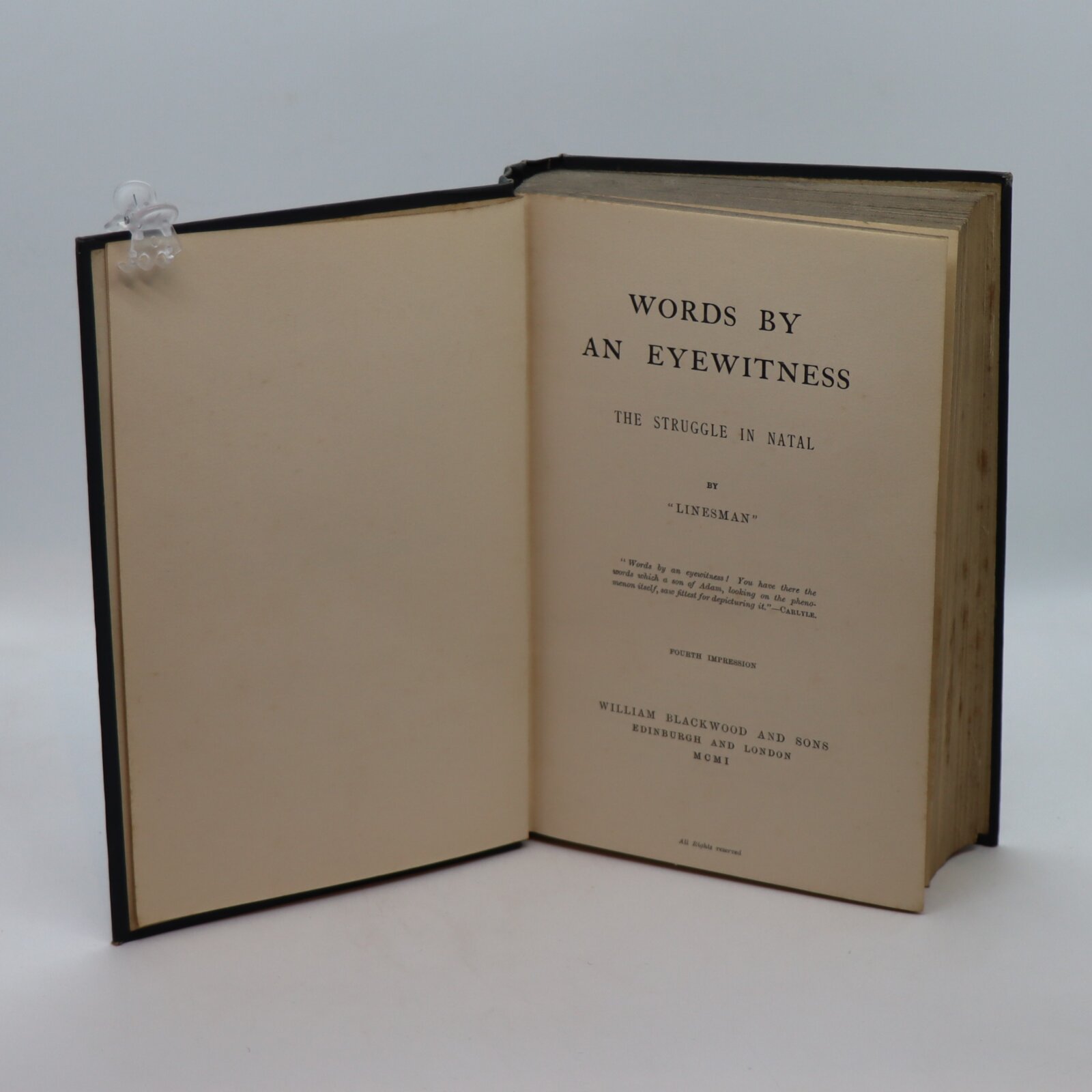
Words by an Eyewitness. Linesman.
By Linesman
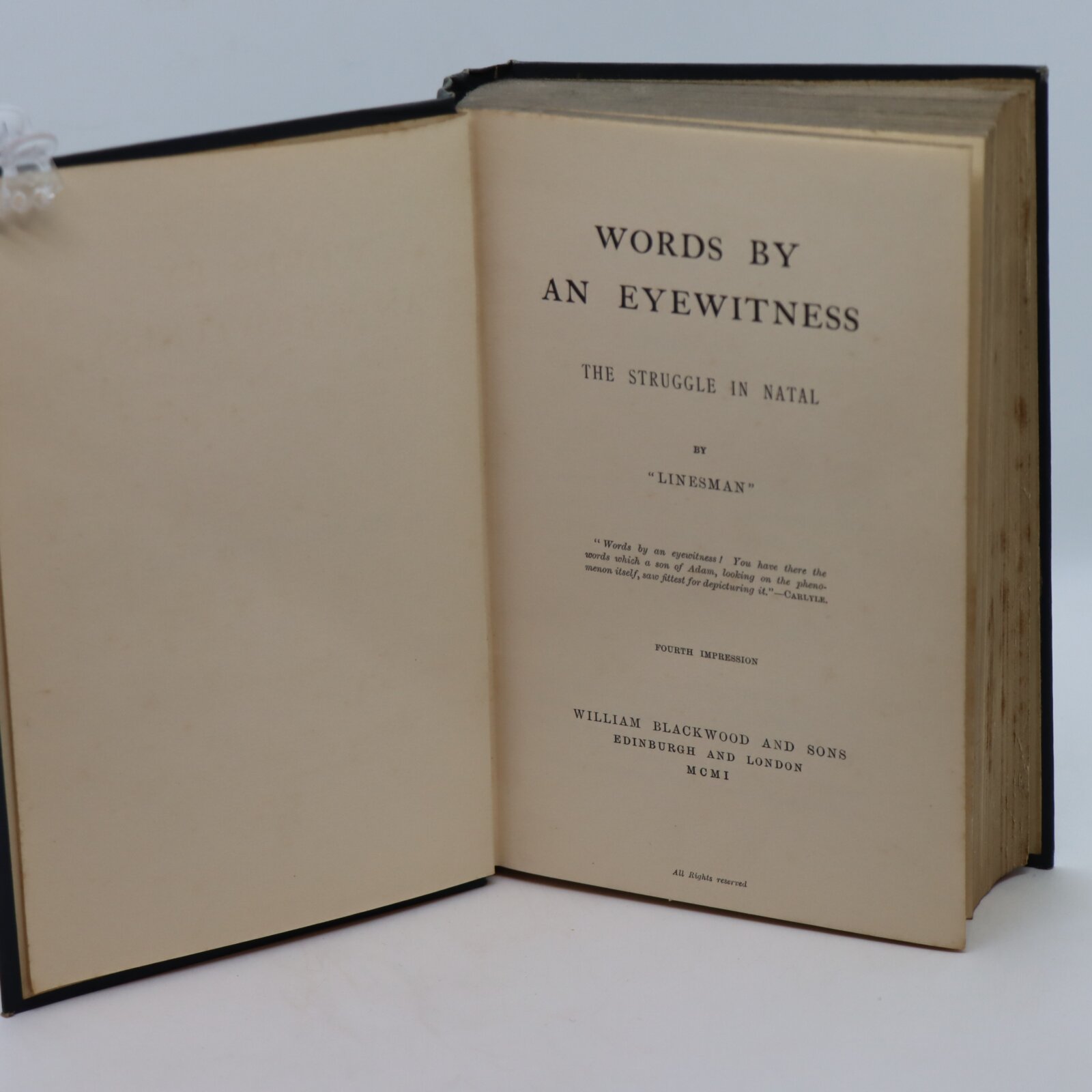
Printed: 1901
Publisher: William Blackwood. Edinburgh
Edition: fourth impression
| Dimensions | 14 × 20 × 4 cm |
|---|---|
| Language |
Language: English
Size (cminches): 14 x 20 x 4
Condition: Fine (See explanation of ratings)
SORRY, THIS ITEM HAS SOLD
Item information
Description
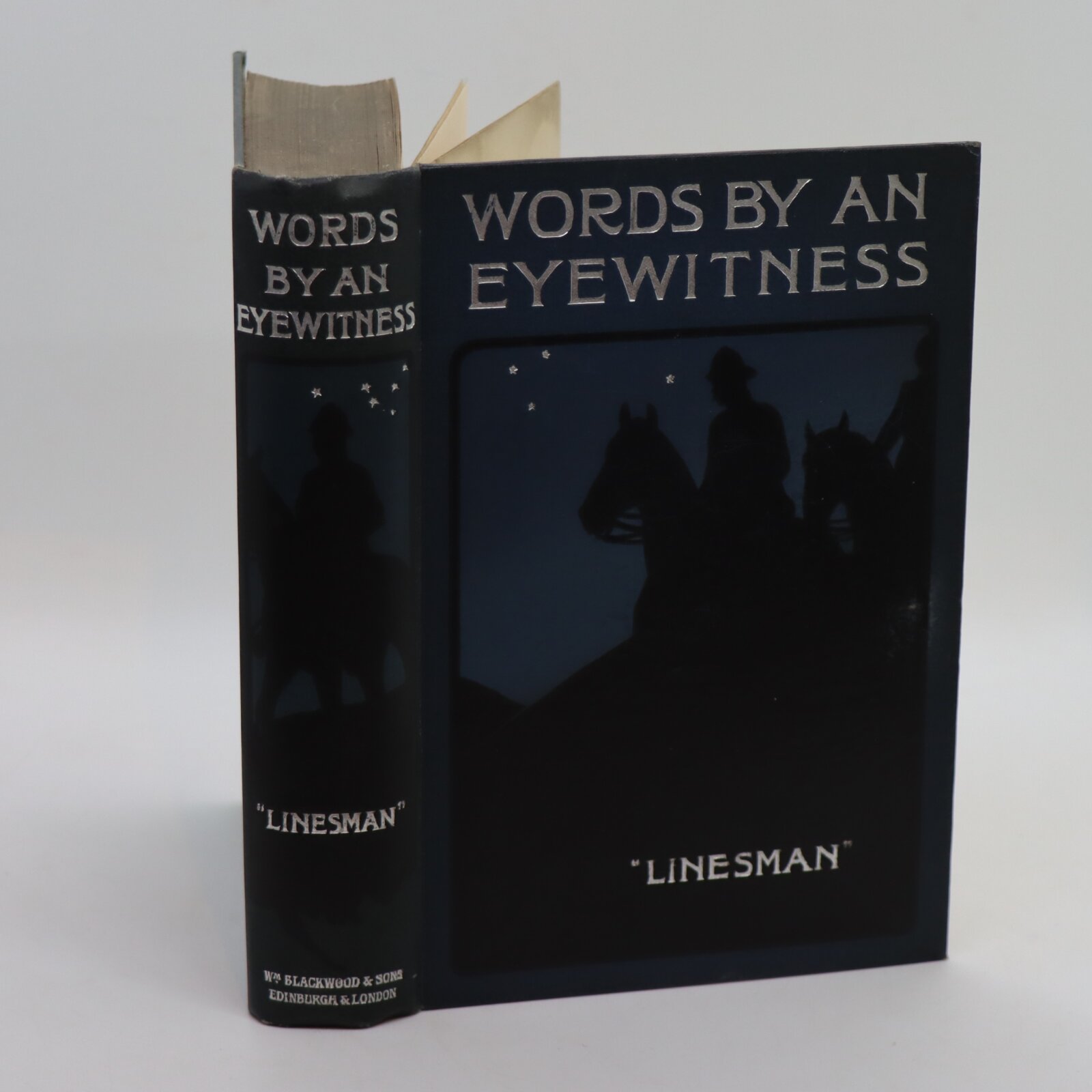
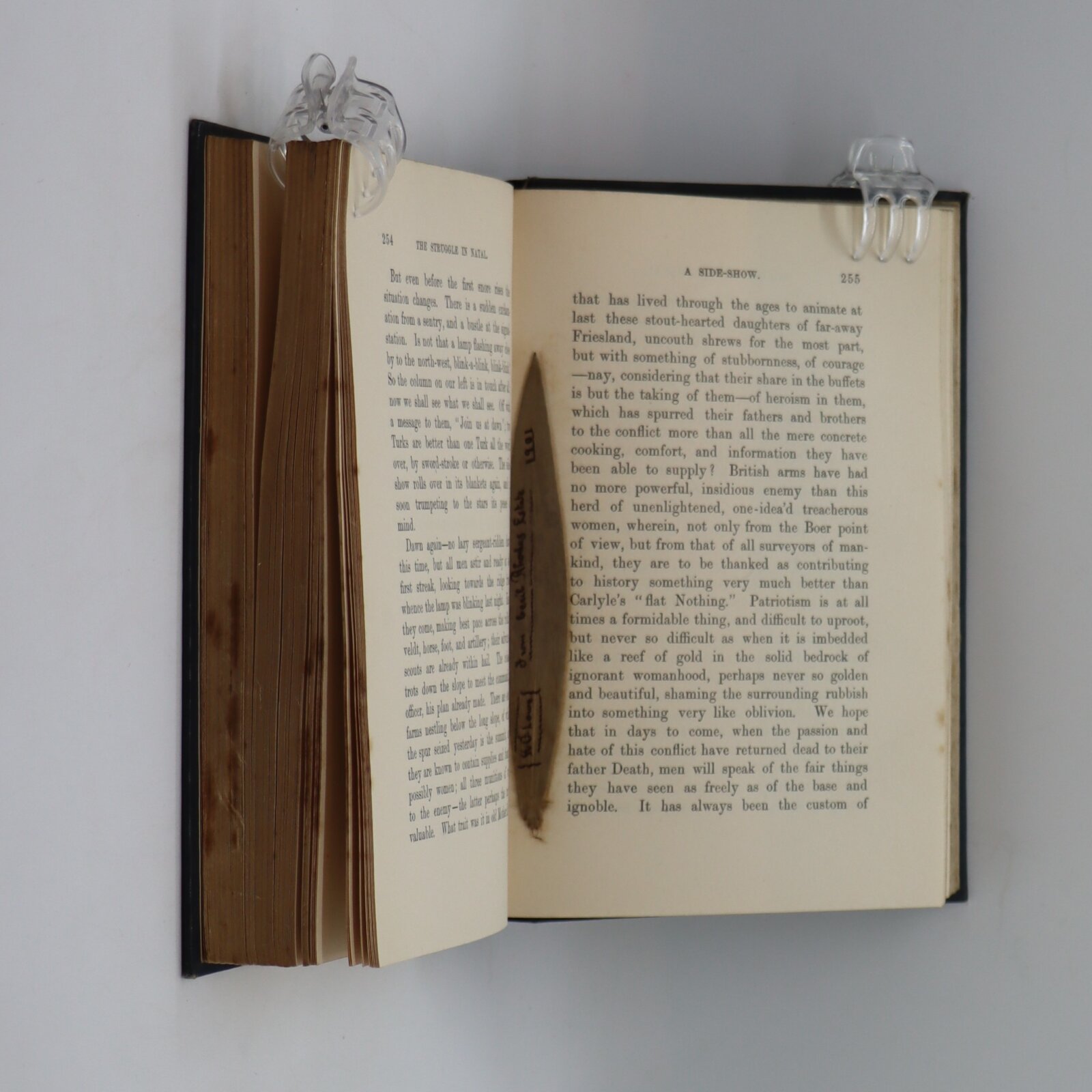
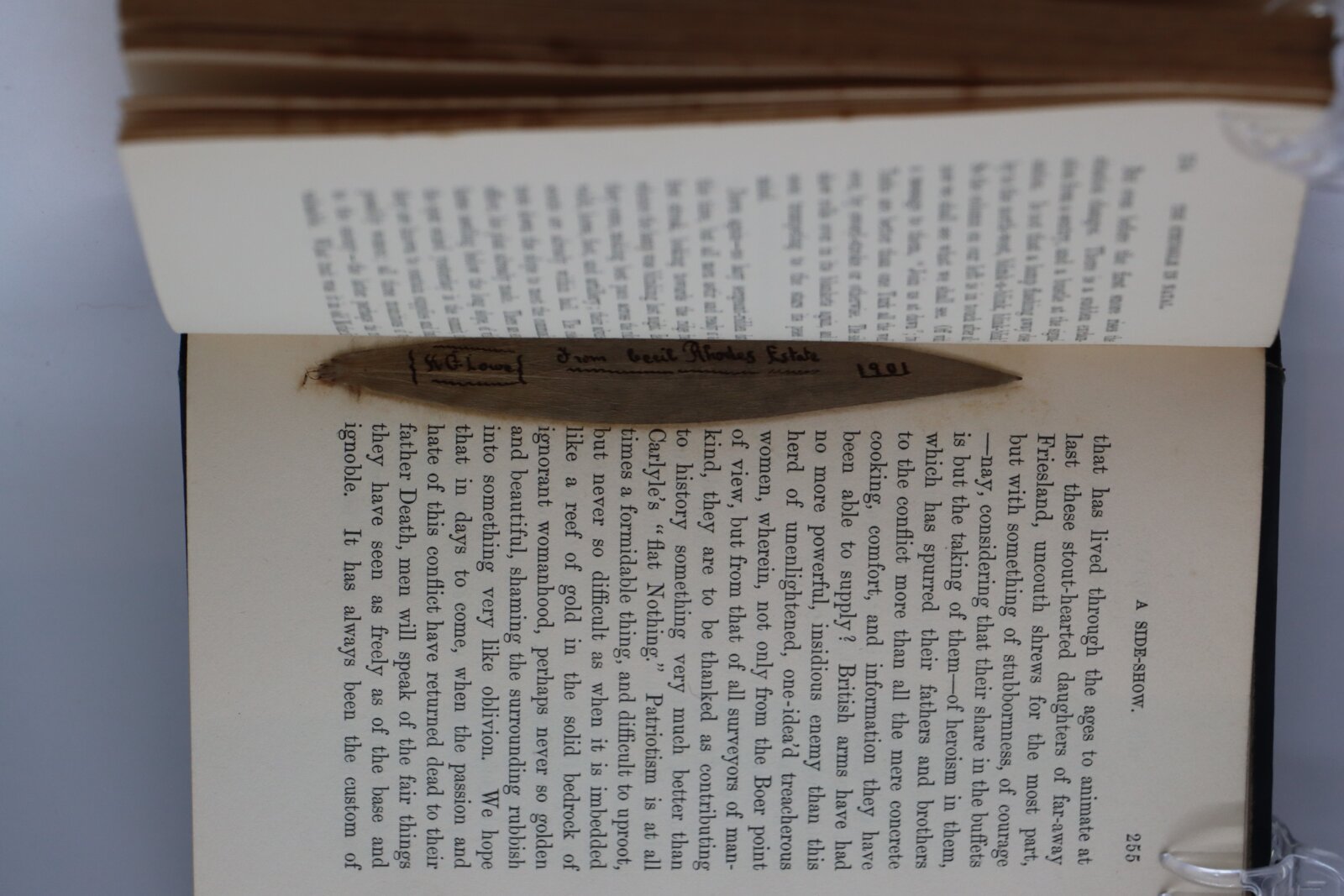
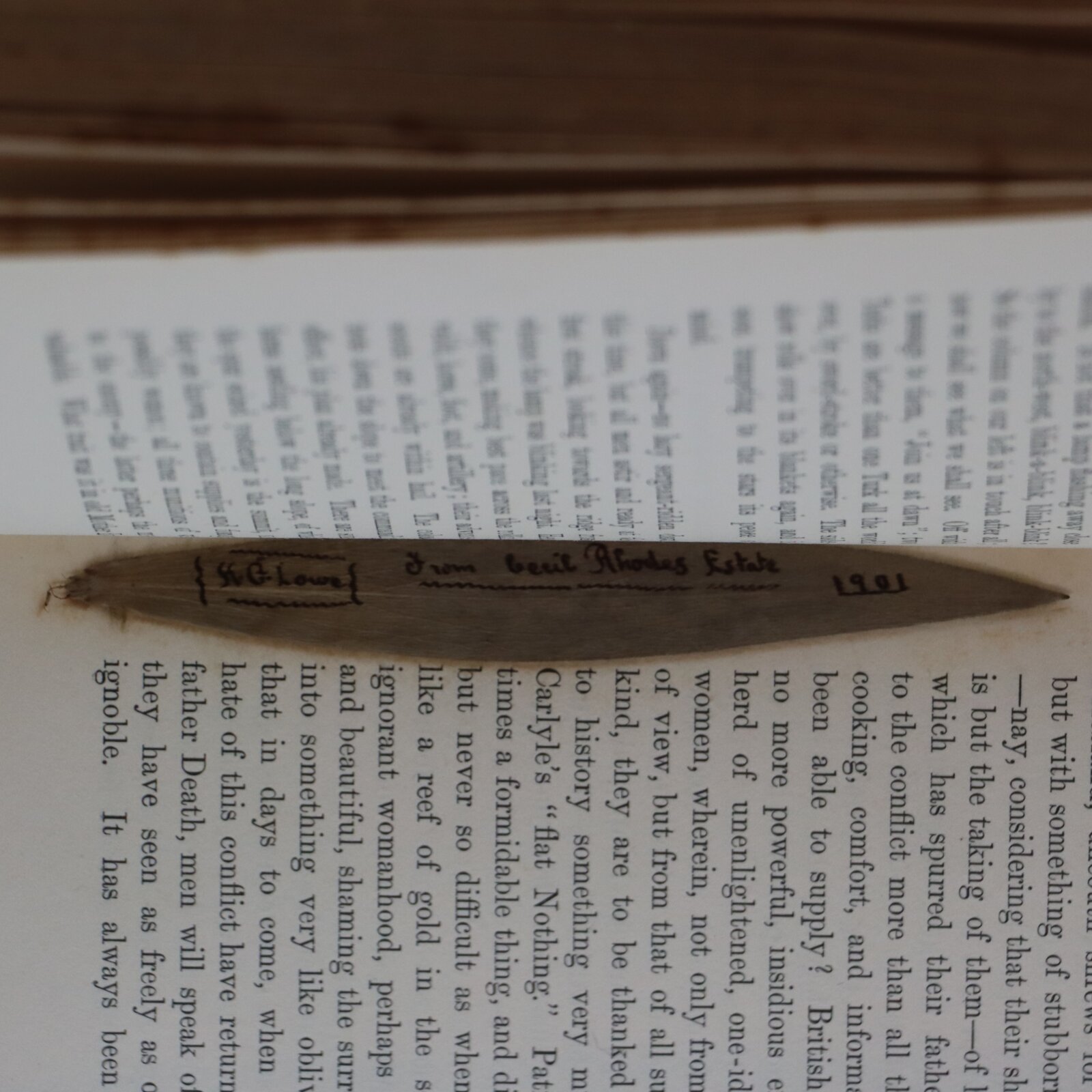
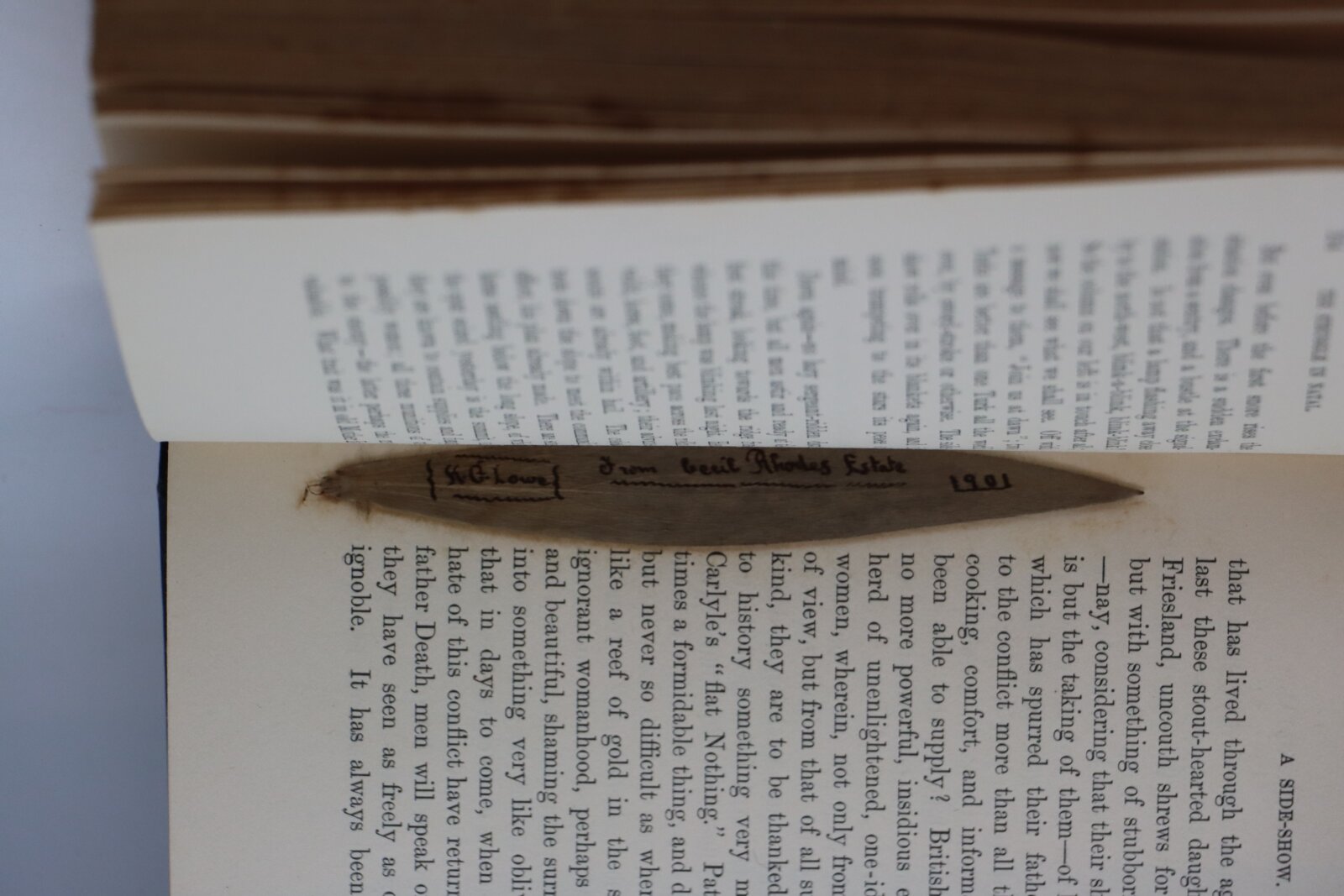
Navy cloth binding. Black horseman on front board. Silver title on front and spine. A tree leaf inside the pages is signed “from Cecil Rhodes estate. 1901” and “K G Lowe”.
This book comes from the private library of Cecil Rhodes
‘See the inscription upon the book dried leaf’
“One of the most brilliant books of sketches on the South African War, full of sharp and clever criticism, with many pathetic touches.”
The Second Boer War (also known as the Boer War, the Anglo-Boer War, or the South African War), was a conflict fought between the British Empire and the two Boer Republics (the South African Republic and the Orange Free State) over the Empire’s influence in Southern Africa from 1899 to 1902. Triggered by the discovery of diamond and gold deposits in the Boer republics, the Boers launched successful attacks against British outposts in the opening stages of the war before being pushed back by imperial reinforcements. Though the British swiftly occupied the Boer republics, numerous Boers refused to accept defeat and engaged in guerrilla warfare. Eventually, British scorched earth policies brought the remaining Boer guerrillas to the negotiating table, ending the war.
The conflict broke out in 1899 when Boer irregulars and militia attacked colonial settlements in nearby British colonies. In 1900, they placed Ladysmith, Kimberley, and Mafeking under siege, and won a string of victories at Colenso, Magersfontein and Stormberg. In response to these developments, increased number of British Army soldiers were brought to Southern Africa, and mounted largely unsuccessful attacks against the Boers. However, British military fortunes changed when their commanding officer, General Redvers Buller was replaced by Lord Roberts and Lord Kitchener, who relieved the three besieged cities and invaded the two Boer Republics in late 1900 at the head of a 400,000-strong expeditionary force. The Boers, aware they were unable to resist such a large force, chose to refrain from fighting pitched battles, allowing the British to occupy both republics.
Boer politicians, including President of the South African Republic Paul Kruger either fled the region or went into hiding; the British Empire officially annexed the two republics in 1900. In Britain, the Conservative ministry led by Lord Salisbury attempted to capitalize on British military successes by calling an early general election, which was dubbed by contemporary observers as a “khaki election”. However, numerous Boer fighters took to the hills and launched a guerrilla campaign against the British occupational forces, becoming known as bittereinders. Led by prominent generals such as Louis Botha, Jan Smuts, Christiaan de Wet, and Koos de la Rey, Boer guerrillas launched a campaign of hit-and-run attacks and ambushes against the British, which would continue for two years.
The Boer guerrilla campaign proved difficult for the British to defeat, due in part to British unfamiliarity with guerrilla tactics and extensive support for the guerrillas among the civilian population in the Boer Republics. In response to continued failures to defeat the Boer guerrillas, British high command ordered several scorched earth policies to be implemented as part of a large scale and multi-pronged counter insurgency campaign; a complex network of nets, blockhouses, strongpoints and barbed wire fences was constructed, virtually partitioning the occupied republics. British troops were ordered to destroy farms and slaughter livestock to deny them to Boer guerrillas, and thousands of Boer civilians (mostly women and children) were forcibly interned in concentration camps, where 26,000 died of various causes, mostly disease and starvation. Black Africans were also interned in concentration camps as well to prevent them from supplying the Boers; 20,000 died in the camps as well, largely due to the same causes as their Boer counterparts.
In addition to these scorched earth policies, British mounted infantry units were deployed to track down and engage individual Boer guerillas units; by this stage of the war, all battles being fought were small-scale skirmishes. Few combatants on other side were killed in action, with most casualties coming via disease. Despite the British efforts to defeat the Boer guerillas, they continued to refuse to surrender. This led Lord Kitchener to offer generous terms of surrender to remaining Boer leaders in an effort to bring an end to the conflict. Eager to ensure their fellow Boers were released from the concentration camps, the majority of Boer commanders accepted the British terms in the Treaty of Vereeniging, formally surrendering in May 1902. The former republics were transformed into the British colonies of the Transvaal and Orange River, and in 1910 were merged with the Natal and Cape Colonies to form the Union of South Africa, a self-governing dominion within the British Empire.
British military efforts were aided significantly by local forces from the Cape Colony, the Natal Colony, Rhodesia, as well as volunteers from the British Empire worldwide, particularly Australia, Canada, India and New Zealand. Later in the war, Black African recruits contributed increasingly to the British war effort. International public opinion was generally sympathetic to the Boers and hostile to the British. Even within the empire, there existed significant opposition to the war. As a result, the Boer cause attracted thousands of volunteers from neutral countries all over the world, including parts of the British Empire such as Ireland. Many consider the Boer War as marking the beginning of the questioning of the British Empire’s level of power and prosperity; this is due to the war’s surprisingly long duration and the unforeseen, discouraging losses suffered by the British fighting the “cobbled-together army” of Boers.
Cecil John Rhodes PC (5 July 1853 – 26 March 1902) was a British mining magnate and politician in southern Africa who served as Prime Minister of the Cape Colony from 1890 to 1896. An ardent believer in British imperialism, Rhodes and his British South Africa Company founded the southern African territory of Rhodesia (now Zimbabwe and Zambia), which the company named after him in 1895. South Africa’s Rhodes University is also named after him. He also devoted much effort to realising his vision of a Cape to Cairo Railway through British territory. Rhodes set up the provisions of the Rhodes Scholarship, which is funded by his estate.
The son of a vicar, Rhodes was born at Netteswell House, Bishop’s Stortford, Hertfordshire. A sickly child, he was sent to South Africa by his family when he was 17 years old in the hope that the climate might improve his health. He entered the diamond trade at Kimberley in 1871, when he was 18, and, thanks to funding from Rothschild & Co, began to systematically buy out and consolidate diamond mines. Over the next two decades he gained near-complete domination of the world diamond market, forming a massive monopoly. His diamond company De Beers, formed in 1888, retained its prominence into the 21st century.
Rhodes entered the Cape Parliament at the age of 27 in 1881, and in 1890, he became prime minister. During his time as prime minister, Rhodes used his political power to expropriate land from black Africans through the Glen Grey Act, while also tripling the wealth requirement for voting under the Franchise and Ballot Act, effectively barring black people from taking part in elections. After overseeing the formation of Rhodesia during the early 1890s, he was forced to resign in 1896 after the disastrous Jameson Raid, an unauthorised attack on Paul Kruger’s South African Republic (or Transvaal). Rhodes’s career never recovered; his heart was weak and after years of poor health he died in 1902. He was buried in what is now Zimbabwe; his grave has been a controversial site.
In his last will, he provided for the establishment of the prestigious international Rhodes Scholarship at Oxford University, the oldest graduate scholarship in the world. Every year it grants 102 full postgraduate scholarships. It has benefited prime ministers of Malta, Australia and Canada, United States President Bill Clinton, and many others.
Want to know more about this item?
We are happy to answer any questions you may have about this item. In addition, it is also possible to request more photographs if there is something specific you want illustrated.
Ask a question
Related products
Share this Page with a friend
