
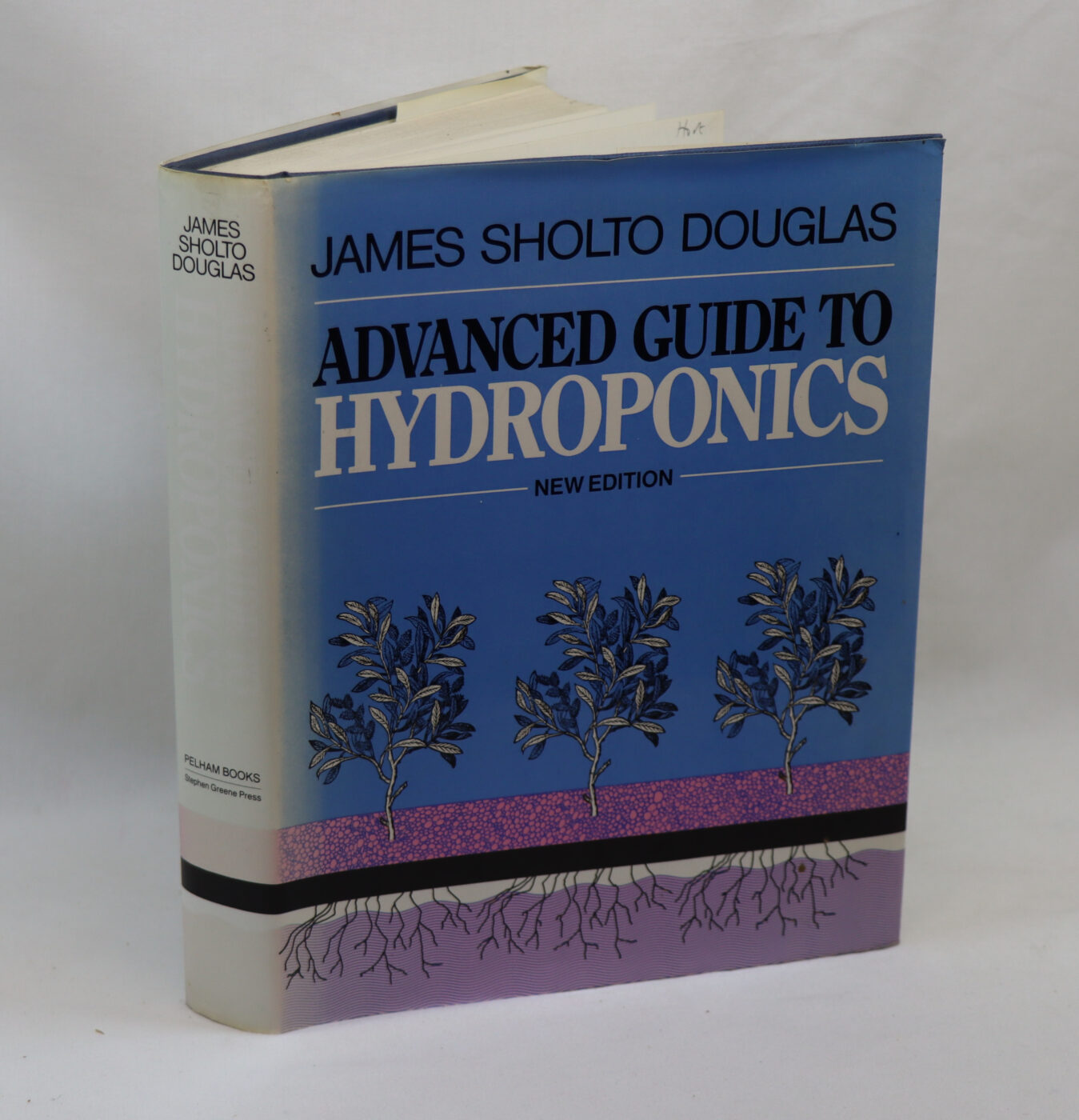
Advanced Guide to Hydroponics.
By James Sholto Douglas
Printed: 1990
Publisher: Pelham Books.
| Dimensions | 18 × 22 × 33 cm |
|---|---|
| Language |
Language: English
Size (cminches): 18 x 22 x 33
Condition: Good (See explanation of ratings)
£42.00
Buy Now



Item information
Description
In the original dust jacket. Navy cloth binding with gilt title on the spine.
We provide an in-depth photographic presentation of this item to stimulate your feeling and touch. More traditional book descriptions are immediately available.
- Note: This book carries a £5.00 discount to those that subscribe to the F.B.A. mailing list
This is one of the better books on hydroponics and it was a favourite of Jack Lang. China regards this technique as the future of farming. In real terms hydroponics is able to grow 90% of the UK’s agricultural needs.
A: What are 6 types of hydroponics? An AI Overview
The six main types of hydroponic systems are: Wick, Deep Water Culture (DWC), Nutrient Film Technique (NFT), Ebb and Flow, Drip, and Aeroponics. They all provide water, nutrients, and oxygen directly to the roots, but they differ in water delivery methods, equipment complexity, and electricity reliance.
- Wick Systems
- How it works: This is the simplest, most passive method. Plants sit in a growing medium while an absorbent wick (like a nylon string) draws a nutrient solution upward from a reservoir into the roots via capillary action.
- Best for: Herbs, microgreens, and small leafy greens. It is ideal for beginners because it requires no pumps or electricity.
- Deep Water Culture (DWC)
- How it works: Plants are placed in a floating platform so their roots dangle directly into a bucket or basin of aerated nutrient water. An air stone and pump are used to provide the necessary oxygen.
- Best for: Fast-growing, water-loving plants like lettuce and larger plants like tomatoes.
- Nutrient Film Technique (NFT)
- How it works: A continuous, shallow stream of nutrient solution flows over the exposed roots. The solution is pumped into a sloped channel, washing over the roots and draining back into the reservoir.
- Best for: Commercial operations and short-cycle, lightweight, leafy greens.
- Ebb and Flow (Flood and Drain)
- How it works: A pump on a timer periodically floods the plant’s grow bed with nutrient solution. Once the bed is full, the pump turns off, and gravity allows the excess water to drain back into the reservoir, giving the roots crucial oxygen.
- Best for: Larger fruiting plants and root vegetables that need wet/dry cycles.
- Drip Systems
- How it works: A pump pushes a nutrient solution through small tubes directly to the base of each individual plant, mimicking standard drip irrigation.
- Best for: Larger plants, slower-growing plants, and a wide variety of commercial crops.
- Aeroponics
- How it works: Plant roots are suspended entirely in the air and misted with a fine spray of nutrient solution at scheduled intervals. This is highly oxygenated and promotes rapid growth.
- Best for: Advanced growers looking to maximize nutrient absorption, speed up plant cycles, and optimize vertical space.
- Where is hydroponics used the most?
China. China is one of the fastest growing regions for hydroponic cultivation. With a population of 1.4 billion people, it only makes sense for the country to develop self-sufficiency around food production. For such a large country, China has surprisingly little agricultural land.
- What is the hydroponic farming technique?
Hydroponic culture is a method of growing plants without soil, utilizing water-based mineral nutrient solutions instead. By delivering water and essential nutrients directly to the roots, plants grow up to 50% faster and yield higher produce while consuming approximately 90% less water than conventional soil farming.
- Hydroponic systems optimize plant growth through several specific goals and advantages:
- Resource Conservation: Because water is continuously recirculated in a closed system, hydroponics uses drastically less water than conventional soil farming.
- Maximized Yield and Speed:
By eliminating the need for roots to search for nutrients, plants grow 30% to 50% faster. This allows for dense, vertical stacking and significantly higher harvests per square foot. - Controlled Environment: Growers have precise control over the nutrient mix, pH, light, and temperature. This makes year-round cultivation possible regardless of seasonal weather changes.
- Pest and Disease Reduction: Without soil, many common soil-borne pests and diseases are eliminated
NOTE: This is an original book from the library gathered by the famous Cambridge Don, computer scientist, food and wine connoisseur, Jack Arnold LANG. Note: Jack founded the Michelin Guide ‘Midsummer House’- Cambridge’s paramount restaurant. This dining experience is hidden amongst the grassy pastures and grazing cattle of Midsummer Common and perched on the banks of the River Cam.
In 2008, Jack was one of the co-founders of the Raspberry Pi Foundation, alongside other members of the Department, and acted as the Foundation’s Chair. The project’s original goals were modest: to build and distribute low-cost computers for prospective applicants to our Computer Science degree. Initially the project was a “success disaster”, as Jack would say, as demand far outstripped the low-scale manufacturing plans. Ultimately the Raspberry Pi became the UK’s most successful computer with more than 60 million sold to date. Jack was drawn to the educational possibilities of the Raspberry Pi, its potential uses in emerging economies and the way it could support self-directed learning.
Want to know more about this item?
We are happy to answer any questions you may have about this item. In addition, it is also possible to request more photographs if there is something specific you want illustrated.
Ask a question
Related products








Share this Page with a friend
