
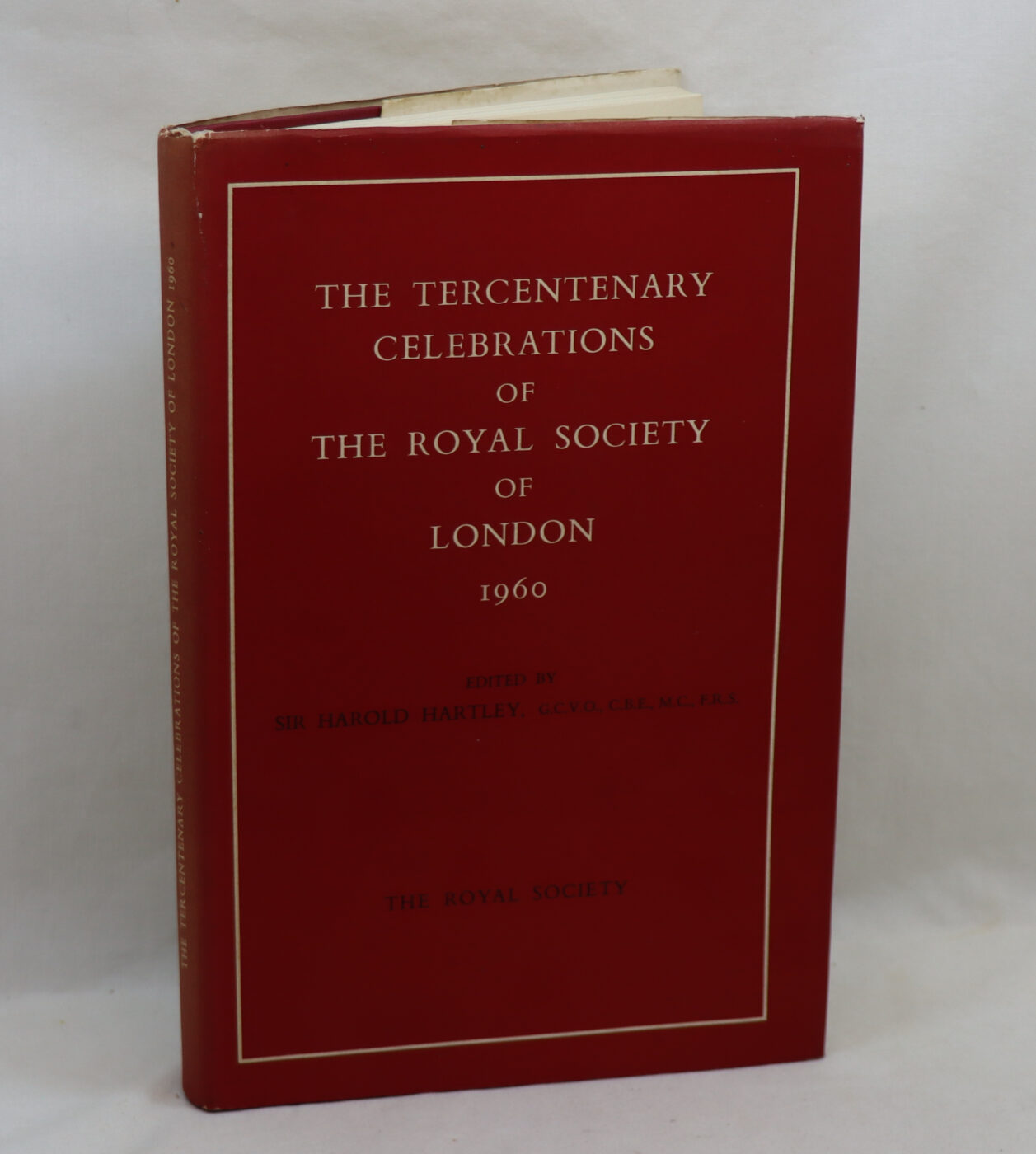
The Tercentenary Celebrations of The Royal Society of London.
By Edited by Sir Harold Hartley
Printed: 1960
Publisher: The Royal Society. London
| Dimensions | 18 × 26 × 2 cm |
|---|---|
| Language |
Language: English
Size (cminches): 18 x 26 x 2
Condition: Very good (See explanation of ratings)
£34.00
Buy Now

Item information
Description
In the original dust cover.Maroon cloth binding with gilt title on the spine. Gilt crest on the front board.
We provide an in-depth photographic presentation of this item to stimulate your feeling and touch. More traditional book descriptions are immediately available
- Note: This book carries a £5.00 discount to those that subscribe to the F.B.A. mailing list
Note: This book carries a £5.00 discount to those that subscribe to the F.B.A. mailing list
“The Tercentenary Celebrations of the Royal Society of London”, edited by Sir Harold Hartley and published by The Royal Society in London in 1961 (though often linked to 1960 planning or printing), is a detailed, official record of the events celebrating the 300th anniversary of the Society’s founding in 1660.
This volume is a key historical document covering the proceedings of the Tercentenary, which took place in London in July 1960.
Key Aspects of the Book
- Editor: Sir Harold Hartley (1878–1972), a British physical chemist, academic, and industrialist.
- Publisher: The Royal Society of London.
- Publication Date: Generally listed as 1961 (1st Edition).
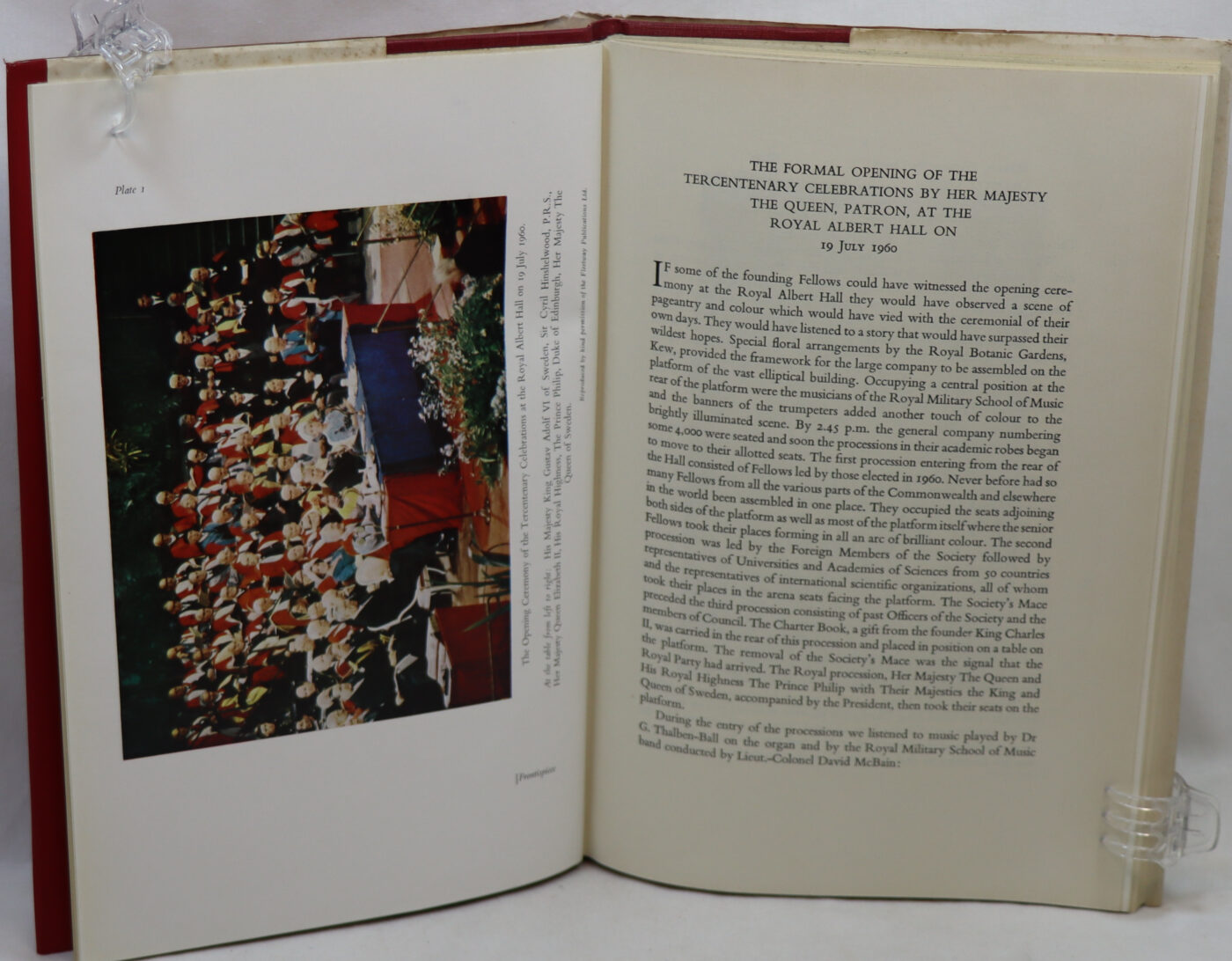
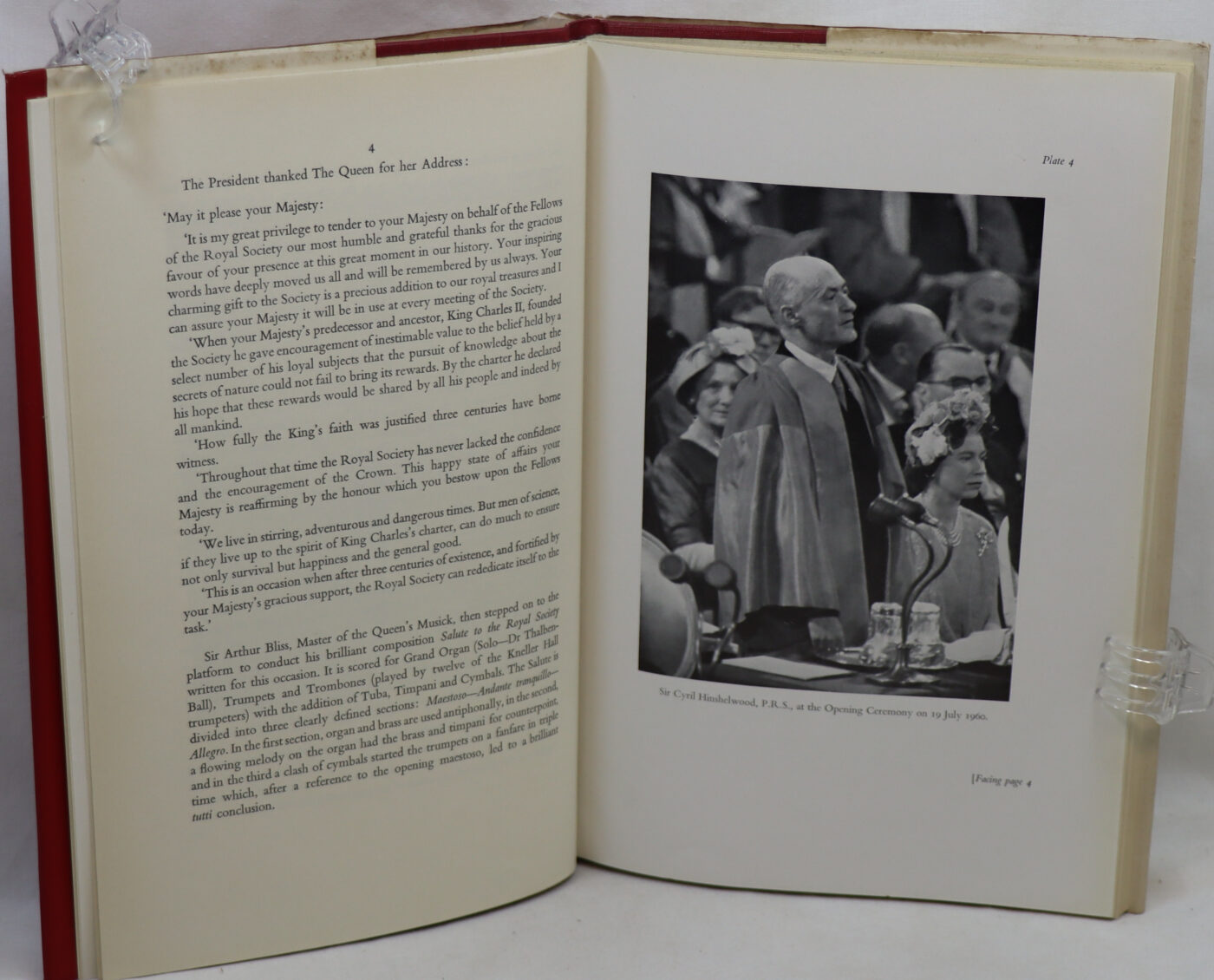
- Content: Contains reports on the formal celebrations, the lectures delivered, congratulatory addresses from universities and scientific institutions worldwide, and social events.
- Physical Details: Usually a hardcover, comprising over 140 pages, often illustrated with plates (approximately 26 cm).
Sir Harold Brewer Hartley (1878-1972) was a British physical chemist whose contributions to both academia and industry were facilitated by a meticulous experimental approach and unrivalled powers of persuasion. Despite being affected throughout the latter half of his career by severe arthritis that eventually left him unable to walk, he continued contributing to the advancement of science until the very end of his life.
Sir Harold Brewer Hartley was born on 3 September 1878 in London. He developed an interest in science as a boy, his father’s mineral collection inspiring an early fascination with the subject of mineralogy, before being introduced as a pupil at Dulwich College to the joys of chemistry.
In 1897, he won a scholarship to Balliol College at the University of Oxford, where, immediately after graduating with First Class Honours, he accepted a role as Tutorial Fellow. He was given responsibility for the teaching of physical chemistry, a relatively young subject without strong foundations in Oxford. As a teacher, he promoted to his students his own deeply held convictions about the value of precision in experimental techniques and the importance of understanding one’s own place in the development of scientific thinking.
NOTE: This is an original book from the library gathered by the famous Cambridge Don, computer scientist, food and wine connoisseur, Jack Arnold LANG. Note: Jack founded the Michelin Guide ‘Midsummer House’- Cambridge’s paramount restaurant. This dining experience is hidden amongst the grassy pastures and grazing cattle of Midsummer Common and perched on the banks of the River Cam.
In 2008, Jack was one of the co-founders of the Raspberry Pi Foundation, alongside other members of the Department, and acted as the Foundation’s Chair. The project’s original goals were modest: to build and distribute low-cost computers for prospective applicants to our Computer Science degree. Initially the project was a “success disaster”, as Jack would say, as demand far outstripped the low-scale manufacturing plans. Ultimately the Raspberry Pi became the UK’s most successful computer with more than 60 million sold to date. Jack was drawn to the educational possibilities of the Raspberry Pi, its potential uses in emerging economies and the way it could support self-directed learning.
Want to know more about this item?
We are happy to answer any questions you may have about this item. In addition, it is also possible to request more photographs if there is something specific you want illustrated.
Ask a question
Related products






Share this Page with a friend
