
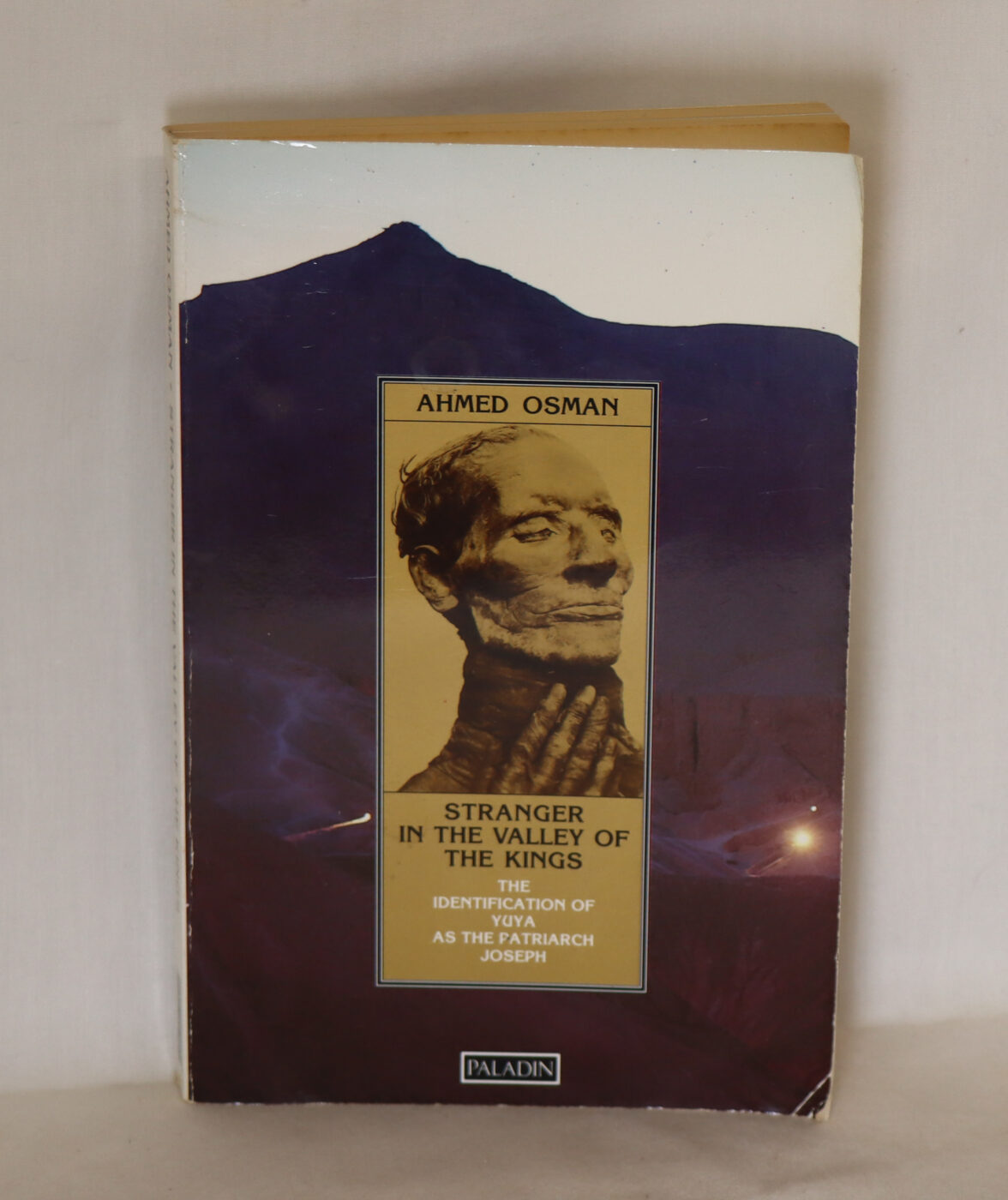
Stranger in the Valley of the Kings.
By Ahmed Osman
ISBN: 9780586087848
Printed: 1987
Publisher: Paladin. London
| Dimensions | 13 × 20 × 1 cm |
|---|---|
| Language |
Language: English
Size (cminches): 13 x 20 x 1
Condition: Good (See explanation of ratings)
£9.00
Buy Now
Item information
Description
Paperback. White cover with black title.
We provide an in-depth photographic presentation of this item to stimulate your feeling and touch. More traditional book descriptions are immediately available
A £3 reduction when collected from FBA shop
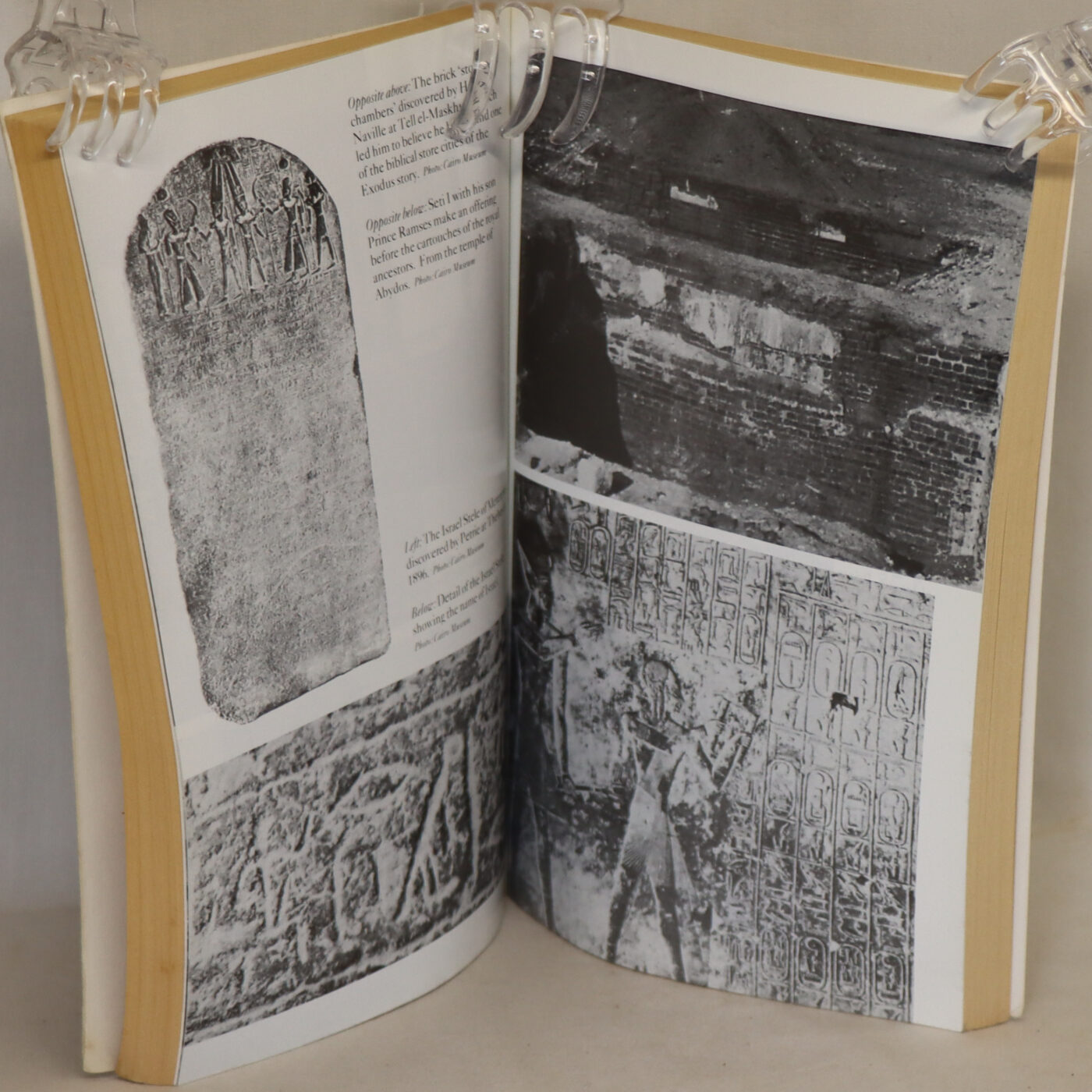
Throughout the long history of Ancient Egypt, only one man is known to have been given the title “a father to the Pharaoh” – Yuza, vizier of the Eighteenth Dynasty King Tuthmosis IV. It was the discovery of this identical title in the Book of Genesis, applied to the patriarch Joseph, that led the author of this book to a revelation that calls into question many of the accepted theories about Egyptian and Old Testament history. Osman claims that Yuza and Joseph were the same person, a discovery that throws a new light on the sudden rise of monotheism in Egypt under Queen Tiye and her son Akhnaten. “Stranger in the Valley of the Kings” draws on detailed evidence from Egyptian, Biblical and Koranic sources.
Ahmed Osman ( born 1934) is an Egyptian-born author. He has put forward a number of theories, some revisionist in nature, about Ancient Egypt and the origins of Islam, Judaism and Christianity. His first hypothesis was that Joseph was the father-in-law of Amenhotep III, Yuya. In 1987 this claim provided the basis for his first book, Stranger in the Valley of the Kings.
Osman identified the Semitic-born Egyptian official Joseph with the Egyptian official Yuya, and asserted the identification of Hebrew liberator Moses with the Egyptian pharaoh Akhenaten. In an article in The Jewish Quarterly Review Egyptologist Deborah Sweeney points out that to do this Osman “revamps the biblical text drastically”, that he has used ideas about Egypt that have been shown to be wrong, and that Yuya’s belief in multiple gods and his position as a priest of Min does not equate with Joseph’s monotheism.
Ahmed Osman has also claimed that Moses and Akhenaten were the same person, supporting his belief by interpreting aspects of biblical and Egyptian history. He alleges that Atenism can be considered monotheistic and related to Judaism, and includes other similarities, including a ban on idol worship and the similarity of the name Aten to the Hebrew Adon, or “Lord”. This would mesh with Osman’s other claim that Akhenaten’s maternal grandfather Yuya was the same person as the Biblical Joseph.
A number of Osman’s positions are in conflict with mainstream Egyptology, including conventional Egyptian chronology. Some Egyptologists have gone as far as rejecting them as unacademic conjecture while others do not consider them worth refuting. Donald B. Redford wrote a scathing review of Stranger in the Valley of the Kings for Biblical Archaeology Review in which he wrote “The author treats the evidence as cavalierly as he pleases. He presents himself as a sober historian, yet when it suits him, the Biblical evidence is accepted at face value and literally… When the Biblical evidence does not suit Osman, it is discarded.”
He also argues that Jesus was not Jewish but was actually the Egyptian Pharaoh Tutankhamun and that there was no Joshua, just a confusion between the names Jesus and Joshua: “Up to the 16th century, when the Old Testament books were translated from the Mesoretic Hebrew text into modern European languages, Jesus was the name of the prophet who succeeded Moses as leader of the Israelites in Egypt. Since the 16th century we started to have two names, Jesus and Joshua, which confused people into the belief that they were two different characters”.
Osman states that the reason mainstream Egyptologists do not accept his ideas is because “Egyptologists have established their careers on their interpretations” and that to accept other theories could give them less authority.
NOTE: This is an original book from the library gathered by the famous Cambridge Don, computer scientist, food and wine connoisseur, Jack Arnold LANG. Note: Jack founded the Michelin Guide ‘Midsummer House’- Cambridge’s paramount restaurant. This dining experience is hidden amongst the grassy pastures and grazing cattle of Midsummer Common and perched on the banks of the River Cam.
In 2008, Jack was one of the co-founders of the Raspberry Pi Foundation, alongside other members of the Department, and acted as the Foundation’s Chair. The project’s original goals were modest: to build and distribute low-cost computers for prospective applicants to our Computer Science degree. Initially the project was a “success disaster”, as Jack would say, as demand far outstripped the low-scale manufacturing plans. Ultimately the Raspberry Pi became the UK’s most successful computer with more than 60 million sold to date. Jack was drawn to the educational possibilities of the Raspberry Pi, its potential uses in emerging economies and the way it could support self-directed learning.
Want to know more about this item?
We are happy to answer any questions you may have about this item. In addition, it is also possible to request more photographs if there is something specific you want illustrated.
Ask a question
Related products
Share this Page with a friend
