
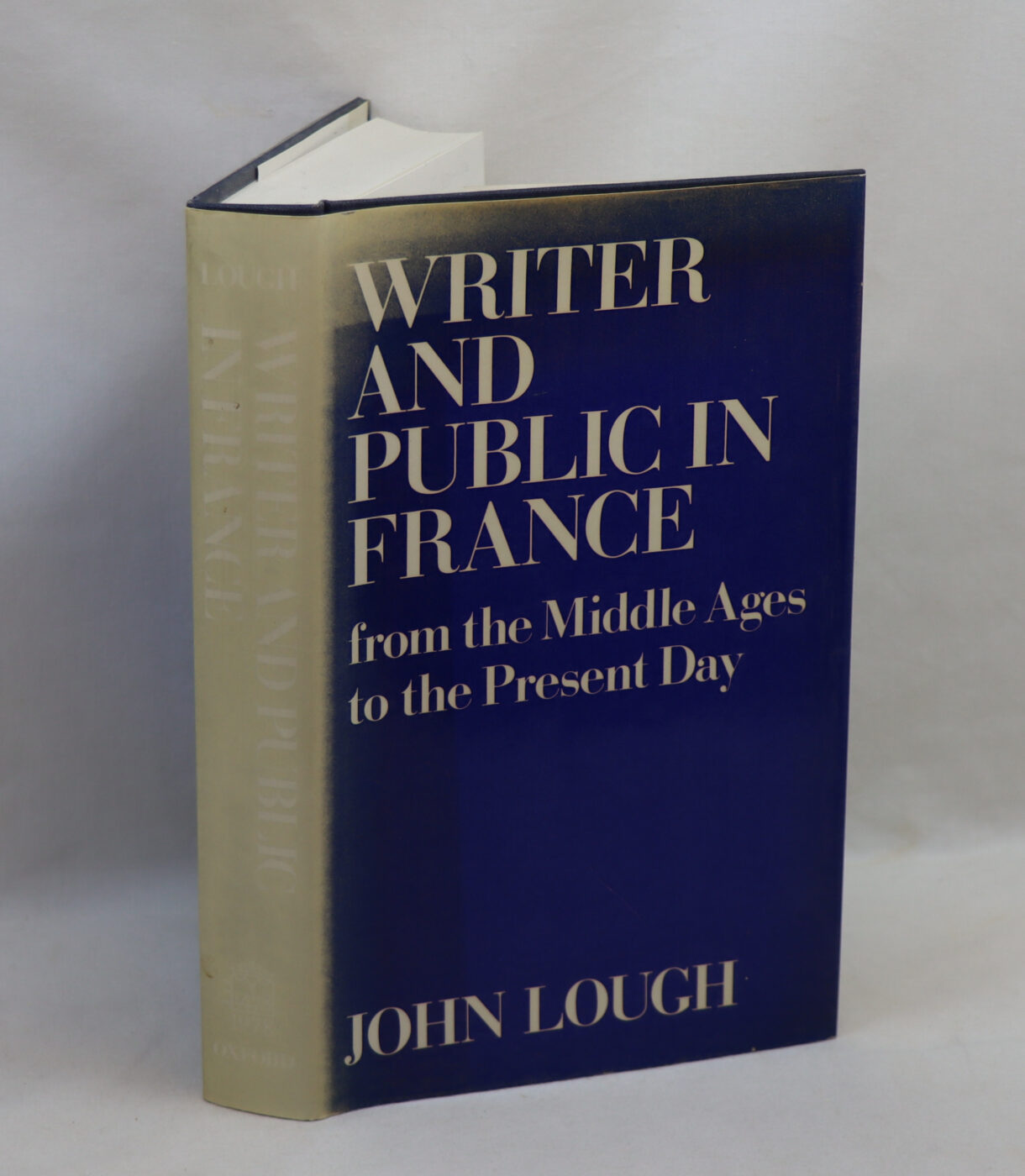
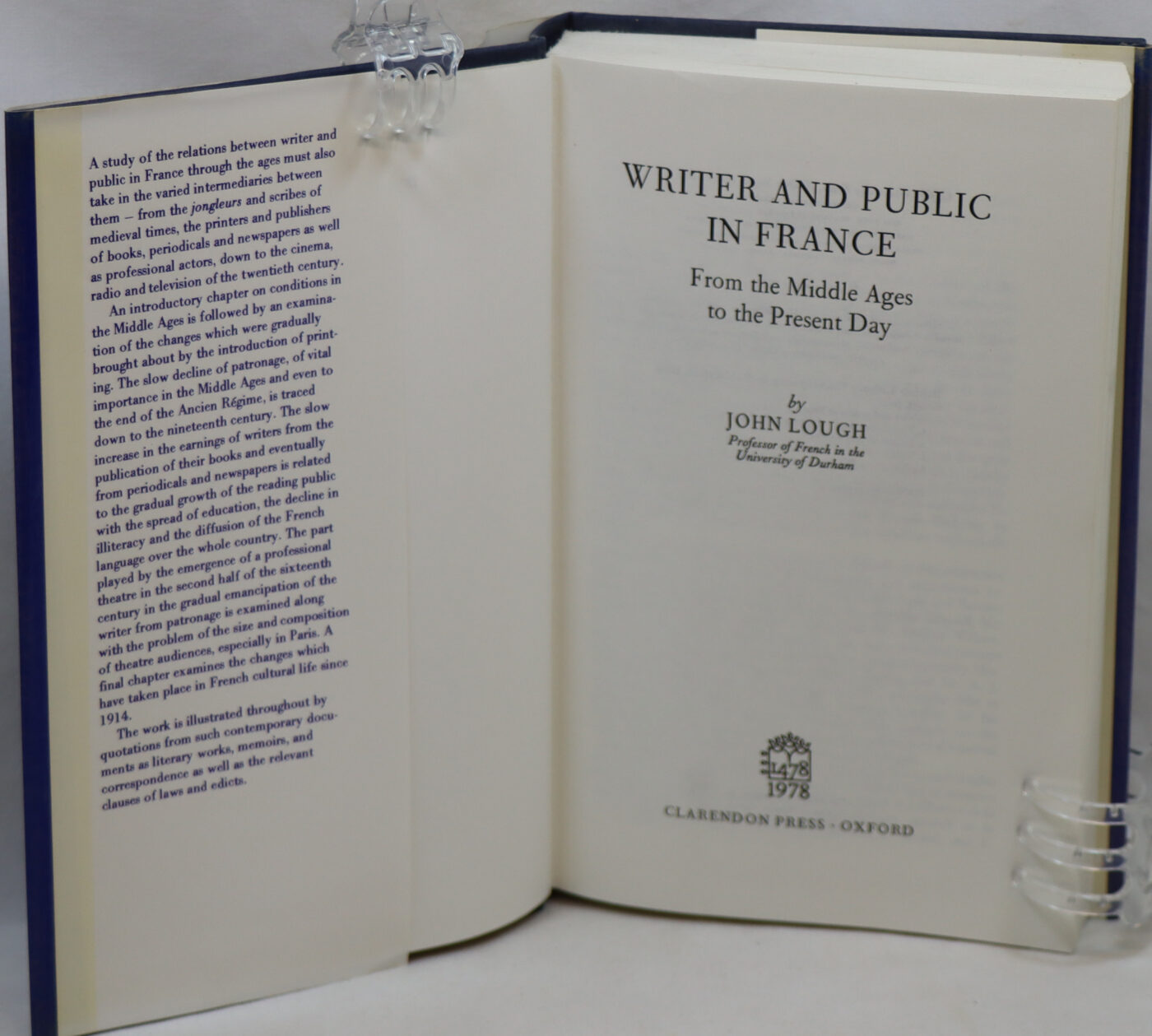
Writer and Public in France.
By John Lough
Printed: 1978
Publisher: Oxford University Press.
| Dimensions | 15 × 23 × 3 cm |
|---|---|
| Language |
Language: English
Size (cminches): 15 x 23 x 3
Condition: Good (See explanation of ratings)
£23.00
Buy Now

Item information
Description
In the original dust cover. Navy cloth binding with gilt title on the spine.
We provide an in-depth photographic presentation of this item to stimulate your feeling and touch. More traditional book descriptions are immediately available
- Note: This book carries a £5.00 discount to those that subscribe to the F.B.A. mailing list
For the specialist this is a very erudite publication and a joy to read.
John Lough, FBA (19 February 1913 – 21 June 2000) was an English scholar of French literature and history. He was the Professor of French at Durham University from 1952 to 1978.
Lough was born in Newcastle upon Tyne on 19 February 1913; his father was a butcher and shopkeeper and his mother came from a family of farmers. He attended the Royal Grammar School in Newcastle, where he excelled and developed an interest in modern languages. He received a scholarship to St John’s College, Cambridge; he placed in the first class for Part I of the Tripos in French and German, and did the same in Part II in 1934. He then completed doctoral studies at Cambridge on Baron d’Holbach, with Harry Ashton as his adviser. He spent 1935–36 on a scholarship to the British Institute in Paris; while there, he met Muriel Alice Barker, whom he later married and collaborated with academically. He was awarded his PhD in 1937.In 1937, Lough was appointed to an assistant lectureship in French at the University of Aberdeen. He was promoted to be a full lecturer in 1945 but moved to the University of Cambridge in 1946 to take up a lectureship (which did not come with a fellowship at any of the colleges). In 1952, he became Professor of French at Durham University. Lough’s expertise was in 17th- and 18th-century French literature and history: he studied Denis Diderot’s work and his Encyclopédie; theatre; and the testimonies of English travellers in France. He edited Diderot’s Selected Philosophical Writings (1953) and Locke’s Travels in France, 1675–1679, as Related in His Journals, Correspondence and Papers (1953). He then wrote: The “Encyclopédie” of Diderot and D’Alembert: Selected Articles (1954), An Introduction to Seventeenth Century France (1954), Paris Theatre Audiences in the Seventeenth and Eighteenth Centuries (1957), An Introduction to Eighteenth Century France (1960), Essays on the “Encyclopédie” of Diderot and D’Alembert (1968), The “Encyclopédie” in Eighteenth-Century England and Other Studies (1970), The “Encyclopédie” (1971), and The Contributors to the “Encyclopédie” (1973). He also edited French Prose Composition with F. C. Roe (1963) and, with Jacques Proust, volumes five to eight of the Œuvres Complètes of Diderot (1976).
Retiring from his chair in 1978, Lough continued to write. He authored Writer and Public in France: From the Middle Ages to the Present Day (1978), Seventeenth-Century French Drama: The Background (1979), The “Philosophes” and Post-Revolutionary France (1982), France Observed in the Seventeenth Century (1985) and France on the Eve of the Revolution: British Travellers’ Observations, 1763–1788 (1987). With his wife Muriel he authored An Introduction to Nineteenth-Century France (1978), and with his sister Elizabeth Merston he wrote John Graham Lough (1789–1876), a Northumbrian Sculptor (1987) about his great-great uncle.
Lough received an honorary doctorate from the University of Clermont-Ferrand (1967) and an Honorary DLitt at Newcastle University (1972), was appointed an Officer of the National Order of Merit of France in 1973 and two years later he was elected to the fellowship of the British Academy. He retired in Durham, where he died on 21 June 2000. Muriel had died two years earlier; he was survived by their daughter.
NOTE: This is an original book from the library gathered by the famous Cambridge Don, computer scientist, food and wine connoisseur, Jack Arnold LANG. Note: Jack founded the Michelin Guide ‘Midsummer House’- Cambridge’s paramount restaurant. This dining experience is hidden amongst the grassy pastures and grazing cattle of Midsummer Common and perched on the banks of the River Cam. The Midsummer House experience is imaginatively curated to delight and amaze, so the surprise set menu changes regularly and is ‘Midsummer’s’ playground to showcase.
In 2008, Jack was one of the co-founders of the Raspberry Pi Foundation, alongside other members of the Department, and acted as the Foundation’s Chair. The project’s original goals were modest: to build and distribute low-cost computers for prospective applicants to our Computer Science degree. Initially the project was a “success disaster”, as Jack would say, as demand far outstripped the low-scale manufacturing plans. Ultimately the Raspberry Pi became the UK’s most successful computer with more than 60 million sold to date. Jack was drawn to the educational possibilities of the Raspberry Pi, its potential uses in emerging economies and the way it could support self-directed learning.
Want to know more about this item?
We are happy to answer any questions you may have about this item. In addition, it is also possible to request more photographs if there is something specific you want illustrated.
Ask a question
Related products
Share this Page with a friend
