
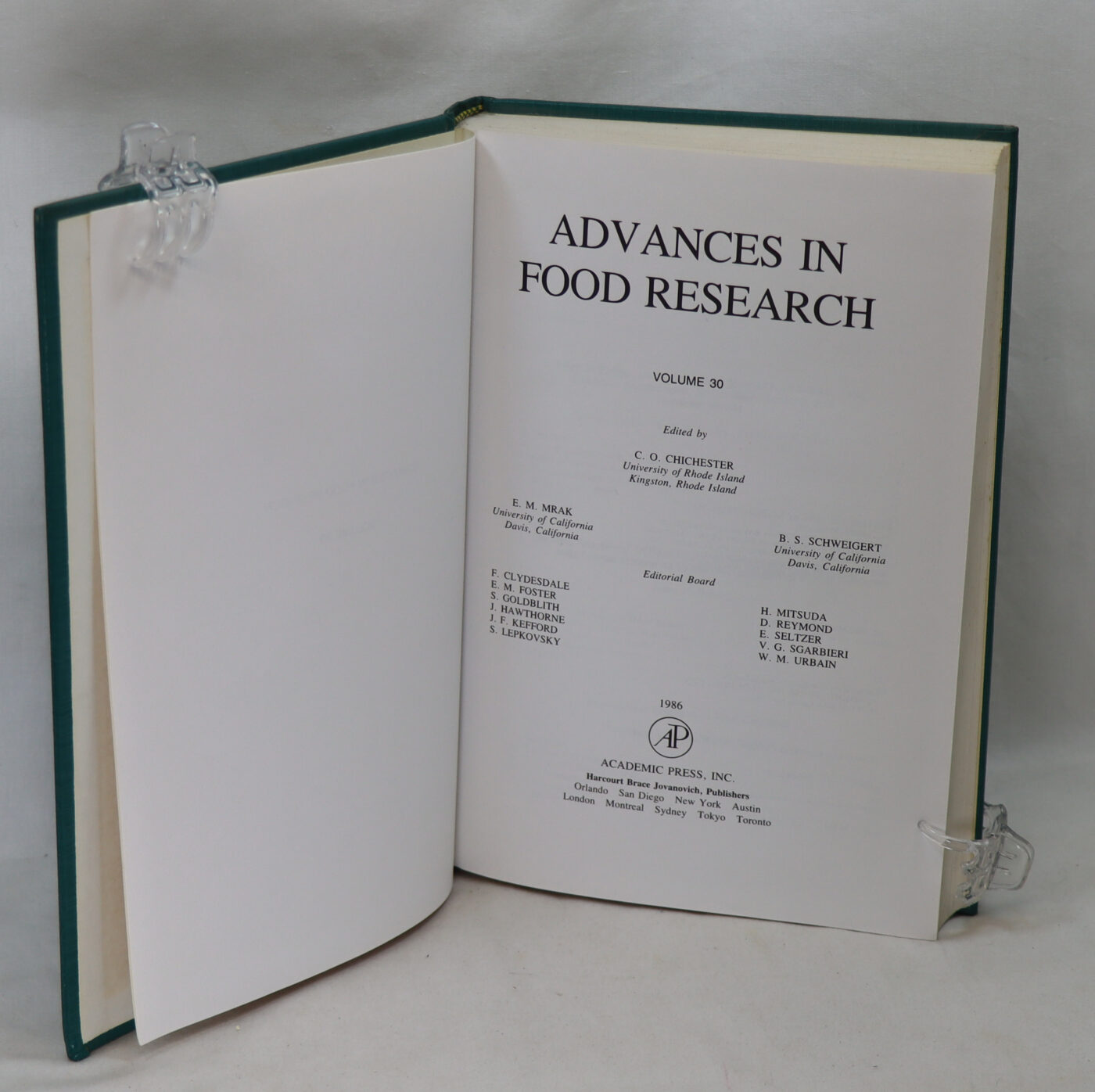
Advances in Food Research.
Printed: 1986
Publisher: Academic Press. Orlando
| Dimensions | 16 × 24 × 3 cm |
|---|---|
| Language |
Language: English
Size (cminches): 16 x 24 x 3
Condition: Very good (See explanation of ratings)
£162.00
FREE shipping
Buy Now

Item information
Description
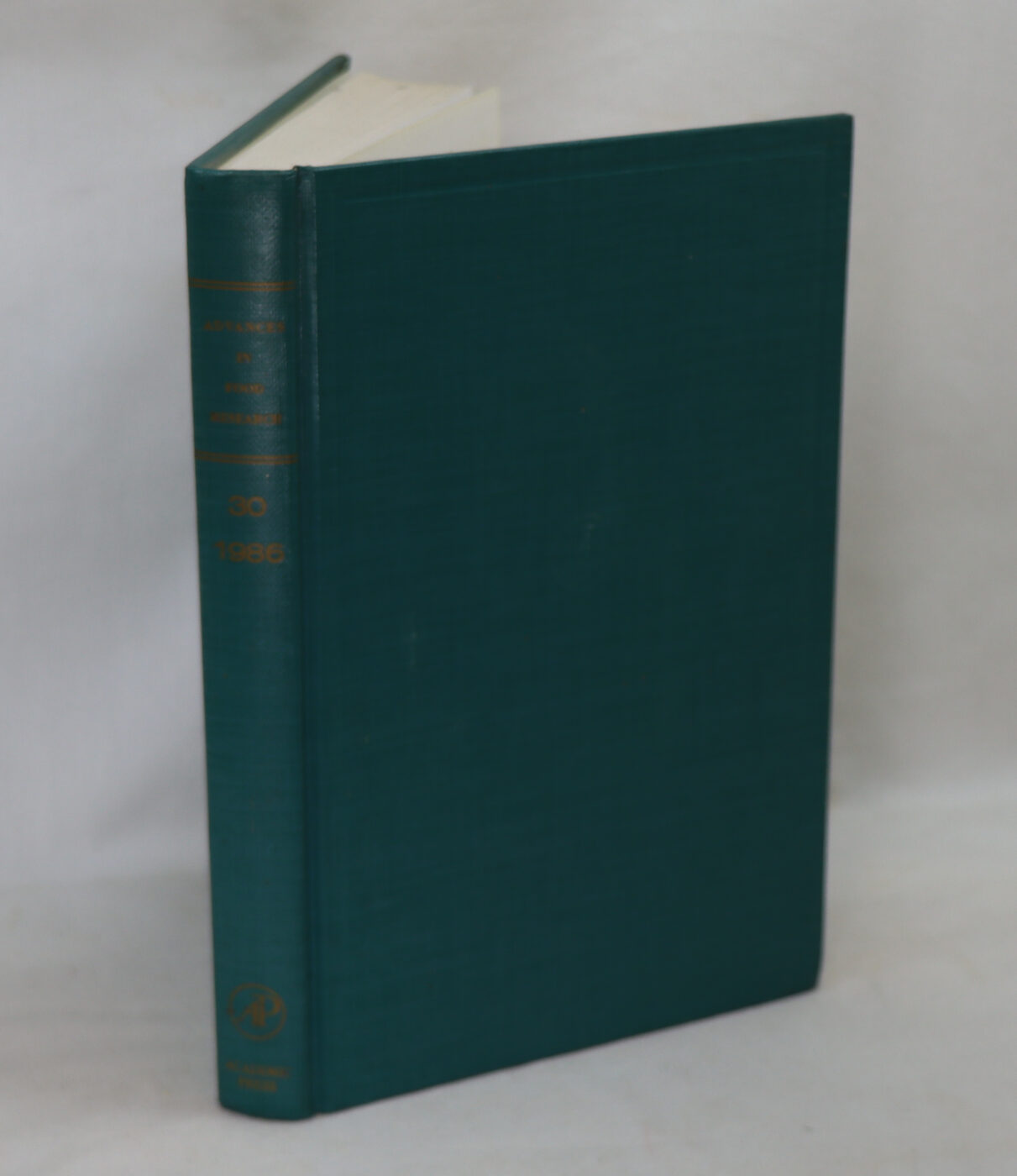
Green cloth binding with gilt title.
We provide an in-depth photographic presentation of this item to stimulate your feeling and touch. More traditional book descriptions are immediately available
- Note: This book carries a £5.00 discount to those that subscribe to the F.B.A. mailing list
This is a scholarly work.
Descriptions of the functional significance of carbohydrates based on the familiar equilibrium thermodynamics of very dilute solutions fail for pragmatical time scales and conditions, which are far from equilibrium. This is not too surprising, since limiting partial-molar properties reflect the independent behavior of solute in the limit of infinite dilution where free volume is maximum at a given temperature, while Tg′-Wg′ properties reflect the cooperative behavior of solute-plasticizer blends at the limiting minimum value of free volume to observe relaxation within experimental time scales. Carbohydrate-water systems, with well-characterized structure and MW above and below the entanglement limit, provide a unique framework for the investigation of non-equilibrium behavior. Thermal analysis by DSC reveals the central role of water as a plasticizer for carbohydrates and of the glass transition as a physicochemical parameter that governs their properties, processing, and stability. A classical polymer science approach is used to study structure-property relationships of carbohydrates as water-compatible food polymers, which are treated as homologous systems of polymers, oligomers, and monomers with their plasticizers and solvents. Mechanical relaxation behavior is described by a “transformation map” of the critical variables of moisture content, temperature, and time. The glass curve is a reference contour, which represents the limiting isogram for free volume, local viscosity, relaxation rates, and rotational and translational mobility. Map domains are discussed as aspects of “water dynamics,” to dispel the myth of “bound water,” and “glass dynamics,” to relate to macroscopic structure and collapse phenomena. A particular glass with invariant composition and Tg (prepared by freeze-concentration) is identified as a pivotal and practical reference state. The Tg observed during DSC analysis is often an effective Tg, resulting from instantaneous relative relaxation rates and non-uniform distribution of total sample moisture. Non-equilibrium melting, annealing, and gelation/recrystallization of kinetically metastable, partially crystalline carbohydrate systems exhibit non-Arrhenius kinetics which depend on the magnitude of ΔT above the appropriate Tg, as defined by WLF relaxation transformations. Thermally reversible aqueous gels (crystallized from an under-cooled, rubbery melt) are described by a “fringed micelle” structural model for a three-dimensional polymer network, composed of microcrystalline junction zones crosslinking plasticized amorphous regions of flexible-coiled, entangled chain segments.
NOTE: This is an original book from the library gathered by the famous Cambridge Don, computer scientist, food and wine connoisseur, Jack Arnold LANG. Note: Jack founded the Michelin Guide ‘Midsummer House’- Cambridge’s paramount restaurant. This dining experience is hidden amongst the grassy pastures and grazing cattle of Midsummer Common and perched on the banks of the River Cam. The Midsummer House experience is imaginatively curated to delight and amaze, so the surprise set menu changes regularly and is ‘Midsummer’s’ playground to showcase.
In 2008, Jack was one of the co-founders of the Raspberry Pi Foundation, alongside other members of the Department, and acted as the Foundation’s Chair. The project’s original goals were modest: to build and distribute low-cost computers for prospective applicants to our Computer Science degree. Initially the project was a “success disaster”, as Jack would say, as demand far outstripped the low-scale manufacturing plans. Ultimately the Raspberry Pi became the UK’s most successful computer with more than 60 million sold to date. Jack was drawn to the educational possibilities of the Raspberry Pi, its potential uses in emerging economies and the way it could support self-directed learning.
Want to know more about this item?
We are happy to answer any questions you may have about this item. In addition, it is also possible to request more photographs if there is something specific you want illustrated.
Ask a question
Related products







Share this Page with a friend
