
Strype's Memorials of Cranmer.
By John Strype
Printed: 1694
Publisher: Richard Chiswell. St Pauls Churchyard, London
| Dimensions | 22 × 32 × 6 cm |
|---|---|
| Language |
Language: English
Size (cminches): 22 x 32 x 6
Condition: Fine (See explanation of ratings)
£478.00
FREE shipping
Buy Now





Item information
Description
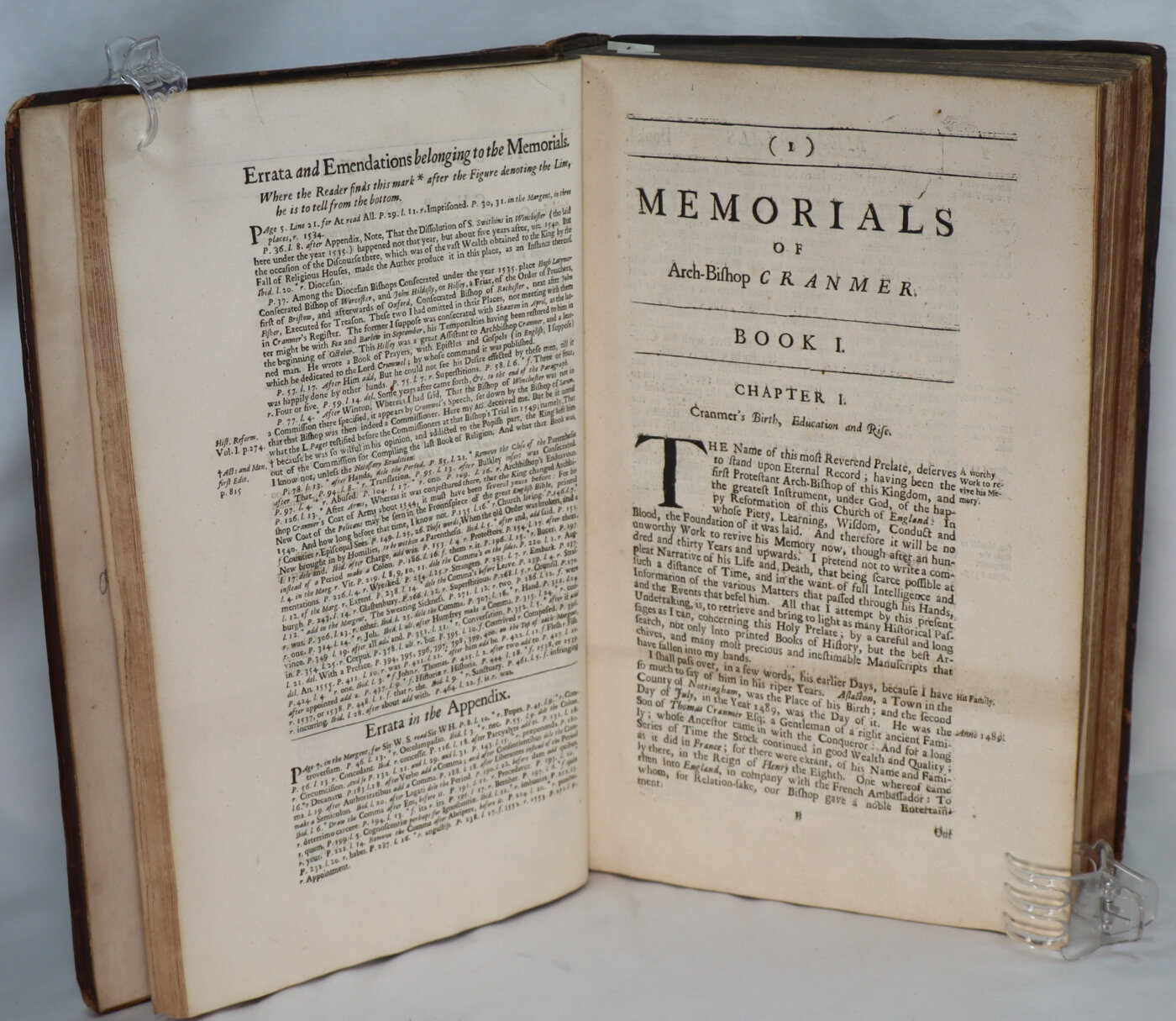
Brown leather binding with raised banding, black title plate and gilt title on the spine.
-
We provide an in-depth photographic presentation of this item to stimulate your feeling and touch. More traditional book descriptions are immediately available.
-
Note: This book carries the £5.00 discount to those that subscribe to the F.B.A. mailing list.
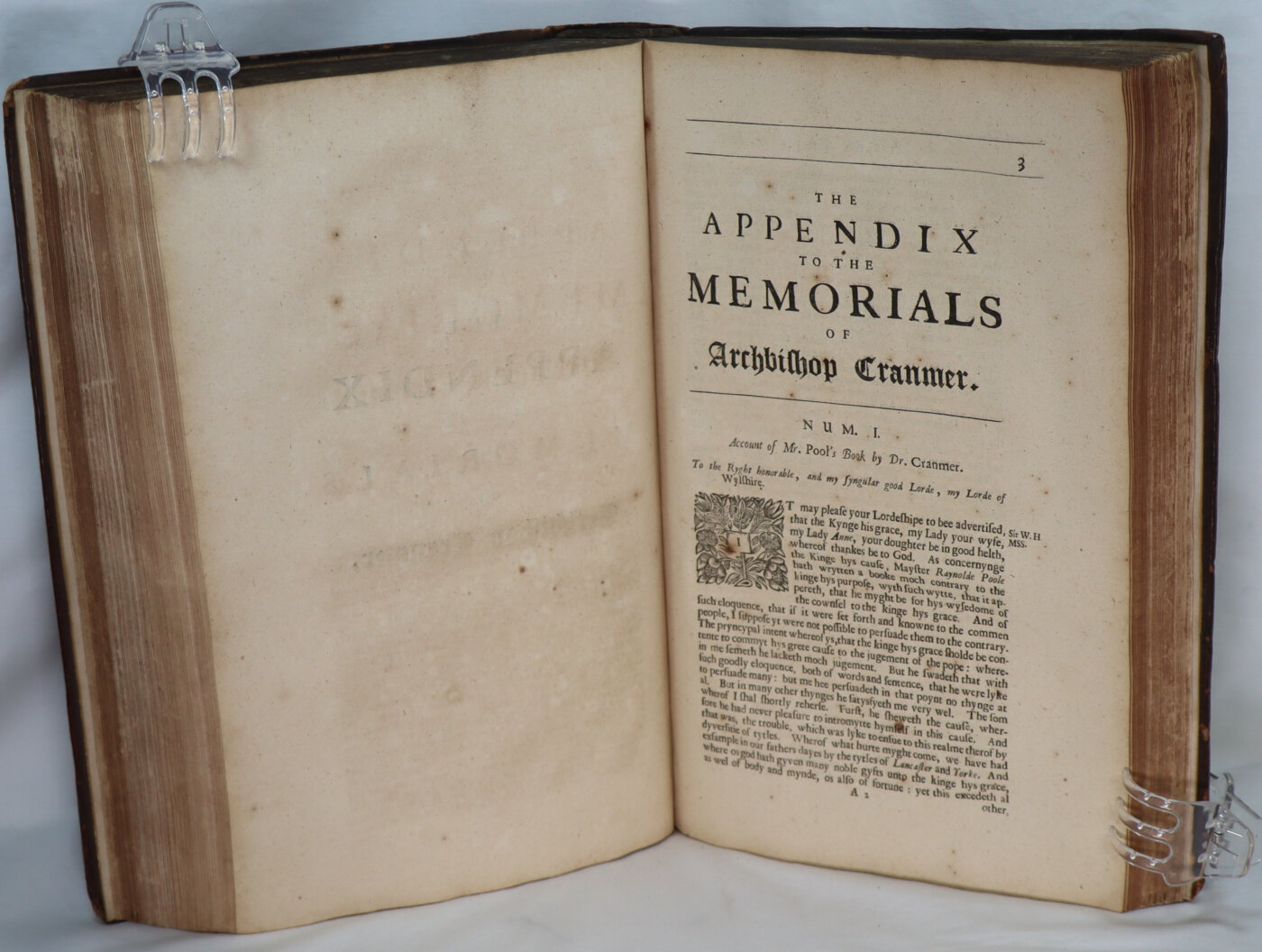
Book Description ‘Memorials of the most Reverend Father in God, Thomas Cranmer, sometime Lord Archbishop of Canterbury. Wherein the history of the Church, and the reformation of it, during the primacy of the said archbishop, are greatly illustrated; and many singular matters relating thereunto, now first published. In three books. Collected chiefly from records, registers, authentic letters, and other original manuscripts. By John Strype, M.A.’
Hardcover. Condition: Near Fine. First edition. Folio volume now bound in leather. The frontispiece is an image of Cranmer executed by Holbein. The remaining 5 portraits are those of Peter Martyr Vermilius, John A’Lasco, Martin Bucer, Hugh Latimer, and Philip Melancthon.
Strype was a very prolific writer with well over a dozen works published. This is his third work, published when he was 46. He lived to be 95. This volume is a remarkably clean, bright and solid example. A lovely book in all respects and an important work of 16th century English historical scholarship. Near Fine.
Thomas Cranmer (2 July 1489 – 21 March 1556) was a religious figure who was leader of the English Reformation and Archbishop of Canterbury during the reigns of Henry VIII, Edward VI and, for a short time, Mary I. He helped build the case for the annulment of Henry’s marriage to Catherine of Aragon, which was one of the causes of the separation of the English Church from union with the Holy See. Along with Thomas Cromwell, he supported the principle of royal supremacy, in which the king was considered sovereign over the Church within his realm.
During Cranmer’s tenure as Archbishop of Canterbury, he established the first doctrinal and liturgical structures of the reformed Church of England. Under Henry’s rule, Cranmer did not make many radical changes in the Church due to power struggles between religious conservatives and reformers. He published the first officially authorised vernacular service, the Exhortation and Litany.
When Edward came to the throne, Cranmer was able to promote major reforms. He wrote and compiled the first two editions of the Book of Common Prayer, a complete liturgy for the English Church. With the assistance of several Continental reformers to whom he gave refuge, he changed doctrine or discipline in areas such as the Eucharist, clerical celibacy, the role of images in places of worship, and the veneration of saints. Cranmer promulgated the new doctrines through the prayer book, the Homilies and other publications.
After the accession of the Catholic Mary I, Cranmer was put on trial for treason and heresy. Imprisoned for over two years and under pressure from Church authorities, he made several recantations and reconciled himself with the Catholic Church. While this would have customarily absolved him, Mary wanted him executed, and he was burned at the stake on 21 March 1556; on the day of his execution, he withdrew his recantations, to die a heretic to Catholics and a martyr for the principles of the English Reformation. Cranmer’s death was immortalised in Foxe’s Book of Martyrs and his legacy lives on within the Church of England through the Book of Common Prayer and the Thirty-Nine Articles, an Anglican statement of faith derived from his work.
John Strype (1 November 1643 – 11 December 1737) was an English clergyman, historian and biographer from London. He became a merchant when settling in Petticoat Lane. In his twenties, he became perpetual curate of Theydon Bois, Essex and later became curate of Leyton; this allowed him direct correspondence with several highly notable ecclesiastical figures of his time. He wrote extensively in his later years.
Born in Houndsditch, London, he was the son of John Strype (or van Stryp) and cousin to sailor and writer Robert Knox. A member of a Huguenot family who, in order to escape religious persecution within Brabant, had settled in East London. Located in what has now become known as Strype Street in Petticoat Lane, he was a merchant and silk throwster. The younger John was educated at St Paul’s School, and on 5 July 1662 entered Jesus College, Cambridge; he went on from there to St Catharine’s Hall, where he graduated B.A. in 1665 and M.A. in 1669.
On 14 July 1669 Strype became perpetual curate of Theydon Bois, and a few months afterwards curate and lecturer of Leyton in the same county. He was never instituted or inducted to the living of St Mary’s Church, Leyton, but in 1674 he was licensed by the Bishop of London to preach and expound the word of God, and to perform the office of priest and curate while it was vacant, and until his death he received the profits of it. In 1711 he obtained from Archbishop Thomas Tenison the sinecure of West Tarring, Sussex, and he discharged the duties of lecturer at Hackney from 1689 until 1724. In Hackney, he spent his last years with a married granddaughter, the wife of a surgeon, Thomas Harris, dying there at the age of 94. He was buried in the church at Leyton.
Through his friendship with Sir William Hicks, Strype obtained access to the papers of Sir Michael Hicks, secretary to Lord Burghley, from which he made extensive transcripts; he also carried on an extensive correspondence with Archbishop William Wake and Bishops Gilbert Burnet, Francis Atterbury and Nicholson. The materials he obtained were used in his historical and biographical works, which relate chiefly to the period of the Protestant Reformation. Most of his original materials have been preserved, and are included among the Lansdowne manuscripts in the British Library. His publications consist of historical reference material of considerable value, and are convenient books of reference.
This is a 1694 first edition folio of Memorials of the Most Reverend Father in God, Thomas Cranmer, Sometime Lord Archbishop of Canterbury by English historian John Strype. Printed in London for Richard Chiswell at the Rose and Crown in St. Paul’s Churchyard, this is a foundational primary-source biography of the key architect of the English Reformation.
Bibliographic & Edition Details
- Full Title. Memorials of the Most Reverend Father in God, Thomas Cranmer, Sometime Lord Archbishop of Canterbury.
- Edition & Format. 1694 First Edition in folio format, matching your listed dimensions of 8.8 x 12.8 inches.
- Publisher. Richard Chiswell, a prominent late 17th-century London bookseller and official printer to the Royal Society, operating at the Rose and Crown in St. Paul’s Churchyard.
- Historical Significance. Strype compiled this work using original manuscripts, letters, and state papers, making it an essential historical record of Henry VIII’s reign, the creation of the Book of Common Prayer, and Cranmer’s martyrdom.
- Key Illustrations & Completeness. First editions typically include an engraved frontispiece portrait of Thomas Cranmer alongside several other engraved portraits of Reformation figures, plus a separate Appendix of original documents.
Collector & Market Context
Because you provided exact catalog specifications and a “Very good” condition grade, the value and desirability of a 1694 first edition depend heavily on physical completeness and binding originality:
- Presence of Plates. Collectors verify that the engraved portrait plates (especially the frontispiece portrait of Cranmer) are intact and have not been removed.
- Binding Style. Contemporary full calf or panelled calf leather bindings from the late 17th century command higher interest than later 19th- or 20th-century rebindings, provided the boards are firmly attached.
- Comparable Listings. Original 1694 Richard Chiswell first editions appear periodically through specialist antiquarian booksellers such as AbeBooks, Schilb Antiquarian, and Frost Books and Artifacts.
Chapter contents and price
The 1694 first edition of John Strype’s Memorials of Cranmer is divided into three chronological books plus an extensive documentary Appendix, while antiquarian retail listings for complete, well-preserved copies sit around $720 to $795 (roughly £550–£630), with past UK auction hammer prices recorded lower depending on condition.
Structure & Chapter Contents
The volume is organised chronologically across the reigns of Henry VIII, Edward VI, and Mary I, ending with primary-source transcripts transcribed from manuscripts. You can view the full digitised table of contents via the University of Michigan EEBO Digital Edition.
- Front Matter. Includes the dedication to Archbishop John Tillotson, Strype’s Preface explaining his archival sources, a detailed Table of Books and Chapters, and an Errata sheet.
- Book I (Reign of Henry VIII). Covers Cranmer’s birth, Cambridge education, royal marriage embassies, consecration as Archbishop of Canterbury, diocesan visitations, promotion of the English Bible translation, the Bishops’ Book, and early views on the Eucharist.
- Book II (Reign of Edward VI). Details the liturgical and doctrinal reforms of the English Reformation, including the Book of Common Prayer, the Forty-Two Articles, disputes over vestments and church governance, and correspondence with continental reformers such as Martin Bucer and Peter Martyr Vermigli.
- Book III (Reign of Mary I & Martyrdom). Traces the restoration of Catholicism, the deprivation of married clergy, Cranmer’s imprisonment and 1554 Oxford disputations, his recantations, his final withdrawal of those recantations, and his execution at the stake in 1556.
- The Appendix. Separately paginated section containing over 100 verbatim primary documents, state papers, royal commissions, and letters gathered from Lambeth Palace and private manuscript collections.
Market & Listing Prices
Antiquarian pricing for the 1694 Richard Chiswell folio varies substantially based on whether all six engraved portrait plates (Cranmer, Peter Martyr Vermigli, John à Lasco, Martin Bucer, Hugh Latimer, and Philip Melanchthon) are present and whether the leather binding is original or sympathetically rebacked:
- A very good first edition folio bound in brown leather with raised bands, gilt spine title, and all six engraved portraits intact.
- Schilb Antiquarian (Retail Listing). Listed at $795.00 for a complete 1694 first edition folio featuring the Holbein-derived frontispiece portrait of Cranmer and accompanying Reformation engravings.
- Bonhams Oxford (Auction Record). A 1694 first edition copy sold at auction for £100 (including buyer’s premium), illustrating the typical gap between unrefurbished auction lots and curated dealer retail prices
Biography of John Strype.
John Strype (1643–1737) was an English Anglican clergyman, historian, and biographer best known for preserving thousands of original Tudor and English Reformation manuscripts through his multi-volume historical works. Living to the age of 94, he spent over six decades serving as a parish minister in Essex while compiling foundational primary-source biographies of major 16th-century Church of England figures.
Early Life & Education
- Birth & Heritage. Born on 1 November 1643 in Stepney, Middlesex, to John van Strype, a silk merchant and Protestant refugee from Brabant (modern-day Belgium), and Hester Bonnell.
- Schooling. Educated at St Paul’s School in London from 1657 to 1662, where he developed a strong foundation in classical languages and ecclesiastical history.
- University Years. Entered Jesus College, Cambridge, in 1662 before migrating to St Catharine’s College, Cambridge, where he earned his Bachelor of Arts in 1665 and Master of Arts in 1669.
Clerical Career
- Low Leyton Ministry. After brief curacies in Essex, Strype was appointed perpetual curate of Low Leyton (now Leyton, East London) in 1669, remaining the parish minister there for 68 years until his death despite never being formally instituted.
- Additional Appointments. Held the sinecure rectory of West Tarring in Sussex from 1711 and served as Sunday lecturer at St John-at-Hackney from 1689 until 1724, where he spent his final years living with his granddaughter’s family.
Historical Scholarship & Legacy
- Manuscript Collector. Strype gained access to the vast collection of Tudor state papers owned by Sir Michael Hicks (former secretary to Queen Elizabeth I’s chief minister, Lord Burghley), copying and transcribing letters, proclamations, and church records that might otherwise have been lost.
- Major Publications. Following Memorials of Thomas Cranmer (1694), he published biographies of Sir Thomas Smith (1698), John Aylmer (1701), Sir John Cheke (1705), Edmund Grindal (1710), Matthew Parker (1711), and John Whitgift (1718).
- Annals of the Reformation. Between 1709 and 1731, he released his massive four-volume Annals of the Reformation and Establishment of Religion, alongside Ecclesiastical Memorials (1721) and a revised, expanded edition of John Stow’s Survey of London (1720).
- Scholarly Reputation. Although later historians noted occasional transcription inaccuracies and loose organization, his works remain indispensable because he printed hundreds of original Tudor documents verbatim. His personal manuscript collection is preserved primarily in the Lansdowne Manuscripts at the British Library.
Want to know more about this item?
We are happy to answer any questions you may have about this item. In addition, it is also possible to request more photographs if there is something specific you want illustrated.
Ask a question


Share this Page with a friend
