
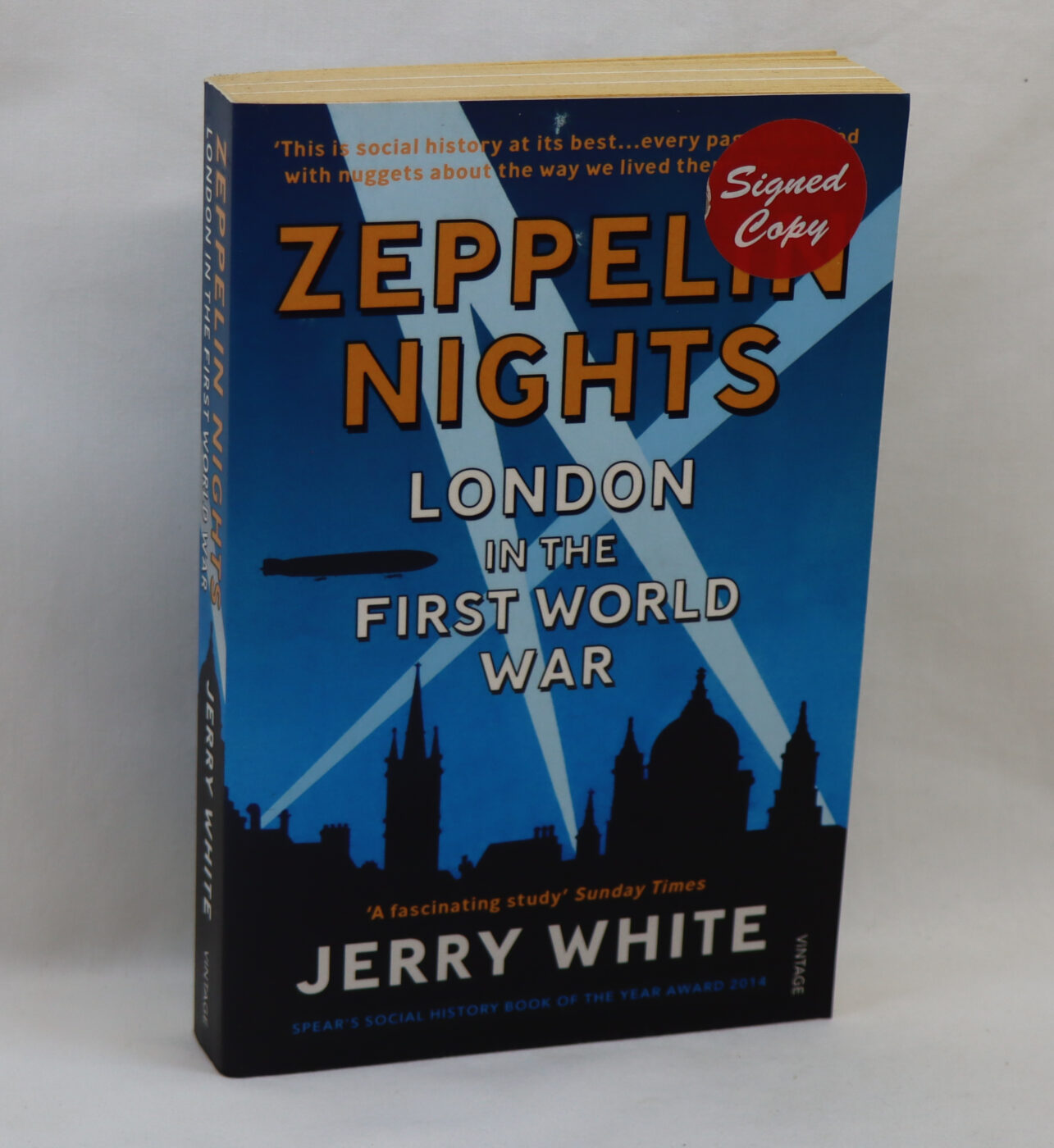
Zeppelin Nights. London in the First World War.
By Jerry White
ISBN: 9781448191932
Printed: 2015
Publisher: Vintage Books. London
| Dimensions | 13 × 20 × 2 cm |
|---|---|
| Language |
Language: English
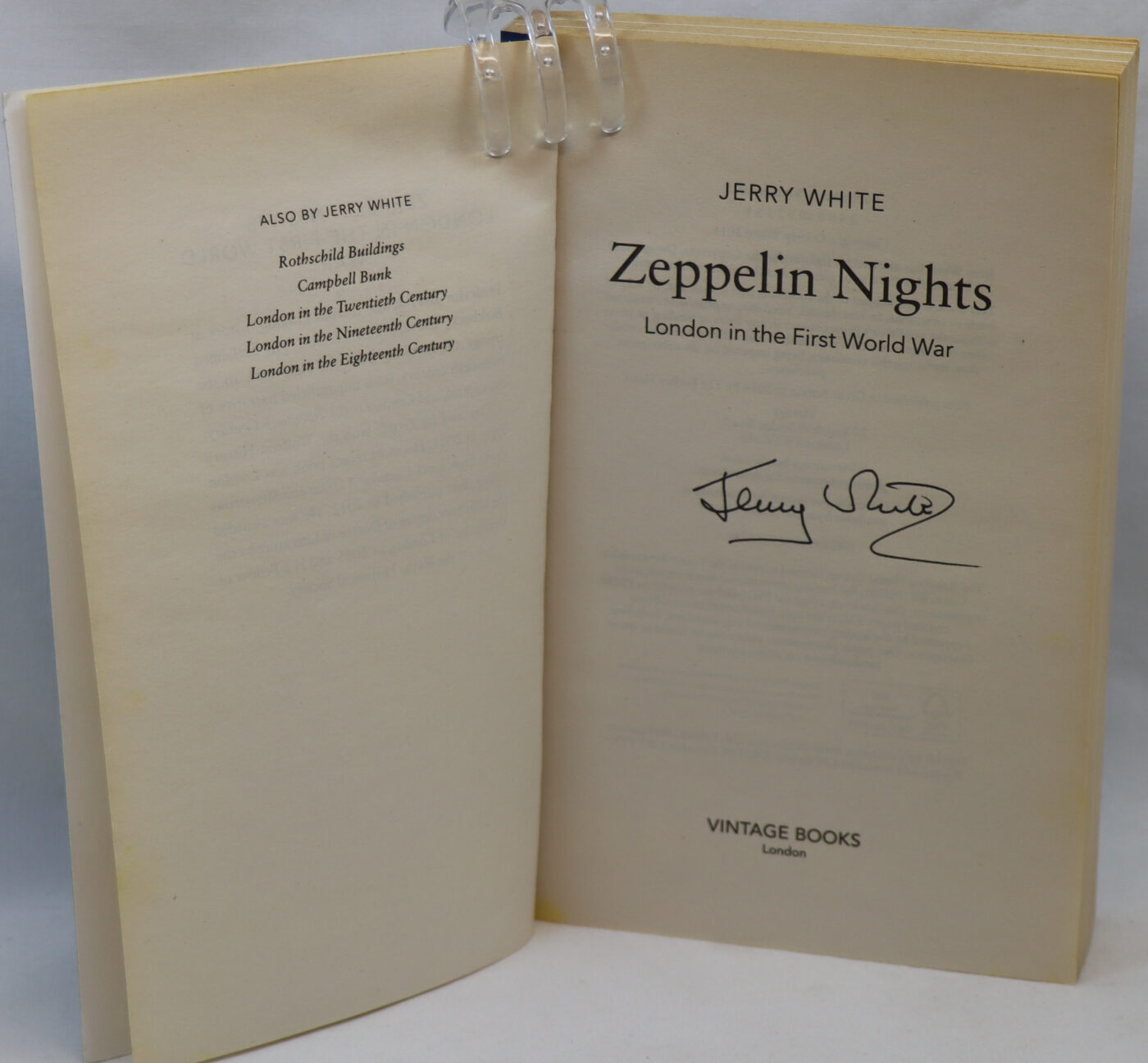
Signed by: Author
Size (cminches): 13 x 20 x 2
Condition: Very good (See explanation of ratings)
£11.00
Buy Now
Your items

Item information
Description
Paperback. Blue cover with a black title and portrait.
We provide an in-depth photographic presentation of this item to stimulate your feeling and touch. More traditional book descriptions are immediately available.
- A £2 reduction when collected from FBA shop
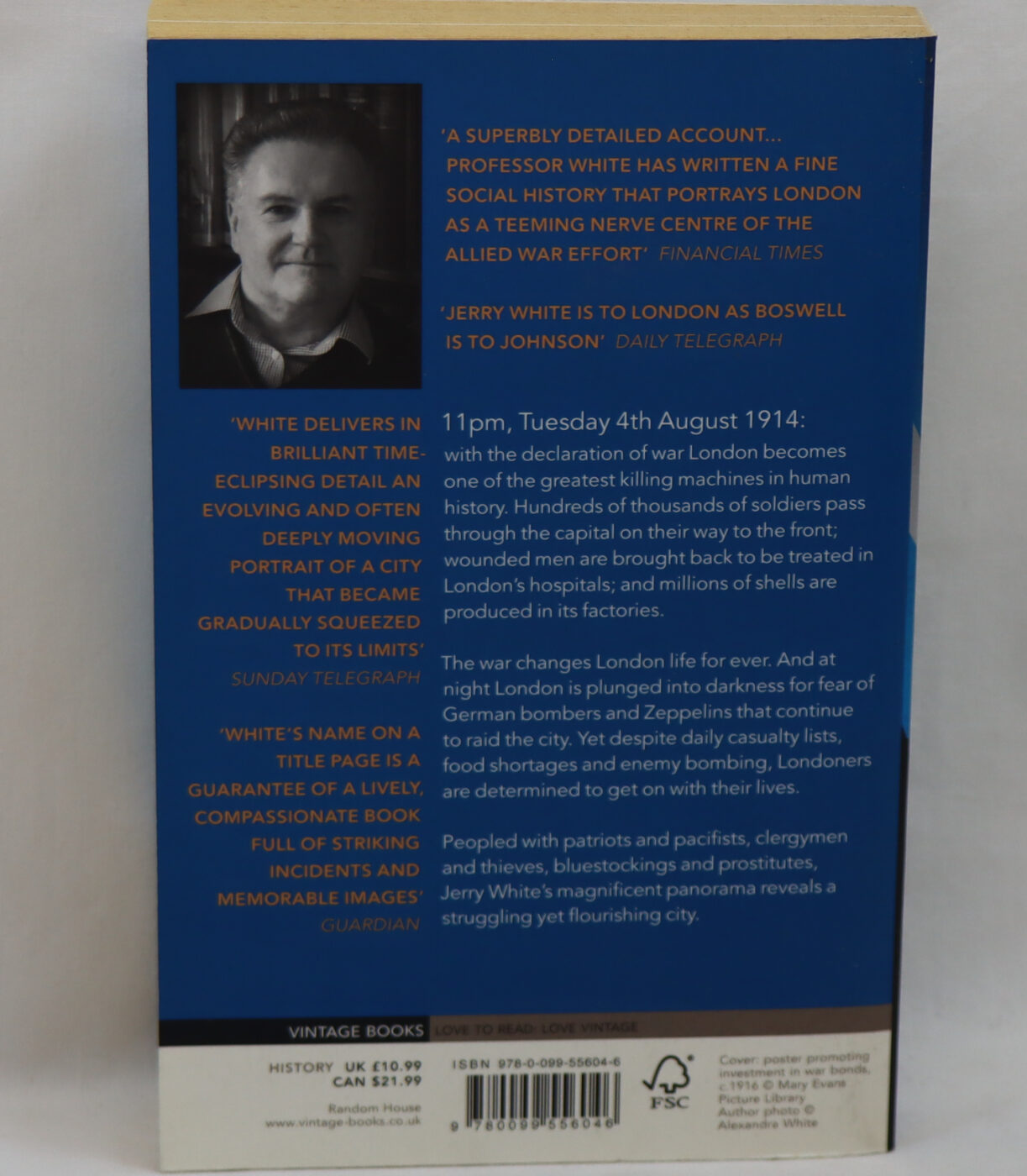
11pm, Tuesday 4 August 1914: with the declaration of war London becomes one of the greatest killing machines in human history. Hundreds of thousands of soldiers pass through the capital on their way to the front; wounded men are brought back to be treated in London’s hospitals; and millions of shells are produced in its factories. The war changed London life forever. Women escape the drudgery of domestic service to work as munitionettes. Full employment puts money into the pockets of the London poor for the first time. Self-appointed moral guardians seize the chance to clamp down on drink, frivolous entertainment and licentious behaviour. As the war drags on, gloom often descends on the capital. And at night London is plunged into darkness for fear of German bombers and Zeppelins that continue to raid the city. Yet despite daily casualty lists, food shortages and enemy bombing, Londoners are determined to get on with their lives and flock to cinemas and theatres, dance halls and shebeens, firmly resolved not to let Germans or puritans spoil their enjoyment. Peopled with patriots and pacifists, clergymen and thieves, bluestockings and prostitutes, Jerry White’s magnificent panorama reveals a struggling yet flourishing city.
Reviews:
-
- Zeppelin Nights is social history at its best… White creates a vivid picture of a city changed for ever by war — Robbie Millen ― The Times
- Jerry White’s name on a title page is a guarantee of a lively, compassionate book full of striking incidents and memorable images… This is a fast-paced social history that never stumbles… A well-orchestrated polyphony of voices that brings history alive — Richard Davenport-Hines ― Guardian
- White delivers in brilliant time-eclipsing detail an evolving and often deeply moving portrait of a city that became gradually squeezed to its limits — Juliet Nicolson ― Sunday Telegraph
- Jerry White is masterful at mixing hard facts and statistics with telling anecdotes — Craig Brown ― Mail on Sunday
- A superbly detailed account… Professor White has written a fine social history that portrays London as a teeming nerve centre of the Allied war effort — Ian Thomson ― Financial Times
- Engrossing history of how the capital fared during the 1914-1918 conflict. London wasn’t the only place on the UK mainland that was raided by German airships and bomber aircraft during the First World War, but it was obviously a prestige target for the enemy, and its population density meant that the psychological impact of bombs being dropped on British mainland for the first time – with the British authorities seemingly powerless to stop them, at first – was intensified. When airships first appeared in the skies over London – picked out by searchlights – people used to stand out in the streets and watch, and were more likely to be killed or injured by falling shrapnel from their anti-aircraft guns than from enemy bombs. When the casualties from bombing started to rack-up – and unrestricted submarine warfare resulting in the sinking of the liner RMS Lusitania in May 1915, leaving 1,198 passengers and crew dead – German and other foreign nationals, many of who had been domiciled in London for years before the outbreak of hostilities, where cruelly targeted for reprisals by angry local populaces, driven from their homes and businesses, and often interned. Jerry White gives an insightful, fact-driven account, compellingly written; much of his evidence is based on contemporary testimony from diaries written at the time. This book is highly recommended.
Professor Jerry White teaches London history at Birkbeck, University of London. He is the author of an acclaimed trilogy of London from the eighteenth to the twentieth centuries. His more recent books include Mansions of Misery: A Biography of the Marshalsea Debtors’ Prison and Zeppelin Nights, a social history of London during the First World War. He was awarded the honorary degree of Doctor of Literature by the University of London in 2005 and is a Fellow of the Royal Historical Society.
Want to know more about this item?
We are happy to answer any questions you may have about this item. In addition, it is also possible to request more photographs if there is something specific you want illustrated.
Ask a question
Related products


Share this Page with a friend
