
Wittgenstein.
By A C Grayling
ISBN: 9780191606588
Printed: 2001
Publisher: Oxford University Press.
| Dimensions | 13 × 17 × 1 cm |
|---|---|
| Language |
Language: English
Size (cminches): 13 x 17 x 1
Condition: As new (See explanation of ratings)
£10.00
Buy Now
Item information
Description
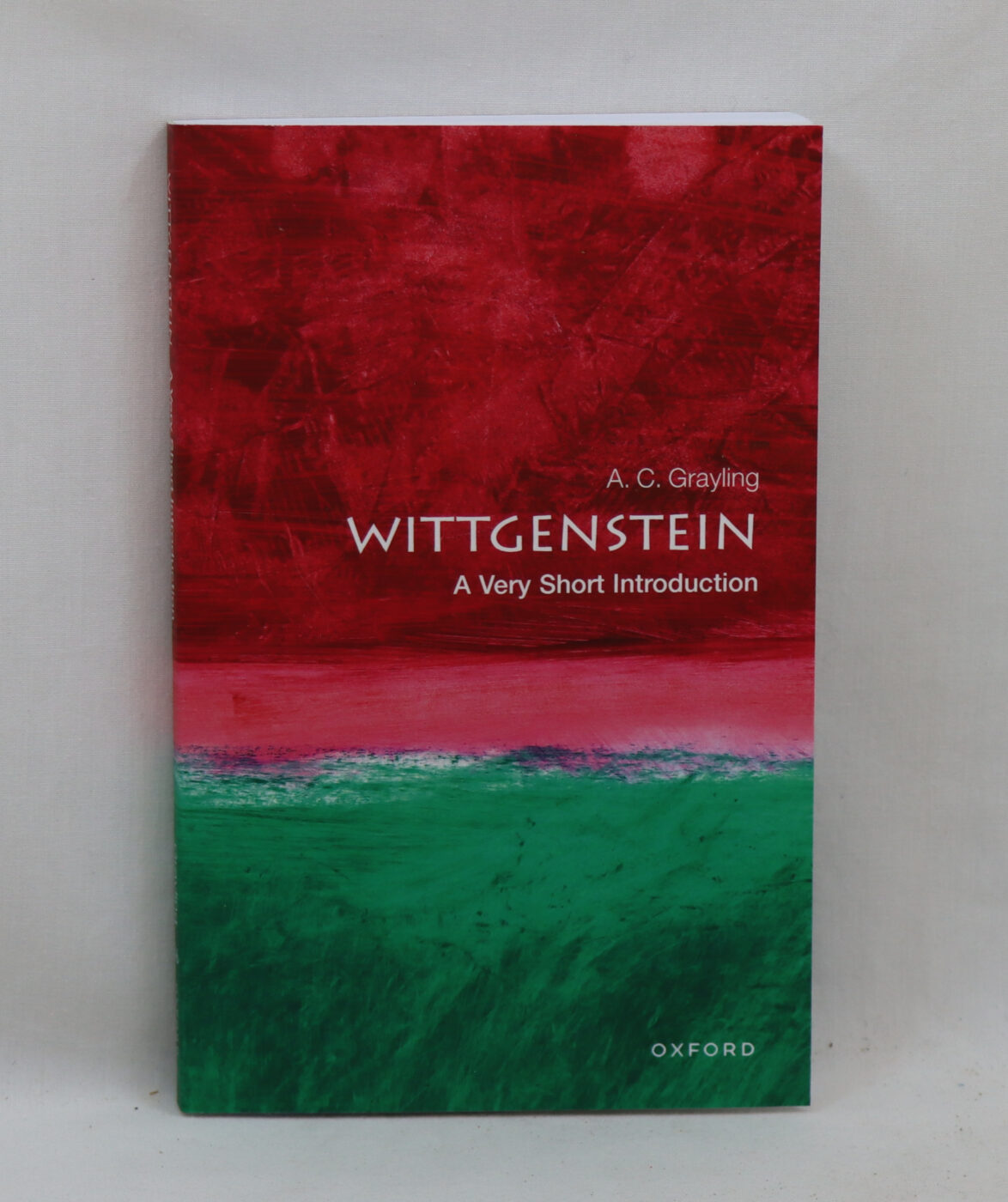
Paperback. Red and green cover with white title.
- We provide an in-depth photographic presentation of this item to stimulate your feeling and touch. More traditional book descriptions are immediately available.
- A £2 reduction when collected from FBA shop
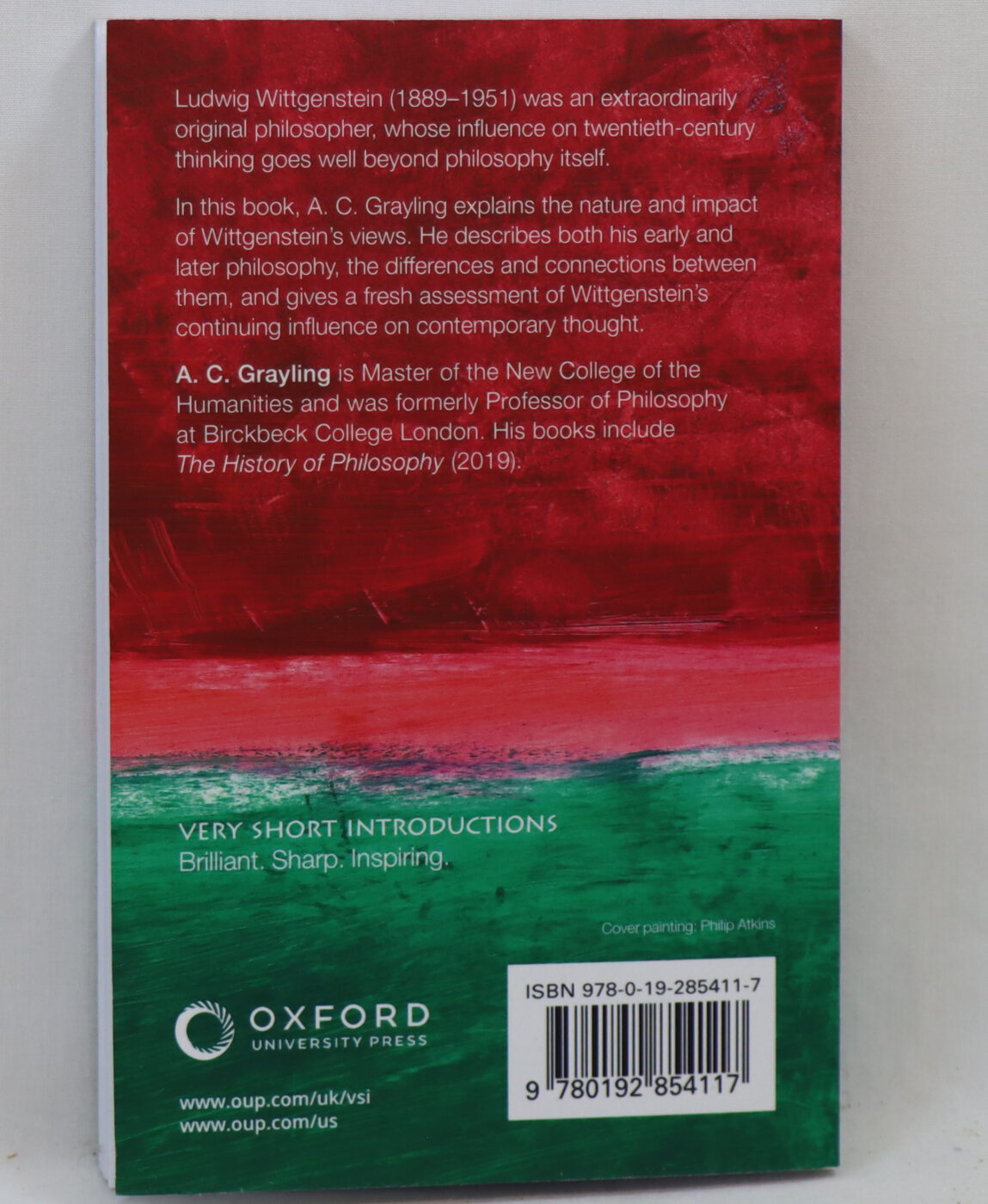
Ludwig Wittgenstein (1889-1951) was an extraordinarily original philosopher, whose influence on twentieth-century thinking goes well beyond philosophy itself. In this book, which aims to make Wittgenstein’s thought accessible to the general non-specialist reader, A. C. Grayling explains the nature and impact of Wittgenstein’s views. He describes both his early and later philosophy, the differences and connections between them, and gives a fresh assessment of Wittgenstein’s continuing influence on contemporary thought.
ABOUT THE SERIES: The Very Short Introductions series from Oxford University Press contains hundreds of titles in almost every subject area. These pocket-sized books are the perfect way to get ahead in a new subject quickly. Our expert authors combine facts, analysis, perspective, new ideas, and enthusiasm to make interesting and challenging topics highly readable.
A.C. Grayling is Professor of Philosophy and Principal of the New College of the Humanities at Northeastern University London. He believes that philosophy should take an active, useful role in society. He has written and edited many books, both scholarly and for a general readership, and has been a regular contributor to The Times, Financial Times, Observer, Independent on Sunday, Economist, Literary Review, New Statesman and Prospect, and is a frequent and popular contributor to radio and television programmes, including Newsnight, Today, In Our Time, Start the Week and CNN news. He is a former Fellow of the World Economic Forum at Davos, a Vice President of the British Humanist Association, an Honorary Associate of the National Secular Society, Patron of the UK Armed Forces Humanist association, Patron of Dignity in Dying, a former Booker Prize Judge, a Fellow of the Royal Literary Society, a member of the human rights group IHEU represented at the UN Human Rights Council in Geneva; and much more.
Ludwig Josef Johann Wittgenstein (Austrian German; 26 April 1889 – 29 April 1951) was an Austro-British philosopher who worked primarily in logic, philosophy of mathematics, philosophy of mind, and philosophy of language.
From 1929 to 1947, Wittgenstein taught at the University of Cambridge. Despite his position, only one book of his philosophy was published during his life: the 75-page Logisch-Philosophische Abhandlung (Logical-Philosophical Treatise, 1921), which appeared, together with an English translation, in 1922 under the Latin title Tractatus Logico-Philosophicus. His only other published works were an article, “Some Remarks on Logical Form” (1929); a review of The Science of Logic by P. Coffey; and a children’s dictionary. His voluminous manuscripts were edited and published posthumously. The first and best-known of this posthumous series is the 1953 book Philosophical Investigations. A 1999 survey of American university and college teachers ranked Philosophical Investigations as the most important book of 20th-century philosophy, standing out as “the one crossover masterpiece in twentieth-century philosophy, appealing across diverse specializations and philosophical orientations”.
His philosophy is often divided into an early period, exemplified by the Tractatus, and a later period, articulated primarily in the Philosophical Investigations.The “early Wittgenstein” was concerned with the logical relationship between propositions and the world, and he believed that by providing an account of the logic underlying this relationship, he had solved all philosophical problems. The “later Wittgenstein” rejected many of the assumptions of the Tractatus, arguing that the meaning of words is best understood as their use within a given language game. More precisely, Wittgenstein wrote, “For a large class of cases of the employment of the word ‘meaning’—though not for all—this word can be explained in this way: the meaning of a word is its use in the language.”
Born in Vienna into one of Europe’s richest families, he inherited a fortune from his father in 1913. Before World War I, he “made a very generous financial bequest to a group of poets and artists chosen by Ludwig von Ficker, the editor of Der Brenner, from artists in need. These included [Georg] Trakl as well as Rainer Maria Rilke and the architect Adolf Loos”, and also the painter Oskar Kokoschka. “In autumn 1916, as his sister reported, ‘Ludwig made a donation of a million crowns [equivalent to about $3.7 million in 2025] for the construction of a 30 cm mortar.'”Later, in a period of severe personal depression after World War I, he gave away his remaining fortune to his brothers and sisters. Three of his four older brothers died by separate acts of suicide.
Wittgenstein left academia several times: serving as an officer on the front line during World War I, where he was decorated a number of times for his courage; teaching in schools in remote Austrian villages, where he encountered controversy for using sometimes violent corporal punishment on both girls and boys (see, for example, the Haidbauer incident), especially during mathematics classes; working during World War II as a hospital porter in London; and working as a hospital laboratory technician at the Royal Victoria Infirmary in Newcastle upon Tyne.
Want to know more about this item?
We are happy to answer any questions you may have about this item. In addition, it is also possible to request more photographs if there is something specific you want illustrated.
Ask a question
Related products
Share this Page with a friend
