
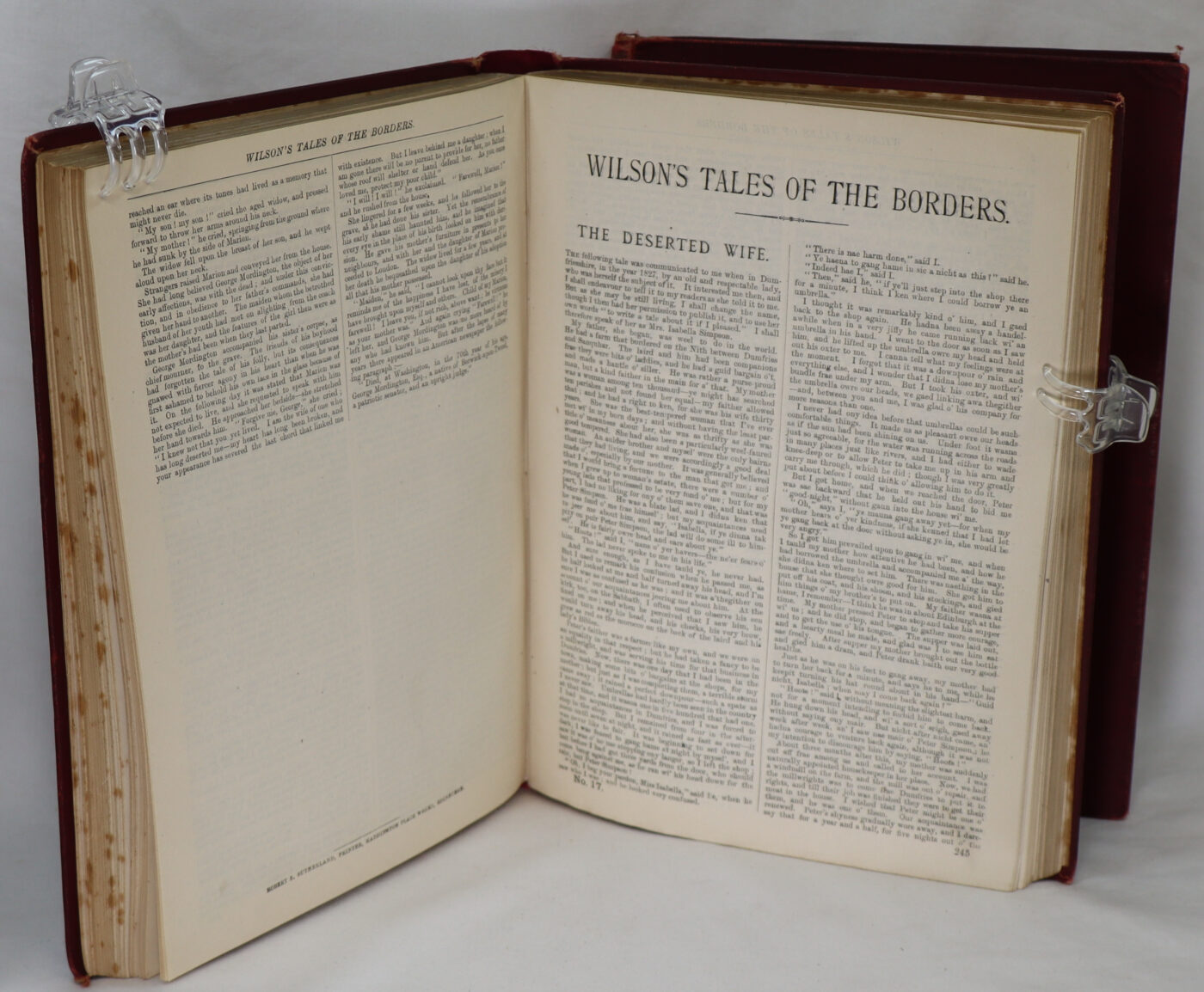
Wilson's Tales of the Borders. Two Vols.
By James Mackay Wilson
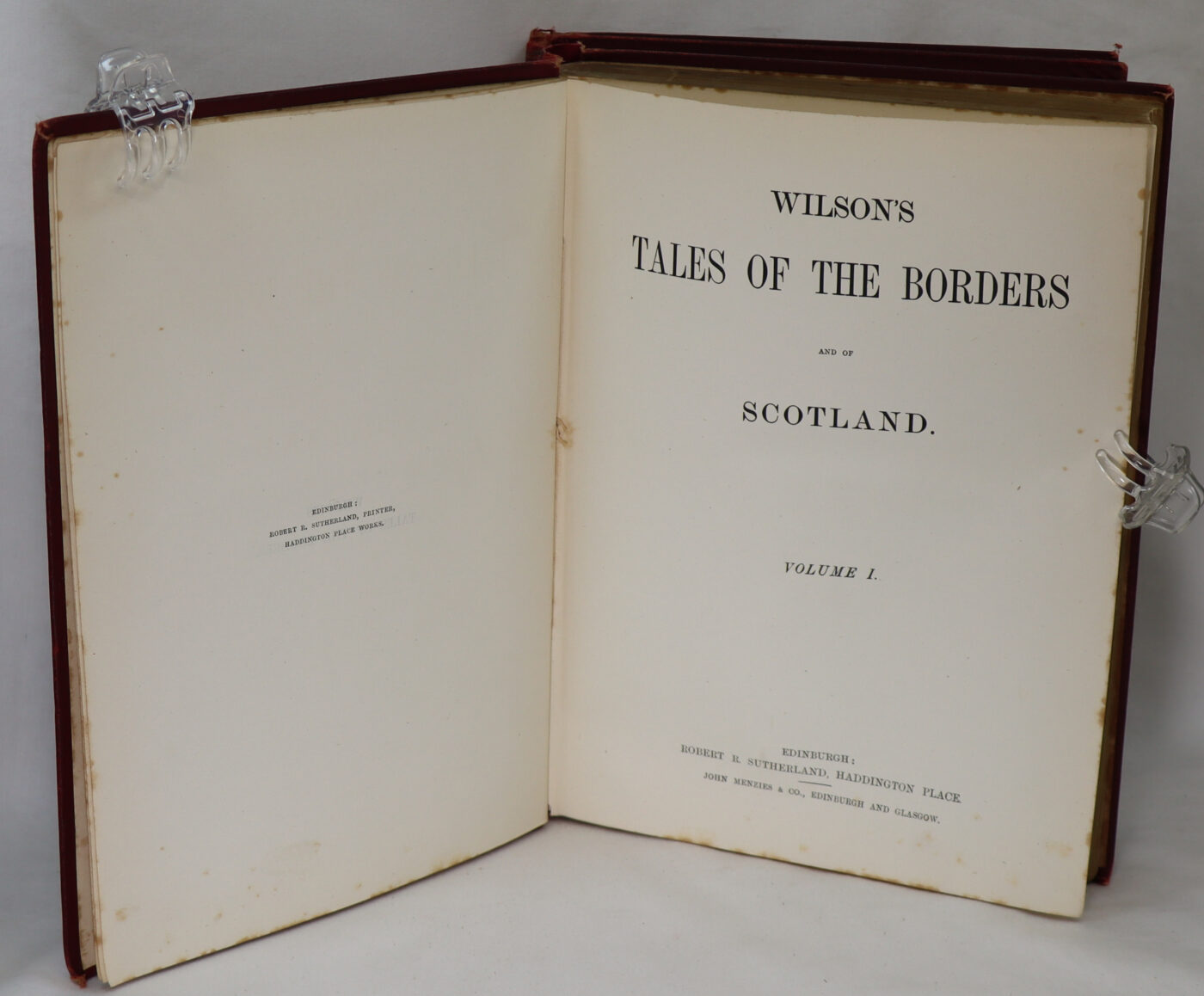
Printed: Circa 1890
Publisher: Robert R Sutherland. Edinburgh
| Dimensions | 19 × 26 × 2 cm |
|---|---|
| Language |
Language: English
Size (cminches): 19 x 26 x 2
Condition: Good (See explanation of ratings)
£334.00
FREE shipping
Buy Now
Your items

Item information
Description
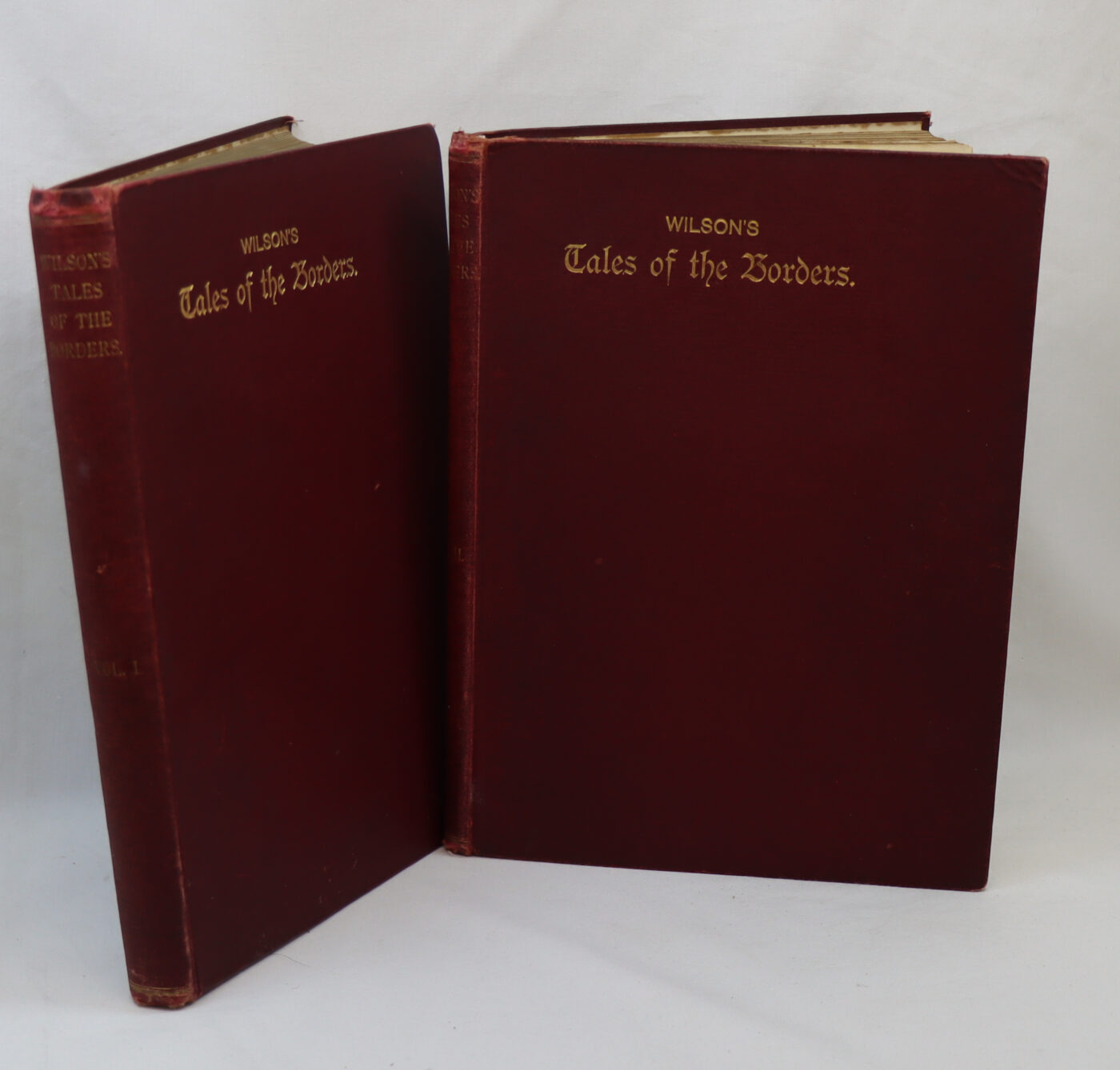
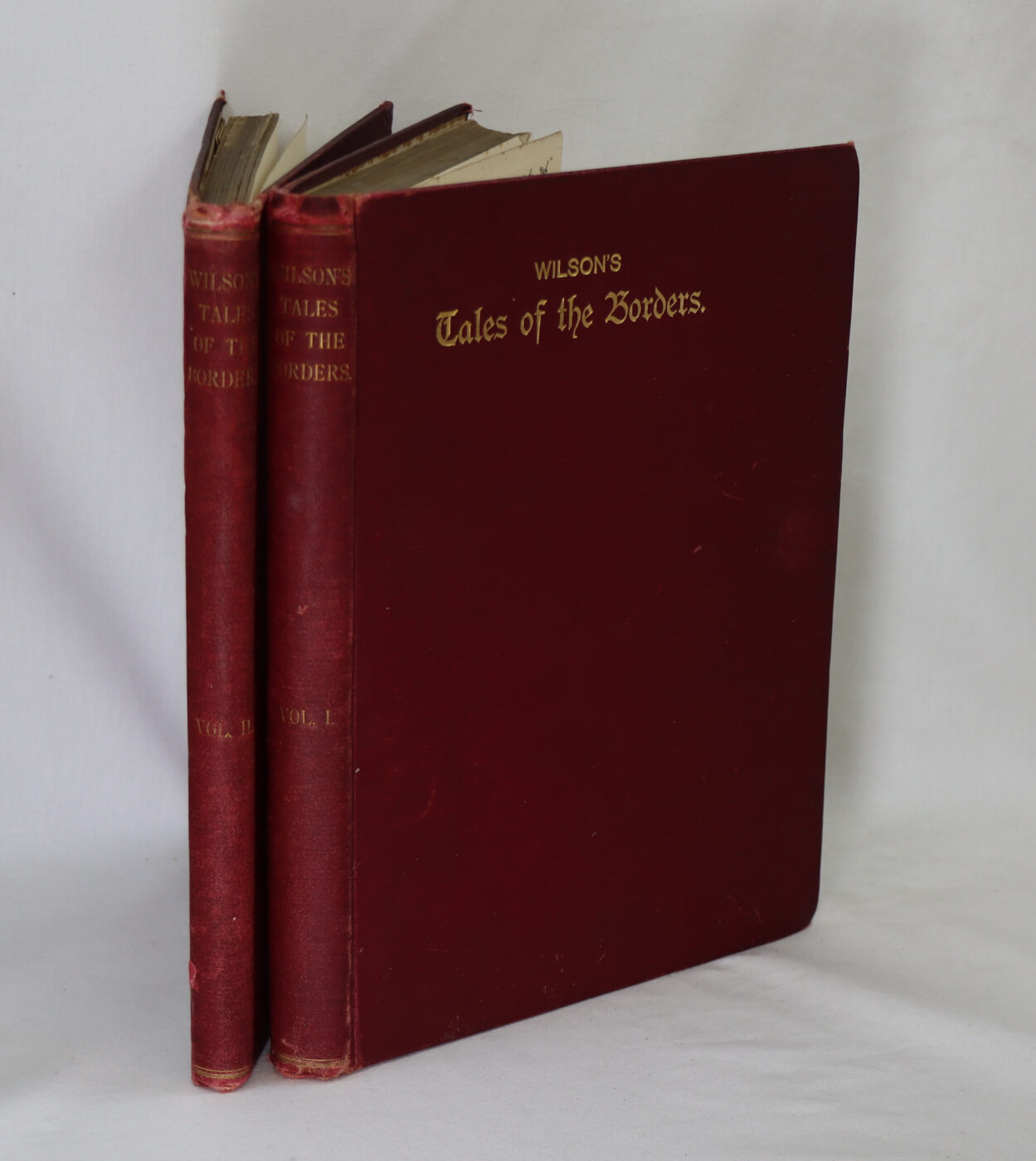
Maroon cloth binding with gilt title on the spine and front board. Dimensions are for one volume.
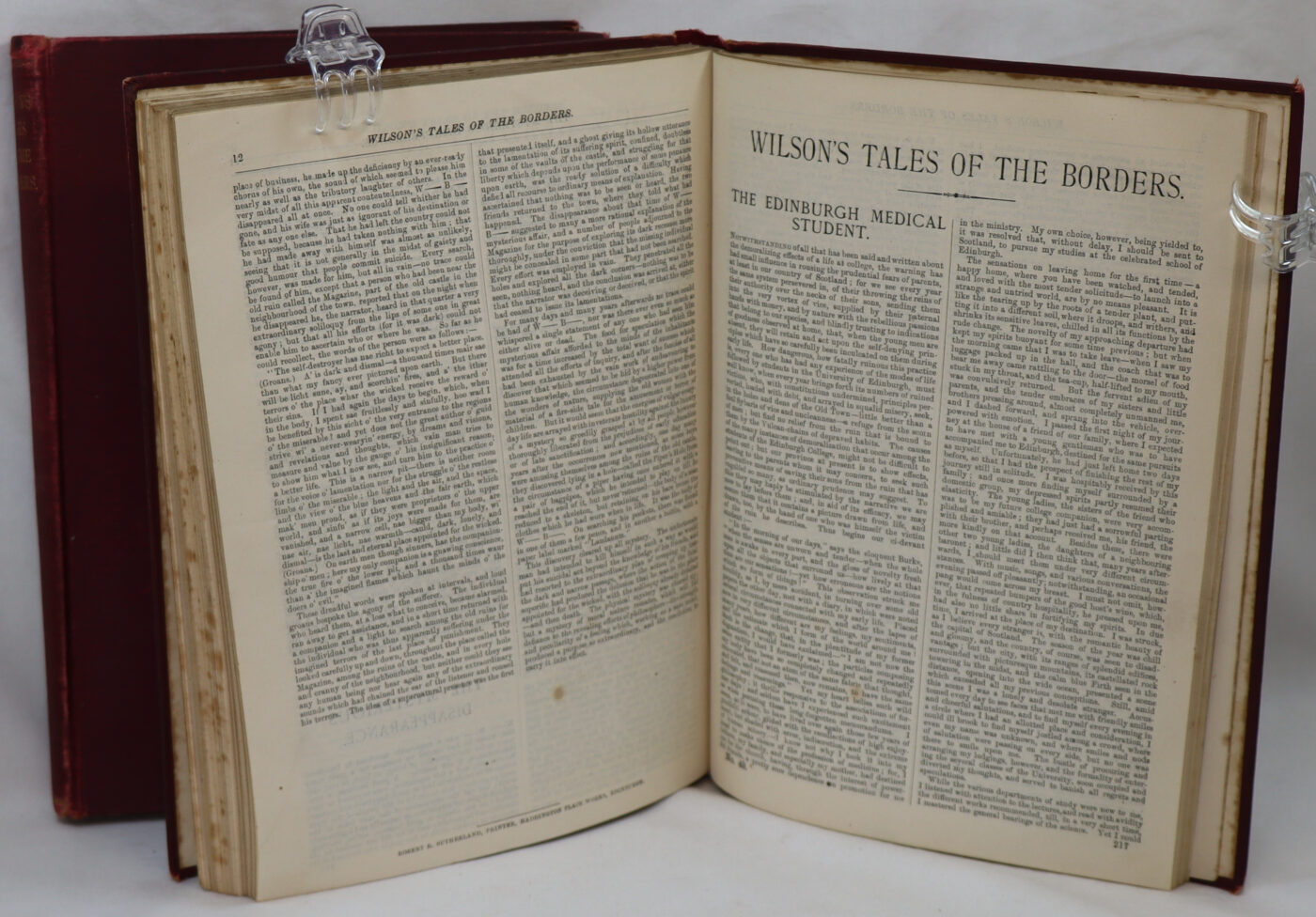
We provide an in-depth photographic presentation of this item to stimulate your feeling and touch. More traditional book descriptions are immediately available.
- Note: This book carries a £5.00 discount to those that subscribe to the F.B.A. mailing list
These two unique quality volumes are amongst the earliest on record: please view the below article –
‘Known Editions And Publication Dates’
Wilson’s Tales of the Borders is a legendary 19th-century collection of Scottish folklore, historical romance, and traditional sketches, originally published by John Mackay Wilson between 1834 and 1840. While the complete series spans dozens of installments, many antique and modern editions (like the Mackenzie edition) were packaged as 6 or more volumes bound into 2 large books.
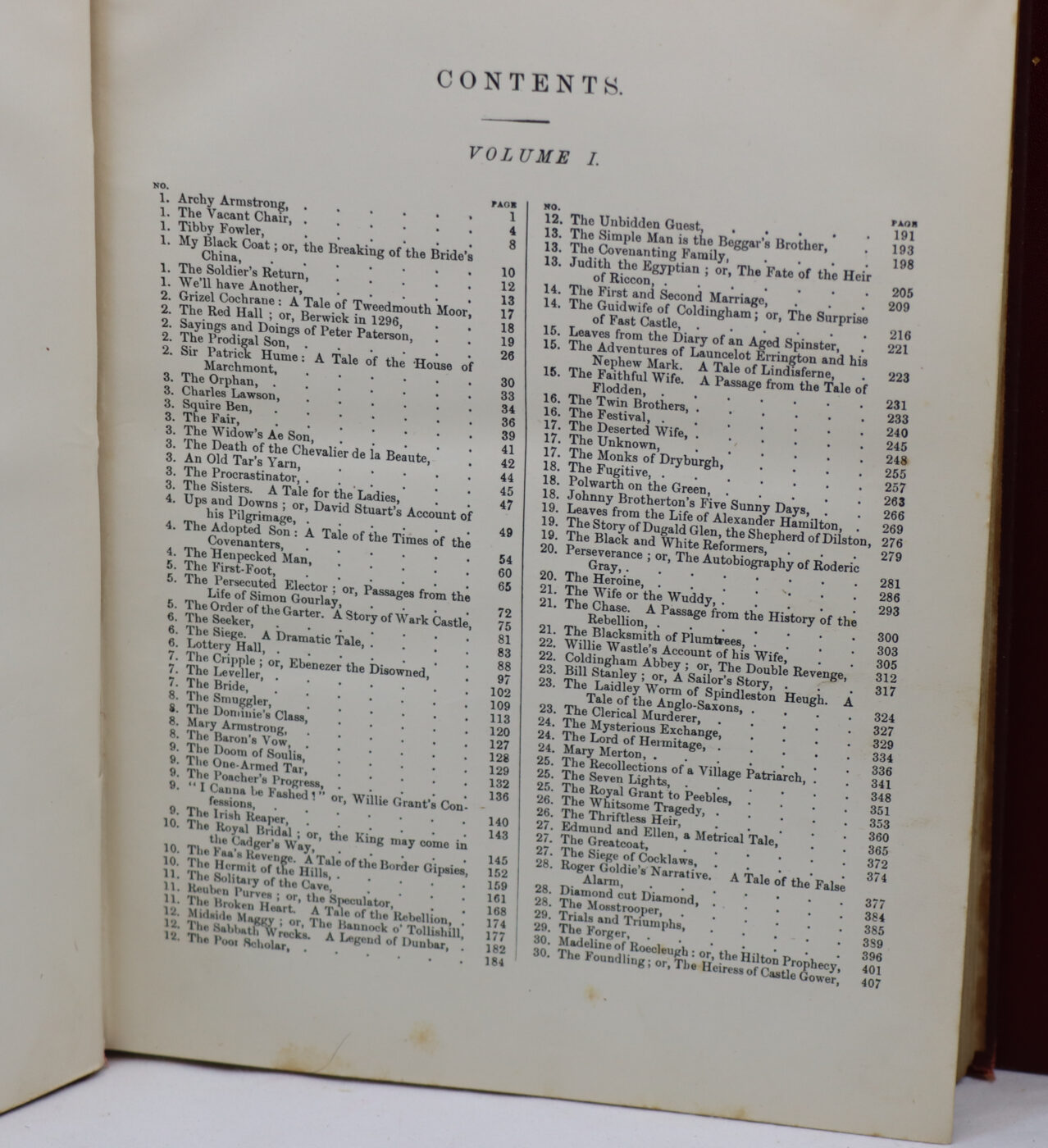
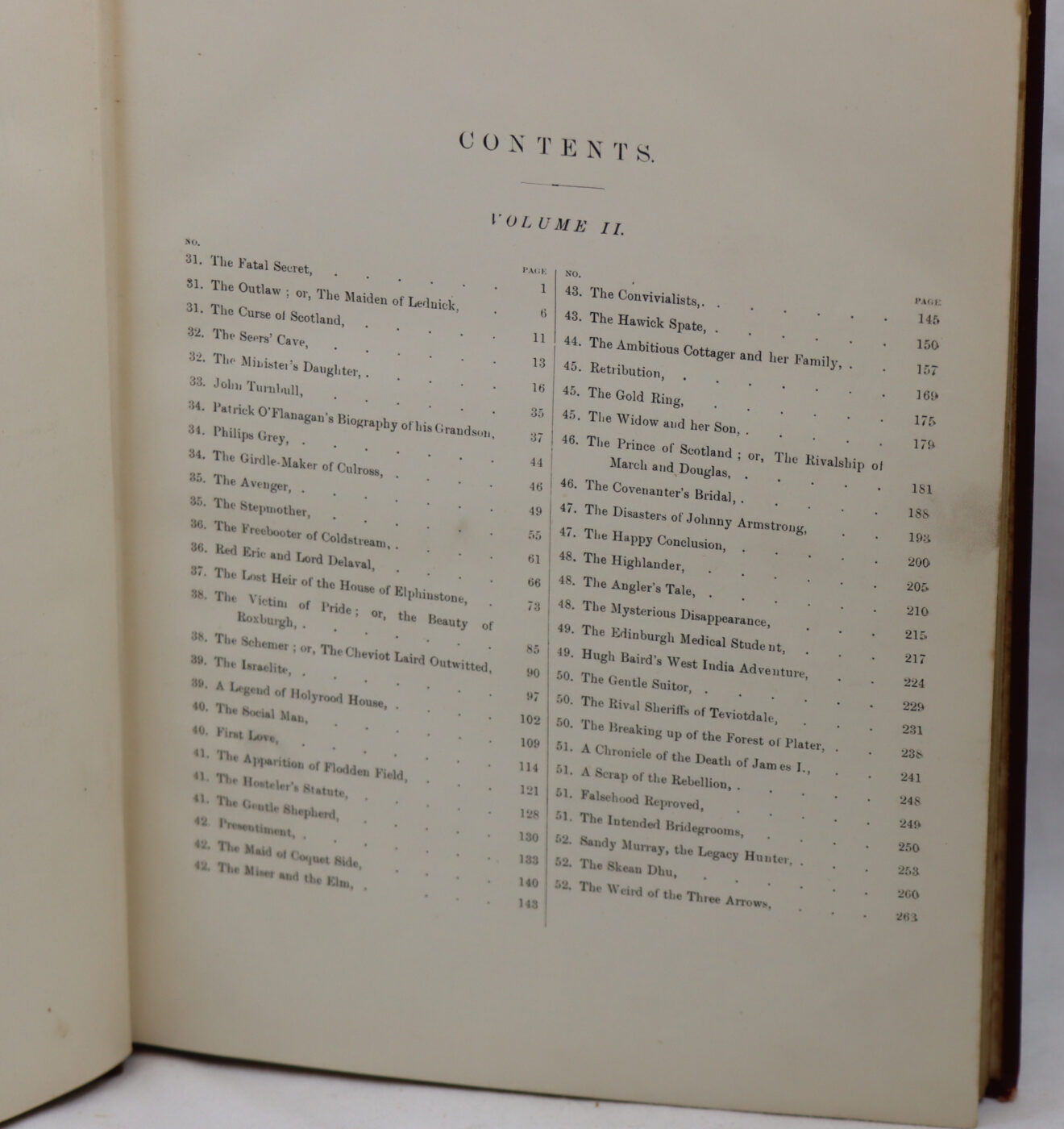
A two-volume set covers the core foundational stories and legends of the Scottish Borders.
- Volume 1 typically sets the stage with Wilson’s original weekly issues, featuring classics such as The Vacant Chair, The Guidwife of Aldie, and The Dominie’s Class.
- Volume 2 (often revised and expanded by Alexander Leighton following Wilson’s early death) delves deeper into historical tragedies, covenanting tales, and imaginative legends.
- Key Features: These collections are prized for preserving regional Scottish dialects, historical context, and providing a glossary to aid readers.
John Mackay Wilson (15 August 1804 – 2 October 1835) was a Scottish writer who wrote the eponymous “Wilson’s Tales of The Borders (and of Scotland)” He was born in Tweedmouth, on the border between Scotland and England. He gave many talks to Temperance societies.
Whilst editor of the Berwick Advertiser, Wilson began publishing local stories. Their popularity led to him reprinting and extending them into a weekly broadsheet, priced at 1 1/2d (a penny halfpenny) Although he died within a year, with his obituary published in issue 49, the Tales ran to 312 editions, in all carrying 485 tales or serialisations. After his death the Tales continued under the editorship of others, in part to provide income for his widow and family. The most notable contributor and subsequent editor being Alexander Leighton.
As well as editing the newspaper, Wilson also wrote poetry and plays. The Wilson’s Tales Project now hosts a literary dinner on the anniversary of his death, at which his poem ‘Beans and Bacon’ is performed. The circumstances and penury of the central character of the poem are generally regarded as being semi autobiographical. His plays include The Gowrie Conspiracy and Margaret of Anjou.
Alexander Leighton (1800–1874) was a Scottish writer, known as the editor of Tales of the Borders. Born at Dundee, he studied at the Dundee Academy, and then took up medicine at the University of Edinburgh. He worked as a lawyer’s clerk in Edinburgh, and then as a man of letters. He also worked as a book editor, and probably as a ghostwriter. Leighton died on 24 December 1874.
The Tales of the Borders, a popular short story serial, was begun at Berwick-on-Tweed in 1834 by John Mackay Wilson, who died the following year. His brother continued the work for a time. Shortly afterwards an Edinburgh publisher, John Sutherland, became proprietor, and Leighton was appointed editor and chief story writer; the series was completed in 1840. In 1857 Leighton re-edited the complete Tales of the Borders, and it was reissued in 1863–4, 1869 (with additions), and in 1888. He received assistance from Hugh Miller and Thomas Gillespie, and contributions from others such as Alexander Bethune and his brother John, and John Howell.
In 1860–1 Leighton published two series of Curious Storied Traditions of Scottish Life, in 1864 Mysterious Legends of Edinburgh, in 1865 Shellburn, a novel, and in 1867 Romance of the Old Town of Edinburgh. Other works were Men and Women of History, Jephthah’s Daughter, A Dictionary of Religions, and a Latin metrical version of Robert Burns’s songs.
Wilson had originally intended to publish 96 editions of his Tales but he died as the 49th edition was about to be published. That edition included the following appeal on behalf of his widow who had “shared his sorrows through many a changing year”:
He has left a widow respectable and respected; and, from what we have said of his struggles through many a dark year, she is left to depend on the profits of his works for the comforts necessary for her, till she sink to rest with him in the grave. Nor are her prospects dark if those who cheered him on in his literary labours still stand by her. His materials are not yet exhausted, and “tales yet untold” are in reserve to keep alive his memory and soothe as far as earthly comforts can her widowed heart … Under the management of Mr James Wilson, her brother-in-law, and Mr Sutherland of 12 Calton Street, Edinburgh, who is now publisher, we trust to see her reap the full reward of his genius and toil whose last hours she sweetened.
On 10th October, only a week after Wilson’s death, the following advertisement was published in the Advertiser and elsewhere:
… the Border Tales for the future will be published for behoof of the Widow of John Mackay Wilson, Berwick, by John Sutherland, 12 Calton Street, Edinburgh. From the Steam-Press of Peter Brown, Printers, Edinburgh. Stereotyped by D Stevenson.
The Newcastle Courant of 21st September 1835 was generous in its editorial about the Tales and the predicament of his widow, thus:
WILSON’S TALES OF THE BORDERS. To an imagination so lively, and powers so versatile, as those possessed by the late John Mackay Wilson, the long history of the English and Scottish borders presented a fertile field from which to gather a series of Tales, such as those now in course of publication. Probably most of our readers have seen occasional numbers of the work; and so feel pretty well assured, the more they see the more they will be gratified. We know of no other publication in this district which, from its cheapness and agreeable a reading, is better adapted to be taken by a few neighbours, and circulated weekly among them. Old and young would alike derive pleasure from its pages, at the same time that they would steer clear of the pernicious effects which many other books that are pleasant reading have a direct or remote tendency to produce. Let it be remembered, too, that in purchasing these Tales, they are engaged in a work of charity-in the support of the widow of the author, whose premature death left her only the memory of his merits as her consolation, and these Tales as her only legacy.
The advertised appeals on behalf of the widow continued for a number of years and an example is presented below.
From The Globe 20th October 1836
As noted above, in the 49th edition of the Tales it was suggested that Wilson left a considerable amount of material. Tait however states:
There was not a leaf of manuscript to be found.
Thus, if publication of the Tales was to continue other writers needed to be recruited. Sutherland appointed Alexander Leighton (1800-1874) as Editor and story-writer. He was from Dundee and had studied medicine at Edinburgh University and had worked at a law office in Edinburgh before turning to literature.
Leighton considerably expanded the work, adding many tales from other sources, including Hugh Miller, Thomas Gillespie, Alexander Bethune and his brother John and John Howell. The Newcastle Daily Chronicle of 25th May 1863 included the following advertisement for Wilson’s Tales:
Ainsworth and Ward and Lock, London 1 shilling per volume, 280 pages in each volume.1863
Tales of the Borders. VoL 1. London: Ward and Lock. The Tales of the Borders had an unprecedented circulation when first published. Deficient in elaborate finish and highly-wrought plots, they yet maintain their place in the affections of the generation now growing old, that made acquaintance with them in their early form. Stray volumes of these tales have for twenty years added to the pleasures of youth, and it will therefore be a cause of gladness for that class of readers to meet with a re-publication of the whole work in shilling volumes. Ten of the tales appear in this first volume. Among them are Hugh Miller’s “Recollections of Ferguson,” and two of Gillespie’s Professor’s Tales. Writers whose names afterwards became famous, co-operated with the enterprising editor, the late John Mackay Wilson, in this still stupendous and then unique work. In the words of the modest preface—“ The only condition by which the natural promptings might have been restrained was that the contributions should be genuine stories, with such an objectiveness as would portray, graphically and naturally, the men and women of the times acting on the stage whereon they were destined to perform their strange parts, and would exclude all false colourings of sentimental fiction belonging to mere subjective moods of the writer’s fancy feeling. The greatest care was also taken with the moral aspect of the tales, with the view that parents and guardians might feel a confidence that, in committing them into the hands of their children and wards, they would be imparting the means of instruction, and, at the same time, securing a guarantee for the growth of moral convictions”.
The Tales changed in character when Leighton took over. The stories were no longer confined to the Borders, but came from all over Scotland and the exploits of Scotsmen around the globe.
Tait comments:
… there can be no doubt that, though the work proceeded as before, and probably maintained its popularity, its character and aims gradually diverged from the original intention; and from Tales having only a remote connection with the Borders, the transition was easy to many in which violence was done to the sequence and consistency of the story, by introducing something which might justify its appearance in a series of Border Tales. Many of the best stories consequently make no pretension to conformity with the title under which they appear. Indeed it may be said that towards its close the publication assumed more the character of a weekly novelette, in which, however, the moral tone and excellence were always well sustained … producing what undoubtedly is the most interesting collection of Tales and Romances descriptive of Scottish life and character which we possess. What was thus a loss to the Borders was a corresponding gain to Scottish literature generally; and the popularity which the “Tales of the Borders” have so long maintained is doubtless due to what we may call the national rather than the local character they ultimately assumed.
Sutherland was over-confident about his ability to make the production of the Tales a success. Tait writes:
Sutherland was so sanguine about the Tales of the Borders, that he went to the expense of having all the numbers stereotyped; and the plates became so bulky, that he was compelled to erect a small building behind the shop for their preservation.
His business eventually ran into difficulties. Tait continues, thus:
The stereotype plates and copyright were sold, and the Border tales thus found their way into the hands of Messrs Ainsworth publishers, Manchester, who more than once issued full sets, printed from the plates, with the original plates deleted.
The Tales continued to be enormously popular in the 19th Century with dozens of editions. In publishing his own edition in 1881, Tait makes the following claim:
… no book has been produced in recent times which has been at once so popular with all classes of the community, and which so thoroughly identified itself with the thoughts and feelings of its readers. By the high moral tone and varied interest, it found its way to the hearts and homes of Scotsmen in all parts of the world. For years it formed the staple source of amusement around many a cotter’s fireside; its weekly issues were waited on with impatience and read with avidity; and even yet after the lapse of nearly fifty years, there is probably no work to which a Scotchman will turn more readily, to while away a leisure hour, than the old but ever-new ‘Tales of the Borders’.
Of course, tastes change. Wilson’s views on poetry as expressed in The Enthusiast were not original or especially stimulating and his writing style was of its time. The poetry is no longer popular and thus The Enthusiast is long out of print. The language of the Tales now seems similarly old-fashioned and the stories often involve unlikely plot twists which are not to the taste of modern readers. Even an advertisement from 1863, cited previously, states the Tales are:
“Deficient in elaborate finish and highly-wrought plots”.
Prior to the Wilson’s Tales Project’s publication of Revival Editions the last publication of Wilson’s Tales was in 1947 by The Ettrick Press. It’s publication stated:
“it is perhaps less true today than it was 20 years ago that the library of every country cottage consisted of the Bible, Burns, the Scotts Worthies and the Tales of the Borders, but it is still true enough to possess significance and deserve note”.
Despite coming from humble origins and leaving school at a young age Wilson achieved a great deal in his short life. His determination to succeed and his work-ethic were impressive. As Rev. Campbell states in the introduction to the Tales of the Borders, Number 48:
Despair seemed an entire stranger to him; and the strength of his own mind stayed him amid darkness and amid tempests.
In all his work his standard of literacy is excellent and he displays a remarkable knowledge of literature, politics and history.
In pursuing a literary career he was confident of his own abilities and not shy in promoting his work, in 1829 he wrote to the Advertiser regarding his poems
If a man does not speak well of his own wares, who does he expect to do it for him, when every person is busy selling wares of his own.
“Health and home are powerful magnets”.
The exile returned home, but success came too little, too late.
————————————————
Known Editions And Publication Dates
The Original Tales were published from 8th November 1834 in weekly installments through to 24th October 1840, by which time 312 editions had been published containing 474 tales.
Wilson originally self-published the tales, but the publishing rights were sold out to John Sutherland of Edinburgh shortly after his death.
There were various “reprints” as the ongoing publishing continued and they were subsequently available in 6, 3 and 2 volume sets, of similar dimensions to a family bible.
Smaller format versions subsequently became available in the late 1800s, principally published by the Walter Scott Publishing Co., who’s edition extended to 24 Volumes.
A one volume selection of The Tales were published in 1934, the centenary of their first publication, which was released again in 1947.
Publishing rights seem to have been owned by various companies over the years and indeed in different parts of the world. There were certainly American, Australian, Canadian and even a German edition in both English and German!
Not all editions actually include the publication date, but research of copies in private ownership, public libraries and available through on line book sellers seem to suggest publications subsequent to the originals in:
1830s: John Sutherland, Edinburgh
1840s(?): Robert R Sutherland, Edinburgh
1840s: James Ainsworth, Manchester
1848: Robert T Shannon, New York.
1857-59: Revised edition, edited by Alex Leighton. W P Nimmo.
1857: Ward & Lock
William P Nimmo
Thomas & Niven (Australian editions)
1860s(?): Adam & Co.
John G Murdoch, London & Melbourne
Johnson, Fry & Co. (American edition)
W.R. McPhun & Son, Glasgow & London
1869: The Walter Scott Publishing Co.
1870s(?): William Mackenzie
The Grand Coliseum Warehousing Co.
(Founded by Walter Wilson in 1869)
Croome & Co, London
James Gemmel
Richard Edward King, Ltd, London
James Semple, Glasgow
1870: The Tyne Publishing Co.
1877: Ward Locke & Bowden
1880: Gall & Inglis
1881: The Edinburgh Publishing Co.
edited with notes by James Tait
Joseph Irving
1883: McCready
1884: S Cowan & Co.
1884: Cassell & Co. Cassell’s “Red Library”
1885(?): Gressner & Schramm, Leipzig
Brook & Chrystal, Manchester
James Askew, Manchester “Gems of Literature Series”
Richard Edward King
1888: Walter Scott
1889: Walter Scott
Alexander Deane & Co. 3 Bath Street, Glasgow
W G Horner, Toronto
1890: Adam & Co.
1892: Walter Scott
1895: Gall & Inglis
1899: Ward, Locke & Bowden
1907: Gall & Inglis
Gall & Inglis, Published as part of “The Stirring Tales Series”. The Faa’s Revenge by J M Wilson and others.
1911: Gall & Inglis
1934: The Moray Press
1947: The Ettrick Press
1991 : Mainstream Publishing, edited by Michael Brander,
“The Tales” were seldom out of print in the 1800s and were still being given as school prizes in the early 20th century.
“Print on demand editions” can be purchased on the internet , based on scans of the originals for around £30, but as single volumes of original issues can be picked up for less than this, an original would seem a better buy.
The Wilson’s Tales project started publishing their edited revival editions in 2014.
Want to know more about this item?
We are happy to answer any questions you may have about this item. In addition, it is also possible to request more photographs if there is something specific you want illustrated.
Ask a question
Related products
Share this Page with a friend
