
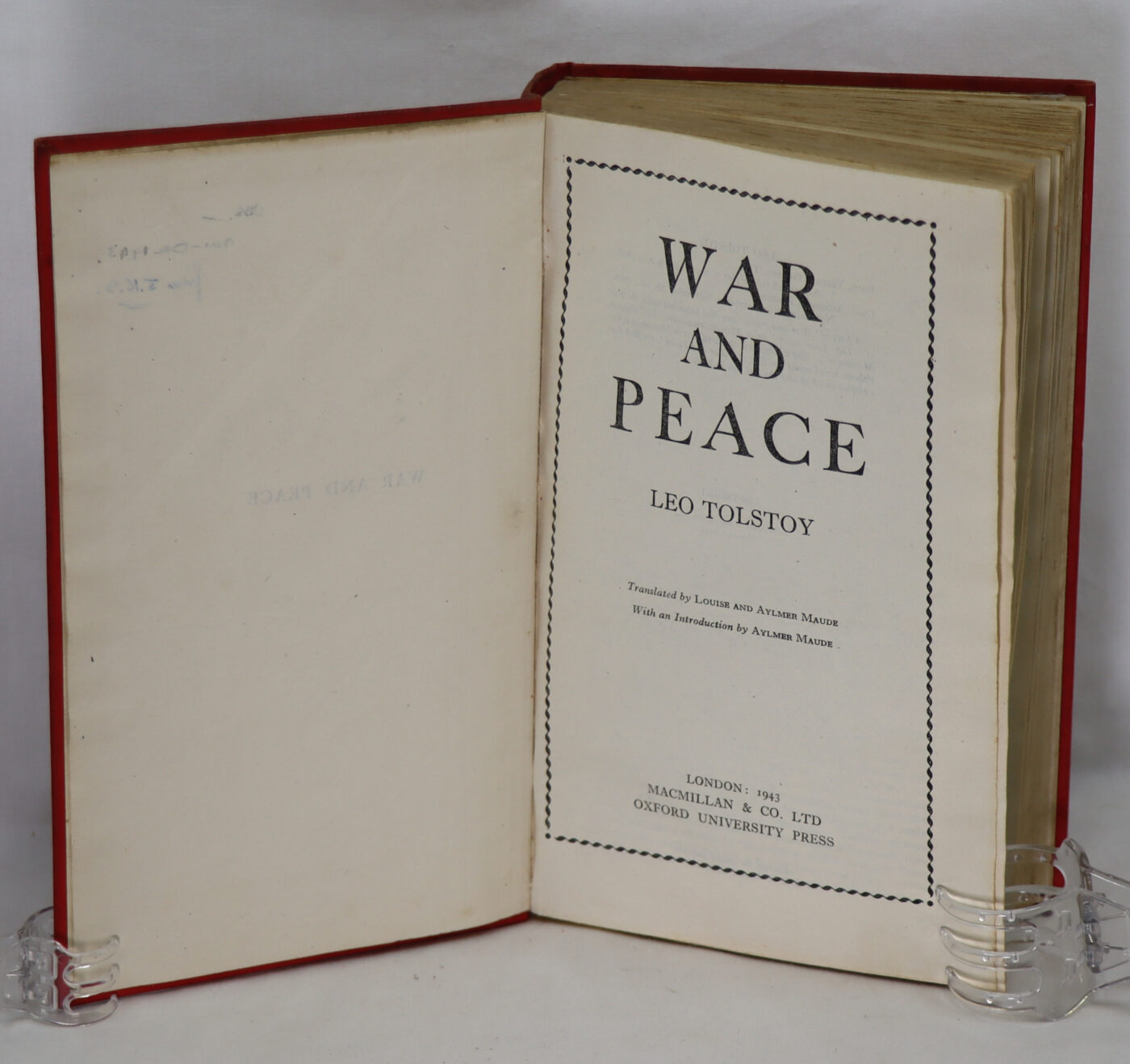
War And Peace.
By Leo Tolstoy
Printed: 1943
Publisher: Macmillan & Co. London
| Dimensions | 15 × 23 × 4 cm |
|---|---|
| Language |
Language: English
Size (cminches): 15 x 23 x 4
Condition: Fair (See explanation of ratings)
£16.00
Buy Now
Your items

Item information
Description
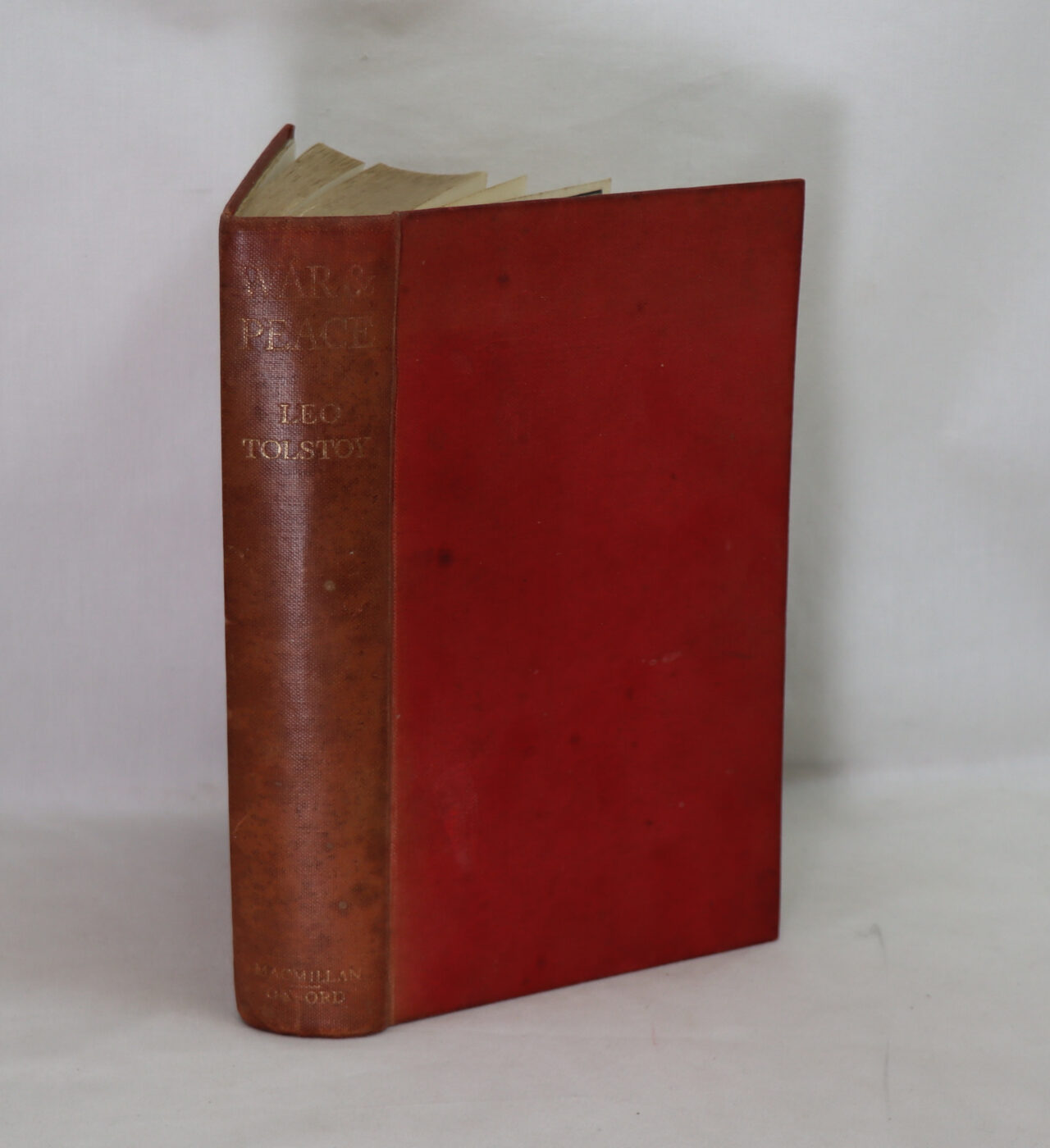
Red cloth binding with gilt title on the spine.
We provide an in-depth photographic presentation of this item to stimulate your feeling and touch. More traditional book descriptions are immediately available
-
Note: This book carries a £5.00 discount to those that subscribe to the F.B.A. mailing list
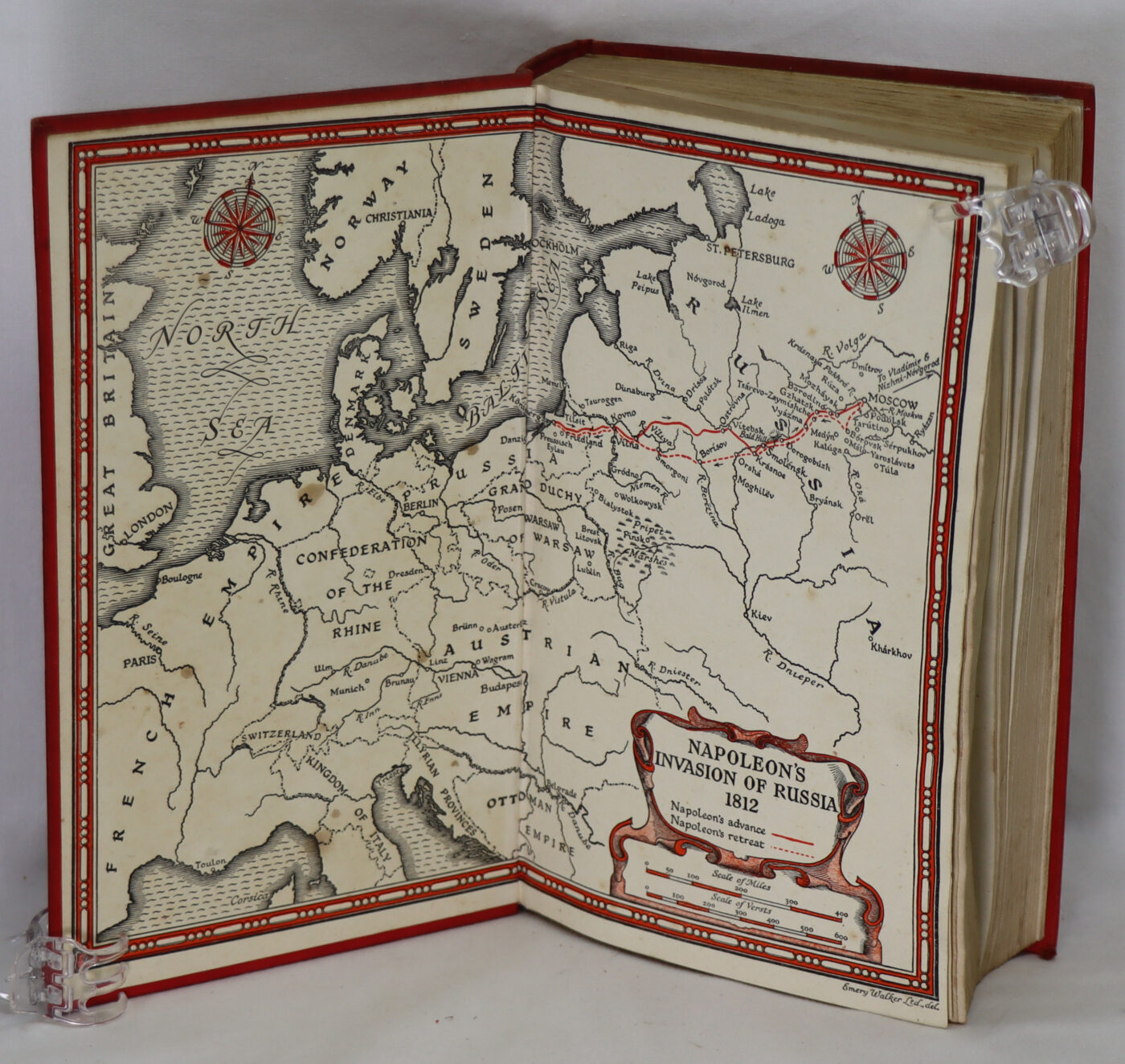
Please view our photographs as to the conditions of this book. A true classic for any library! Anna Pávlovna makes her own statement regarding political matters in Chapter I – “Oh, don’t speak to me of Austria. Perhaps I don’t understand things, but Austria never has wished, and does not wish, for war. She is betraying us! Russia alone must save Europe. Our gracious sovereign recognizes his high vocation and will be true to it. That is the one thing I have faith in! Our good and wonderful sovereign has to perform the noblest role on earth, and he is so virtuous and noble that God will not forsake him. He will fulfil his vocation and crush the hydra of revolution, which has become more terrible than ever in the person of this murderer and villain! We alone must avenge the blood of the just one…. Whom, I ask you, can we rely on? – does she manage to make an impact with her outburst? Read further to find out and add this excellent title to your vintage collection!
Count Lev Nikolayevich Tolstoy (9 September [O.S. 28 August] 1828 – 20 November [O.S. 7 November] 1910), usually referred to in English as Leo Tolstoy, was a Russian writer. He is regarded as one of the greatest and most influential authors of all time. Born to an aristocratic family, Tolstoy achieved acclaim in his twenties with his semi-autobiographical trilogy, Childhood, Boyhood and Youth (1852–1856), and with Sevastopol Sketches (1855), based on his experiences in the Crimean War. His War and Peace (1869), Anna Karenina (1878), and Resurrection (1899), which is based on his youthful sins, are often cited as pinnacles of realist fiction and three of the greatest novels ever written. His oeuvre includes short stories such as “Alyosha the Pot” (1911) and “After the Ball” (1911) and novellas such as Family Happiness (1859), The Death of Ivan Ilyich (1886), The Kreutzer Sonata (1889), The Devil (1911), and Hadji Murat (1912). He also wrote plays and essays concerning philosophical, moral and religious themes.
In the 1870s, Tolstoy experienced a profound moral crisis, followed by what he regarded as an equally profound spiritual awakening, as outlined in his non-fiction work Confession (1882). His literal interpretation of the ethical teachings of Jesus, centering on the Sermon on the Mount, caused him to become a fervent Christian anarchist and pacifist. His ideas on nonviolent resistance, expressed in such works as The Kingdom of God Is Within You (1894), had a profound impact on such pivotal 20th-century figures as Mahatma Gandhi, Ludwig Wittgenstein, Martin Luther King Jr., and James Bevel. He also became a dedicated advocate of Georgism, the economic philosophy of Henry George, which he incorporated into his writing, particularly in his novel Resurrection (1899).
Tolstoy received praise from countless authors and critics, both during his lifetime and after. Virginia Woolf called Tolstoy “the greatest of all novelists”, and Gary Saul Morson referred to War and Peace as the greatest of all novels. He received nominations for the Nobel Prize in Literature every year from 1902 to 1906 and for the Nobel Peace Prize in 1901, 1902, and 1909. Tolstoy never being awarded a Nobel Prize remains a major Nobel Prize controversy.
Want to know more about this item?
We are happy to answer any questions you may have about this item. In addition, it is also possible to request more photographs if there is something specific you want illustrated.
Ask a question
Related products
Share this Page with a friend
