
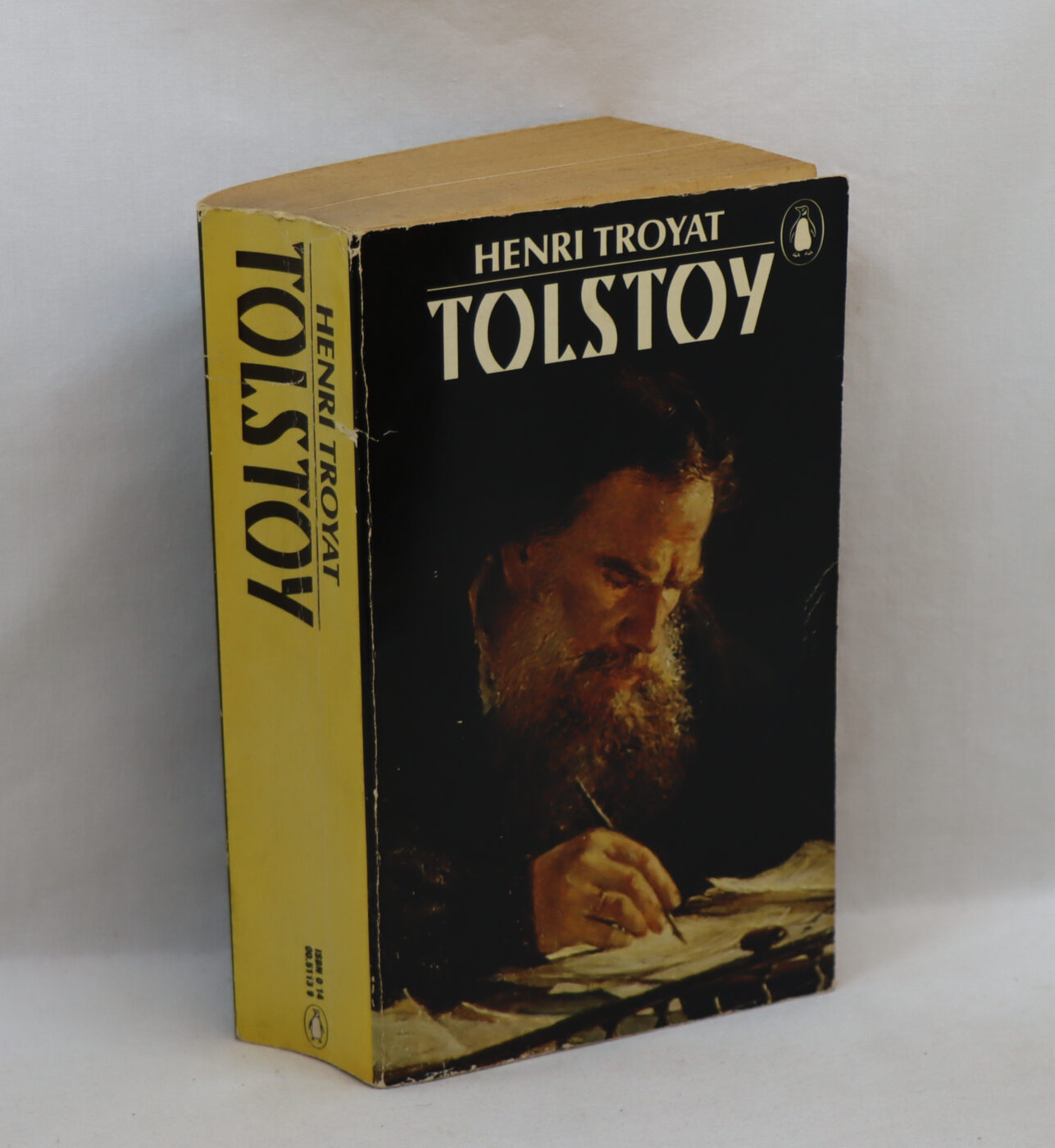
Tolstoy.
By Henri Troyay
ISBN: 9780802137685
Printed: 1980
Publisher: Penguin Books. London
| Dimensions | 11 × 18 × 5 cm |
|---|---|
| Language |
Language: English
Size (cminches): 11 x 18 x 5
Condition: Fair (See explanation of ratings)
£22.00
Buy Now
Your items

Item information
Description
Paperback. Black cover with white title.
We provide an in-depth photographic presentation of this item to stimulate your feeling and touch. More traditional book descriptions are immediately available
-
THIS FROST PAPERBACK is a USED book which a member of the Frost family has checked for condition, cleanliness, completeness and readability. When the buyer collects their book from Frost’s shop, the delivery charge of £3.00 is deducted
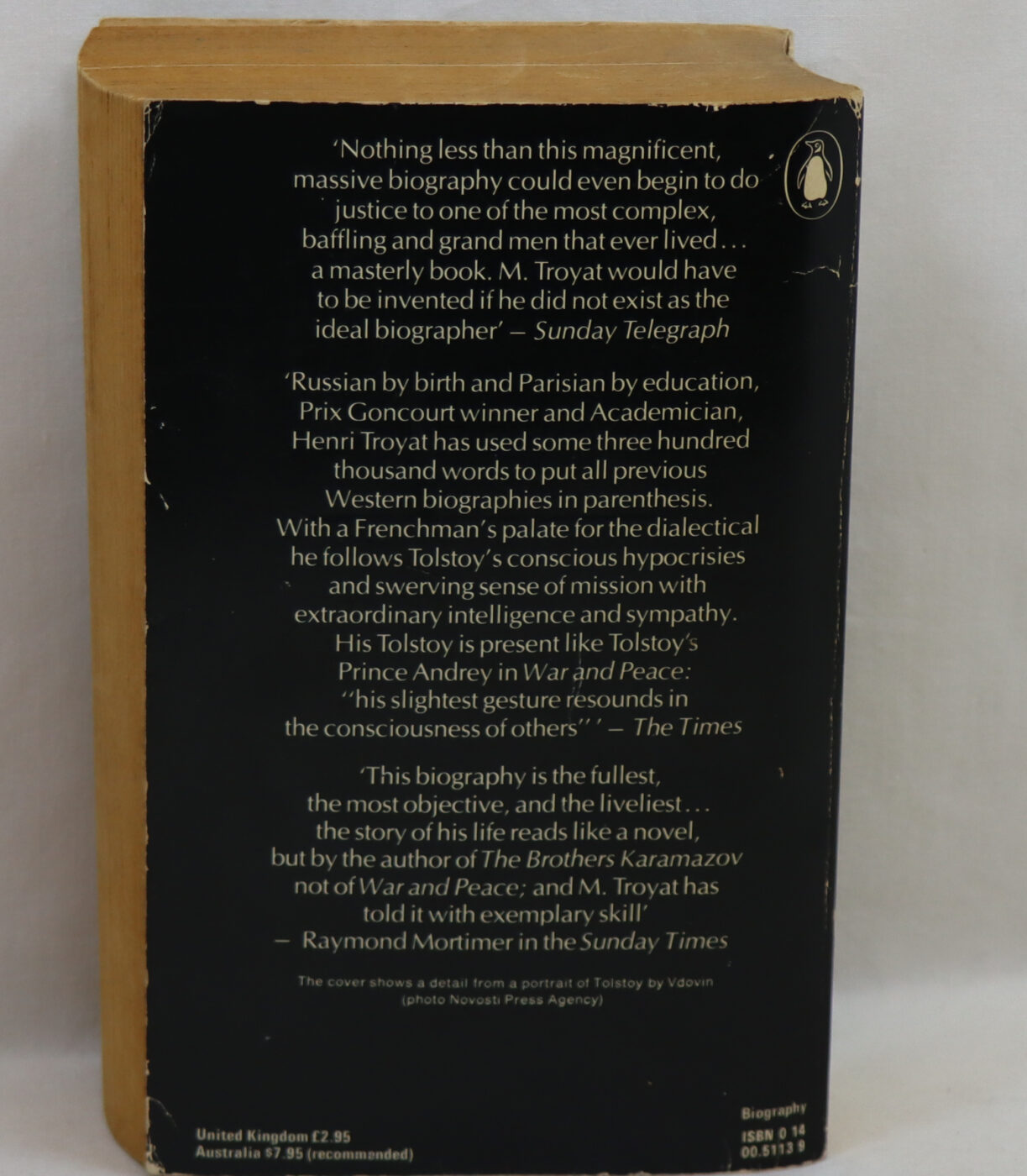
For conditions, please view our photographs. Probably the best writing on Tolstoy, this book is from the library gathered by the famous Cambridge Don, computer scientist, food and wine connoisseur, Jack Arnold LANG.
In this definitive portrait of one of the greatest novelists of all time, Leo Tolstoy embodies the most extraordinary contradictions. He was a wealthy aristocrat who preached the virtues of poverty and the peasant life, a misogynist who wrote Anna Karenina, and a supreme writer who declared: “Literature is rubbish.” Yet his titanic personality and the astonishing range of his talents and interests made him, as an author and as a strange self-proclaimed prophet, one of the undisputed literary giants of the nineteenth century. From his famously bad marriage to his enormously successful career, Troyat presents a brilliant portrait that reads like an epic novel written by Tolstoy himself.
Count Lev Nikolayevich Tolstoy (9 September [O.S. 28 August] 1828 – 20 November [O.S. 7 November] 1910), usually referred to in English as Leo Tolstoy, was a Russian writer. He is regarded as one of the greatest and most influential authors of all time. Born to an aristocratic family, Tolstoy achieved acclaim in his twenties with his semi-autobiographical trilogy, Childhood, Boyhood and Youth (1852–1856), and with Sevastopol Sketches (1855), based on his experiences in the Crimean War. His War and Peace (1869), Anna Karenina (1878), and Resurrection (1899), which is based on his “youthful sins,” are often cited as pinnacles of realist fiction and three of the greatest novels ever written. His oeuvre includes short stories such as “Alyosha the Pot” (1911) and “After the Ball” (1911) and novellas such as Family Happiness (1859), The Death of Ivan Ilyich (1886), The Kreutzer Sonata (1889), The Devil (1911), and Hadji Murat (1912). He also wrote plays and essays concerning philosophical, moral and religious themes. In the 1870s, Tolstoy experienced a profound moral crisis, followed by what he regarded as an equally profound spiritual awakening, as outlined in his non-fiction work Confession (1882). His literal interpretation of the ethical teachings of Jesus, centering on the Sermon on the Mount, caused him to become a fervent Christian anarchist and pacifist.His ideas on nonviolent resistance, expressed in such works as The Kingdom of God Is Within You (1894), had a profound impact on such pivotal 20th-century figures as Mahatma Gandhi, Ludwig Wittgenstein, Martin Luther King Jr., and James Bevel. He also became a dedicated advocate of Georgism, the economic philosophy of Henry George, which he incorporated into his writing, particularly in his novel Resurrection (1899). Tolstoy received praise from countless authors and critics, both during his lifetime and after. Virginia Woolf called Tolstoy “the greatest of all novelists”, and Gary Saul Morson referred to War and Peace as the greatest of all novels. He received nominations for the Nobel Prize in Literature every year from 1902 to 1906 and for the Nobel Peace Prize in 1901, 1902, and 1909. Tolstoy never being awarded a Nobel Prize remains a major Nobel Prize controversy.
Henri Troyat (born Lev Aslanovich Tarasov; 1 November, 1911 – 2 March 2007) was a Russian-French writer, biographer, historian, and novelist. Lev Aslanovich Tarasov (Russian: Лев Асланович Тарасов, Lev Aslanovich Tarasov) was born in Moscow to parents of Armenian heritage. In his autobiography, he states that his surname is Armenian (Torossian). His family fled Russia after the outbreak of the revolution. After a long exodus taking them to the Caucasus on to Crimea and later by sea to Istanbul and then Venice, the family finally settled in Paris in 1920, where young Troyat was schooled and later earned a law degree. The stirring and tragic events of this flight across half of Europe are vividly recounted by Troyat in Tant que la terre durera (While the earth lasts). Troyat received his first literary award, Le prix du roman populaire, at the age of twenty-four, and by twenty-seven, he was awarded the Prix Goncourt. He published more than 100 books, novels and biographies, among them those of Anton Chekhov, Catherine the Great, Rasputin, Fyodor Dostoyevsky, Ivan the Terrible and Leo Tolstoy. Troyat’s best-known work is La neige en deuil (The snow in mourning), which was adapted as an English-language film in 1956 under the title The Mountain. Troyat was elected as a member of the Académie Française in 1959. At the time of his death, he was the longest-serving member.
Want to know more about this item?
We are happy to answer any questions you may have about this item. In addition, it is also possible to request more photographs if there is something specific you want illustrated.
Ask a question
Share this Page with a friend
