
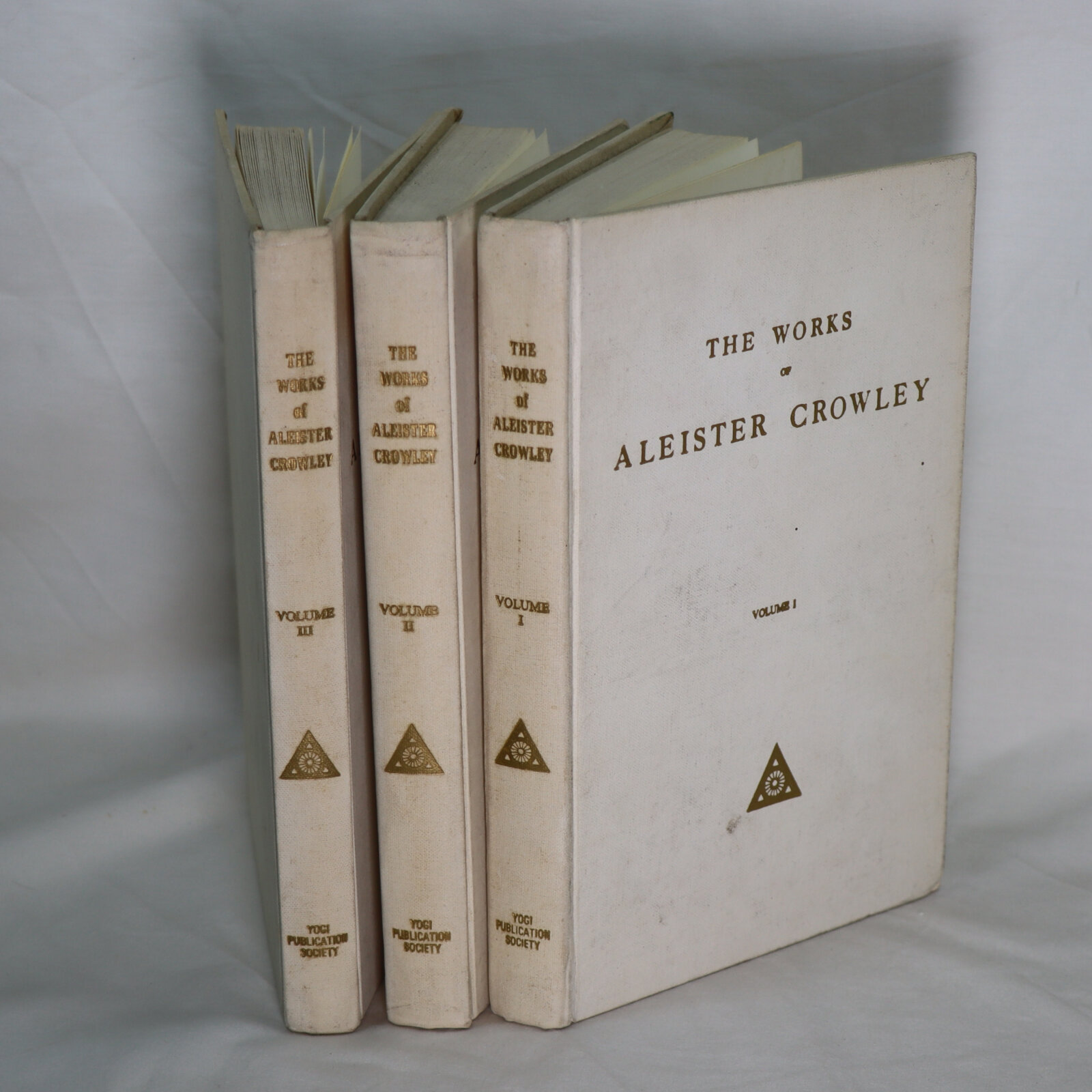
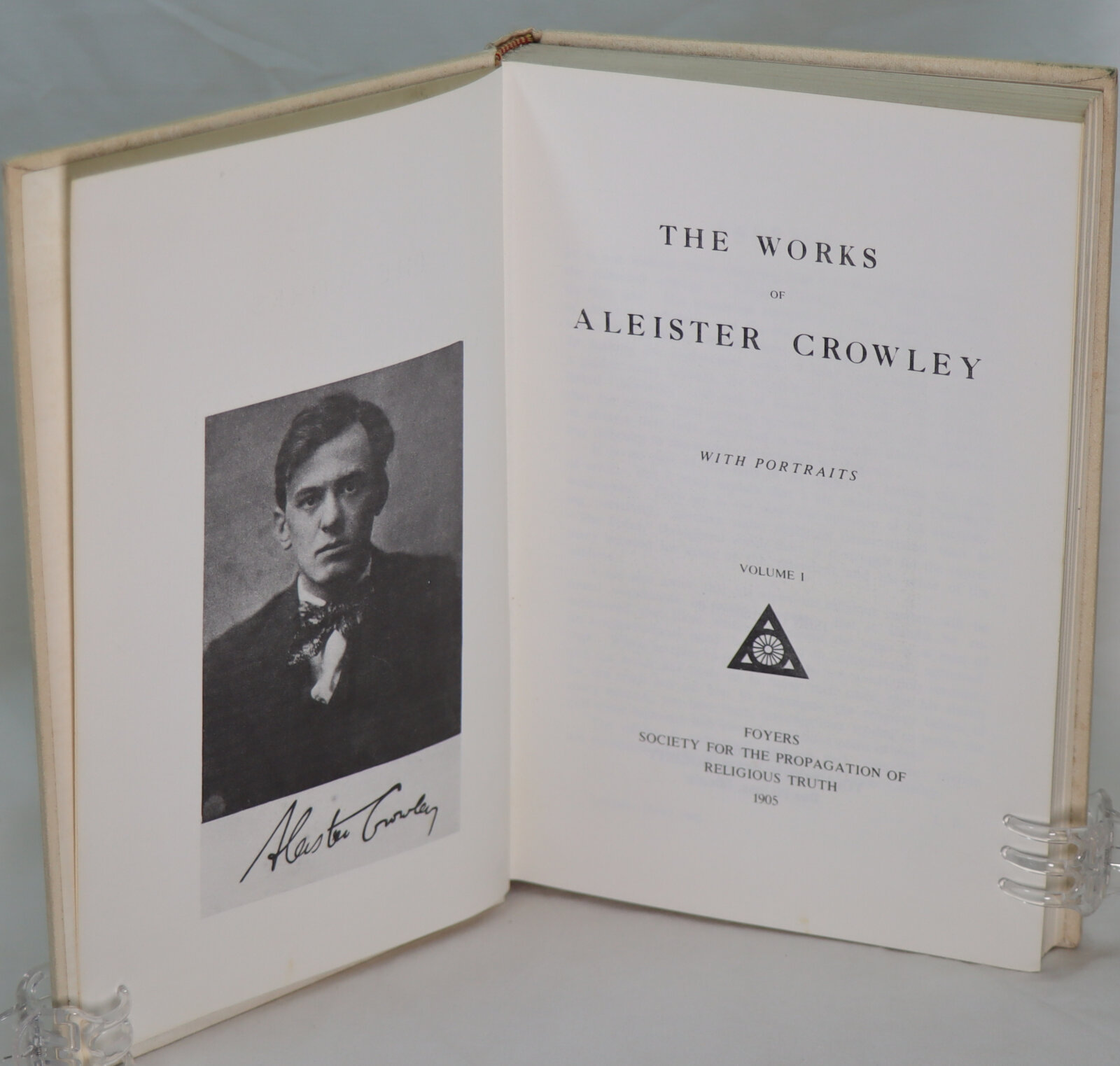
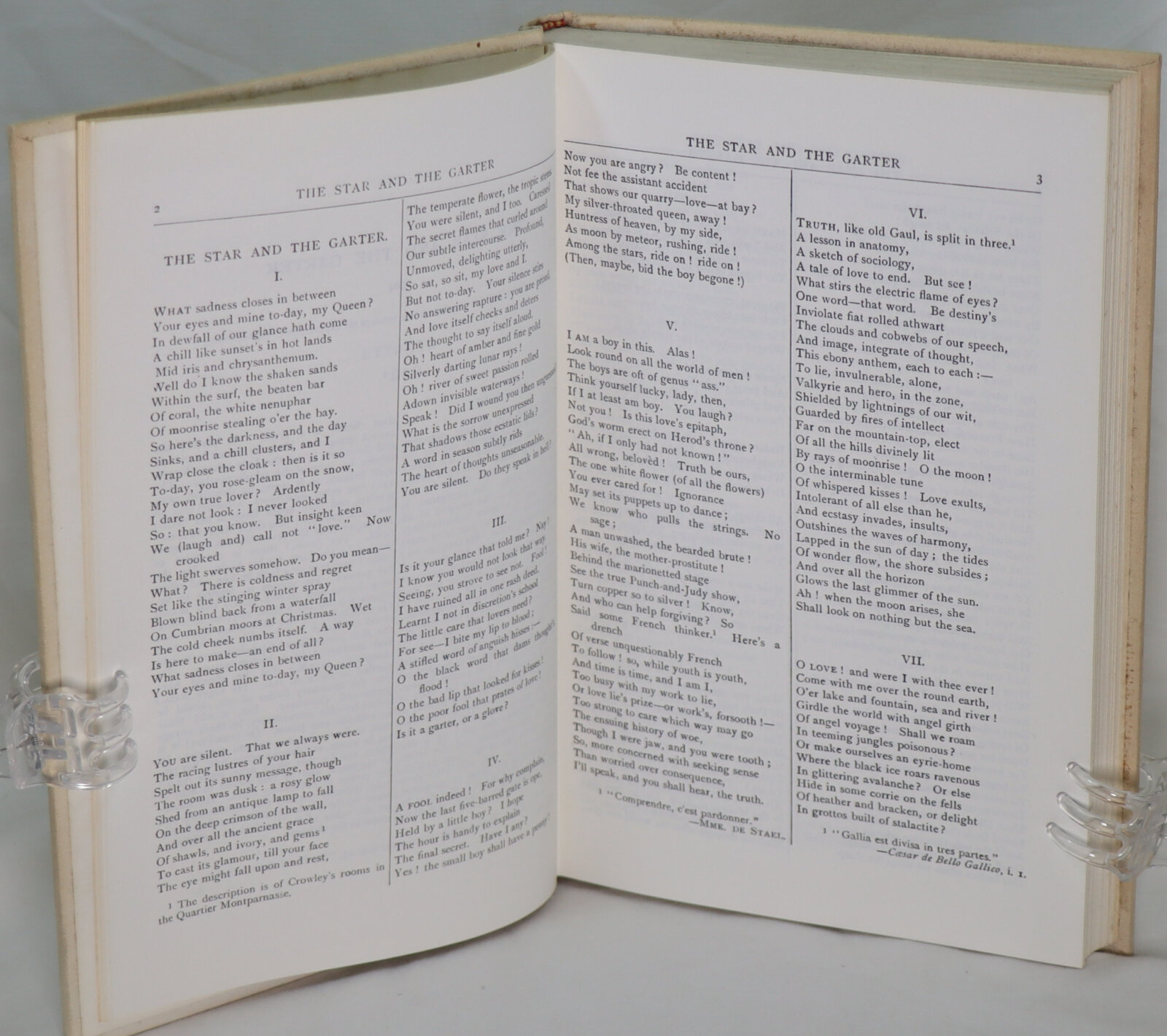
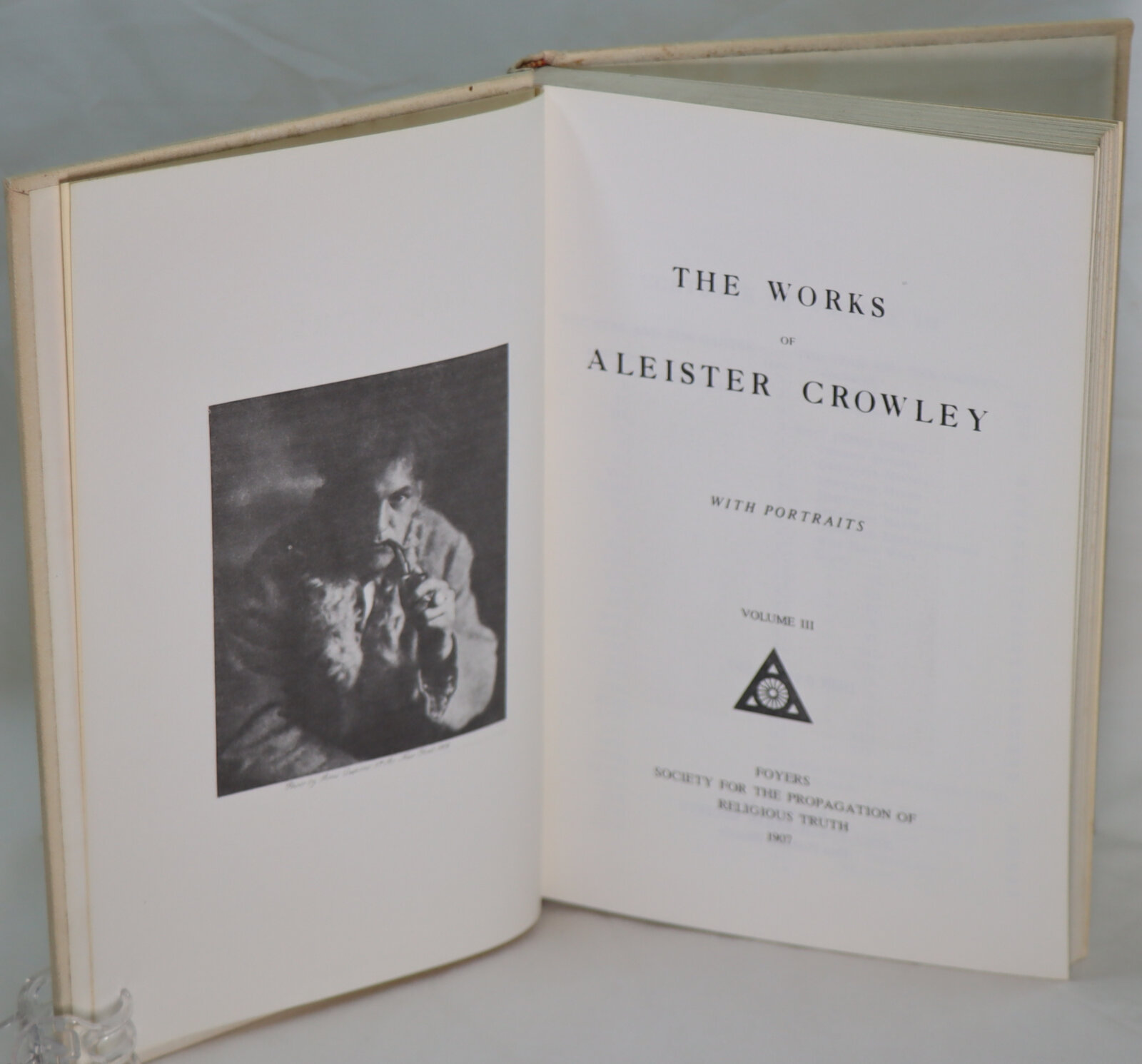
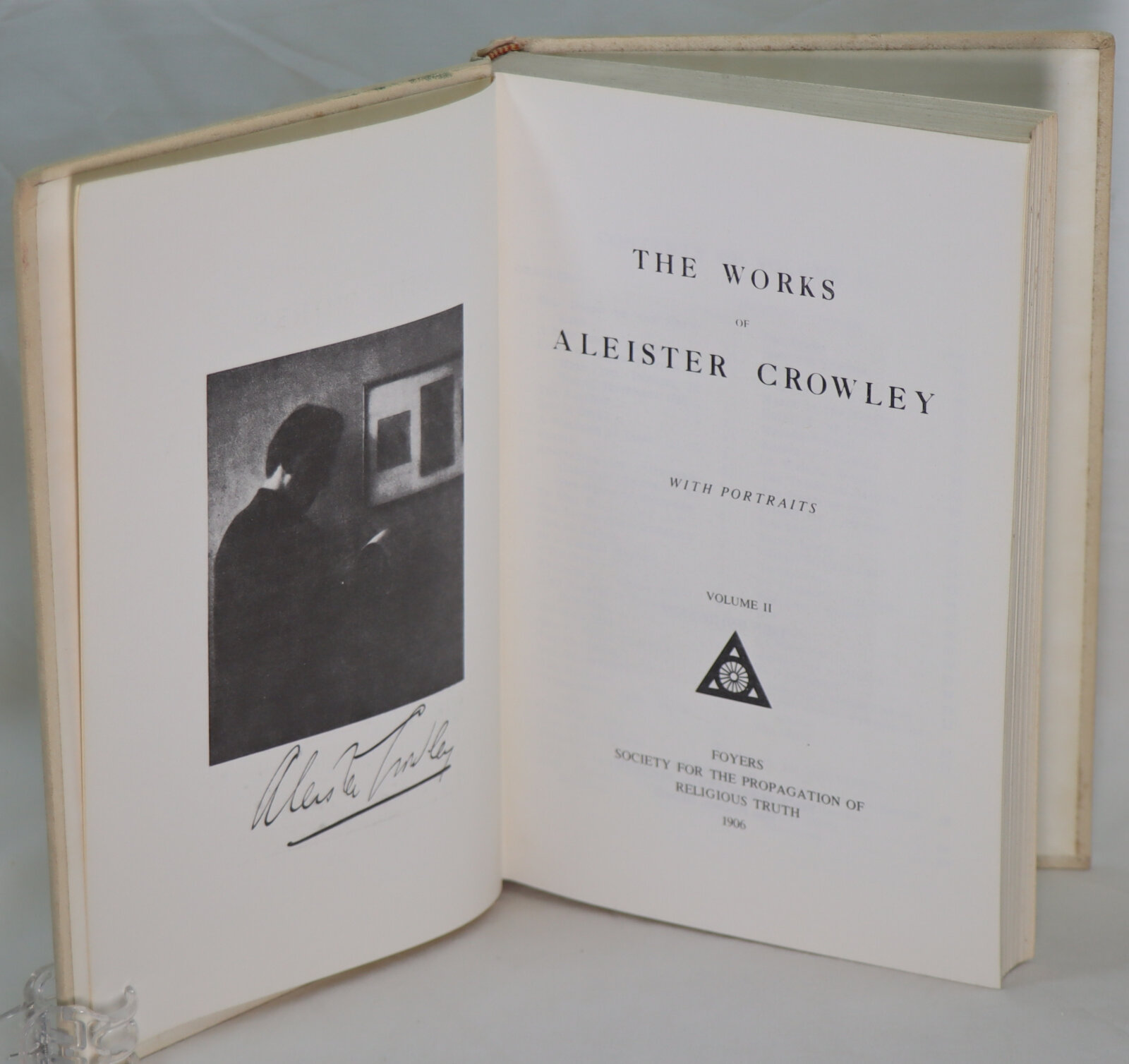
The Works of Aleister Crowley. Volumes I,II & III.
By Aleister Crowley
Printed: 1905-1907
Publisher: Foyers. Society for the Propagation of Religious Truth.
| Dimensions | 15 × 21 × 2 cm |
|---|---|
| Language |
Language: English
Size (cminches): 15 x 21 x 2
Condition: Fine (See explanation of ratings)
THIS ITEM WILL BE AVAILABLE SOON
SORRY, THIS ITEM HAS SOLD
Item information
Description
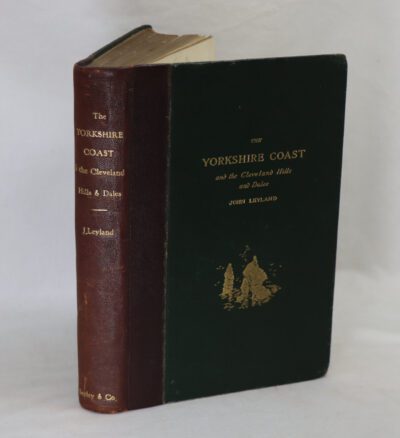
Cream cloth binding with gilt title on the spine and front board. Dimensions are for one volume.
-
F.B.A. provides an in-depth photographic presentation of this item to stimulate your feeling and touch. More traditional book descriptions are immediately available.
-
‘Oft described as a Black Magic Masterpiece’
Published as a full reprint by Yogi Publication Society in 1970 of the original early 20th century banned edition, this copy has become extremely rare in its own right.

Aleister Crowley (born Edward Alexander Crowley; 12 October 1875 – 1 December 1947) was an English occultist, philosopher, ceremonial magician, poet, painter, novelist and mountaineer. He founded the religion of Thelema, identifying himself as the prophet entrusted with guiding humanity into the Æon of Horus in the early 20th century. A prolific writer, he published widely over the course of his life.
Born to a wealthy family in Royal Leamington Spa, Warwickshire, Crowley rejected his parents’ fundamentalist Christian Plymouth Brethren faith to pursue an interest in Western esotericism. He was educated at Trinity College at the University of Cambridge, where he focused his attention on mountaineering and poetry, resulting in several publications. Some biographers allege that here he was recruited into a British intelligence agency, further suggesting that he remained a spy throughout his life. In 1898, he joined the esoteric Hermetic Order of the Golden Dawn, where he was trained in ceremonial magic by Samuel Liddell MacGregor Mathers and Allan Bennett. He went mountaineering in Mexico with Oscar Eckenstein, before studying Hindu and Buddhist practices in India. In 1904, he married Rose Edith Kelly and they honeymooned in Cairo, Egypt, where Crowley claimed to have been contacted by a supernatural entity named Aiwass, who provided him with The Book of the Law, a sacred text that served as the basis for Thelema. Announcing the start of the Æon of Horus, The Book declared that its followers should “Do what thou wilt” and seek to align themselves with their True Will through the practice of ceremonial magic.
After the unsuccessful 1905 Kanchenjunga expedition and a visit to India and China, Crowley returned to Britain, where he attracted attention as a prolific author of poetry, novels and occult literature. In 1907, he and George Cecil Jones co-founded an esoteric order, the A∴A∴, through which they propagated Thelema. After spending time in Algeria, in 1912 he was initiated into another esoteric order, the German-based Ordo Templi Orientis (O.T.O.), rising to become the leader of its British branch, which he reformulated in accordance with his Thelemite beliefs. Through the O.T.O., Thelemite groups were established in Britain, Australia and North America. Crowley spent the First World War in the United States, where he took up painting and campaigned for the German war effort against Britain, later revealing that he had infiltrated the pro-German movement to assist the British intelligence services. In 1920, he established the Abbey of Thelema, a religious commune in Cefalù, Sicily where he lived with various followers. His libertine lifestyle led to denunciations in the British press, and the Italian government evicted him in 1923. He divided the following two decades between France, Germany and England, and continued to promote Thelema until his death.
Crowley gained widespread notoriety during his lifetime, being a drug user, bisexual and an individualist social critic. Crowley has remained a highly influential figure over Western esotericism and the counterculture of the 1960s and continues to be considered a prophet in Thelema. He is the subject of various biographies and academic studies.
It is regularly forgotten that ‘magic’ in all its attributes still dwells within the hierarchy of Western Society with explicit examples being no less than the decoration upon the United States dollar and within the bulk of the writings of Sir Isaac Newton.
Below are some general observations on the magic topic:
A grimoire (also known as a “book of spells“, “magic book“, or a “spellbook“) is a textbook of magic, typically including instructions on how to create magical objects like talismans and amulets, how to perform magical spells, charms, and divination, and how to summon or invoke supernatural entities such as angels, spirits, deities, and demons. In many cases, the books themselves are believed to be imbued with magical powers, although in many cultures, other sacred texts that are not grimoires (such as the Bible) have been believed to have supernatural properties intrinsically. The only contents found in a grimoire would be information on spells, rituals, the preparation of magical tools, and lists of ingredients and their magical correspondences. In this manner, while all books on magic could be thought of as grimoires, not all magical books should be thought of as grimoires.
While the term grimoire is originally European—and many Europeans throughout history, particularly ceremonial magicians and cunning folk, have used grimoires—the historian Owen Davies has noted that similar books can be found all around the world, ranging from Jamaica to Sumatra. He also noted that in this sense, the world’s first grimoires were created in Europe and the ancient Near East.
The 18th century saw the rise of the Enlightenment, a movement devoted to science and rationalism, predominantly amongst the ruling classes. However, amongst much of Europe, belief in magic and witchcraft persisted, as did the witch trials in certain areas. Governments tried to crack down on magicians and fortune tellers, particularly in France, where the police viewed them as social pests who took money from the gullible, often in a search for treasure. In doing so, they confiscated many grimoires.
Beginning in the 17th century, a new, ephemeral form of printed literature developed in France; the Bibliothèque bleue. Many grimoires published through this circulated among a growing percentage
of the populace; in particular, the Grand Albert, the Petit Albert (1782), the Grimoire du Pape Honorius, and the Enchiridion Leonis Papae. The Petit Albert contained a wide variety of magic; for instance, dealing in simple charms for ailments, along with more complex things, such as the instructions for making a Hand of Glory.
In the late 18th and early 19th centuries, following the French Revolution of 1789, a hugely influential grimoire was published under the title of the Grand Grimoire, which was considered particularly powerful, because it involved conjuring and making a pact with the devil’s chief minister, Lucifugé Rofocale, to gain wealth from him. A new version of this grimoire was later published under the title of the Dragon rouge and was available for sale in many Parisian bookstores. Similar books published in France at this time included the Black Pullet and the Grimoirium Verum. The Black Pullet, probably authored in late-18th-century Rome or France, differs from the typical grimoires in that it does not claim to be a manuscript from antiquity, but told by a man who was a member of Napoleon’s armed expeditionary forces in Egypt.
The widespread availability of printed grimoires in France—despite the opposition of both the rationalists and the church—soon spread to neighbouring countries, such as Spain and Germany. In Switzerland, Geneva was commonly associated with the occult at the time, particularly by Catholics, because it had been a stronghold of Protestantism. Many of those interested in the esoteric traveled from Roman Catholic nations to Switzerland to purchase grimoires or to study with occultists. Soon, grimoires appeared that involved Catholic saints; one example that appeared during the 19th century, and became relatively popular—particularly in Spain—was the Libro de San Cipriano, or The Book of St. Ciprian, which falsely claimed to date from c. 1000. As with most grimoires of this period, it dealt with (among other things) how to discover treasure.
In Germany, with the increased interest in folklore during the 19th century, many historians took an interest in magic and in grimoires. Several published extracts of such grimoires in their own books on the history of
magic, thereby helping to further propagate them. Perhaps the most notable of these was the Protestant pastor Georg Conrad Horst (1779–1832) who, from 1821 to 1826, published a six-volume collection of magical texts in which he studied grimoires as a peculiarity of the Medieval mindset.
Another scholar of the time interested in grimoires, the antiquarian bookseller Johann Scheible first published the Sixth and Seventh Books of Moses; two influential magical texts that claimed to have been written by the ancient Jewish figure Moses. The Sixth and Seventh Books of Moses were among the works which later spread to the countries of Scandinavia, where—in Danish and Swedish—grimoires were known as black books and were commonly found among members of the army.
In Britain, new grimoires continued to be produced throughout the 18th century, such as Ebenezer Sibly’s A New and Complete Illustration of the Celestial Science of Astrology. In the last decades of that century, London experienced a revival of interest in the occult which was further propagated by Francis Barrett’s publication of The Magus in 1801. The Magus contained many things taken from older grimoires—particularly those of Cornelius Agrippa—and, while not achieving initial popularity upon release, it gradually became an influential text.
One of Barrett’s pupils, John Parkin, created his own handwritten grimoire The Grand Oracle of Heaven, or, The Art of Divine Magic, although it was never published, largely because Britain was at war with France, and grimoires were commonly associated with the French. The only writer to publish British grimoires widely in the early 19th century was Robert Cross Smith, who released The Philosophical Merlin (1822) and The Astrologer of the Nineteenth Century (1825), but neither sold well.
In the late 19th century, several of these texts (including The Book of Abramelin and the Key of Solomon) were reclaimed by para-Masonic magical organisations, such as the Hermetic Order of the Golden Dawn and Ordo Templi Orientis.
Magic publications are books and periodicals which are created on the subject of magic. They include reviews of new equipment and techniques, announcements of upcoming events, interviews with prominent magicians, announcements of awards, and columns on such subjects as the history and ethics of the art of magic. Most also feature various explanations and ideas pertaining to magic tricks/effects. Additionally, you can commonly advertise for businesses and events with little charge.
Black magic has traditionally referred to the use of supernatural powers or magic for evil and selfish purposes.
The links and interaction between black magic and religion are many and varied. Beyond black magic’s historical persecution by Christianity and its inquisitions, there are links between religious and black magic rituals. For example, 17th-century priest Étienne Guibourg is said to have performed a series of Black Mass rituals with alleged witch Catherine Monvoisin for Madame de Montespan. During his period of scholarship, A. E. Waite provided a comprehensive account of black magic practices, rituals and traditions in The Book of Ceremonial Magic (1911).
The influence of popular culture has allowed other practices to be drawn in under the broad banner of black magic, including the concept of Satanism. While the invocation of demons or spirits is an accepted part of black magic, this practice is distinct from the worship or deification of such spiritual beings. The two are usually combined in medieval beliefs about witchcraft.’
Condition notes
Binding slightily faded
Want to know more about this item?
We are happy to answer any questions you may have about this item. In addition, it is also possible to request more photographs if there is something specific you want illustrated.
Ask a question
Related products



Share this Page with a friend
