
The Water Babies.
By Charles Kingsley
Printed: 1908
Publisher: J M Dent & Co. London
| Dimensions | 16 × 20 × 4.5 cm |
|---|---|
| Language |
Language: English
Size (cminches): 16 x 20 x 4.5
Condition: Very good (See explanation of ratings)
£355.00
FREE shipping
Buy Now



Item information
Description
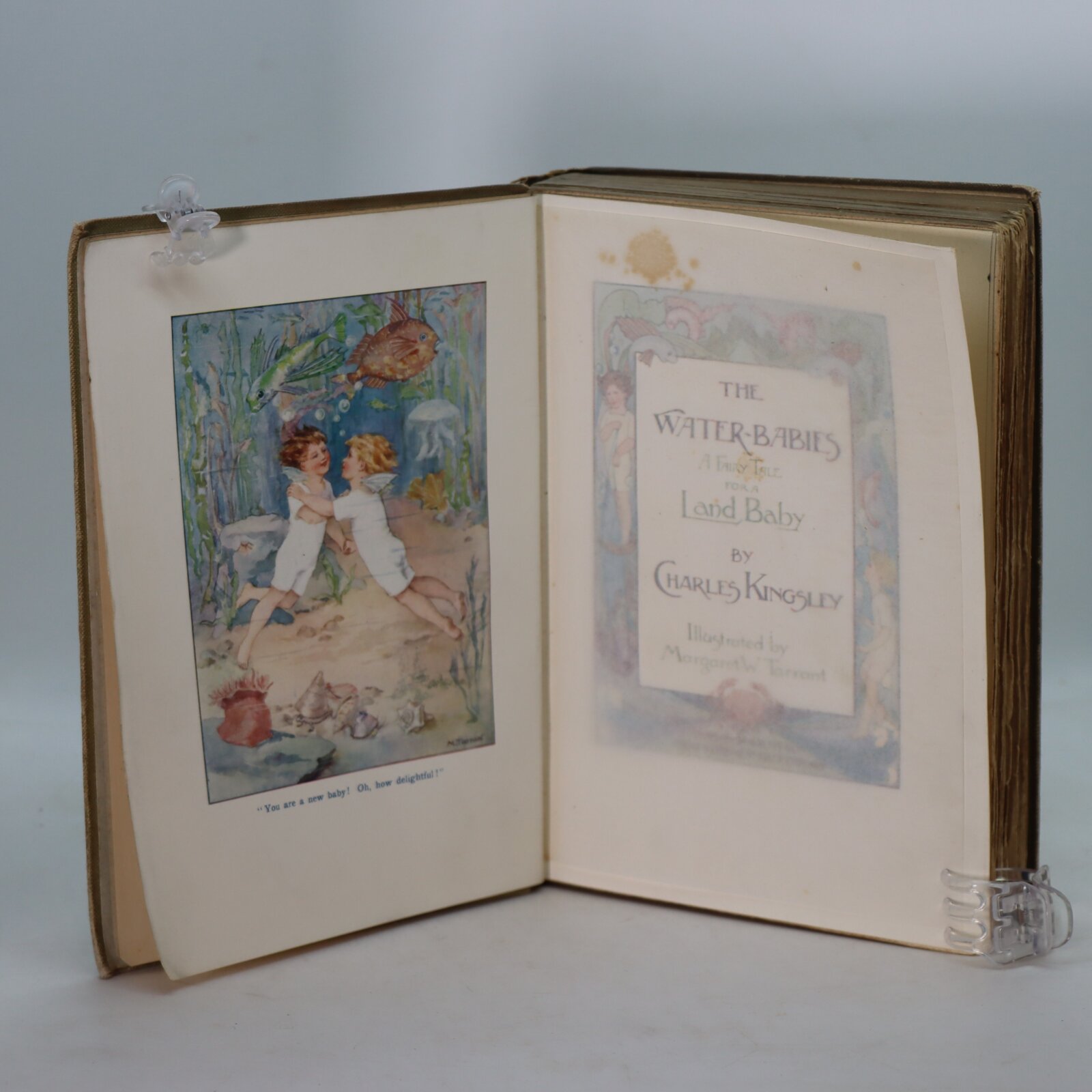
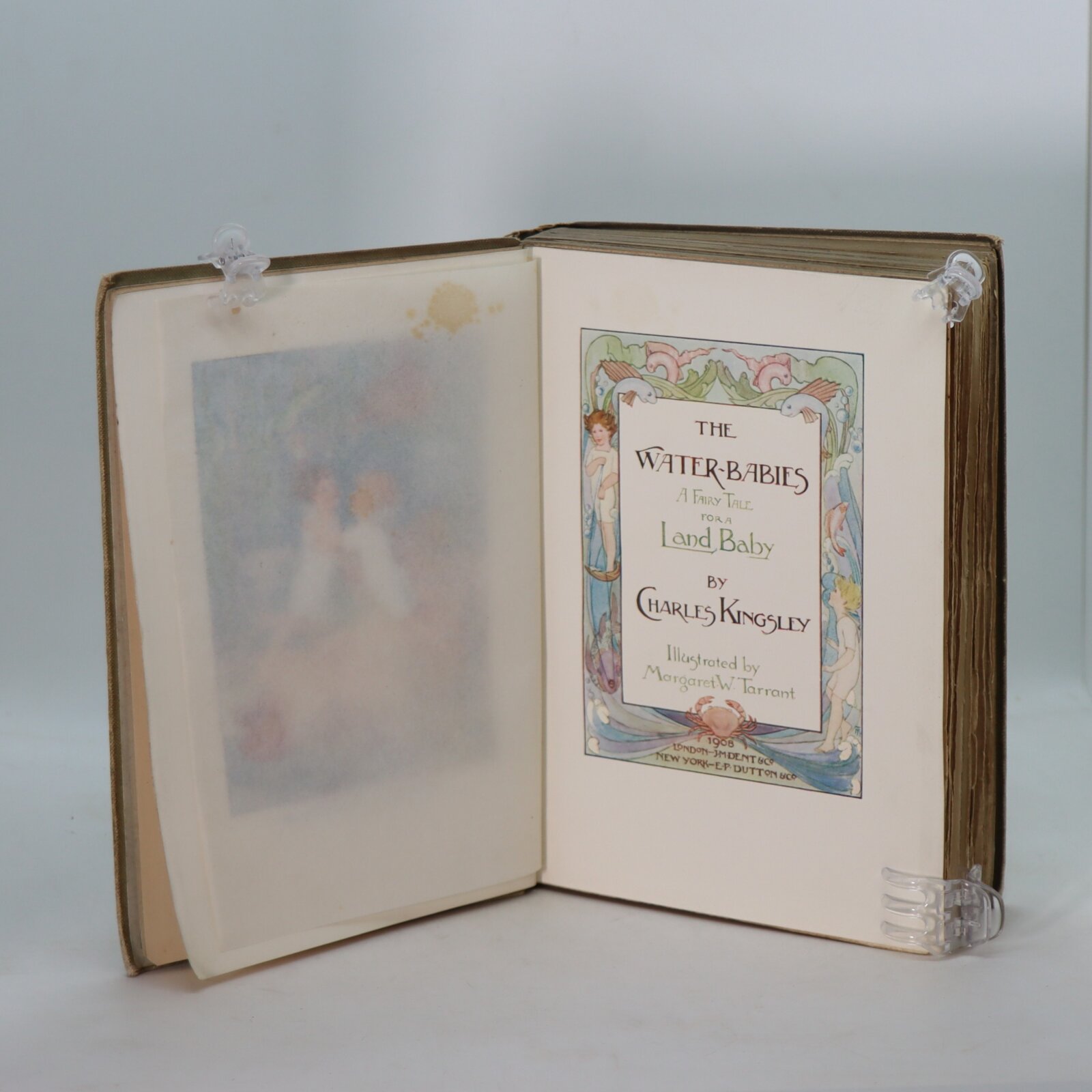
Beige cloth binding with title and coloured child pictures on the front board. Similar on the spine.
F.B.A. provides an in-depth photographic presentation of this item to stimulate your feel and touch. More traditional book descriptions are immediately available
This edition has unique colour illustrations by Margaret Winifred Tarrant
The Water-Babies, A Fairy Tale for a Land Baby is a children’s novel by Charles Kingsley. Written in 1862–63 as a serial for Macmillan’s Magazine, it was first published in its entirety in 1863. It was written as part satire in support of Charles Darwin’s On The Origin of Species. The book was extremely popular in the United Kingdom and was a mainstay of British children’s literature for many decades, but eventually fell out of favour in America in part due to its claimed prejudices against Irish, Jews, Catholics and Americans.
The story: The protagonist is Tom, a young chimney sweep, who falls into a river after encountering an upper-class girl named Ellie and being chased out of her house. There he appears to drown and is transformed into a “water-baby”, as he is told by a caddisfly—an insect that sheds its skin—and begins his moral education. The story is thematically concerned with Christian redemption, though Kingsley also uses the book to argue that England treats its poor badly, and to question child labour, among other themes.
Tom embarks on a series of adventures and lessons, and enjoys the community of other water-babies on Saint Brendan’s Island once he proves himself a moral creature. The major spiritual leaders in his new world are the fairies Mrs. Doasyouwouldbedoneby (a reference to the Golden Rule), Mrs. Bedonebyasyoudid, and Mother Carey. Weekly, Tom is allowed the company of Ellie, who became a water-baby after he did.
Grimes, his old master, drowns as well, and in his final adventure, Tom travels to the end of the world to attempt to help the man where he is being punished for his misdeeds. Tom helps Grimes to find repentance, and Grimes will be given a second chance if he can successfully perform a final penance. By proving his willingness to do things he does not like, if they are the right things to do, Tom earns himself a return to human form, and becomes “a great man of science” who “can plan railways, and steam-engines, and electric telegraphs, and rifled guns, and so forth”. He and Ellie are united, although the book states (perhaps jokingly) that they never marry, claiming that in fairy tales, no one beneath the rank of prince and princess ever marries.
The book ends with the caveat that it is only a fairy tale, and the reader is to believe none of it, “even if it is true.”
Charles Kingsley (12 June 1819 – 23 January 1875) was a broad church priest of the Church of England, a university professor, social reformer, historian, novelist and poet. He is particularly associated with Christian socialism, the working men’s college, and forming labour cooperatives, which failed, but encouraged later working reforms. He was a friend and correspondent of Charles Darwin.
Charles Kingsley’s novel Westward Ho! led to the founding of a village by the same name (the only place name in England with an exclamation mark) and inspired the construction of the Bideford, Westward Ho! and Appledore Railway. A hotel in Westward Ho! was named after and opened by him. A hotel which was opened in 1897 in Bloomsbury, London, and named after Kingsley was founded by teetotallers, who admired Kingsley for his political views and his ideas on social reform. It still exists as The Kingsley by Thistle.
In 1905 the composer Cyril Rootham wrote a musical setting of Kingsley’s poem Andromeda. This was performed at the Bristol Music Festival in 1908. Like Kingsley, Rootham had been educated at Bristol Grammar School.
Margaret Winifred Tarrant (19 August 1888 – 29 July 1959) was an English illustrator, and children’s author, specializing in depictions of fairy-like children and religious subjects. She began her career at the age of 20, and painted and published into the early 1950s. She was known for her children’s books, postcards, calendars, and print reproductions.
Condition notes
Binding a bit grubby.
Want to know more about this item?
We are happy to answer any questions you may have about this item. In addition, it is also possible to request more photographs if there is something specific you want illustrated.
Ask a question
Related products



Share this Page with a friend
