
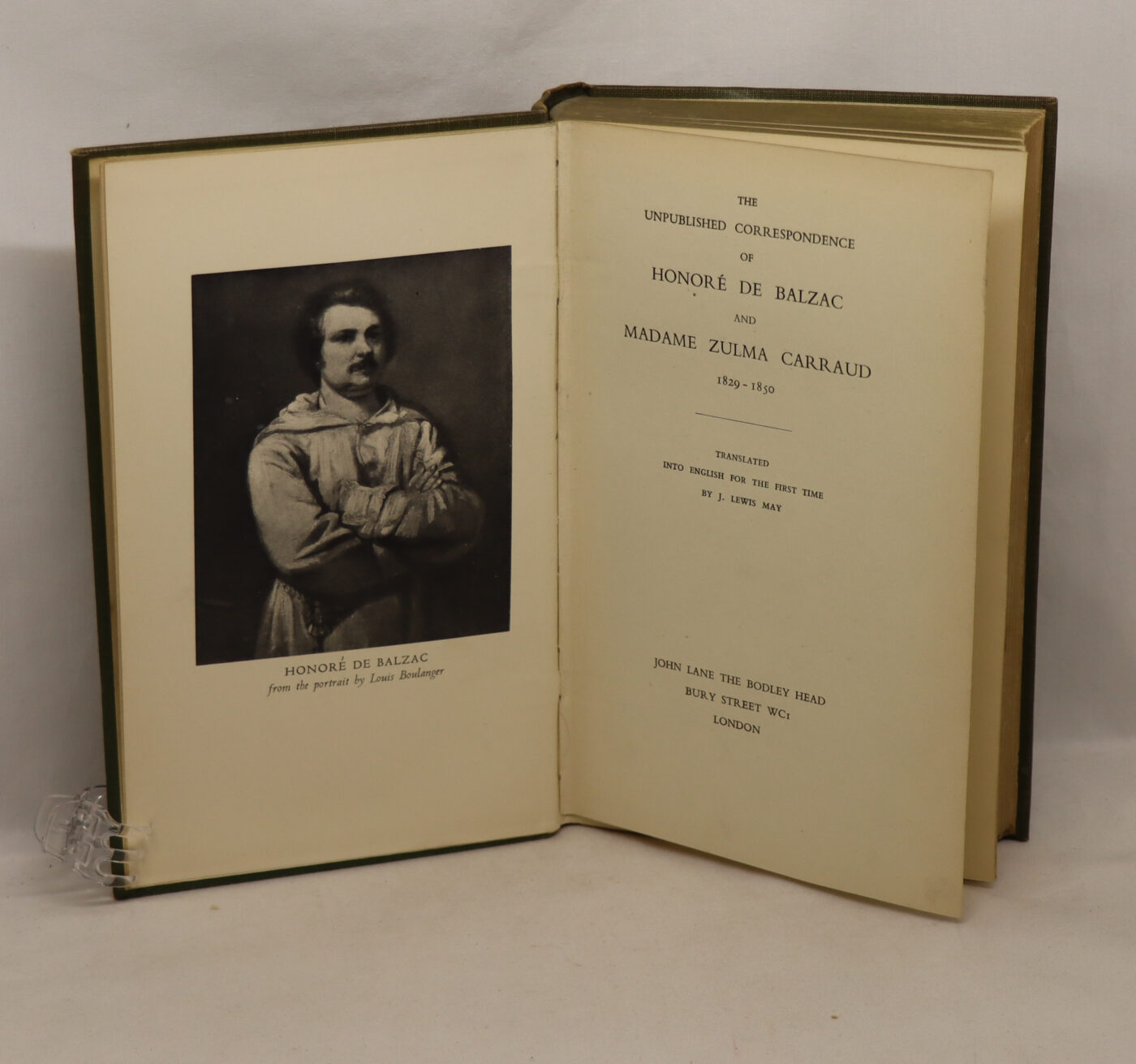
The Unpublished Correspondence of Honore de Balzac and Madame Zulma Carrauld. 1820-1850.
By J Lewis May
Printed: 1937
Publisher: John Lane The Bodley Head. London
Edition: First edition
| Dimensions | 16 × 23 × 4 cm |
|---|---|
| Language |
Language: English
Size (cminches): 16 x 23 x 4
Condition: Very good (See explanation of ratings)
£127.00
Buy Now
Your items

Item information
Description
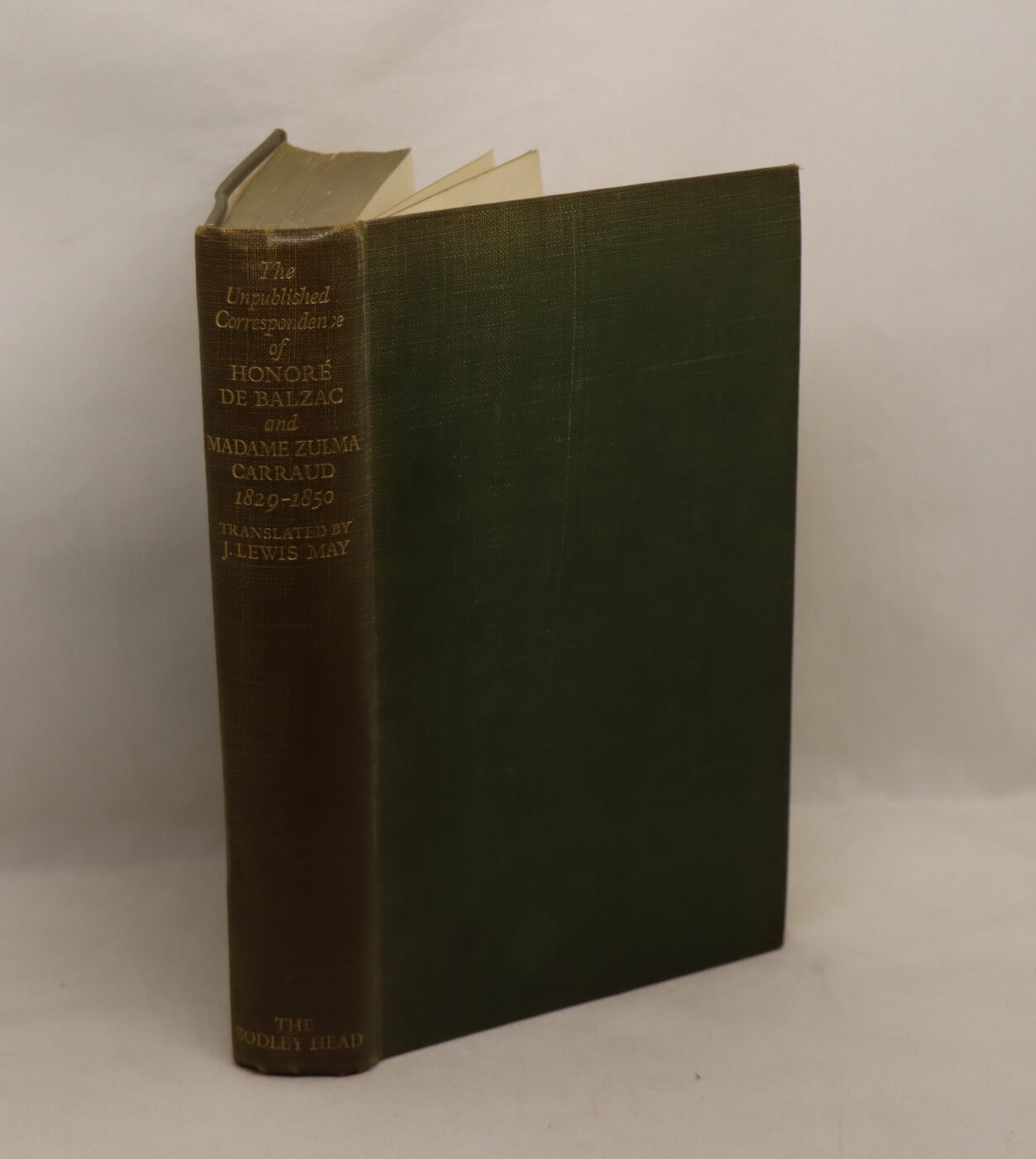
Green cloth binding with gilt title on the spine.
We provide an in-depth photographic presentation of this item to stimulate your feeling and touch. More traditional book descriptions are immediately available
- Note: This book carries a £5.00 discount to those that subscribe to the F.B.A. mailing list
For conditions, please view our photographs. A now rare book from the library gathered by the famous Cambridge Don, computer scientist, food and wine connoisseur, Jack Arnold LANG. This book is a true snapshot in time relating to a different epoch when men and women while equal had a different life role. Most thoughtful and needs to be read.
This formative and quality book was purchased by Jack’s mother: a Cambridge Don who while famous in her own right is now seen as the intellectual power behind her outstanding husband and Jack.
First Edition. Near fine in the original title-blocked cloth. A clean impression. ; 400 pages; Description: xxiii, 400 p. Incl. Facsims. Front. (port. ) 24 cm. Subject: Balzac, Honore de (1799-1850) — correspondence. Carraud, Z. (1796-1889)
Honoré de Balzac (20 May 1799 – 18 August 1850) was a French novelist and playwright. The novel sequence La Comédie humaine, which presents a panorama of post-Napoleonic French life, is generally viewed as his magnum opus. Owing to his keen observation of detail and unfiltered representation of society, Balzac is regarded as one of the founders of realism in European literature. He is renowned for his multi-faceted characters; even his lesser characters are complex, morally ambiguous and fully human. Inanimate objects are imbued with character as well; the city of Paris, a backdrop for much of his writing, takes on many human qualities. His writing influenced many famous writers, including the novelists Émile Zola, Charles Dickens, Marcel Proust, Gustave Flaubert, Henry James and Fyodor Dostoevsky, and filmmakers François Truffaut and Jacques Rivette. Many of Balzac’s works have been made into films and continue to inspire other writers. James called him “really the father of us all.” An enthusiastic reader and independent thinker as a child, Balzac had trouble adapting to the teaching style of his grammar school. His willful nature caused trouble throughout his life and frustrated his ambitions to succeed in the world of business. When he finished school, Balzac was apprenticed in a law office, but he turned his back on the study of law after wearying of its inhumanity and banal routine. Before and during his career as a writer, he attempted to be a publisher, printer, businessman, critic, and politician; he failed in all of these efforts. La Comédie humaine reflects his real-life difficulties, and includes scenes from his own experience. Balzac suffered from health problems throughout his life, possibly owing to his intense writing schedule. His relationship with his family was often strained by financial and personal drama, and he lost more than one friend over critical reviews. In 1850, Balzac married Ewelina Hańska (née Contessa Rzewuska), a Polish aristocrat and his longtime love. He died in Paris six months later.
Zulma Carraud (24 March 1796 – 24 April 1889) was a French author. She is best known for her children’s books and textbooks particularly La Petite Jeanne ou le devoir and Maurice ou le travail. Carraud was born on 24 March 1796 in Issoudun. She attended a boarding school where she met Laure de Balzac and through her, Honoré de Balzac, both of whom she remained lifelong friends with. She married her second cousin François Michel Carraud, who was 15 years her senior, in 1816. They had two children, Ivan and Yorick. They moved to Nohant to live with her brother due to financial troubles in the 1850s. Carraud died in Paris on 24 April 1889 at the age of 93.
Career: After moving to Nohant, Carraud volunteered as a country doctor and as a teacher at a rural school from 1852 until 1868. She began writing books and textbooks for children in rural areas after struggling to get proper books while she was a teacher. She wrote books aimed specifically at children from peasant families and their parents and was one of the first children’s authors to focus on main characters that were not from noble, bourgeois or working-class families. Her first book, La Petite Jeanne ou le devoir was published in 1852 and was aimed at girls. Her second book, aimed at boys, was called Maurice ou le travail and was published in 1853. Both were sold across France and were endorsed by the Minister of Public Instruction and Beaux-Arts and by the Archbishop of Paris. Between 1864 and 1920, both books sold over 400,000 copies and were used in many schools to teach children from rural backgrounds both reading and middle-class values with clearly defined gender roles.
Want to know more about this item?
We are happy to answer any questions you may have about this item. In addition, it is also possible to request more photographs if there is something specific you want illustrated.
Ask a question
Related products
Share this Page with a friend
