
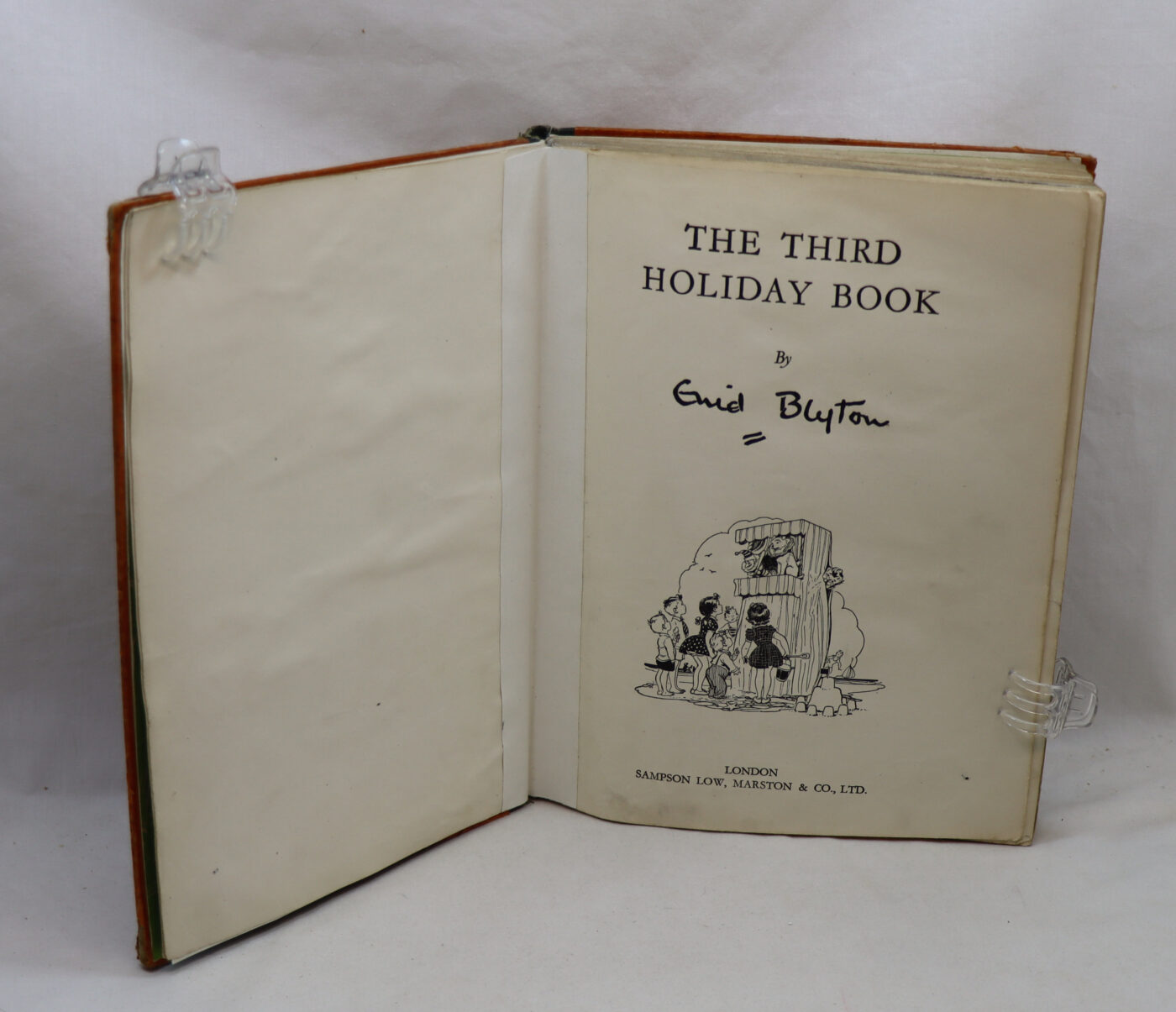
The Third Holiday Book. Enid Blyton.
By Enid Blyton
Printed: 1948
Publisher: Sampson Low Marston & Co. London
| Dimensions | 20 × 25 × 3 cm |
|---|---|
| Language |
Language: English
Size (cminches): 20 x 25 x 3
Condition: Fair (See explanation of ratings)
£44.00
Buy Now

Item information
Description
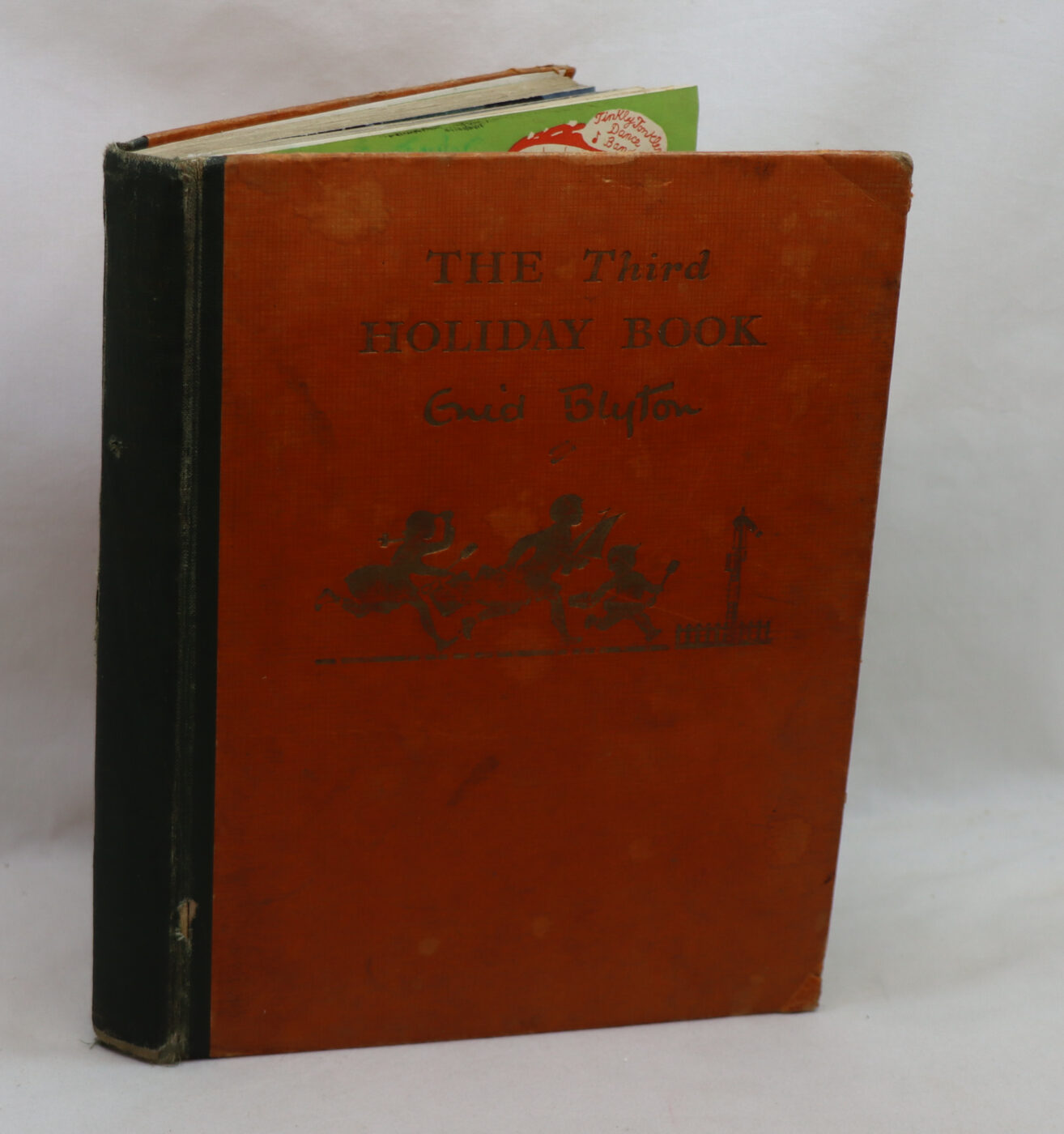
Orange board binding with gilt title on the front board and green cloth spine. Repaired.
We provide an in-depth photographic presentation of this item to stimulate your feeling and touch. More traditional book descriptions are immediately available
-
Note: This book carries a £5.00 discount to those that subscribe to the F.B.A. mailing list
Without doubt this is one of Enid’s more popular books which proved to be a child’s favourite.
Hardback. No dustwrapper. Orange boards with green cloth spine in Fair condition. Gilt lettering to front together with a gilt embossed scene of three children with spades in their hands running by a railway line and showing the signal. 192 Pages.
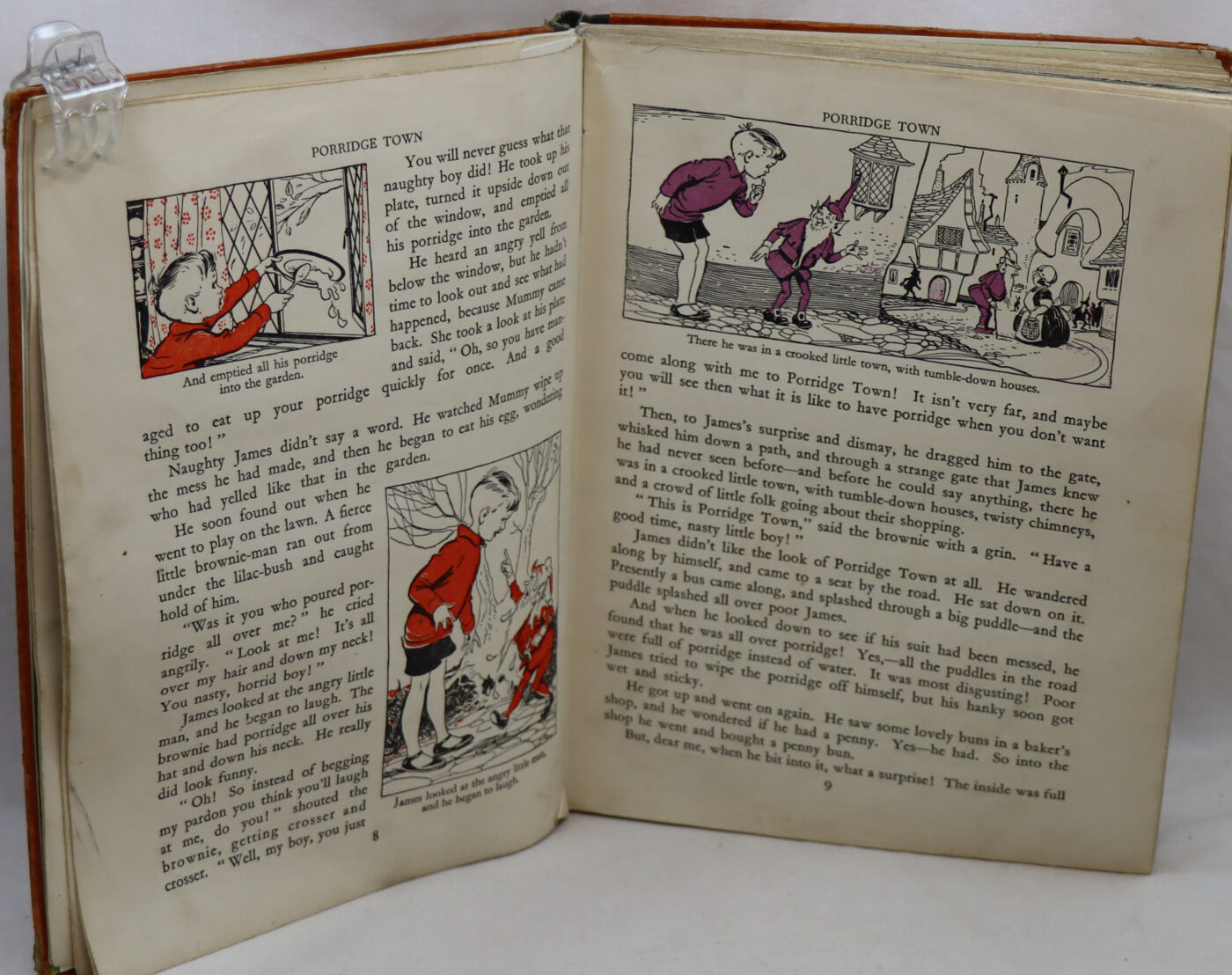
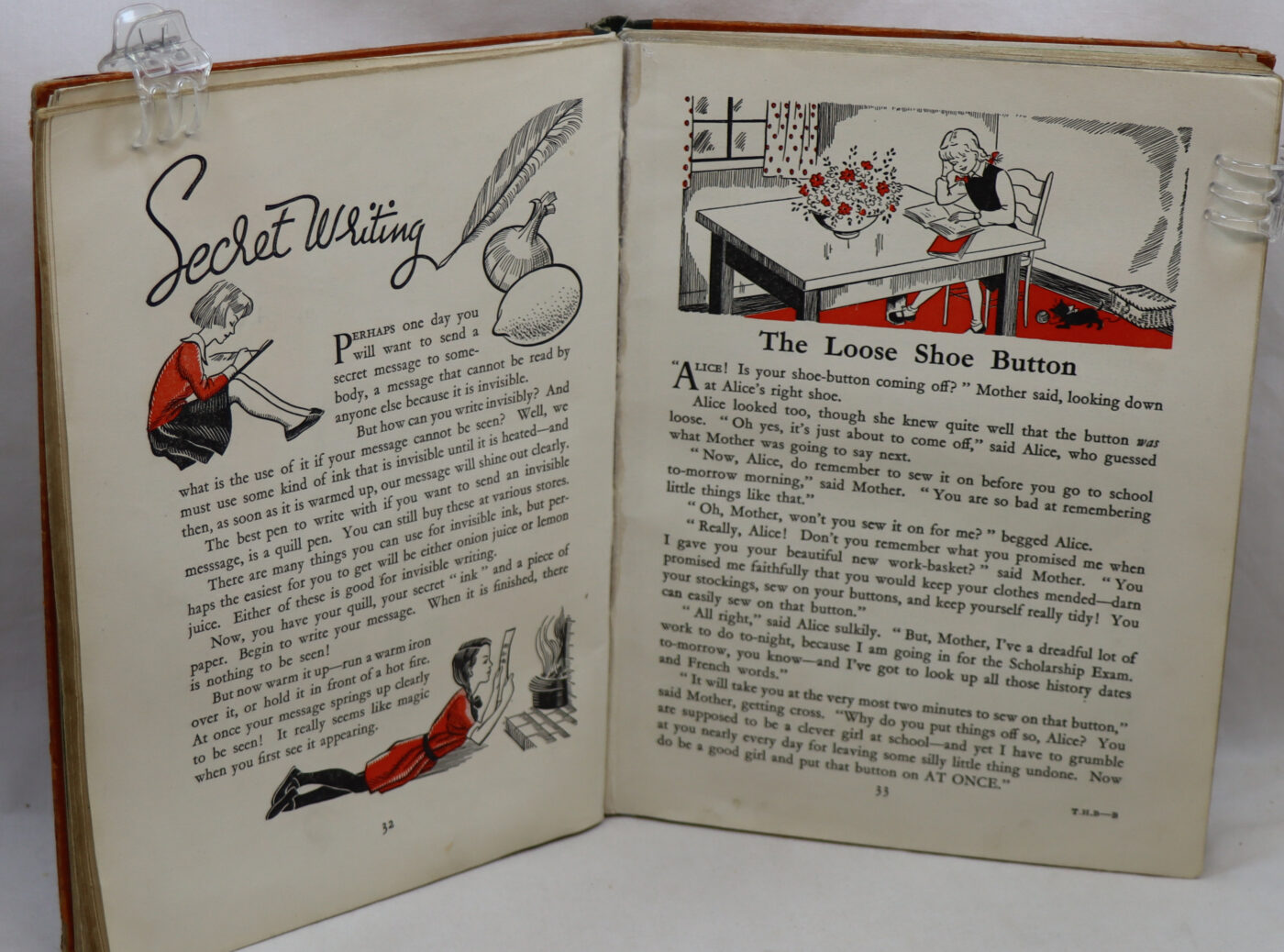
This was the third in a twelve volume series, this one containing 29 stories by Enid Blyton illustrated by Hilda Boswell, Eileen Soper and others
Enid Mary Blyton (11 August 1897 – 28 November 1968) was an English children’s writer. She is one of the best selling and most prolific writers of all time, particularly in the realm of children’s literature. Blyton’s books have been worldwide bestsellers since the 1930s, selling more than 600 million copies, and have been translated into ninety languages. As of June 2019, Blyton was the fourth-most translated author. She wrote on a wide range of topics, including education, natural history, fantasy, mystery, and biblical narratives. She is best remembered for her Noddy, Famous Five, Secret Seven, the Five Find-Outers, and Malory Towers books, although she also wrote many others, including St. Clare’s, The Naughtiest Girl, and The Faraway Tree series.
Her first book, Child Whispers, a 24-page collection of poems, was published in 1922. Following the commercial success of her early novels, such as Adventures of the Wishing-Chair (1937) and The Enchanted Wood (1939), Blyton went on to build a literary empire, sometimes producing fifty books a year in addition to her prolific magazine and newspaper contributions. Her writing was unplanned and sprang largely from her unconscious mind; she typed her stories as events unfolded before her. The sheer volume of her work and the speed with which she produced it led to rumours that Blyton employed an army of ghost writers, a charge she vehemently denied.
Blyton’s work became increasingly controversial among literary critics, teachers, and parents beginning in the 1950s due to the alleged unchallenging nature of her writing and her themes, particularly in the Noddy series. Some libraries and schools banned her works, and from the 1930s until the 1950s, the BBC refused to broadcast her stories because of their perceived lack of literary merit. Her books have been criticised as elitist, sexist, racist, xenophobic, and at odds with the more progressive environment that was emerging in post-World War II Britain, but updated versions of her books have continued to be popular since her death in 1968.
She felt she had a responsibility to provide her readers with a strong moral framework, so she encouraged them to support worthy causes. In particular, through the clubs she set up or supported, she encouraged and organised them to raise funds for animal and paediatric charities. The story of Blyton’s life was dramatised in Enid, a BBC television film featuring Helena Bonham Carter in the title role. It was first broadcast in the UK on BBC Four in 2009.
Blyton’s daily routine varied little over the years. She usually began writing soon after breakfast, with her portable typewriter on her knee and her favourite red Moroccan shawl nearby; she believed that the colour red acted as a “mental stimulus” for her. Stopping only for a short lunch break, she continued writing until five o’clock, by which time she would usually have produced 6,000–10,000 words.
Hilda Boswell (1903–1976) was a British illustrator and writer of children’s books. She was born in London in 1903, the daughter of an architect, and studied at Hornsey School of Art and Regent Street Polytechnic. Her preferred medium was watercolour, and she admired the work of Beatrix Potter, Kate Greenaway and Arthur Rackham. She took an interest in the countryside, and enjoyed reading and gardening. In the 1930s, Boswell began drawing adventure picture strips for the comics of Amalgamated Press. Her longest running feature was Strongheart, based on the canine film star of the same name. The series had been originated by G W Backhouse in 1927, and Boswell worked on it from 1939, first for the weekly comic Crackers and later for Jingles. Boswell’s first book is believed to be Edward and Gumbo, published in 1943. Amongst her best known works are the dust jackets she produced for Enid Blyton’s “flower” and “holiday” book series during the 1940s and 1950s. Boswell illustrated a popular 1963 edition of Robert Louis Stevenson’s A Child’s Garden of Verses, while her own books included The Little Birthday Horse published in 1950 and Little Crazy Car published in 1965. Hilda Boswell’s Treasury of Nursery Rhymes, published by Collins in 1960, was the first in her “treasury” series of titles, which also included a Treasury of Fairy Tales and a Treasury of Poetry. Hilda Boswell died in London in 1976.
NOTE: This is an original book from the library gathered by the famous Cambridge Don, computer scientist, food and wine connoisseur, Jack Arnold LANG. Note: Jack founded the Michelin Guide ‘Midsummer House’- Cambridge’s paramount restaurant. This dining experience is hidden amongst the grassy pastures and grazing cattle of Midsummer Common and perched on the banks of the River Cam.
In 2008, Jack was one of the co-founders of the Raspberry Pi Foundation, alongside other members of the Department, and acted as the Foundation’s Chair. The project’s original goals were modest: to build and distribute low-cost computers for prospective applicants to our Computer Science degree. Initially the project was a “success disaster”, as Jack would say, as demand far outstripped the low-scale manufacturing plans. Ultimately the Raspberry Pi became the UK’s most successful computer with more than 60 million sold to date. Jack was drawn to the educational possibilities of the Raspberry Pi, its potential uses in emerging economies and the way it could support self-directed learning.
Condition notes
Repaired
Want to know more about this item?
We are happy to answer any questions you may have about this item. In addition, it is also possible to request more photographs if there is something specific you want illustrated.
Ask a question
Related products



Share this Page with a friend
